
AI科技革命

Search documents
历史新高后回落,短短30分钟资金逆市净申购有色ETF华宝(159876)超3800万份!
Mei Ri Jing Ji Xin Wen· 2026-01-22 03:47
Group 1 - The core viewpoint is that the non-ferrous metal sector is experiencing a super cycle driven by the "AI leap" and "century change," with historical parallels to significant macroeconomic narratives [1] - The non-ferrous ETF Huabao (159876) has seen a net inflow of approximately 600 million yuan over the last 10 trading days, indicating strong investor interest [1] - Historical data suggests that commodity cycles are long, typically lasting 25-30 years, with upward trends lasting 8-10 years and downward trends lasting 15-20 years [1] Group 2 - The non-ferrous ETF Huabao (159876) and its linked fund (017140) cover a wide range of metals including copper, aluminum, gold, rare earths, and lithium, providing comprehensive exposure to different economic cycles [2] - As of January 21, the latest scale of the non-ferrous ETF Huabao (159876) reached 1.736 billion yuan, marking a new historical high and making it the largest ETF tracking the non-ferrous metal index in the market [2]
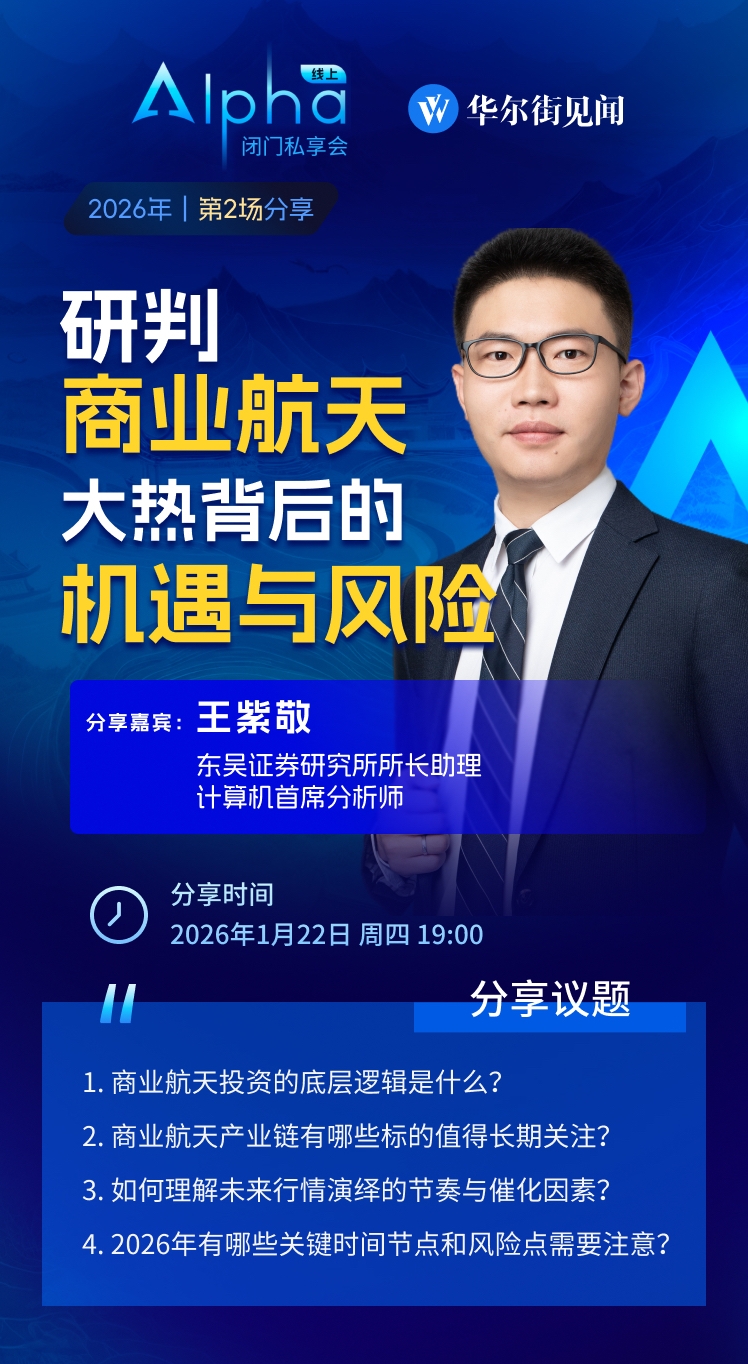
市场分期时刻,听东吴证券王紫敬闭门分享商业航天大热背后的机遇与风险
Hua Er Jie Jian Wen· 2026-01-21 20:08
股市方面,A股18连阳行情强势站上4100点,成交量创下历史新高,逼近4万亿大关,科技与顺周期板块成资金主线,而美股则高位小幅回 调,市场等待1月美联储议息会议结果。 债市方面,中债呈牛平特征收益率曲线下移,而美债则熊陡走弱,收益率上行,市场对美联储降息节奏预期趋谨慎。 大宗商品市场更是冰火两重天,贵金属、有色金属大涨,而能源化工、黑色系则受供需失衡拖累表现低迷。 A股牛市还能上车吗?哪类资产最值得关注?港股与A股怎么选? 美股2026年还能继续科技AI的牛市狂欢吗? 1月美联储议息会议传递出哪些新信息?如何前瞻美国通胀形势与降息节奏? 十五五规划中,有哪些战略新兴产业值得重点关注? 美国拉斯维加斯CES、英伟达GTC大会上科技行业有哪些新产品、新进展? 商业航天大热背后的机遇与风险? 反内卷政策能否推动商品价格持续上涨? ...... 2026年开年,全球市场分化剧烈: 关于全球大类资产与热点行业,大家在2026年一季度最关心的问题是: 为了帮大家看清2026年一季度大类资产轮动与风向变化、热点行业的前瞻解读,我们一季度预计邀请多位重磅嘉宾来主讲Alpha线上闭门私享会 ——百亿私募敦和资管首席经济学家徐小 ...


ETF日报:黄金价格的上涨不仅源于其避险属性,也受益于“抛售美国”交易逻辑的再现
Xin Lang Cai Jing· 2026-01-21 13:43
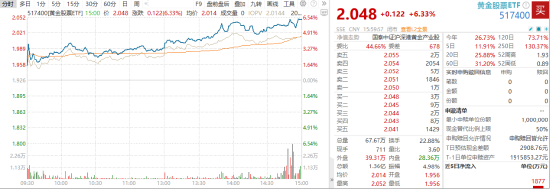
Market Overview - The A-share market experienced fluctuations today, with the Shanghai Composite Index slightly up by 0.08% at 4116.94 points, while the Shenzhen Component Index rose by 0.70%, the ChiNext Index by 0.54%, and the Sci-Tech Innovation Index by 2.32% [1][15] - The total trading volume in the Shanghai and Shenzhen markets was approximately 26,007.01 billion yuan, a decrease of about 1,770.97 billion yuan compared to the previous trading day [1][15] - The technology and gold sectors led the gains, with integrated circuits, chips, and non-ferrous metals performing well, while financials, coal, and transportation sectors lagged [1][15] - Overall market sentiment was neutral to strong, with 3,096 stocks rising and 2,197 falling [1][15] Gold Market - Gold stocks ETF (517400) surged by 6.33%, and gold fund ETF (518800) increased by 2.93%, driven by geopolitical tensions leading to higher gold prices [1][15] - As of 3 PM on the 21st, the London spot gold price reached a high of $4,888 per ounce [1][15] - Year-to-date, gold fund ETF has risen by 11.60%, and gold stocks ETF has increased by 26.73%, ranking among the top performers in ETFs [19][20] Semiconductor Sector - The semiconductor sector was active today, with CPU prices being a major driver. Integrated circuit ETF (159546) rose by 5.47%, chip ETF (512760) by 4.28%, and Sci-Tech chip ETF (589100) by 4.14% [1][21] - The current shortage of Intel's fourth and fifth generation CPUs is attributed to order mismatches, and the sixth generation CPUs require more time for customer adaptation [21] - The AI wave is expected to drive significant growth in the CPU market, with Nvidia GPUs and other major ASIC manufacturers projected to maintain high double-digit growth in 2026 [21][22] Central Bank Gold Purchases - The Polish central bank approved a plan to purchase 150 tons of gold, aiming to increase its gold holdings limit from 550 tons to 700 tons by the end of the year [4][17] - The Polish central bank has emphasized the special role of gold in its reserve structure, which contributes to the stability of the Polish economy [4][17]
连续15个交易日加仓!资金大搬家入有色,有色ETF华宝(159876)规模再创新高
Mei Ri Jing Ji Xin Wen· 2026-01-21 05:05
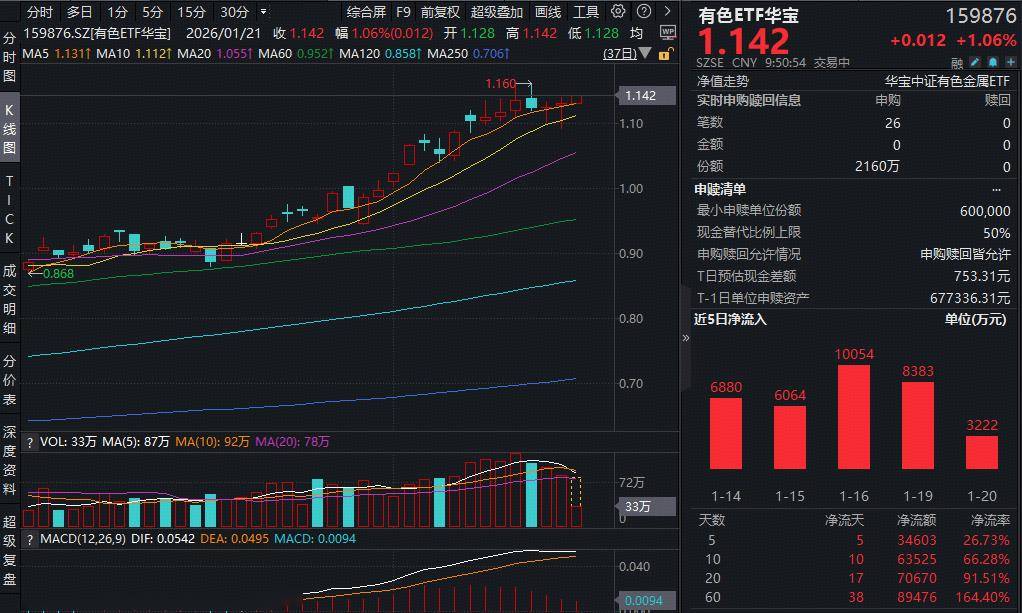
1月21日,有色板块彰显韧性,热门ETF品种——有色ETF华宝(159876)开盘短暂回调后,随即 强势拉升涨逾2%,价格再度冲击历史新高,且今日有望创收盘价历史新高。截至发稿,有色ETF华宝 (159876)获资金实时净申购2100万份。最近15个交易日,资金连续净流入有色ETF华宝(159876)合 计超6亿元。 中国银河证券建议把握"AI飞跃+百年变局"共振下的有色金属超级周期。回顾历史,每一轮超级铜 周期都对应一段清晰而强大的宏观叙事,而本轮周期同时叠加了"AI科技革命"与"全球秩序重塑"两大长 期逻辑,其持续性和战略意义不亚于战后重建、我国对外开放等历史阶段。 有色ETF华宝(159876)及其联接基金(017140)标的指数全面覆盖铜、铝、黄金、稀土、锂等行 业,涵盖贵金属(避险)、战略金属(成长)、工业金属(复苏)等不同景气周期,全品类覆盖能够更 好把握整个板块的贝塔行情。截至1月20日,有色ETF华宝(159876)最新规模16.65亿元,续创历史新 高,在全市场3只跟踪中证有色金属指数的ETF中,是规模最大的ETF。 每日经济新闻 (责任编辑:张晓波 ) 【免责声明】本文仅代表作者本人观点, ...
ETF盘中资讯|为何说有色行情还远远没走完?有色ETF华宝(159876)盘中拉升1%,冲击3连阳!近10日狂揽6.35亿元!
Sou Hu Cai Jing· 2026-01-21 02:19
今日(1月21日)揽尽有色金属行业龙头的有色ETF华宝(159876)强势拉升,场内价格现涨1.06%,在近几日市场盘整时,仍收获2日连涨,今日冲击3 连阳,行情表现彰显韧性。 值得关注的是,截至1月20日,有色ETF华宝(159876)最新规模16.65亿元,续创历史新高。在全市场3只跟踪中证有色金属指数的ETF中,是规模最大的 ETF。 成份股方面,湖南白银领涨超8%,盛新锂能涨逾7%,永兴材料、中矿资源、白银有色涨逾5%。权重股方面,山东黄金涨超3%,北方稀土涨逾1%,紫 金矿业飘红。 【有色风口已至,"超级周期"势不可挡】 有色ETF华宝(159876)及其联接基金(A类:017140,C类:017141)标的指数全面覆盖铜、铝、黄金、稀土、锂等行业,涵盖贵金属(避险)、战略 金属(成长)、工业金属(复苏)等不同景气周期,全品类覆盖能够更好把握整个板块的贝塔行情。 伴随火热的行情,资金积极进场布局!截至发稿,有色ETF华宝(159876)获资金实时净申购2160万份,拉长时间来看,近10日连续吸金,合计狂揽6.35 亿元! | 序号 | 名称 | 涨跌幅 | 两日图 | 申万一级行业 | 申万二级行业 ...
为何说有色行情还远远没走完?有色ETF华宝(159876)盘中拉升1%,冲击3连阳!近10日狂揽6.35亿元!
Xin Lang Cai Jing· 2026-01-21 02:10
Core Viewpoint - The non-ferrous metal sector is experiencing a strong rally, with the Huabao Non-Ferrous ETF (159876) showing resilience and attracting significant capital inflow, indicating a bullish sentiment in the market [1][11]. Group 1: Market Performance - The Huabao Non-Ferrous ETF (159876) increased by 1.06% today, marking two consecutive days of gains and aiming for a third [1][11]. - The ETF has seen a net subscription of 21.6 million units, accumulating a total of 635 million yuan over the past ten days [1][11]. - Key stocks in the sector, such as Hunan Silver and Shengxin Lithium Energy, have shown significant price increases, with Hunan Silver leading at 8.23% [2][4][14]. Group 2: Industry Insights - Analysts suggest that the current non-ferrous metal cycle is part of a longer-term trend, with historical cycles lasting 25-30 years, indicating that the current upward trend may persist for several years [3][13]. - The sector is expected to benefit from a combination of factors, including global capital expenditure cycles, manufacturing recovery, and improved domestic macroeconomic expectations [3][13]. - The Huabao Non-Ferrous ETF is the largest among three ETFs tracking the CSI Non-Ferrous Metal Index, with a recent scale of 1.665 billion yuan, setting a new historical high [5][15]. Group 3: Future Outlook - The industry is anticipated to enter a bull market driven by monetary, demand, and supply factors by 2026, with institutions broadly optimistic about a comprehensive bull market in non-ferrous metals [5][13]. - The ongoing geopolitical uncertainties and central bank gold purchases are expected to support long-term gold prices, reinforcing the bullish outlook for precious metals [2][12].
帝科股份(300842) - 2026年1月19日~1月20日投资者关系活动记录表
2026-01-21 01:02
Group 1: Financial Performance - The company expects a net profit loss of 200 million to 300 million yuan for 2025, compared to a profit of 360 million yuan in the same period last year [2] - The net profit after deducting non-recurring gains and losses is projected to be between 160 million and 240 million yuan, a year-on-year decrease of 63.56% to 45.34% from the previous year's profit of 439 million yuan [2] Group 2: Competitive Advantages - The company's storage business has significant competitive barriers due to its integrated design capabilities, specialized testing equipment, and long-term collaborations with leading SOC chip design companies [3] - The company maintains a unique technological advantage with proprietary testing equipment that is not sold externally, creating hardware barriers [3] Group 3: Product and Market Strategy - The storage business primarily targets B-end customers, with brands such as Jingkai and Yinmeng for external sales [3] - The company plans to balance its focus between photovoltaic and storage sectors, aiming to become a leading third-party DRAM storage module enterprise within two to three years [3] Group 4: Industry Outlook and Mergers - The storage business is expected to grow continuously over the next three years, driven by market demand and the company's core competitive strengths [5] - The company has acquired 51% of Yinmeng Holdings in 2024 and plans to acquire 62.5% of Jiangsu Jingkai in 2025, completing an integrated supply chain for the storage industry [5] Group 5: Risk Management - The company does not directly bear the risks of significant fluctuations in silver prices, utilizing silver futures to hedge against price volatility [6] - The storage business's lack of wafer production capacity is mitigated by its integrated processing capabilities, ensuring diverse wafer procurement to meet production needs [7]
有色冲高回调逾2%!资金实时反向加仓逾3100万份,近10日狂揽6.4亿元
Sou Hu Cai Jing· 2026-01-20 02:49
Group 1 - The core viewpoint of the news highlights the accelerating investment in the non-ferrous metals sector, driven by a combination of the "AI leap" and the "century change" in global order, suggesting a super cycle for non-ferrous metals [1] - The non-ferrous ETF Huabao (159876) has seen significant net subscriptions, with over 31 million shares purchased in real-time and a total of 376 million yuan in the last five days, indicating strong market interest [1] - Historical patterns show that each super copper cycle corresponds with a strong macro narrative, and the current cycle is expected to last until at least 2026, influenced by factors such as the recovery of the US dollar credit and strategic stockpiling [1] Group 2 - The non-ferrous ETF Huabao (159876) and its linked fund (017140) cover a wide range of sectors including copper, aluminum, gold, rare earths, and lithium, allowing for better capture of the overall sector's beta performance [2] - As of January 19, the latest scale of the non-ferrous ETF Huabao (159876) reached 1.626 billion yuan, setting a new historical high and making it the largest ETF tracking the China Nonferrous Metals Index in the market [2]
春季躁动中场休息
AVIC Securities· 2026-01-18 14:56
Core Insights - The report highlights that the A-share market is currently experiencing a phase of regulatory adjustments aimed at controlling excessive market enthusiasm while ensuring sustainable growth [8][9][10] - It emphasizes the importance of the AI technology revolution and the trend of de-globalization, which are expected to persist for the next 5-10 years, creating investment opportunities in related sectors [9][10][22] - The report suggests that the Chinese economy is in a transition phase, benefiting from a unified market policy and a low-interest-rate environment, which may lead to increased foreign capital inflows into RMB assets [10][12] Market Overview - The A-share market saw a significant trading volume of 3.99 trillion yuan on January 14, marking a historical high, but subsequently retreated to around 3 trillion yuan, indicating a cooling of market exuberance [8][9] - The report notes that the recent increase in the financing margin ratio from 80% to 100% by the regulatory authority reflects a counter-cyclical adjustment strategy [8][9] Investment Opportunities - The report recommends focusing on investment opportunities in commodities such as copper, rare earths, and gold, which are expected to gain value amid geopolitical tensions and the ongoing trend of de-globalization [10][18][20] - It also points out that the rapid development of AI is likely to drive demand for computing power and related infrastructure, benefiting sectors like new energy vehicles and resource materials [22][24] Economic Trends - The report anticipates that the global economy will continue to experience a loose monetary policy environment, with fiscal expansions expected in major economies, which may further enhance liquidity and support resource sectors [20][22] - Historical data indicates that periods of RMB appreciation are often accompanied by significant foreign capital inflows into Chinese assets, suggesting a favorable outlook for the A-share market [10][12]
杨德龙:市场短期调整有利于长期走势更加稳健
Xin Lang Cai Jing· 2026-01-16 09:12
Group 1 - The A-share market has continued the year-end rally that started in mid-December last year, achieving a 17-day consecutive rise and briefly surpassing the 4100-point mark, indicating a significant recovery in overall market risk appetite [1][7] - The strong upward momentum is primarily supported by two factors: the AI sector and other hot sectors attracting substantial capital, leading to strong profit-making effects, and January typically being the month with the highest credit issuance, with new credit generally reaching around 3 trillion to 4 trillion yuan [1][7] - After continuous upward movement, the market shows signs of short-term overheating, with daily trading volume nearing 4 trillion yuan, a historical high, and margin financing balance exceeding 2.6 trillion yuan, also a record [1][7] Group 2 - Following the 17-day rise, nearly 30 listed companies have issued profit warnings for 2025, contrasting with the usual trend of companies reporting positive forecasts first, indicating potential overheating and high valuations in certain sectors [2][8] - The current market rally is characterized as a structural bull market, with economic fundamentals reflecting the performance of traditional industries like real estate and retail remaining sluggish, while the market surge is concentrated in technology innovation sectors [2][8] - The disparity between market performance and economic fundamentals is largely due to differing perspectives, with traditional industries lagging while emerging sectors receive significant capital inflow, particularly in the context of the ongoing AI technology revolution [3][9] Group 3 - The economic growth rate for 2025 is projected to be around 5%, achieving the initial target, but with significant disparities between emerging and traditional industries [4][10] - As growth stabilization policies take effect, improvements in economic data are expected, potentially leading to opportunities for a rotation in the A-share market, especially in consumer sectors [4][10] - The current 17-day rally has ended and adjustments have begun, emphasizing the importance of value investing and selecting quality industries, companies, or funds based on fundamentals to better capture long-term opportunities in the slow bull market [4][11]