稀土出口管制

Search documents
商务部:中国已依法批准一定数量的稀土相关物项出口许可合规申请
Xin Hua Wang· 2025-08-12 05:50
【纠错】 【责任编辑:邱丽芳】 "我们已经多次强调,稀土相关物项具有军民两用属性,对其实施出口管制符合国际通行做法。"何 亚东说,中方愿就此进一步加强与相关国家的出口管制沟通对话,促进便利合规贸易。(记者张晓洁、 潘洁) 商务部新闻发言人何亚东在6月12日举行的商务部例行新闻发布会上说,中国作为负责任的大国, 充分考虑各国在民用领域的合理需求与关切,依法依规对稀土相关物项出口许可申请进行审查,已依法 批准一定数量的合规申请,并将持续加强合规申请的审批工作。 ...
光大证券:稀土行业对价利好频出 建议关注广晟有色等
Zhi Tong Cai Jing· 2025-08-11 00:21
Group 1 - The core viewpoint is that both light and heavy rare earths are expected to see price increases in the future, with supply tightening and demand maintaining a growth trend [1] - The Chinese government has implemented four rounds of export controls on strategic metal resources in 2023, indicating an increasing focus on these resources [1][2] - The report suggests monitoring four companies primarily engaged in rare earth production: Guangxi Youse (600259), Shenghe Resources (600392), China Rare Earth (000831), and Northern Rare Earth (600111) [1] Group 2 - Light rare earth supply is expected to be limited due to the lack of publicly available mining quota information from the Ministry of Industry and Information Technology [3] - The demand for light rare earths is projected to grow, particularly in key sectors such as new energy vehicles and wind power, with significant year-on-year increases in production [4] - China dominates global rare earth smelting and separation capacity, holding approximately 88.56% of the total capacity, although this share is expected to decline in the coming years as other countries increase their capacities [4]

光大证券:稀土行业对价利好频出 建议关注广晟有色(600259.SH)等
智通财经网· 2025-08-10 09:08
Group 1 - The core viewpoint is that both light and heavy rare earths are expected to see price increases in the future, with supply tightening and demand maintaining a growth trend [1] - The Chinese government has implemented four rounds of export controls on strategic metal resources in 2023, with an increasing number of metal categories and faster implementation times [2] - Previous export controls have led to price increases for metals such as gallium, germanium, and antimony, indicating a similar trend may occur for tungsten and medium-heavy rare earth elements in the coming months [3] Group 2 - The supply of light rare earths is expected to be limited due to the lack of publicly available mining quota information from the Ministry of Industry and Information Technology [4] - Demand for light rare earths is projected to grow significantly, driven by the increase in production of new energy vehicles and wind power installations [5] - China dominates global rare earth smelting and separation capacity, accounting for approximately 88.56% of the total, although this share is expected to decrease in the coming years as other countries increase their capacities [6]
研判2025!中国氧化铽行业产业链、价格及进出口分析:出口管制与资源战略双轮驱动,中国氧化铽市场成全球市场风向标[图]
Chan Ye Xin Xi Wang· 2025-08-08 01:29
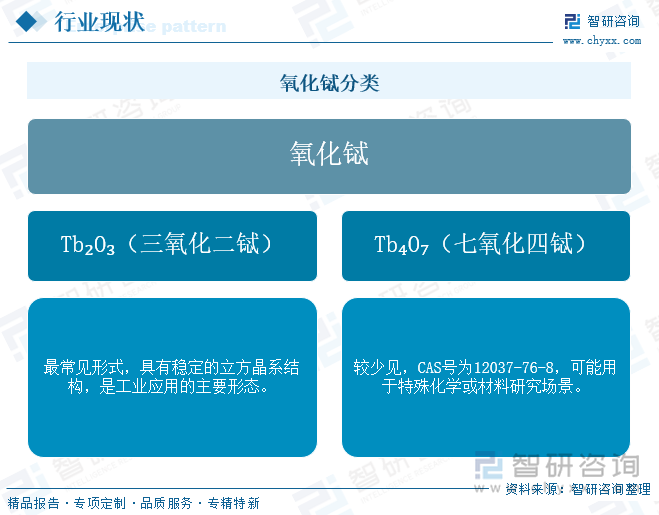
Core Viewpoint - China, as the world's richest country in rare earth resources, is leading in the terbium oxide industry in terms of resource reserves, production capacity, and technological development. The country is reshaping the global rare earth supply chain through policy regulation and market mechanisms, with terbium oxide being a key strategic resource whose price fluctuations are critical indicators of international geopolitical and industrial trends [1][8][17]. Industry Overview - Terbium oxide (Tb₂O₃) is a black-brown powder with unique optical and magnetic properties, relatively stable chemical characteristics, and is insoluble in water but soluble in acid [2]. - China's rare earth reserves are approximately 44 million tons, accounting for nearly half of the global proven reserves, with production reaching 270,000 tons in 2024, a year-on-year increase of 12.50% [6][8]. Industry Chain - The upstream of the terbium oxide industry includes rare earth mineral resources and various production equipment. The midstream involves the manufacturing of terbium oxide, while the downstream applications include fluorescent materials, magneto-optical materials, catalysts, electronic ceramics, and new energy materials [4]. Current Industry Status - In April 2025, China implemented export controls on seven types of medium and heavy rare earths, causing international market panic and leading to a spike in European terbium oxide prices to $3,000 per kilogram (approximately 2.181 million RMB per ton). By June 2025, the domestic price of terbium oxide reached 7.09 million RMB per ton, a year-on-year increase of 31.30% [1][10][12]. Key Enterprises' Performance - The Chinese terbium oxide industry is characterized by a competitive landscape dominated by state-owned enterprises, with significant advantages in production and market position. For instance, China Northern Rare Earth Group has a net profit increase of 727.3% in Q1 2025, while China Rare Earth Group has a production volume of 7,785.27 tons in 2024, a year-on-year increase of 107.27% [12][15]. Industry Development Trends 1. **Policy Regulation and Export Control**: The export control policy is expected to be a long-term strategic tool, significantly altering the global rare earth supply-demand structure. The average approval cycle for export licenses has been shortened by 30% [17]. 2. **Technological Innovation**: The industry is focusing on green transformation and high value-added production, with companies like Northern Rare Earth investing in zero wastewater discharge systems and achieving a 30% reduction in energy consumption per unit of output [19]. 3. **Market Demand Evolution**: The demand for terbium and dysprosium is expected to grow significantly due to high-end markets like robotics and new energy vehicles, although there are potential risks from alternative materials and geopolitical tensions [20].


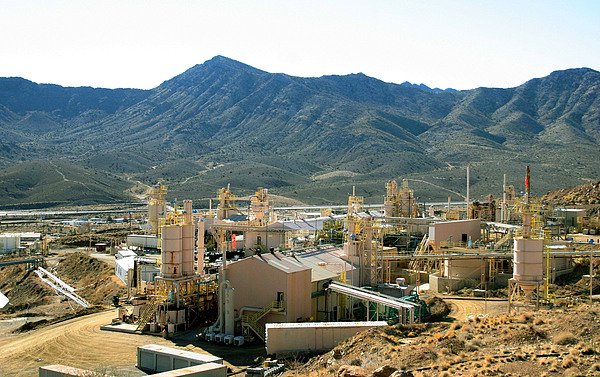
中国严管稀土军事用途,美国防务公司恐慌:每天都在担心库存
Guan Cha Zhe Wang· 2025-08-04 10:08
Core Viewpoint - China's recent announcement to strengthen export controls on certain rare earth-related items has sparked widespread attention and diverse interpretations, emphasizing the dual-use nature of these materials and the need for compliance with international practices [1] Group 1: Export Controls and Market Impact - China has approved a certain number of export licenses for rare earth-related items, considering the reasonable demands of various countries in the civilian sector [1] - Following China's restrictions, prices for certain materials required by the U.S. defense industry have surged, with some materials now costing over five times their pre-restriction prices, and samarium prices reaching 60 times normal levels [1] - The U.S. defense industry is increasingly aware of its dependency on China for critical minerals, as nearly all supply chains for key minerals involve at least one Chinese supplier [5][6] Group 2: Supply Chain Challenges - Companies like Leonardo DRS are facing supply challenges, with their germanium stock at "safe inventory" levels, necessitating improved material supply by the second half of 2025 [4] - The U.S. Department of Defense has mandated contractors to cease procurement of rare earth magnets sourced from China by 2027, leading to concerns about insufficient inventory for many critical minerals [4] - Small drone manufacturers are particularly vulnerable due to limited revenue and experience in supply chain management, often lacking substantial reserves of rare earth magnets and metals [4] Group 3: Efforts to Diversify Supply - Companies are actively seeking alternative suppliers for rare earth materials, but many of these alternatives also rely on Chinese sources [6][7] - The U.S. Department of Defense has invested $400 million in MP Materials, the largest rare earth producer in the U.S., to secure a stable supply of magnets for defense applications [9][10] - Concerns have been raised about the potential market disruption caused by the U.S. government's investment in MP Materials, with critics arguing it may create an unfair competitive advantage [10] Group 4: Regulatory Environment - China has begun requiring detailed documentation from companies regarding the end-use of rare earth materials to ensure they are not used for military purposes [6] - The Chinese government emphasizes that its export control measures aim to regulate rather than prohibit exports, promoting compliant trade rather than severing normal commercial ties [11]
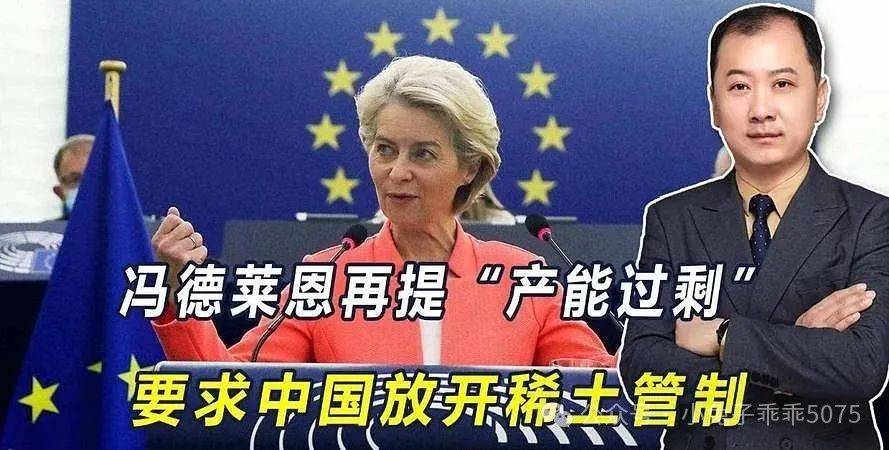
欧盟再提"产能过剩",要求中国放开稀土管制,却被中方反将一军
Sou Hu Cai Jing· 2025-08-02 12:45
Group 1 - The European Union (EU) is criticizing China for "overcapacity" in industries like new energy and steel while simultaneously demanding that China lift export restrictions on rare earth minerals, highlighting a double standard in their approach [3][8][9] - China holds approximately 87% of the world's rare earth resources, which are essential for various high-tech applications, indicating a significant leverage in global supply chains [5][6] - China's response to the EU's demands emphasizes the importance of regulating rare earth exports to protect national resources, asserting that market demand will dictate production capacity rather than external pressures [9][10] Group 2 - In 2022, China's exports of new energy vehicles to the EU increased by 35%, suggesting that European consumers prefer Chinese products despite claims of overcapacity [8] - The EU's request for China to take on "great power responsibility" for global supply chain stability is seen as hypocritical, given past instances where the EU did not advocate for such responsibilities when benefiting from cheap Chinese rare earths [3][6] - The current situation reflects a shift in power dynamics, with China now in a position to negotiate from strength regarding its rare earth resources, contrasting with previous times when it faced technology restrictions from the EU [10]
上次提到后,它已经涨了26.4%
Sou Hu Cai Jing· 2025-08-01 04:35
Core Viewpoint - The recent increase in rare earth prices is attributed to various events that have led to a rise in both volume and price in the market [1] Part 1: Volume - Export controls on rare earths are gradually being relaxed, with a significant increase in export volume expected as approval peaks pass [3] - In June, rare earth exports increased by 30% month-on-month, particularly with exports of rare earth magnets to the U.S. surging to over seven times the volume in May [5] - Lynas Corporation in Australia has begun producing dysprosium oxide in Malaysia, marking it as the first company outside China capable of refining heavy rare earths [5] Part 2: Price - Domestic rare earth prices are rising due to high overseas prices, which have opened up price ceilings domestically [8] - Three main factors are supporting rare earth prices: 1. **Supply Constraints**: Although some export licenses have been approved, the review process remains slow, and smuggling has become more difficult due to stricter regulations [12] 2. **Demand Support**: Ongoing trade tensions with the U.S. and Europe have led manufacturers to stockpile rare earths, further driving up prices [15][17] 3. **Competitive Pricing**: MP Materials, the only rare earth mining and production company in the U.S., has secured a $500 million order from Apple and received significant investment from the U.S. Department of Defense, establishing a price floor for their products [20]

中国稀土对美出口暴涨660%,已经达成稀土和解?中方随即打破惯例
Sou Hu Cai Jing· 2025-07-31 02:15
Core Insights - The article discusses the strategic manipulation of rare earth exports by China, particularly in relation to the U.S. military and automotive industries, highlighting a significant increase in exports of rare earth magnets to the U.S. while restricting military-grade materials [1][4][8] Group 1: Export Dynamics - In June, China's exports of rare earth magnets to the U.S. surged to 353 tons, a 660% increase from May's 46 tons, indicating a tactical maneuver rather than a genuine trade recovery [1][3] - The U.S. military's reliance on rare earth materials is underscored, with the F-35 fighter jet requiring 417 kg of rare earths and Virginia-class submarines needing up to 4 tons [3][4] Group 2: Strategic Agreements - A temporary agreement was reached in May, allowing Chinese exports of civilian-grade magnets to U.S. automakers like General Motors and Ford, in exchange for the U.S. permitting exports of Nvidia's H20 chips to China [4][6] - Despite this agreement, military-grade rare earths remain tightly controlled, forcing the Pentagon to resort to recycling materials from old phones [4][7] Group 3: Market Manipulation - China has shifted to a "strategic ambiguity" regarding rare earth mining quotas, delaying the announcement of the first batch for 2025 and not disclosing specific figures, which disrupts international market clarity [6][8] - The price of dysprosium oxide in Europe has surged to $700-$1000 per kg, three times higher than domestic prices, due to the lack of transparency in China's export quotas [6][8] Group 4: U.S. Industry Challenges - U.S. company MP Materials received $400 million from the Defense Department but has only restored 45% of its production capacity, with a 40% waste rate in magnet production [7][8] - The influx of 353 tons of magnets from China led U.S. automakers to cancel domestic orders, resulting in a significant drop in MP Materials' stock price [7][8] Group 5: Ongoing Tensions - The article emphasizes that the competition between the U.S. and China over rare earths is far from over, with China monitoring the destination of exported magnets to prevent them from reaching military applications [8][9] - The U.S. is facing a strategic dilemma, as investments of $40 billion have not resolved the underlying issues of dependency on Chinese rare earths and chips [9][11]

突发!印度工厂停摆?苹果″去中国化″栽在一粒稀土上
Xin Lang Cai Jing· 2025-07-30 14:24
Core Viewpoint - Apple is facing significant challenges in relocating its AirPods production to India due to a critical shortage of the rare earth element dysprosium, which is essential for manufacturing the magnetic components of the earbuds [1][4][6]. Group 1: Dysprosium's Importance - Dysprosium is a key component in the magnets used in AirPods, and its scarcity poses a risk to production [4][6]. - China produces over 90% of the world's dysprosium, making it a crucial player in the supply chain [5][8]. - The global demand for dysprosium exceeds its annual production, leading to a reliance on existing stockpiles [8][12]. Group 2: Apple's Shift to India - Apple's move to India is driven by a desire for supply chain diversification amid geopolitical pressures [6][10]. - The initial setup of the production line in India faced immediate challenges due to the lack of local dysprosium suppliers [6][7]. - The Indian workforce is less efficient compared to their Chinese counterparts, impacting production rates [9][10]. Group 3: Supply Chain Realities - The logistics of sourcing materials from China to India adds significant costs and delays, undermining the benefits of relocating production [9][10]. - Apple's previous attempts to shift production to India for iPhones revealed similar supply chain limitations, leading to a return to China [10][12]. - The perception of India as a viable alternative to China for manufacturing is questioned due to its current capabilities [9][12]. Group 4: Geopolitical Context - China's export controls on rare earth elements are framed as a response to historical trade practices by Western countries [12][13]. - The narrative of "decoupling" from China is challenged by the reality of supply chain dependencies that Apple and other companies face [10][14]. - The situation highlights the complexities of global supply chains and the challenges of resource management in a competitive landscape [12][14].

对华能源出口几乎归零!美终于发现不对劲,中方一举击中美“痛点”,特朗普急了喊话谈判
Sou Hu Cai Jing· 2025-07-28 21:58
Group 1 - The ongoing trade friction between China and the US has led to a significant decline in US energy exports to China, with imports of crude oil dropping to zero in June, marking the first time in three years [1][3] - The US shale oil industry is facing severe impacts due to the loss of the Chinese market, resulting in a dramatic drop in overseas sales and potential overcapacity risks [3][4] - China's ability to cut off US energy imports is attributed to increased tariffs making US energy products less competitive and its diversified energy supply strategy, including strong ties with Saudi Arabia and Russia [4][6] Group 2 - The Trump administration is under pressure from domestic energy sectors affected by the trade conflict, with significant job losses and investment reductions in key energy-producing states [6][8] - The upcoming third round of trade negotiations is critical for both countries, with the US seeking to address trade deficits and restore energy exports, while China aims to protect its rights and counter unreasonable trade restrictions [8] - China's strategic advantage in rare earth resources, which are crucial for high-end manufacturing and military applications, further strengthens its position in the trade negotiations [6][8]