多模态大模型

Search documents
【行业前瞻】2025-2030年全球及中国多模态大模型行业发展分析
Sou Hu Cai Jing· 2025-05-07 03:45
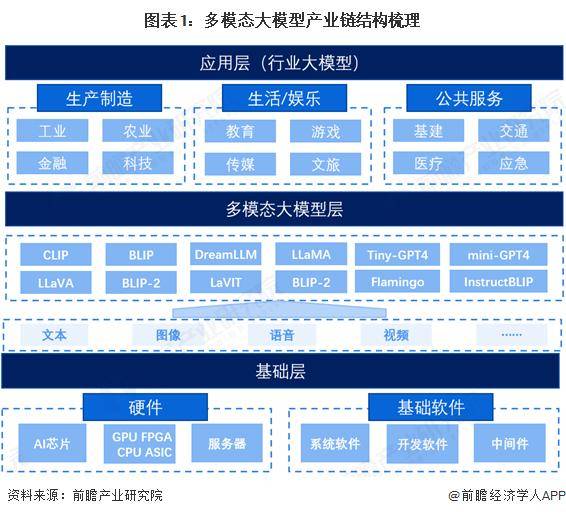
Core Insights - The multi-modal large model industry focuses on deep learning models capable of processing, understanding, and generating various types of data, including text, images, audio, and video, enabling complex and intelligent tasks [1] - The industry has a wide application potential across various sectors such as natural language processing, image recognition, speech recognition, intelligent driving, and medical imaging diagnosis [1] Industry Overview - The multi-modal large model industry chain is complex, encompassing hardware facilities, software development, and various model types, including CLIP, BLIP, and LLaMA, among others [1] - The industry is divided into three layers: the foundational layer (hardware and basic software), the model layer (various types of multi-modal large models), and the application layer (industry-specific applications) [1] Cost Structure - The training costs for mainstream domestic large models range from tens of millions to hundreds of millions of dollars, with major companies like Baidu, Alibaba, and Tencent investing over $200 million [3][5] - Startups like Kimi and DeepSeek have managed to reduce training costs to between $30 million and $60 million through technological optimizations [3] - Cloud hosting costs are significantly influenced by model scale, with major companies leveraging their own cloud platforms to reduce costs [3] Development History - The global large model industry has evolved through several phases: early exploration (1956-2005), rapid growth (2006-2019), the rise of large models (2020-2022), and the current phase of widespread application starting in 2023 [6] Computational Demand - The demand for computational power in AI is increasing, with larger models requiring exponentially more computational resources; for instance, the GPT-3 model requires 3640 PF-days of computation and at least 10,000 GPUs [9] - As model parameters increase, the computational investment needed grows significantly, influenced by model architecture, optimization efficiency, and hardware capabilities [9]




【投资视角】启示2025:中国多模态大模型行业投融资及产业基金分析(附投融资事件、投资类型和兼并重组等)
Qian Zhan Wang· 2025-05-06 08:08
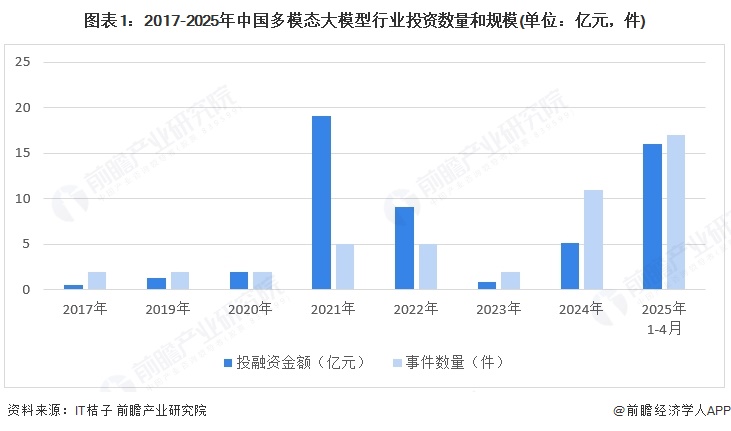
转自:前瞻产业研究院 行业主要公司:阿里巴巴(09988.HK,BABA.US);百度(09888.HK,BIDU.US);腾讯(00700.HK, TCEHY);科大讯飞(002230.SZ);三六零(601360.SH);云从科技(688327.SH)等 本文核心数据:多模态大模型代表企业融资规模;多模态大模型代表企业投资规模 2025年开始投融资呈爆发式增长 截至2025年4月,多模态大模型投融事件数量接近50件,其中国2021年投融资金额出现了高峰,达19.1 亿元,尽管当年投资事件数量为5件。2024年开始新一轮的投资周期,共有11件投资事件,金额达5.16 亿元。2025年前4个月,共有17件投资事件,金额为16亿元,后续多模态大模型题材的投资将呈现爆发 式增长。 企业能获得多轮投资 根据IT桔子显示,多模态大模型行业2025年开始投融资恢复热度。主要的融资事件如下: | 时间 | 254 | 地区 | 在不同分 | 金额 | 融资金额 | 投资方 | | --- | --- | --- | --- | --- | --- | --- | | 2025/4/9 | 爱芯元智 | 宁波市 | 人工智 ...

多模态技术爆发元年,行业应用如何落地?
AI前线· 2025-05-06 04:25
作者 | AICon 全球人工智能开发与应用大会 策划 | 李忠良 编辑 | 宇琪 近年来,多模态大模型技术发展迅速,展现出强大的视觉理解能力,显著提升了 AIGC 的可控 性,各行各业正经历从"人工密集型"到"AI 原生驱动"的颠覆性变革。那么,多模态技术中面临哪 些核心技术挑战?在 AIGC 技术落地过程中,会产生什么新的应用场景?大模型的下一阶段突破 可能来自哪些方向? 近日 InfoQ《极客有约》X AICon 直播栏目特别邀请了 上海交通大学人工智能学院副教授赵波担任主 持人,和快手快意多模态模型算法负责人高欢、腾讯混元专家研究员邵帅一起,在 AICon 全球人工智 能开发与应用大会 2025 上海站即将召开之际,共同探讨多模态大模型如何开启智能交互新篇章。 部分精彩观点如下: 在 5 月 23-24 日将于上海举办的 AICon全球人工智能开发与应用大会 先训练一个大模型,再用它来蒸馏小模型或减少推理步数,比直接训练小模型或低步数模型效果 更好。 现阶段,比起通用模型,针对特定业务场景定制化的垂直领域模型仍是更优选择。 如果单纯为了追求效果而无限制地扩大模型规模,虽然可能获得性能提升,但投入产出比 ...

一文了解中国音频行业发展现状及未来前景趋势预测(智研咨询发布)
Sou Hu Cai Jing· 2025-05-03 06:18
Core Viewpoint - The audio industry in China is experiencing significant growth driven by technological advancements, particularly in AI and multimodal models, enhancing content creation and user experience. The market size is projected to reach 28.7 billion yuan in 2024, reflecting a year-on-year growth of 14.80% [2][9]. Industry Overview - Audio refers to sound signals perceptible to the human ear, typically ranging from 20 Hz to 20,000 Hz. It can be classified into analog and digital audio based on the signal format [2]. Industry Development History - The Chinese audio industry has evolved through four main stages: - **Incubation Period (1996-2005)**: Initiated with Guangdong Pearl River Economic Broadcasting's real-time online broadcasting in 1996 and the introduction of podcasts by Apple in 2005 [4][5]. - **Exploration Period (2006-2015)**: Marked by the launch of early Chinese audiobook websites and regulatory frameworks, including the establishment of Douban FM and the founding of Ximalaya [4][5]. - **Expansion Period (2016-2019)**: Characterized by the introduction of live streaming features by major platforms like Ximalaya and Lizhi, intensifying competition [4][5]. - **Maturity Period (2020-Present)**: Notable events include Lizhi's IPO in the U.S. in 2020 and advancements in AI applications in audio systems, indicating a shift towards comprehensive AI integration in the industry [4][5]. Industry Value Chain - The audio industry value chain consists of: - **Upstream**: Content creation (music, audiobooks, podcasts), raw materials (metals, plastics), and components (resistors, capacitors, microphones) [6]. - **Midstream**: Audio platforms that facilitate content distribution [6]. - **Downstream**: Various listening channels including smartphones, smart speakers, and wearable devices, along with the end-users [6]. Related Companies - Key listed companies in the audio sector include Tencent Music (01698), NetEase Cloud Music (09899), and Edifier (002351), among others [2].
2025年迈向智能驱动新纪元,大语言模型赋能金融保险行业的应用纵览与趋势展望报告-众安信科
Sou Hu Cai Jing· 2025-04-30 22:57
Group 1 - The report by Zhong An Technology and Zhong An Financial Technology Research Institute explores the application of large language models (LLMs) in the financial and insurance industries, concluding that LLMs present new opportunities but face challenges in implementation that require multi-party collaboration [1] - The development of large model technology is diversifying globally, with vertical models emerging to provide tailored industry solutions. China has made progress in computing autonomy and data optimization, leading to a trend of functional differentiation and specialization in its ecosystem [1][24] - New technologies are driving down the costs of training, operation, and inference for large models, prompting a restructuring of processes in the financial industry. Financial enterprises need to balance acquisition, inference, and operational costs while selecting appropriate deployment models and roles [1][12] Group 2 - Domestic models like DeepSeek and Tongyi Qianwen have achieved breakthroughs in cost control and inference performance, providing better technical options for insurance institutions while ensuring data security and compliance [1][15] - Insurance institutions are accelerating the integration of large models, focusing on internal efficiency improvements across the entire insurance business chain and back-office management. Caution is advised during pilot applications to address data security and AI hallucination issues [1][16] - The value of data elements is becoming more prominent, with the financial and insurance industries building high-quality datasets through horizontal, vertical, and government-enterprise collaboration mechanisms to promote intelligent transformation [1][19] Group 3 - The application of large language models in the financial and insurance sectors is transitioning from pilot exploration to systematic integration, with initial deployments focusing on low-risk, low-intervention auxiliary business scenarios such as intelligent customer service and smart claims [6][7] - The introduction of large language models is not only enhancing process efficiency but also driving a deep transformation in information processing paradigms and decision-making logic within the industry [8][9] - The rise of large language models is reshaping the operational philosophies, business logic, and value creation models of financial institutions, leading to trends such as precision financial services and cross-industry ecological collaboration [9][10] Group 4 - The evolution of large model technology is characterized by a shift from purely algorithmic breakthroughs to the construction of systemic capabilities that integrate model deployment, business processes, and system interfaces [29][30] - The deployment capabilities of large models are transitioning from "usable" to "adaptable," with future competition likely focusing on building flexible deployment mechanisms across architectures and scenarios [31] - The emergence of vertical large models is addressing the specific needs of industries like finance and healthcare, enhancing precision and efficiency in tasks such as risk assessment and compliance checks [40][41]

人工智能赋能千行百业 上海创新浓度提升
Zhong Guo Xin Wen Wang· 2025-04-30 21:59
Core Insights - The article highlights the growing concentration of innovation in Shanghai's artificial intelligence (AI) sector, particularly through platforms like "Mosu Space" which hosts over 100 AI-related startups [1][4] - The integration of AI technology into various industries is emphasized, showcasing the importance of practical applications and user engagement in driving the value of AI [2][3] Group 1: AI Innovation and Collaboration - "Mosu Space" serves as a hub for AI entrepreneurs, featuring numerous events and discussions focused on cutting-edge topics such as multimodal models and data innovation [1][2] - Regular events like "AI Geek Night" facilitate knowledge sharing between industry experts and researchers, fostering collaboration and practical insights [1][2] Group 2: AI Product Development and Application - The facility includes an AI product experience center with over 200 AI technology products, allowing users to interact with innovations like smart rings and AI guitars [3] - Shanghai's humanoid robot sector is rapidly advancing, with companies like Zhiyuan Robotics achieving significant milestones, including the production of their 1000th general-purpose robot [4] Group 3: Talent and Industry Growth - Shanghai is home to approximately 250,000 AI professionals, contributing to a vibrant ecosystem of innovative companies and young talent [4] - The integration of AI and robotics is driving advancements in technology and enhancing the capabilities of the component supply chain [4]
美的集团(000333):2025年一季报点评:持续拓展全球推动数智驱动
Dongguan Securities· 2025-04-30 09:04
Investment Rating - The report maintains an "Accumulate" rating for the company, indicating an expectation that the stock will outperform the market index by 5%-15% over the next six months [7]. Core Views - The company achieved total revenue of 128.43 billion yuan in Q1 2025, representing a year-on-year growth of 20.61%. The net profit attributable to shareholders was 12.42 billion yuan, up 38.02% year-on-year, and the net profit after deducting non-recurring gains and losses was 12.75 billion yuan, also up 38.03% year-on-year, aligning with expectations [1]. - The company is actively expanding its global production capacity and investing in its own brand development to mitigate trade risks. It operates in over 200 countries, with a low revenue share from the U.S. It has 22 R&D centers and 23 major manufacturing bases across multiple continents [5][6]. - The company is advancing its digital intelligence strategy, focusing on the application of large models and Agent technology. It has developed a language model for the home appliance sector, enhancing user interaction and control across various smart products [5]. Summary by Sections Financial Performance - In Q1 2025, the company's gross margin decreased by 1.87 percentage points to 25.45%, while the net profit margin increased by 1.45 percentage points to 9.97%, primarily due to a reduction in expense ratios [5]. - The company forecasts revenue for 2025 to be 443.97 billion yuan, with net profit expected to reach 43.02 billion yuan, translating to an earnings per share (EPS) of 5.61 yuan, corresponding to a price-to-earnings (PE) ratio of 13 times [6]. Strategic Initiatives - The company is committed to its four strategic pillars: technological leadership, direct user engagement, digital intelligence, and global expansion. It aims to enhance its R&D capabilities and maintain a leading position in the industry [5].

星宸科技:4月29日召开业绩说明会,投资者参与
Zheng Quan Zhi Xing· 2025-04-30 07:09
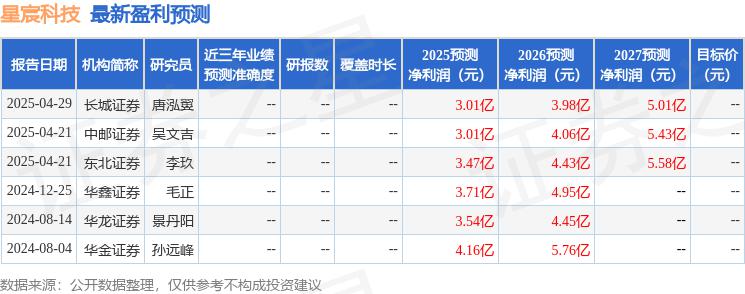
Core Viewpoint - Company achieved significant growth across various business lines in Q1 2025, with all segments exceeding 20% year-on-year growth, particularly in smart IoT and automotive sectors [2][3]. Financial Performance - In 2024, the company reported a net profit of approximately 256 million yuan, a year-on-year increase of about 25.18%. For Q1 2025, the net profit was approximately 51.18 million yuan, showing a slight increase of 0.48% year-on-year [3][10]. - The company's Q1 2025 revenue reached approximately 665 million yuan, reflecting a year-on-year growth of 26.36% [10]. Business Segments - The smart IoT sector saw substantial growth, with significant contributions from leading brand clients in smart robotics, where quarterly shipments and revenue exceeded the total for 2024 [2]. - In the automotive sector, the company experienced notable growth in ADAS and perception chips due to increased market penetration [2]. - The smart security segment has solidified its market position with a comprehensive product lineup [2]. Research and Development - The company invested approximately 602 million yuan in R&D for 2024, a year-on-year increase of about 21.95%, with an R&D investment rate of approximately 25.59% [4]. - For Q1 2025, R&D investment was about 168 million yuan, up 19.8% year-on-year, with an R&D investment rate of approximately 25.24% [4]. Market Strategy - The company is focusing on long-term growth through strategic investments in cutting-edge IP technologies, including high-performance computing and low-power sensors, targeting sectors like smart robotics and smart eyewear [3][4]. - The company has established a global sales strategy, with over half of its sales coming from international markets [5]. Future Outlook - The company is actively evaluating potential investments or acquisitions to enhance its R&D capabilities and product offerings [6]. - The industry is expected to see advancements in AI SoC chips, with increasing demand for efficient, low-power solutions across various applications, including smart security and automotive sectors [8][9].
新华财经早报:4月30日
Xin Hua Cai Jing· 2025-04-30 02:13
Group 1: Financial Performance - Guizhou Moutai achieved a record revenue of 51.443 billion yuan in Q1, a year-on-year increase of 10.67%, and a net profit of 26.847 billion yuan, up 11.56% year-on-year [5][8] - Vanke A reported a revenue decline of 38.31% to 37.995 billion yuan in Q1, with a net loss of 6.246 billion yuan compared to a net loss of 362 million yuan in the same period last year [5][8] - Major state-owned banks announced the decision to abolish their supervisory boards, which requires approval from the shareholders' meeting [4][8] Group 2: Market Developments - The National Development and Reform Commission (NDRC) announced the issuance of 81 billion yuan in special long-term bonds to support the consumption upgrade policy [4] - The bond market saw a total issuance of 87,356.6 billion yuan in March, with government bonds accounting for 12,786.3 billion yuan and corporate credit bonds for 13,335.2 billion yuan [4] - The Hong Kong Stock Exchange is preparing to assist Chinese companies that have not yet listed in Hong Kong to return to the market [4] Group 3: Industry Trends - The steel industry reported a total revenue of 1.436 trillion yuan in Q1, a year-on-year decrease of 6.61%, while total profits increased by 108% to 21.583 billion yuan [4] - The real estate sector continues to face challenges, as evidenced by Vanke A's significant revenue drop [5] - The consumer confidence index in the U.S. fell for the fifth consecutive month, indicating potential impacts on global market sentiment [6]

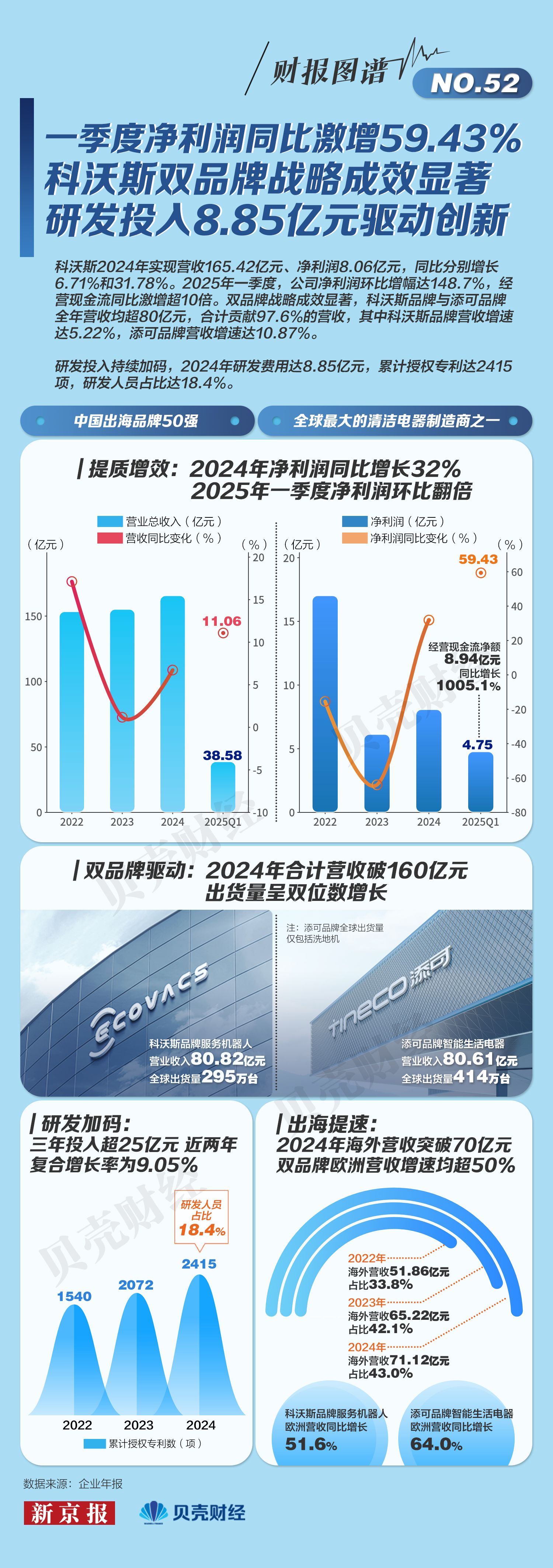
“扫地茅”科沃斯强势回归,一季度净利同比增60%再创行业新高
Bei Ke Cai Jing· 2025-04-30 00:34
Core Insights - The company achieved a total revenue of 165.42 billion yuan in 2024, representing a year-on-year growth of 6.71%, while net profit reached 8.06 billion yuan, up 31.70% year-on-year [6][8][11]. Financial Performance - In Q1 2025, the company reported a revenue of 38.58 billion yuan, an increase of 11.06% year-on-year, and a net profit of 4.75 billion yuan, which is a 59.43% year-on-year increase [7][11]. - The company's cash flow from operations surged over tenfold year-on-year [2]. Brand Strategy - The dual-brand strategy has proven effective, with both brands contributing significantly to revenue, with the Kewos brand generating 80.82 billion yuan and the Tineco brand achieving a revenue growth rate of 10.87% [2][11][28]. - The company has invested 8.85 billion yuan in R&D in 2024, with R&D personnel accounting for 18.4% of the workforce [2][22]. Market Expansion - The global cleaning appliance market reached a retail value of 20 billion USD in 2024, with a year-on-year growth of 8% [27]. - The company has seen significant growth in the European market, with revenues increasing by 51.6% for Kewos and 64.0% for Tineco [28][32]. Product Innovation - The company launched several successful products in 2024, including the T30, T50, and X8 series of robotic vacuum cleaners, which have performed well in the market [16][19]. - Tineco introduced innovative products targeting specific consumer needs, such as the 180° lying flat smart washing machine and lightweight models for small homes [17][19]. Cost Management - The company has implemented effective cost management strategies, resulting in a 3.53% reduction in marketing expenses and improved overall gross margin to 46.52%, an increase of 1.94 percentage points year-on-year [11][12][24]. Future Outlook - The company plans to continue increasing R&D investments and expanding its product lines, particularly in high-end markets and new categories [25][34].