滞胀

Search documents
百利好晚盘分析:滞胀风险升温 金价有望走高
Sou Hu Cai Jing· 2025-08-04 09:20
从供给端看,欧佩克+从4月份开始增产。在最新的会议上,欧佩克+同意9月份大幅增产54.8万桶,提前一年退出本轮的减产计 划。同时欧佩克还释放消息称,下个月仍然存在进一步增产的可能。从实际增产数量看,虽然4月和5月份欧佩克+的增产额度并 未超过预期,但是6月份增产幅度基本符合市场预期,暗示后续产油国产量进一步上升将是大概率事件。 黄金方面: 美联储在今年7月份的利率决议上维持当前的利率水平不变,同时美联储主席鲍威尔并没有释放后续降息的信号,金价承压。 不过紧随其后美国公布7月非农就业人数录得增加7.3万人,不及市场预期的11万人;特别值得注意的是美国劳工部将上个月非农 就业人数从原来的14.7万人,大幅下修至1.4万人,这样一来,说明美国5月至7月新增非农就业人口数据远不及市场预期。 另外美国政府的关税政策正在开始发生作用,美国的通胀水平在最近的两个月里面出现了明显的反弹。数据显示,美国CPI未季 调年率已经从4月份的2.3%反弹至当前的2.7%。美国经济出现了"滞胀"的特征。 百利好特约智昇研究资深分析师辰宇认为,当前美国经济陷入滞胀的风险较高,市场押注美联储降息的情绪比较浓厚,黄金价 格存在进一步走高的机会 ...


再度飙升!今年最大赢家卷土重来?
Sou Hu Cai Jing· 2025-08-04 08:56
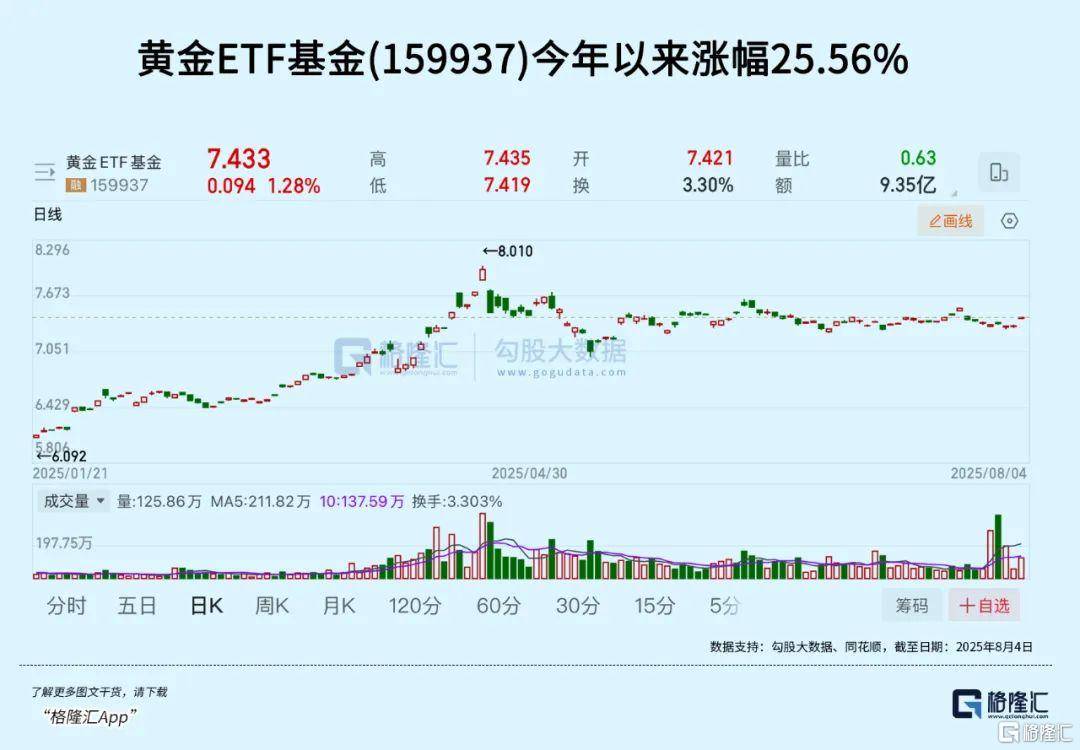
Core Viewpoint - Recent surge in gold prices is attributed to multiple factors including economic fundamentals, monetary policy, trade policy, and geopolitical risks [4] Group 1: Economic Factors - Weak U.S. economic data, including a July PMI of 48.0 and disappointing non-farm payrolls, has diminished market confidence [6] - Non-farm employment increased by only 73,000 in July, significantly below the expected 110,000, with the unemployment rate rising from 4.1% to 4.2% [6] - Historical trends indicate that gold tends to outperform other asset classes during stagflation, as seen in the 1970s [8] Group 2: Monetary Policy Expectations - The weak employment data has increased the likelihood of a rate cut by the Federal Reserve, with the probability for a September cut rising from 38% to 90% [10] - Historical data shows that Fed rate cut cycles are often accompanied by rising gold prices, with increases of approximately 30% during the 2007-2008 financial crisis and over 40% during the 2019-2020 rate cut cycle [12] - Recent tensions within the Fed, including dissenting votes on monetary policy, suggest potential shifts in policy direction [10] Group 3: Geopolitical and Trade Factors - Recent trade tensions, including high tariffs imposed by the U.S. on various countries, contribute to the upward pressure on gold prices [13] - Ongoing geopolitical conflicts and central banks' increasing gold purchases are also supporting gold's appeal as a safe-haven asset [20] Group 4: Investment Trends - Global central banks added 166 tons of gold in Q2, with 95% of surveyed central banks expecting to increase their gold reserves in the next 12 months [22] - Gold ETF investments have surged, with inflows of 170 tons in Q2 and a total of 397 tons in the first half of the year, marking the highest level since 2020 [23] - Domestic funds are increasingly investing in gold ETFs, with significant inflows and a growing fund size [24] Group 5: Technical Analysis - Recent technical indicators suggest that gold may have completed its adjustment phase, with key resistance levels surpassed [26] - Market sentiment is turning optimistic, as reflected in increased net long positions by fund managers [28] - Major investment banks, including Citigroup, have raised their gold price forecasts, indicating bullish sentiment for the near term [28]
贵金属日评:美国7月新增非农远不及预期市场预期美联储下半年或降息三次-20250804
Hong Yuan Qi Huo· 2025-08-04 06:31
| FERENS 贵金属日评20250804: 美国7月新增非农远不及预期, 市场预期美联储下半年或降息三次 | | | --- | --- | | 交易日期 2025-08-01 2025-07-31 2025-07-28 较昨日变化 较上周变化 | | | 上海黄金 收盘价 767.18 766. 58 771.58 0. 60 -4. 40 | | | 持仓重 206334.00 207044.00 -710.00 210216.00 -3, 882. 00 价差(近月与远月) 近月连续-远月活跃 -3.28 -3. 48 -2.78 0. 20 -0. 50 | | | 基差(现货与期货) 现货价格-期货价格 -3.54 -3. 70 -3. 20 0.16 -0. 34 收盘价 8918.00 9008.00 9212. 00 -90. 00 -294.00 | | | 交易日期 2025-08-01 2025-07-31 2025-07-24 较昨日变化 较上周变化 收盘价 3342. 30 3416. 00 3371.30 73. 70 44. 70 | | | 伦敦黄金现货 伦敦金现 3346 ...
沪铜日评:国内铜冶炼厂8月检修产能或环减,国内电解铜社会库存量环比减少-20250804
Hong Yuan Qi Huo· 2025-08-04 06:21
1. Report Industry Investment Rating - Not provided in the content 2. Core View of the Report - The weakening US job market has increased the market's expectation of the Fed's interest rate cut. However, due to the traditional consumption off - season in China suppressing downstream demand, the total inventory of electrolytic copper at home and abroad has been fluctuating upwards. As a result, there may still be room for the Shanghai copper price to decline. It is recommended that investors hold their previous short positions cautiously and pay attention to key support and resistance levels for Shanghai copper, London copper, and US copper [2]. 3. Summary by Relevant Catalogs Market Data - **Shanghai Copper Futures**: On August 1, 2025, the closing price of the active contract was 78,400 yuan, up 360 yuan from the previous day; the trading volume was 80,943 lots, a decrease of 28,068 lots; the open interest was 167,671 lots, a decrease of 8,522 lots; the inventory was 20,349 tons, an increase of 727 tons; the average price of SMM 1 electrolytic copper was 78,330 yuan, a decrease of 235 yuan [2]. - **Shanghai Copper Basis and Spreads**: The Shanghai copper basis was - 70 yuan, a decrease of 595 yuan; the spot premium or discount in different regions had different changes, such as a 5 - yuan increase in Guangzhou, a 10 - yuan decrease in North China, and no change in East China; the spreads between different contract months also changed, with the spread between the near - month and the first - continuous contract decreasing by 70 yuan, and the spreads between other contract months having corresponding increases or decreases [2]. - **London Copper**: On August 1, 2025, the closing price of the LME 3 - month copper futures (electronic trading) was 9,633 US dollars, up 26 US dollars from the previous day; the total inventory of registered and cancelled warrants was 0 tons, a decrease of 141,750 tons; the spreads between different contract periods also changed, with the 0 - 3 - month contract spread increasing by 1.51 US dollars and the 3 - 15 - month contract spread decreasing by 15.18 US dollars; the ratio of Shanghai - London copper price was 8.1387, an increase of 0.02 [2]. - **COMEX Copper**: On August 1, 2025, the closing price of the active copper futures contract was 4.443 US dollars, a decrease of 0.19 US dollars; the total inventory was 259,681 tons, an increase of 3,733 tons [2]. Industry News - **Policy Impact**: On July 30, 2025, the US government's decision on the Section 232 investigation of steel led to the exemption of import tariffs on electrolytic copper. The spread between COMEX copper and LME copper collapsed, causing a large amount of electrolytic copper to shift from COMEX warehouses to the LME delivery warehouse in New Orleans [2]. - **Mine Expansion**: Codelco planned to invest $5.7 billion in 2022 to expand the El Teniente mine, including three new ore layers. As of March 31, 2025, the Andes Norte project was 73% complete, the Andesita project was 70% complete and started operation in February 2025, and the Diamante project was 43% complete. The expansion project is expected to contribute 2 - 3 tons of copper production increment in 2025, reaching 15 tons after full - production. The annual output is expected to reach 50 tons after all projects are put into operation [2]. - **Accident**: A Chilean earthquake caused a casualty accident at Codelco's El Teniente copper mine, with 6 people reported dead, and operations in the accident area were suspended for investigation [2]. Market Supply and Demand - **Supply Side**: The production (import) volume of copper concentrates in China in August is expected to increase month - on - month. The import index of Chinese copper concentrates is negative and has increased compared to last week. The departure (arrival, inventory) volume of copper concentrates at Chinese ports has decreased compared to last week. The export restriction of high - quality scrap steel in Europe has limited Chinese importers to purchasing copper rice or brass. Uncertainty in Sino - US tariff negotiations has led to low direct imports of US scrap copper and indirect supply through countries like Japan, South Korea, and Thailand. The negative price difference between domestic electrolytic copper and bright and aged scrap steel has weakened the economic viability of scrap copper, closing the scrap copper import window and potentially reducing the production (import) volume of domestic scrap copper in August. Some copper smelters have suspended production, such as Glencore's PASAR copper smelter in the Philippines with a capacity of 200,000 tons, Zhongkuang Resources' Tsuneb copper smelter in Namibia (annual processing capacity of 240,000 tons of copper concentrates), and Glencore's Altonorte smelter in Chile with a capacity of 350,000 tons. The Congo's moa - Kakula copper smelter is expected to be completed and put into operation in June 2025, with an annual output of 500,000 tons. Liangshan Mining's 150,000 - ton copper reform project is in the pre - work stage, and the second rotary anode furnace of the pyrometallurgical system of the Yunnan Zhongyou Non - ferrous Recycling Copper Resource Recycling Base produced anode copper at the beginning of the month. The weekly processing fee for crude copper in northern (southern) China remained flat (increased) month - on - month, and the capacity of crude copper smelter maintenance in China in August may decrease month - on - month, potentially increasing the production (import) volume of domestic crude copper in August [2]. - **Demand Side**: The traditional consumption off - season in China has suppressed downstream demand [2].
美联储主席紧急预警:关税冲击比预想更猛,消费者钱包即将被“榨干”
Sou Hu Cai Jing· 2025-08-04 04:57
Group 1 - The U.S. economy is experiencing a price surge driven by tariffs, affecting a wide range of products and businesses, leading to a significant economic impact [2][9] - The Consumer Price Index (CPI) for June shows a 1% increase in home goods prices, with textiles rising by 4.2%, and appliances up by 1.9%, indicating widespread inflation across various sectors [3] - Companies like Procter & Gamble and Mohawk Industries are raising prices due to increased costs from tariffs, with Procter & Gamble announcing an average price increase of 2.5% on about a quarter of its products [3][5] Group 2 - A survey by HSBC reveals that 72% of small and medium-sized enterprises in the U.S. are forced to increase operational costs, with 81.5% planning to raise prices [5] - The fluctuating tariff rates have created uncertainty for businesses, with some companies unable to plan effectively due to drastic changes in tax rates [5] - The shipping volume at the Port of Los Angeles has decreased by 15% compared to the previous month, as retailers are reducing order cycles to avoid tariffs [5] Group 3 - Federal Reserve Chairman Jerome Powell warns that the impact of tariffs is more severe than anticipated, creating a conflict between maintaining price stability and ensuring employment [6] - Economists predict that tariffs could increase inflation by approximately 1 percentage point over the next 12 months, indicating a potential rise in consumer prices [6] - The current economic situation is characterized by stagnant growth and high inflation, leading to concerns about stagflation, which poses challenges for the Federal Reserve's monetary policy [6][9]


人类为什么总喜欢造新词儿
Hu Xiu· 2025-08-03 09:58
Group 1 - The article discusses the disparity in economic recovery in Hong Kong, highlighting a "jobless recovery" phenomenon where GDP is growing but employment is not improving [1][4][5] - Despite a reported 10 consecutive quarters of GDP growth and a 16-month rise in exports, many residents feel the economic situation is poor, with low consumer spending and business closures [2][3] - The term "jobless recovery" is used to describe the current economic state of Hong Kong, indicating a lack of job growth despite overall economic indicators suggesting recovery [4][7] Group 2 - The article references a podcast discussing the economic conditions in Hong Kong, questioning the true state of the economy and the reasons behind the perceived disparity in economic experiences [5] - The concept of "jobless recovery" has historical roots, having been used since the 1990s to describe situations where economic growth does not correlate with job growth [7] - The discussion includes the broader implications of creating new economic concepts to explain unusual economic phenomena, suggesting that language plays a crucial role in shaping economic understanding [8][12][20]

突发意外!两个月数据被批水分十足,美股崩不住了,鲍威尔面临两难选择!
Sou Hu Cai Jing· 2025-08-02 02:56
Group 1 - The Federal Reserve has maintained the interest rate range at 4.25%-4.5% for the fifth consecutive time, reflecting significant pressure on Chairman Powell's decision-making [1] - Former President Trump criticized Powell for being slow to act, highlighting the increasing burden of national debt, which has surpassed $36 trillion, with annual interest payments reaching $1.2 trillion [1] - The current economic situation presents a dilemma for the Federal Reserve, balancing high inflation, which remains at 3.4%, against rising unemployment, with July's job additions at only 114,000 and an unemployment rate of 4.3% [1][3] Group 2 - Analysts on Wall Street have noted that the current interest rate levels are suppressing the real economy, leading to decreased investment willingness among businesses and reduced consumer spending due to high credit card rates [3] - The strong dollar, resulting from stagnant interest rate expectations, poses a dual challenge for export-oriented industries [3] - The conflict between the Trump administration and the Federal Reserve highlights the clash between political objectives and economic realities, with the former seeking low rates to alleviate debt pressure ahead of the 2024 elections [3][5] Group 3 - The Federal Reserve's predicament reflects a broader anxiety among Western economies in the post-pandemic era, characterized by high debt, high inflation, and low growth, leading to the diminishing effectiveness of traditional monetary policy tools [5] - Powell's challenge is emblematic of a critical question facing all developed economies: how to navigate the balance between political pressure and economic principles [5] - The outcome of this struggle may redefine the operational rules of the global monetary system, with alternative approaches, such as structural monetary policy tools from certain Eastern economies, potentially offering new solutions [5]

激活“八月魔咒”的首个拼图? 美国非农远逊于预期 华尔街陷入抛售恐慌
智通财经网· 2025-08-01 13:48
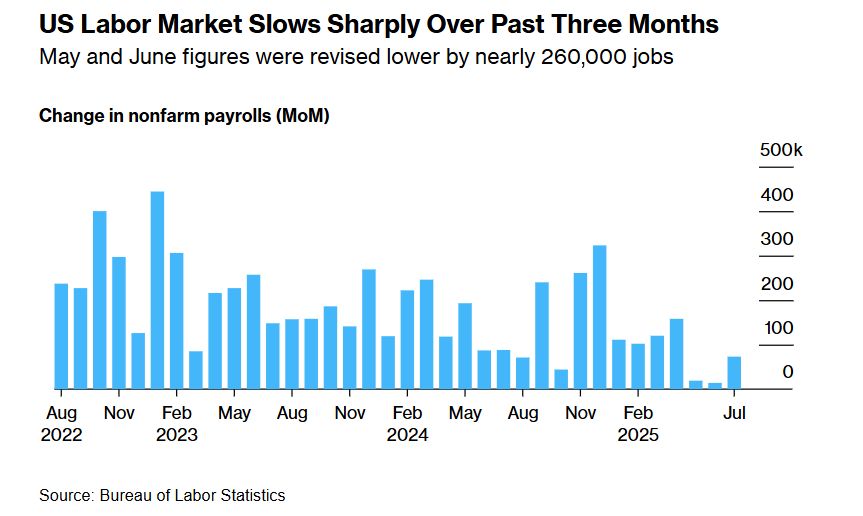
Core Viewpoint - The U.S. labor market is showing significant signs of weakness, with recent non-farm payroll data indicating a sharp decline in job growth, which has heightened expectations for interest rate cuts by the Federal Reserve [1][5][6]. Labor Market Data - In July, non-farm employment increased by only 73,000, far below the expected 104,000, and previous months' figures were revised down by nearly 260,000 [6][8]. - The unemployment rate rose slightly to 4.2%, aligning with market expectations [6]. - Over the past three months, the average monthly job growth was only 35,000, marking the worst performance since the COVID-19 pandemic began [1][5]. Economic Implications - The slowdown in job growth and rising unemployment are contributing to risks for consumer and business spending, which are already showing signs of deceleration [5][9]. - The labor market's deterioration is increasing pressure on the Federal Reserve to consider interest rate cuts, especially in light of the conflicting economic signals [7][8]. Sector-Specific Insights - Job losses were particularly pronounced in manufacturing, professional and business services, and government sectors, with federal government jobs decreasing for six consecutive months [8][9]. - Despite the overall job market weakness, demand in other sectors remains relatively healthy, with job vacancies still above pre-pandemic levels [9][10]. Market Reactions - Following the release of the disappointing non-farm payroll data, U.S. stock index futures experienced significant declines, reflecting a surge in selling sentiment on Wall Street [8][12]. - Historical data suggests that August is typically a challenging month for stock performance, with the S&P 500 index often experiencing declines during this period [11][12].
领峰金评:初请数据现就业疲软 金价短期困守危城
Sou Hu Cai Jing· 2025-08-01 03:14
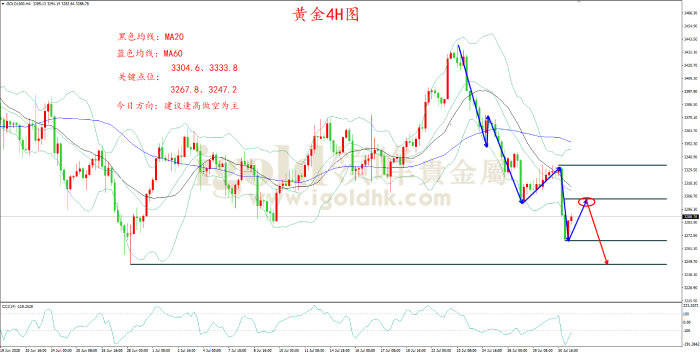
Fundamental Analysis - The U.S. White House announced that Trump signed an executive order modifying reciprocal tariff rates for certain countries, imposing a 10% tariff on countries not listed in the order, increasing tariffs on Canada from 25% to 35%, and imposing a 40% punitive tariff on transshipped goods. These measures have strengthened the demand for the U.S. dollar in international trade settlements, indirectly suppressing the monetary appeal of gold [1] - Despite some countries like Brazil and Indonesia receiving tariff exemptions, the overall escalation of trade tensions has not significantly stimulated market demand for gold as a safe haven, suggesting that gold prices may face upward limitations in the short term [1] - Economic data indicates that July's Challenger job cuts reached the highest level for the same period since 2020, and initial jobless claims show signs of labor market weakness. However, June's core PCE inflation unexpectedly rebounded to 2.8%, with consumer spending nearly stagnant, hinting at potential stagflation. This complex economic environment should support gold, but expectations regarding Federal Reserve policy are key suppressive factors [1] - Treasury Secretary Mnuchin indicated that personnel adjustments at the Federal Reserve will be completed by the end of the year, and Trump publicly criticized Powell's policy missteps, suggesting the potential appointment of more hawkish officials. Market expectations for the Fed to maintain high interest rates to combat inflation have risen, increasing the opportunity cost of holding non-yielding gold, which may exert downward pressure on gold prices in the short term [1] Technical Analysis - The current gold price is in a downtrend after retreating from its high, with the 4-hour chart indicating a bearish trend. The moving averages MA20 and MA60 are in a bearish arrangement, and the middle band of the Bollinger Bands along with MA20 is exerting pressure on the price [4] - The CCI indicator is near the oversold zone and is turning down, suggesting that the downtrend may continue. The trading strategy for the day is to focus on short positions [4] Market News - Key economic indicators to be released include the UK July Manufacturing PMI final value, Eurozone July CPI year-on-year and month-on-month initial values, U.S. July unemployment rate, U.S. July non-farm payrolls, and various other employment-related metrics [7][8]
耶鲁大学研究揭示关税政策或致美国物价短期飙升,家庭年均损失达2400美元
Sou Hu Cai Jing· 2025-07-30 07:57
Core Insights - The current U.S. tariff policy is projected to increase domestic prices by 1.8% in the short term, resulting in an average additional annual expenditure of $2,400 per American household [1][2] - This price increase is expected to push inflation levels close to double the Federal Reserve's target of 2%, significantly impacting consumer purchasing power, especially for low-income families [2][3] - The indirect effects of the tariff policy may persist for several years, potentially leading to delayed price adjustments and long-term economic consequences, such as reduced investment and job cuts in manufacturing [3][4] Economic Impact - The tariff policy is seen as a double-edged sword, providing short-term protection for certain domestic industries while increasing consumer costs and risking retaliatory measures from trade partners [4] - If the tariff policy continues until 2025, the average annual loss for American households could further escalate, prompting calls for policymakers to reassess the net benefits of tariffs [4] - Rising inflation pressures may compel the Federal Reserve to adopt a more aggressive stance on interest rates, which could hinder corporate investment and job market recovery, exacerbating the risk of economic stagnation [4]