
新发展格局

Search documents
安伟在调度全市融入服务全国统一大市场建设工作时强调
Zheng Zhou Ri Bao· 2025-09-03 07:09
Group 1 - The meeting emphasized the importance of integrating and serving the national unified market construction as a foundational support for the new development pattern and a systematic task [1][2] - The city aims to leverage its advantageous industries to attract high-quality resources from across the nation and globally, enhancing participation in international industrial cooperation [1] - The leadership acknowledged the progress made in the previous phase and stressed the need for a market-oriented, legal, and international business environment to consolidate and innovate advantages [1] Group 2 - Responsibilities must be reinforced and research detailed, with departments required to take on primary responsibilities and set clear goals and quantifiable indicators [2] - The city is urged to adopt a sense of urgency to tackle challenges and ensure timely completion of tasks, focusing on high-quality development of key industrial chains [2] - The initiative includes leveraging data-driven innovations and implementing "Artificial Intelligence+" actions to enhance the efficient allocation and aggregation of production factors [2]
李迅雷:大国债务——经济增长的代价
Sou Hu Cai Jing· 2025-09-03 04:47
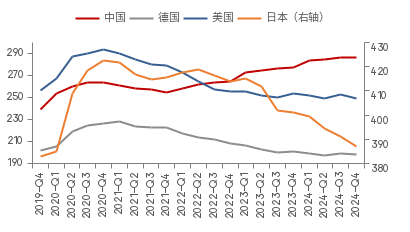
Group 1 - The macro leverage ratio in China has increased to 300.4% in Q2 2025, marking a significant rise from 298.5% in Q1 2025, indicating a growing debt burden associated with economic growth [1] - The rapid increase in debt levels in China is primarily driven by government departments and state-owned enterprises leveraging up [2][9] - The macro leverage ratio of China is projected to rise from 239.5% in 2019 to 286.5% by the end of 2024, showing the most significant increase among major economies [2][28] Group 2 - The leverage ratio of non-financial enterprises in China has shown a pattern of increase since 2022, reaching 139.4% by Q3 2024, driven by significant investments in emerging industries and high-end manufacturing [5][32] - The debt levels of state-owned enterprises are notably higher than those of non-state enterprises, with an average asset-liability ratio of 85.6% for state-owned enterprises compared to 78.3% for non-state enterprises [7][9] - Government leverage in China has risen from 59.6% at the end of 2019 to 88.4% by the end of 2024, contrasting with the trends in Germany, Japan, and the US, where government leverage has fluctuated [9][10] Group 3 - The nominal GDP growth in China has been slower compared to the actual GDP growth, which has implications for the macro leverage ratio as it is inversely related to the growth of nominal GDP [32][34] - The price levels in China have been declining, negatively impacting the growth of nominal GDP, which is crucial for managing the macro leverage ratio [36][37] - The efficiency of debt usage in China is under scrutiny, with suggestions for improving capital allocation and enhancing productivity to manage the rising leverage ratio effectively [38][44]

强化责任 对标对表 见行见效 巩固优势 放大优势 创新优势
Zheng Zhou Ri Bao· 2025-09-03 00:33
Core Viewpoint - The meeting emphasized the importance of integrating and serving the national unified market construction as a foundational support for the new development pattern, highlighting the need for a systematic approach to achieve this goal [3]. Group 1 - The meeting was chaired by the city party secretary, An Wei, and aimed to implement the important speeches of General Secretary Xi Jinping regarding the construction of a national unified market [1][3]. - An Wei acknowledged the achievements made in the previous phase of work and stressed the necessity of deepening understanding of central and provincial deployment requirements [3]. - The city aims to leverage its advantageous industries to attract high-quality resources from across the nation and globally, enhancing participation in international industrial cooperation [3]. Group 2 - An Wei called for a clear delineation of responsibilities among departments, emphasizing the need for precise goals and quantifiable indicators [4]. - The focus will be on high-quality development of key industrial chains, with an emphasis on practical outcomes and effective reforms [4]. - The city plans to capitalize on opportunities by implementing "Artificial Intelligence+" initiatives and promoting the resourceization, assetization, and capitalization of data elements [4].
人民日报:有效畅通“大循环”,建设统一大市场
Ren Min Ri Bao· 2025-08-31 23:54
Group 1 - The core viewpoint emphasizes the importance of a unified national market for China's development, highlighting that a large, efficient, and open market is crucial for gaining a competitive edge in the global landscape [1][2][3] - The construction of a unified national market is seen as essential for promoting high-quality development and optimizing market competition [1][2] - The concept of "Five Unifications and One Openness" is introduced as a guiding principle for local governments to break down barriers and enhance economic circulation [1][2][3] Group 2 - The article discusses the need for a holistic approach in governance, urging leaders to focus on national interests rather than local benefits, which aligns with the goal of building a unified market [2][3] - It highlights the necessity of breaking local protectionism and market segmentation to facilitate smooth economic circulation [2][3] - The importance of fostering a collaborative mindset among regions to enhance overall market strength is emphasized, suggesting that cooperation leads to mutual benefits [7][8] Group 3 - The article stresses that a high degree of legal governance is vital for a unified market, with clear market rules leading to stable expectations for business entities [4][5] - It outlines the government's role in creating a fair competitive environment through regulatory measures and legal frameworks [6][5] - The need for a balanced approach where government intervention supports rather than stifles market dynamics is highlighted [6][5] Group 4 - The article provides examples of successful cross-regional collaborations, such as the establishment of a cross-province air freight station and water rights trading, demonstrating the benefits of a unified market [7][9] - It mentions the growth of collaborative innovation indices in regions like the Yangtze River Delta, indicating the positive impact of unified market initiatives on economic performance [9] - The article concludes that a unified national market will enhance China's attractiveness as a destination for foreign investment, with a notable increase in new foreign enterprises established [9][10]
为什么既要坚定不移办好自己的事,也要坚定不移扩大高水平对外开放?
Si Chuan Ri Bao· 2025-08-31 22:27
Group 1 - The core viewpoint emphasizes the necessity of both "doing one's own business well" and "expanding high-level opening-up" as complementary strategies for building a new development pattern [1][4][6] - The internal foundation for constructing the new development pattern is to strengthen domestic capabilities, while the external condition is to create development opportunities and expand cooperation [1][6] - High-quality development is positioned as a fundamental requirement for China's modernization, necessitating a focus on both internal and external strategies to address uncertainties in the current environment [5][6][7] Group 2 - The approach of "doing one's own business well" is seen as essential for responding to external risks and challenges, enhancing strategic resilience [3][7] - The commitment to high-level opening-up is characterized as a distinctive feature of China's modernization, serving as a driving force for reform and development [4][5] - The integration of domestic and international markets is crucial for promoting high-quality development, with an emphasis on leveraging China's large market advantages [6][7]
学习笔记|实施要素市场化配置改革,推进全国统一大市场建设
2 1 Shi Ji Jing Ji Bao Dao· 2025-08-31 08:59
Core Viewpoint - The article emphasizes the importance of implementing market-oriented reforms in factor allocation to promote the construction of a unified national market, highlighting the need for efficient and fair resource distribution and the elimination of local protectionism [1][3][4]. Group 1: Policy Initiatives - The State Council's recent meeting discussed the implementation of pilot reforms for market-oriented factor allocation in certain regions, aiming to enhance the decisive role of the market in resource allocation [1]. - The Central Committee has been consistently deploying and advancing factor market reforms since the issuance of the 2020 guidelines, which focus on breaking down barriers to the free flow of factors and expanding the scope of market-oriented allocation [2]. - The 2024 decision by the Central Committee emphasizes the need to improve the institutional framework for factor markets, ensuring smooth flow and efficient allocation of resources [2][3]. Group 2: Economic Implications - The reform of factor market allocation is crucial for advancing the construction of a unified national market, which requires overcoming local protectionism and promoting the free flow of resources across broader regions [3][4]. - The promotion of free movement of various production factors, such as labor, capital, technology, and data, is essential for achieving high-quality economic development and enhancing overall productivity [4]. - The ongoing reforms are expected to significantly improve the efficiency of land, capital, and technology allocation, which aligns with the goals of developing new productive forces and fostering innovation [4][5]. Group 3: Historical Context and Progress - Historical reforms have already improved land allocation efficiency, with successful pilot projects in collective land use and household registration system reforms contributing to enhanced urban welfare for migrant workers [5]. - The steady advancement of factor market reforms is seen as a vital step towards establishing a high-level socialist market economy and facilitating high-quality economic growth [5].
坚定文化自信 建设文化强国丨以强烈的历史主动精神推进文化建设
Zhong Yang Ji Wei Guo Jia Jian Wei Wang Zhan· 2025-08-29 00:32
Group 1 - The core idea of Xi Jinping's cultural thought emphasizes the importance of cultural confidence as a fundamental and enduring force in the development of a nation and its people [2][6] - Xi Jinping's cultural thought provides a comprehensive framework for understanding the role, goals, principles, and strategies of cultural construction in the new era, integrating theoretical innovation with practical deployment [3][5] - The thought system highlights the dialectical unity of cultural inheritance and innovation, establishing a value evaluation system with Chinese characteristics [3][4] Group 2 - The focus on a people-centered approach integrates cultural development with the well-being of the populace, promoting a strong sense of cultural identity and confidence [4][6] - The emphasis on openness and inclusivity in cultural exchanges aims to enhance the international influence of Chinese culture while maintaining its core values [7][8] - The call for innovation in cultural practices and industries is aimed at fostering high-quality development in the cultural sector, aligning with the new development stage of the country [8][10] Group 3 - The integration of cultural construction with economic and social development is essential for promoting a new development pattern that emphasizes domestic circulation [10][11] - The establishment of a clean culture is highlighted as a significant aspect of socialist cultural construction, contributing to the party's self-revolution and societal progress [11]

高质量发展扎实推进,中国经济焕发蓬勃生机
Huan Qiu Wang· 2025-08-26 01:53
Group 1: Economic Development and Quality Improvement - The quality level in China has significantly improved since the "14th Five-Year Plan," with a focus on high-quality development as a key characteristic of the economy [1] - The establishment of a comprehensive macro quality policy system is marked by the release of the "Quality Strong Country Construction Outline" and the "National Standardization Development Outline" [1] - The manufacturing quality competitiveness index has risen to 85.86, while the satisfaction levels for service quality and public service quality have reached 81.33 and 81.62, respectively, indicating substantial progress in quality construction [1] Group 2: Business Environment and Market Dynamics - Continuous optimization of the business environment has led to a significant increase in market entities, with a net increase of 19.99 million enterprises and 33.94 million individual businesses since the "14th Five-Year Plan" [2] - The national development bank has issued loans amounting to 385 billion yuan for advanced manufacturing and strategic emerging industries, marking a 51.3% year-on-year increase [2] - The implementation of reforms such as "separation of licenses and permits" and a unified market access negative list has greatly stimulated entrepreneurial and innovative activities [2] Group 3: Trade and Domestic Market Integration - The integration of domestic and foreign trade is accelerating, with a 3.5% growth in imports and exports in the first seven months of the year [3] - Exports of mechanical and electrical products have increased by 9.3%, accounting for 60% of total exports, with high-tech products like smart home devices and electric vehicles showing strong growth [3] - Domestic consumption is also on the rise, with rural online retail sales increasing by 6.4% and agricultural product online retail sales growing by 7.4% in the same period [3] Group 4: Future Economic Outlook - The future of China's economic development appears promising, with a commitment to advancing quality strong country construction and enhancing the resilience and safety of supply chains [4]
市委召开专题会议研究外贸工作 全力推动外贸高质量发展 加快打造内陆开放高地
Chang Jiang Ri Bao· 2025-08-26 01:11
Core Viewpoint - The meeting emphasized the importance of high-level opening-up and the need for proactive adaptation to external changes to promote high-quality foreign trade development in the city [1][2]. Group 1: Foreign Trade Development Strategies - The city aims to implement a "short-term response, medium-term expansion, and long-term transformation" strategy to balance scale expansion and quality improvement in foreign trade [2]. - There is a focus on stabilizing export growth while integrating domestic and foreign trade, ensuring the effective implementation of foreign trade policies to support enterprises in maintaining orders and expanding markets [2]. - The city plans to actively increase imports, leveraging its large market size to meet diverse consumer demands and enhance international cooperation [2]. Group 2: Strengthening Trade Entities and New Trade Dynamics - The city intends to cultivate and strengthen foreign trade entities, particularly by supporting leading enterprises and encouraging collaboration among businesses of various sizes [2]. - There is a push to enhance new trade dynamics by reforming the foreign trade system and developing new business models such as cross-border e-commerce and overseas warehouses [2]. - The focus will also be on improving international competitiveness by optimizing industrial structure and promoting exports of high-tech products like new energy vehicles and biomedicine [2]. Group 3: Coordination and Capacity Building - The meeting highlighted the need for coordinated efforts to ensure the effective implementation of foreign trade initiatives [3]. - There is an emphasis on enhancing professional knowledge and international perspectives to improve the capabilities in managing foreign trade [3]. - The city aims to deepen institutional reforms to facilitate trade and create a favorable environment for high-quality foreign trade development [3].
《中国金融》|陈四清:中国式现代化与国有商业银行的责任
Sou Hu Cai Jing· 2025-08-22 09:17
Group 1 - The core argument emphasizes the necessity of building a strong financial nation to advance Chinese-style modernization, with state-owned commercial banks playing a crucial role due to their solid foundation, extensive business scope, and large scale [1][7]. - Chinese-style modernization, as defined by the Communist Party, provides a unique direction for financial reform and development, highlighting the importance of maintaining centralized leadership and ensuring high-quality financial development [2][7]. - The financial sector must focus on serving the real economy, enhancing financial services to meet the growing demand for quality financial products from the public, and addressing pressing issues faced by the populace [3][8]. Group 2 - There is a strong emphasis on supporting high-quality development by aligning financial services with the new development pattern, focusing on optimizing resource allocation, and enhancing financial service quality [3][8]. - The financial sector is urged to increase support for technological innovation, ensuring that financial services align with national strategies for education, technology, and innovation [4][8]. - The promotion of green finance is highlighted as essential for achieving harmony between humanity and nature, with a focus on directing investments towards low-carbon and sustainable economic practices [5][8]. Group 3 - Financial risk prevention and resolution are identified as ongoing priorities, with a call for a comprehensive risk management system to maintain financial stability and national security [6][9]. - Continuous reform and innovation in the financial sector are necessary, with a focus on balancing economic security and development, and adapting to changing external environments [10][11].