硬科技

Search documents
2025年A股并购重组盘点: 活跃度显著提升 “硬科技”成焦点
Zhong Guo Zheng Quan Bao· 2025-12-30 22:25
劳志明表示,今年以来,民企交易在首次披露端占比有所提升。民企交易以市场化交易为主,商业谈判 难度相比国企更大。考虑到审核周期等因素,2025年民企过会占比尚未有明显增加,预计2026年民企交 易在过会口径占比应该会有所上升。 "硬科技"获重点支持 数据显示,截至12月30日,2025年沪深北交易所共首次披露134单发行股份购买资产交易。2023年和 2024年同期,首次披露的数量分别为53单和78单。2025年并购重组市场活跃度显著提升,并且热度仍在 保持。在这134单中,涉及沪主板33单,深主板36单,科创板27单,创业板37单,北交所1单,科创板和 创业板重组较前些年活跃度大幅提升。 华泰联合证券董事总经理劳志明对中国证券报记者表示,2025年,并购市场活跃度整体提升。今年以 来,交易所对并购重组事项的受理和审核进度加快。民企交易占比在首次披露端明显提高,过会端占比 相对稳定。相较前几年,监管部门明显提高了对优质未盈利资产的包容度,半导体等"硬科技"成为监管 部门支持的重点。 ● 本报记者 董添 交易所受理和审核速度加快 临近年末,A股并购重组市场持续活跃。近期,多家A股上市公司发布发行股份购买资产交易的 ...
2025年A股并购重组盘点:活跃度显著提升 “硬科技”成焦点
Zhong Guo Zheng Quan Bao· 2025-12-30 21:11
Wind数据显示,截至12月30日,2025年沪深北交易所共首次披露134单发行股份购买资产交易。2023年 和2024年同期,首次披露的数量分别为53单和78单。2025年并购重组市场活跃度显著提升,并且热度仍 在保持。在这134单中,涉及沪主板33单,深主板36单,科创板27单,创业板37单,北交所1单,科创板 和创业板重组较前些年活跃度大幅提升。 华泰联合证券董事总经理劳志明对中国证券报记者表示,2025年,并购市场活跃度整体提升。今年以 来,交易所对并购重组事项的受理和审核进度加快。民企交易占比在首次披露端明显提高,过会端占比 相对稳定。相较前几年,监管部门明显提高了对优质未盈利资产的包容度,半导体等"硬科技"成为监管 部门支持的重点。 ● 本报记者 董添 交易所受理和审核速度加快 临近年末,A股并购重组市场持续活跃。近期,多家A股上市公司发布发行股份购买资产交易的公告, 引发市场关注。 五矿发展12月29日晚间公告,公司收到实际控制人中国五矿《关于筹划重大资产重组事项的通知》,拟 通过资产置换、发行股份及支付现金方式购买控股股东五矿股份持有的五矿矿业、鲁中矿业的股权,并 募集配套资金。同时,公司拟置 ...
A股这一年:结构之变与价值重估
Zhong Guo Zheng Quan Bao· 2025-12-30 21:11
"2025年,我在A股市场的收益率超40%,全靠运气。很多年没有这么高的收益率了。"河南的投资者小 马告诉中国证券报记者。 在小马"全靠运气"取得高收益率的背后,是2025年中国资产崛起,A股市场的持续走强,上证指数一度 站上4000点,A股总市值、成交额、融资余额等连创纪录。 Wind数据显示,截至12月30日,2025年以来,A股市场成交额达417.82万亿元,日均成交额达1.73万亿 元,均创年度历史新高。A股总市值为119.04万亿元,在2025年连创新高,并于11月13日创下119.95万 亿元的纪录。上证指数、深证成指、创业板指分别累计上涨18.30%、30.62%、51.42%,从2025年低点 算起的最大涨幅则分别高达32.67%、51.40%、89.67%。(下转A05版) (上接A01版)长江证券研究所总经理王鹤涛说:"从整体看,2025年A股市场走势整体呈现震荡上行行 情,其中科技和有色板块领涨。从全年节奏看,市场呈现出较为明显的季节效应。" ● 本报记者 吴玉华 "在高点买入很多年的ETF终于在2025年解套赚钱了""这一年收益率超过60%,结构性行情突出,跟随主 线做波段才更好赚钱" ...
板块迎来第600家上市公司科创板“硬科技”阵地积厚成势
Xin Lang Cai Jing· 2025-12-30 20:11
Core Insights - Strong One Co., Ltd. (688809.SH) officially listed on the Sci-Tech Innovation Board, becoming the 600th company, marking a significant milestone in the board's growth since its inception in 2019 [1] - The Sci-Tech Innovation Board has established itself as a key platform for empowering hard-tech enterprises, reflecting China's commitment to innovation-driven development and the cultivation of new productive forces [1] Financial Performance - In the first three quarters of 2025, companies on the Sci-Tech Innovation Board achieved a total operating revenue of 1,105.01 billion yuan, representing a year-on-year growth of 7.9% [2] - Net profit reached 49.27 billion yuan, with an 8.9% year-on-year increase, while the net profit after deducting non-recurring items was 31.97 billion yuan, up 5.5% [2] - R&D investment totaled 119.75 billion yuan, 2.4 times the net profit, with a median R&D intensity of 12.4%, indicating a strong focus on technological innovation [2] Industry Development - The Sci-Tech Innovation Board has formed a distinctive hard-tech industry cluster, particularly in the semiconductor sector, which includes over 100 companies, accounting for about 60% of the total in the A-share market [3] - Revenue in the integrated circuit industry grew by 25% year-on-year, with net profit increasing by 67% [3] - The biopharmaceutical sector saw the approval of nine Class 1 new drugs and potential total transaction amounts exceeding 13 billion USD from 16 outbound BD deals, enhancing industry competitiveness [3] Future Outlook - The emergence of the 600th company is seen as both a summary of past achievements and a starting point for future development [3] - The Sci-Tech Innovation Board aims to deepen reforms and enhance support for hard-tech enterprises, fostering the growth of high-quality tech companies through capital [3] - The board is expected to attract and cultivate more world-class technology enterprises, leading to the emergence of more innovative company stars in the future [3]


2026年新年献词:不确定的年代,做确定的你
Bei Jing Shang Bao· 2025-12-30 15:57
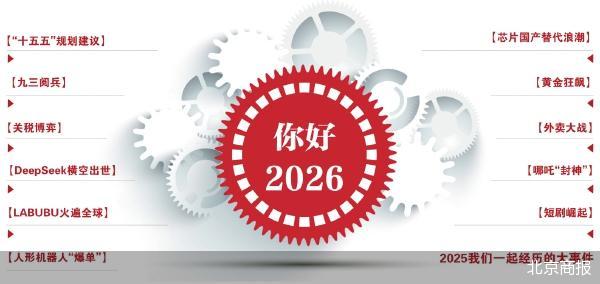
Core Viewpoint - The year 2025 is positioned as a pivotal moment in history, marked by significant developments in technology, economy, and societal changes, particularly in the realms of hard technology and new consumption [1][4][9]. Group 1: Economic and Technological Landscape - The economic future is closely tied to advancements in technology, with a focus on hard technology and new consumption as key coordinates for development in 2025 [4][6]. - China is facing unprecedented challenges and opportunities as it attempts to integrate industrialization, information technology, intelligence, and urbanization [4]. - The capital market is witnessing a surge in hard technology investments, particularly in areas like chips and innovative pharmaceuticals, which are crucial for narrowing the technological gap [4][6]. Group 2: New Consumption Trends - New consumption is evolving beyond mere material goods to encompass cultural and service-oriented aspects, indicating a shift in consumer behavior and preferences [6]. - Emotional and trendy consumption is rapidly gaining traction, reflecting a societal shift where consumers are increasingly valuing experiences and emotional connections over traditional goods [4][6]. - The service industry is identified as a fertile ground for the emergence of new consumption giants, highlighting the need for innovation in service delivery [6]. Group 3: Societal Implications - The relationship between national developments and individual experiences is emphasized, suggesting that the fate of the country is intertwined with the actions and aspirations of its citizens [3][9]. - The narrative of personal agency is reinforced, indicating that individuals have the potential to shape their futures amidst the uncertainties of a rapidly changing world [10]. - The importance of continuous innovation in systems, technology, and business practices is underscored as essential for meeting new demands and creating new supply [6].

韧行2025·企业家画像之王兴兴:硅基一舞惊人
Mei Ri Jing Ji Xin Wen· 2025-12-30 13:27
Core Insights - The humanoid robot industry is expected to be a leading sector in the capital markets by 2025, with Yushutech and its founder Wang Xingxing emerging as significant players [1] - Yushutech has made notable advancements in humanoid robotics, showcasing rapid evolution and gaining public attention through various high-profile events [1] - Wang Xingxing's journey from obscurity to prominence highlights the shift in the industry narrative from "traffic economy" to "hardcore innovation" [2] Company Developments - Yushutech has been recognized as one of the "Six Little Dragons of Hangzhou" and has initiated its IPO process after completing a Series C funding round [1] - The company has captured 70% of the global quadruped robot market and is expanding its humanoid robot product line with the launch of Unitree R1 and H2 [3] - Yushutech is actively building an open-source ecosystem to foster innovation and collaboration in embodied intelligence and robotics technology [3] Industry Trends - China is leading the competition in humanoid robot manufacturing, with a patent accumulation rate five times that of the United States over the past five years [4] - The evolution of the Chinese robotics industry has transitioned from "follower" to "leader," indicating a systemic advancement in technology and market presence [4] - Despite advancements, the humanoid robot technology path remains unresolved, with significant challenges in commercialization and technological breakthroughs [5] Challenges Ahead - Yushutech faces multiple challenges, including organizational structure, technological advancements, industry competition, and capital market dynamics as it approaches its IPO [5] - The need for strategic vision is emphasized as Wang Xingxing transitions from a tech entrepreneur to a strategic business leader [5]
科创板满600家!市值超10万亿
Zhong Guo Zheng Quan Bao· 2025-12-30 10:44
Core Insights - The total market capitalization of the 600 companies listed on the Sci-Tech Innovation Board exceeds 10 trillion yuan, with IPO fundraising amounting to 955.7 billion yuan and refinancing raising 213.9 billion yuan, totaling over 1.1 trillion yuan [2] Group 1: Company Statistics - As of December 30, the number of companies listed on the Sci-Tech Innovation Board reached 600 with a total market capitalization exceeding 10 trillion yuan [2] - Among the 600 companies, 389 are included in the national "specialized and innovative" small giant enterprises list, while 65 are recognized as manufacturing "single champion" demonstration enterprises [2] - 49 companies have their main products rated as manufacturing "single champion" products, with a total of 418 unique companies (after deduplication) accounting for 70% of the board's total [2] Group 2: Support for Special Enterprises - The Sci-Tech Innovation Board has continuously optimized its system to support more special types of "hard technology" enterprises for listing [2] - A total of 60 unprofitable companies, 9 with special equity structures, 7 red-chip companies, and 22 companies listed under the fifth set of standards have been supported, with 22 unprofitable companies achieving profitability post-listing [2] - Among the 22 companies listed under the fifth set of standards, 21 have launched 48 drug or vaccine products, with one company having submitted a product listing application, and 9 companies achieving first-time profitability post-listing [2]
A股硬科技领跑IPO,港股重回全球募资之巅
Bei Jing Shang Bao· 2025-12-30 10:42
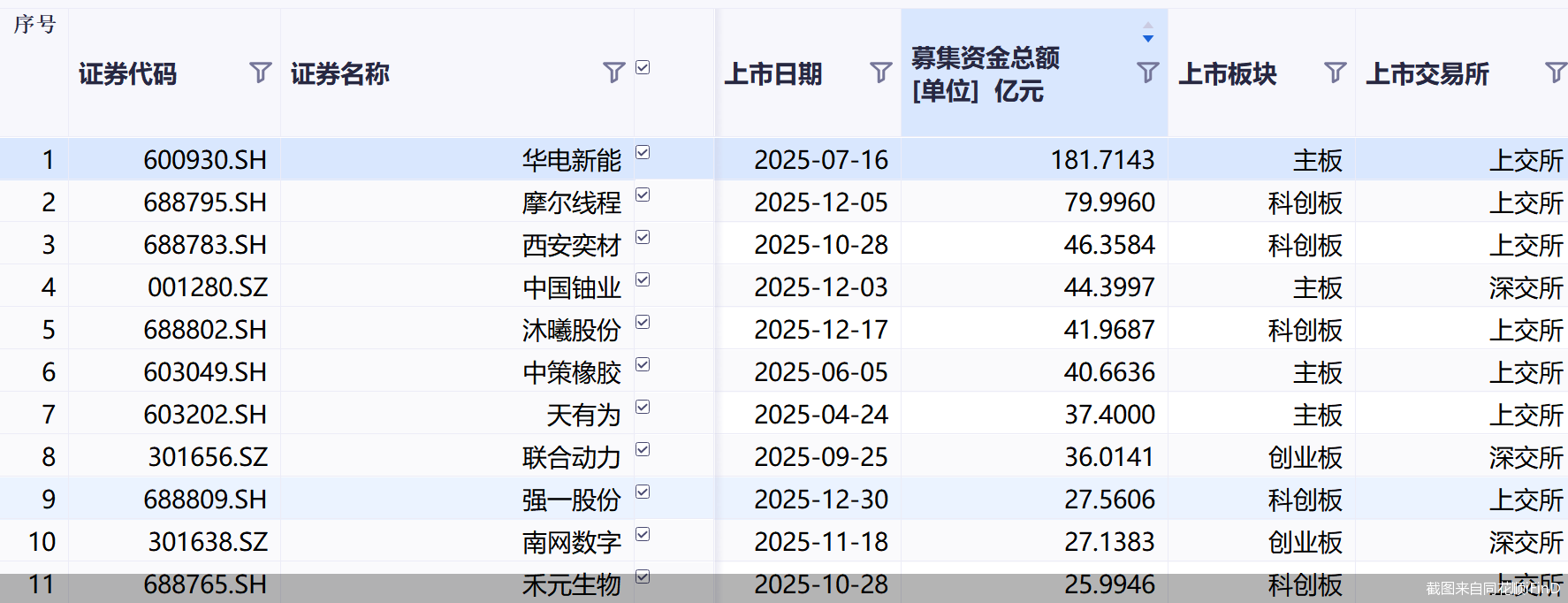
Core Insights - The capital markets in China are experiencing a vibrant end-of-year surge, with significant IPO activity in both A-shares and Hong Kong stocks, reflecting a positive outlook for 2025 [1][2] A-Share Market - In 2025, the A-share market saw a total of 116 new IPOs, raising a total of 131.77 billion yuan, marking a 95.64% increase compared to the previous year [4][5] - The A-share IPO market is characterized by a focus on "hard technology," with notable companies like Moer Technology and Muxi leading the way [4][6] - The top IPOs included Huadian New Energy, which raised 18.17 billion yuan, followed by Moer Technology and Xian Yicai, with 8 billion yuan and 4.64 billion yuan respectively [5] Hong Kong Market - The Hong Kong IPO market thrived in 2025, with 117 new listings raising a total of 285.69 billion HKD, a 220% increase year-on-year, making it the top global fundraising venue [8][9] - Eight major IPOs contributed significantly to this total, including Ningde Times, which raised 41.01 billion HKD, accounting for nearly half of the total fundraising [9][10] - The market saw a low first-day loss rate of 27.35%, the lowest in five years, indicating strong investor confidence [10] Regulatory and Market Dynamics - The growth in both A-share and Hong Kong IPO markets is attributed to supportive policies and a robust market environment, with a focus on technology and innovation [11][12] - The Chinese government has implemented various measures to enhance the appeal of the capital markets, including the establishment of a growth tier on the Sci-Tech Innovation Board [11][12] - The influx of international capital and the increasing participation of domestic investors are reshaping the investor landscape in Hong Kong [13][17] Future Outlook - Expectations for 2026 are optimistic, with projections of continued growth in both A-share and Hong Kong IPO markets, driven by a focus on quality and structural improvements rather than sheer volume [15][16] - The Hong Kong market is anticipated to see around 160 new IPOs, with significant contributions from technology and media sectors [15][16]

资本热话 | 科创板上市公司满600家,投资吸引力不断增强
Sou Hu Cai Jing· 2025-12-30 10:25
Core Insights - The Science and Technology Innovation Board (STAR Market) has grown from 25 initial companies to 600, with total fundraising exceeding 1.1 trillion yuan, including 95.57 billion yuan from IPOs and 21.39 billion yuan from refinancing [1][3]. Group 1: Industry Growth and Development - The STAR Market has become the preferred listing destination for hard technology companies in China, with 600 listed companies primarily in high-tech and strategic emerging industries [3]. - 389 companies are recognized as national "specialized and innovative" small giants, and 65 are designated as manufacturing "single champions," indicating a strong focus on innovation and specialization [3]. - The board has supported various types of companies, including 60 unprofitable firms and 22 companies listed under the fifth set of standards, with many achieving profitability post-listing [4]. Group 2: R&D Investment - R&D investment in STAR Market companies reached 132.86 billion yuan in the first three quarters of 2025, 2.7 times the net profit of the board, with a median R&D investment to revenue ratio of 12.5%, significantly higher than other markets [4][5]. - The total R&D investment for 2024 is projected to be 168.1 billion yuan, a year-on-year increase of 6.4% [4]. Group 3: Innovation and Performance - Approximately 30% of STAR Market companies have products or projects that are industry-first, with over 80% targeting import substitution and self-sufficiency [5]. - The average gross profit margin for STAR Market companies is 40%, outperforming other A-share markets [5]. Group 4: Mergers and Acquisitions - The STAR Market has seen increased activity in mergers and acquisitions, with over 160 new industry mergers since June 2024, totaling over 49 billion yuan in disclosed transaction amounts [6][7]. - The market has also seen a rise in cash acquisitions and securities transactions, with significant involvement from unprofitable targets and companies planning IPOs [7]. Group 5: Investor Engagement and Returns - 448 STAR Market companies have implemented 831 equity incentive plans, covering approximately 150,000 individuals [7]. - Over 60% of companies have announced cash dividend plans for 2024, with total dividends amounting to 38.8 billion yuan [7]. - The STAR Market has launched multiple indices, with over 100 ETFs listed, and the total scale of index tracking products exceeding 310 billion yuan [8].
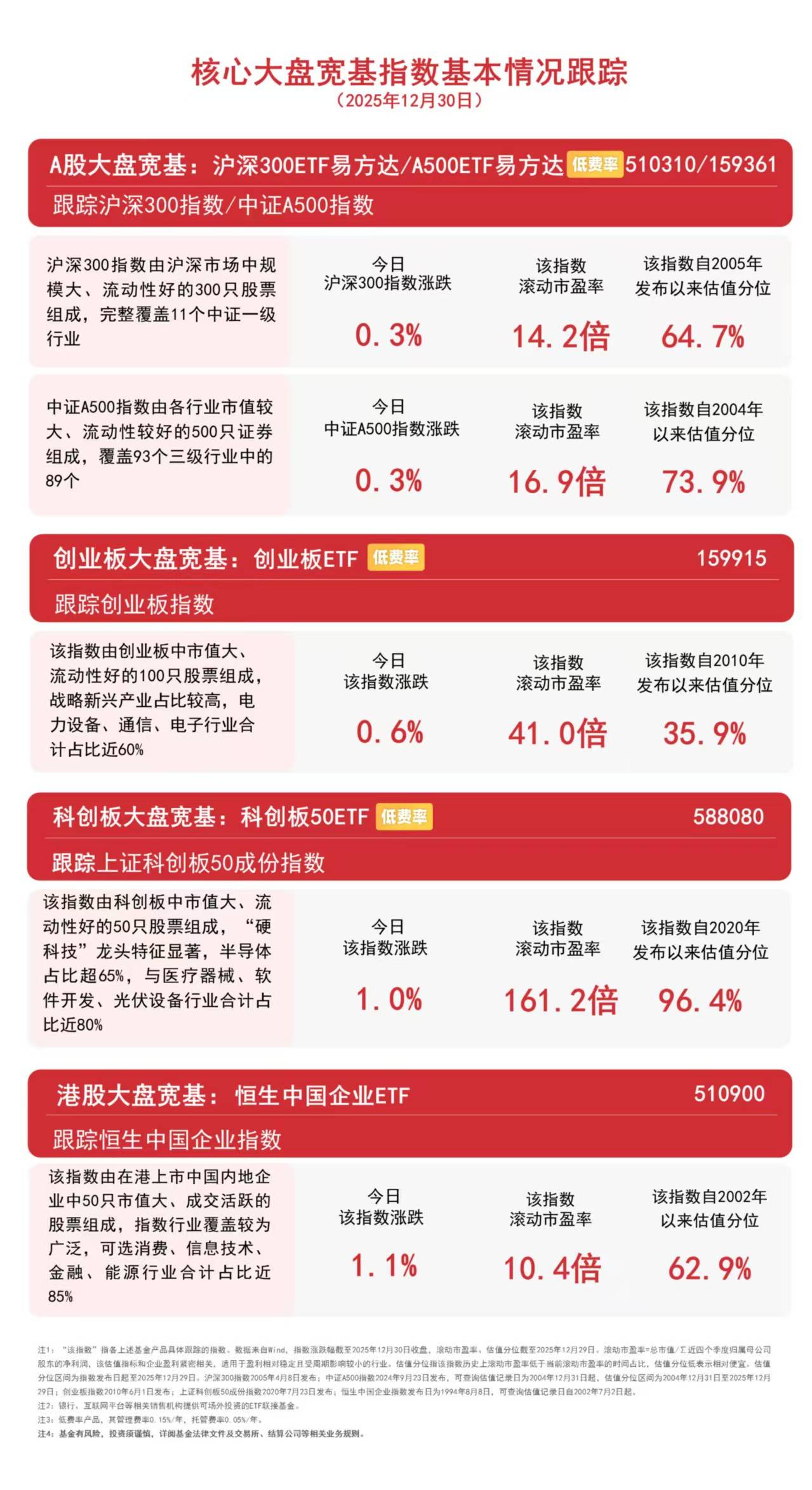
沪指十连阳,A500ETF易方达(159361)、沪深300ETF易方达(510310)等助力布局A股核心资产
Sou Hu Cai Jing· 2025-12-30 10:22
Core Viewpoint - The A-share market showed mixed performance on December 30, with the Shanghai Composite Index experiencing a low opening but rebounding to record ten consecutive gains, while the total market turnover reached 2.16 trillion yuan. Market Performance - The Shanghai Composite Index opened lower but rebounded, achieving ten consecutive days of gains [1] - The total market turnover was 2.16 trillion yuan [1] - The CSI A500 Index rose by 0.3%, the CSI 300 Index increased by 0.3%, the ChiNext Index went up by 0.6%, and the STAR Market 50 Index climbed by 1.0% [1] - The Hang Seng China Enterprises Index increased by 1.1% [1] Sector Performance - The human-like robots, ice and snow tourism, and embodied intelligence sectors saw significant gains [1] - The Hainan Free Trade Port, photovoltaic glass, and commercial aerospace sectors experienced notable declines [1] - In the Hong Kong market, the semiconductor, oil and petrochemical, and non-ferrous metals sectors strengthened, while the pharmaceutical and consumer sectors weakened [1]