高端机床

Search documents
险资看好2026权益市场 掘金“硬科技”投资机会
Shang Hai Zheng Quan Bao· 2026-01-18 18:15
Group 1 - The influx of incremental funds is expected to act as a "catalyst" for market growth, with residents shifting their asset allocation from deposits to other assets due to low long-term deposit rates [1] - There is a noticeable increase in residents' enthusiasm for purchasing insurance, particularly dividend insurance products, which may channel funds into the stock market in the future [1] - The trend of "deposit migration" indicates that household savings are entering the capital market through various channels, with ordinary residents' funds likely becoming a major source of market entry by 2026 [1] Group 2 - Insurers are adopting a "barbell" asset allocation strategy, heavily investing in dividend assets while also allocating to growth assets, particularly in response to emerging structural opportunities in the equity market [2] - The market's profit growth rate is expected to rebound in 2026, with a focus on "hard technology" sectors such as AI computing power, industrial software, high-end machine tools, hydrogen energy, and aerospace support [2] - Technology and advanced manufacturing are identified as key investment themes for 2026, with firms like Huatai Asset actively positioning in AI, semiconductors, robotics, and new energy sectors while selectively investing in finance, cyclical, and consumer sectors [2] Group 3 - Mid-sized insurance companies are focusing on growth assets that can deliver tangible results, targeting three main areas: manufacturing with global competitive advantages, sectors experiencing accelerated domestic substitution with real demand, and early-stage industries supported by clear policies and capital [3] - Key sectors of interest include engineering machinery, new energy equipment, semiconductors, new materials, commercial aerospace, and AI applications [3]
2025年进出口总值创历史新高 中国外贸展现韧性与活力
Ren Min Ri Bao Hai Wai Ban· 2026-01-17 07:10
Core Viewpoint - China's foreign trade demonstrates resilience and vitality, achieving a record high in total import and export value in 2025, maintaining its position as the world's largest goods trading nation [1][2]. Group 1: Trade Performance - In 2025, China's total import and export value reached 45.47 trillion yuan, a year-on-year increase of 3.8%, marking nine consecutive years of growth [1]. - Exports amounted to 26.99 trillion yuan, growing by 6.1%, while imports were 18.48 trillion yuan, with a modest increase of 0.5% [1]. - The growth in high-tech product exports was notable, with a year-on-year increase of 13.2%, contributing 2.4 percentage points to overall export growth [2]. Group 2: Import Trends - China maintained its status as the world's second-largest import market for 17 consecutive years, with imports reaching a historical high in 2025 [4]. - Import growth was driven by a recovering economy, with a continuous increase in imports for three consecutive quarters starting from Q2 [4]. - The 8th China International Import Expo saw record participation, with intended transaction amounts exceeding 80 billion USD [4]. Group 3: Trade Partnerships - China's trade partnerships expanded significantly, becoming a major trading partner for over 160 countries and regions, an increase of more than 20 since 2020 [6]. - Trade with ASEAN countries and Central Asian nations saw substantial growth, with imports from these regions increasing by 3.9% and over 1 billion USD in trade volume, respectively [6][7]. - In 2025, trade with countries involved in the Belt and Road Initiative reached 23.6 trillion yuan, growing by 6.3%, which is 2.5 percentage points higher than the overall trade growth rate [7].
2025年上海市实现外贸进出口4.51万亿元,创历史新高
Xin Lang Cai Jing· 2026-01-16 09:53
Core Viewpoint - Shanghai's foreign trade achieved a record high of 4.51 trillion yuan in 2025, reflecting the city's strong economic resilience and potential, with exports growing by 10.8% and imports by 1.8% [3][4]. Group 1: Economic Performance - Shanghai's foreign trade maintained stability and achieved growth despite challenging external conditions, with a historical breakthrough of 4.5 trillion yuan in total trade [3]. - The growth rate of Shanghai's foreign trade exceeded the national average by 1.8 percentage points, with export growth leading the nation by 4.7 percentage points, ranking first among the five major foreign trade provinces [3][4]. - Compared to the end of the 13th Five-Year Plan in 2020, Shanghai's foreign trade increased by over 1 trillion yuan, equivalent to adding a new largest trading partner [3]. Group 2: Market Expansion - Shanghai's foreign trade expanded to 167 countries and regions, with double-digit growth in emerging markets such as Africa, India, and ASEAN [4]. - The number of "billion-dollar trade partners" increased to 49, indicating a broadening of trade relationships [4]. Group 3: High-Value Exports - Exports of high-end manufacturing products, referred to as the "new three samples," reached 156.67 billion yuan, with electric vehicle exports surpassing 100 billion yuan and hybrid vehicle exports increasing by nearly 150% [4]. - Exports of advanced industries showed significant growth, with high-end machine tool exports increasing by nearly 30%, industrial robot exports by over 40%, and surgical robot exports experiencing explosive growth of 370% [4]. Group 4: Structural Development - Shanghai's open platforms and district collaboration created a robust development matrix, with special regulatory zones accounting for over 40% of total trade, totaling 1.87 trillion yuan, a growth of 9.4% [5]. - The Waigaoqiao Free Trade Zone's trade volume exceeded 1 trillion yuan, maintaining its position as the leading special regulatory zone in the country [5]. - The Pudong New Area's foreign trade reached 2.76 trillion yuan, accounting for over 60% of the city's total, with several districts showing strong growth rates exceeding 10% [5].


企业牢牢站稳科创舞台“C位”
Ke Ji Ri Bao· 2026-01-08 08:15
Group 1 - The core role of enterprises in technological innovation is emphasized in the recent guidelines from the Central Committee, highlighting the need for innovation resources to concentrate on enterprises [1][3] - The R&D expenditure in China is projected to reach 3.6 trillion yuan, accounting for 2.68% of GDP by 2024, with enterprises contributing over 77% of this investment [2] - The strategic direction to strengthen the role of enterprises in innovation has been consistently reinforced in national policies, indicating a clear commitment to gather innovation resources within enterprises [3][4] Group 2 - The government is shifting from being a "leader" to an "enabler," providing maximum freedom for innovation and creating a supportive ecosystem for future industries [8][9] - Companies like Huasheng Composite Technology have benefited from local innovation platforms that assist in addressing financing and market challenges, showcasing the importance of specialized support for technology transfer [10] - The integration of technology, industry, and finance is being optimized to create a virtuous cycle, with enterprises taking a leading role in original innovation and resource allocation [10]
“十五五”中国企业全球化:新出海、新伙伴、新未来
Jing Ji Guan Cha Wang· 2026-01-06 03:03
Core Insights - The article highlights the transformation of Chinese companies' international expansion strategies during the "15th Five-Year Plan" period, moving from simple product exports to a more integrated approach involving technology, brand, and ecosystem development [2][8]. Group 1: Project Developments - A 2600 MW solar power plant in Saudi Arabia, the largest in the Middle East, showcases the EPC capabilities of China Energy Engineering Group, integrating China's strong manufacturing with Schneider Electric's advanced technology [1]. - Schneider Electric collaborates with China Energy Engineering Group to provide electrical solutions for the solar project, demonstrating effective risk management in complex overseas environments [3]. Group 2: Globalization and Localization - The article emphasizes the need for Chinese companies to adopt a validated globalization methodology and seek reliable partners, particularly multinational corporations that understand both Chinese and global markets [3][6]. - Schneider Electric's extensive global network and deep understanding of the Chinese market position it as a key partner for Chinese companies looking to expand internationally [6][7]. Group 3: Collaborative Opportunities - Schneider Electric is actively partnering with various Chinese firms, such as China Power Construction and CATL, to explore third-party markets in the Middle East and Southeast Asia, contributing to local energy infrastructure [4]. - The collaboration with core suppliers like Jinrong Tianyu has led to significant upgrades in digitalization and internationalization, enhancing their global supply chain presence [4]. Group 4: Innovation and Technology Transfer - Schneider Electric's localized operations have resulted in a strong innovation network in China, producing advanced technologies like environmentally friendly switchgear and new generation circuit breakers that are now entering global markets [7][8]. - The partnership between Schneider Electric and Chinese companies facilitates the transfer of China's innovations in new energy and digitalization to broader markets, aligning with the global expansion of Chinese enterprises [8][9].
寻找“国家级”风口:一份关于十五五的产业内参|36氪年度透视⑧
3 6 Ke· 2025-12-29 03:37
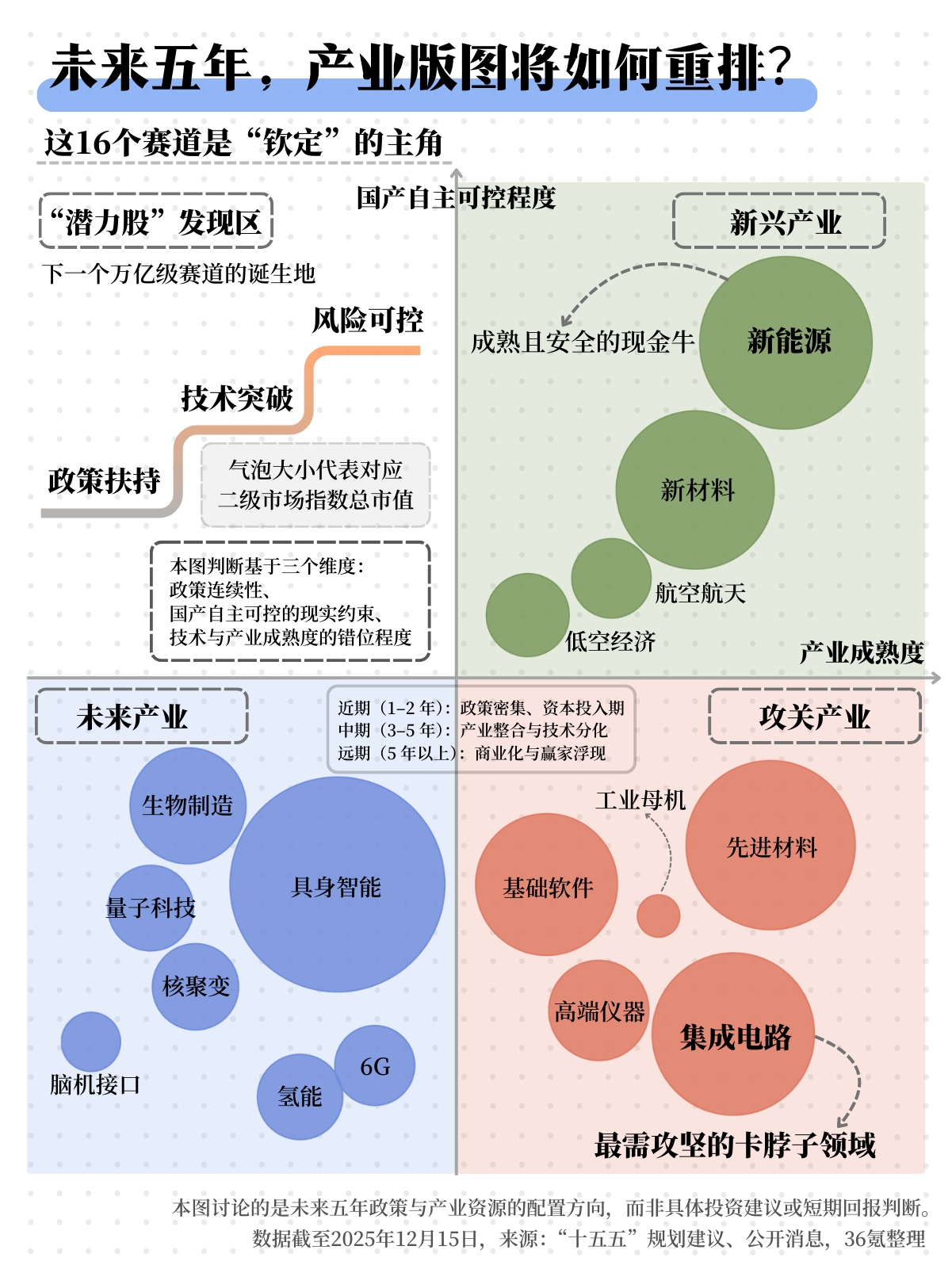
Core Insights - The Chinese capital market is undergoing a systematic shift in its underlying logic over the next five years, with a high historical fulfillment rate of the core objectives outlined in the "Five-Year Plan" [2] - The focus of policy and industrial resource allocation will be concentrated on 16 key sectors, including semiconductors and new materials, while traditional infrastructure and real estate are losing importance [7][10] Group 1: Industry Trends - There is a significant potential for domestic substitution in high-end manufacturing, with a 90% domestic replacement space identified in various sectors [6] - The current domestic replacement rates for critical components are low, indicating substantial opportunities for growth in areas such as photolithography and high-end machine tools [6][12] - The policy support is no longer evenly distributed but is highly concentrated on specific sectors, marking a shift in resource allocation [7] Group 2: Investment Implications - The competition in sectors where domestic rates are nearing saturation is becoming intense, while areas with lower domestic rates present longer-term opportunities for investment [12] - Sustainable returns in hard technology sectors will favor participants who can maintain long-term investment strategies rather than seeking short-term profits [15] - The historical context of policy changes reflects a transfer of wealth in China, with the semiconductor sector now positioned as a new economic engine [10]
夯实东北全面振兴基础
Jing Ji Ri Bao· 2025-12-11 21:37
Group 1 - The core objective is to achieve a 500 billion yuan target for the silver economy industry in Jilin Province during the "14th Five-Year Plan" period, indicating a strong push for economic revitalization in Northeast China [1] - Northeast China is recognized as a crucial industrial base, grain production area, and ecological protection barrier, playing a vital role in national security and development [2] - The region has made significant progress in various fields, including state-owned enterprise reform in Liaoning, record grain production in Jilin, and notable achievements in the "4567" modern industrial system in Heilongjiang [2] Group 2 - The transformation of traditional industrial areas is a global challenge, with examples from Germany and the United States showcasing successful transitions to modern service and high-tech centers [3] - Northeast China possesses rich strategic resources and deep technological foundations, providing a strong basis for development in the context of China's modernization [3] - Challenges include the need to enhance technological innovation capabilities and the relatively slow development of emerging industries [3] Group 3 - There is a call to accelerate industrial structure adjustments, focusing on upgrading traditional industries and fostering strategic emerging industries such as aerospace and new materials [4] - Strengthening technological innovation is essential, with an emphasis on high-end machine tools and fine chemicals, and promoting local transformation of scientific achievements [4] - Environmental protection efforts are highlighted, including the preservation of black soil and the development of a circular economy to promote green and low-carbon transitions in industries [4]
友城携手,从“我”到“我们”
Shan Xi Ri Bao· 2025-11-02 22:58
Group 1 - The core viewpoint of the articles highlights the growing international friendship city relationships of Shaanxi Province, emphasizing cultural exchanges and cooperation in various fields such as education, agriculture, and trade [1][2][4] - Shaanxi has established 121 pairs of international friendship city relationships with 41 countries, ranking first in the number of provincial international friendship cities in China [1][4] - The province has expanded its international friendship city network, including new partnerships with Central Asian countries during the China-Central Asia Summit, achieving full coverage with all five Central Asian countries [4][5] Group 2 - The articles detail specific collaborative projects, such as agricultural technology exchanges between Shaanxi and Kazakhstan, aimed at improving crop yields and introducing quality agricultural products to the Chinese market [6][7] - Economic cooperation is deepening, with initiatives like the establishment of logistics processing bases and agricultural parks, enhancing trade and investment opportunities between Shaanxi and its international partners [7][8] - Youth exchanges and cultural performances, such as those between Shaanxi and Belgium, are fostering international understanding and strengthening ties between cities [8][9]
科德数控(688305):盈利短期承压,新领域布局可期
HTSC· 2025-10-30 12:25
Investment Rating - The investment rating for the company is "Buy" with a target price of RMB 81.74 [7]. Core Views - The company reported a revenue of RMB 400 million for the first three quarters of 2025, representing a year-on-year increase of 5.01%, while the net profit attributable to shareholders was RMB 64 million, a decrease of 11.53% year-on-year. The third quarter saw a revenue of RMB 106 million, down 15.97% year-on-year and 35.32% quarter-on-quarter, primarily due to a decrease in sales revenue and an increase in share-based payment expenses [1]. - The company is focusing on high-end product launches to achieve domestic substitution and is deepening its engagement in the aerospace industry while continuously expanding applications in the civilian sector. The outlook for the company leading high-end machine tool domestic substitution is positive [1]. Summary by Sections Financial Performance - For the first three quarters of 2025, the company's gross margin was 38.71%, down 3.97 percentage points year-on-year, and the net profit margin was 15.90%, down 3.01 percentage points year-on-year. The decline in gross margin is attributed to the lower gross margin of the automation production line business, which is rapidly increasing in proportion [2]. - The expense ratio for the first three quarters of 2025 was 22.79%, an increase of 2.09 percentage points year-on-year. The sales expense ratio, management expense ratio, R&D expense ratio, and financial expense ratio were 8.61%, 6.88%, 7.53%, and -0.24%, respectively [2]. Product and Market Positioning - The company has a complete product layout, forming a competitive advantage of full industry chain autonomy. It has four general technology platform products and four specialized technology platform products, widely used in aerospace, energy, automotive, shipbuilding, molds, low-altitude economy, and medical fields [3]. - The company is expanding into emerging fields, focusing on low-altitude economy and humanoid robots. It is developing high-end precision manufacturing equipment for components of drones and helicopters, and its control algorithms and servo drives can be adapted for humanoid robot control systems [4]. Profit Forecast and Valuation - The company's net profit forecasts for 2025-2027 have been revised down by 5.82%, 10.38%, and 7.64%, respectively, to RMB 163 million, RMB 210 million, and RMB 268 million, with a three-year compound growth rate of 27.25%. The corresponding EPS is projected to be RMB 1.22, RMB 1.58, and RMB 2.01 [5]. - The company is assigned a PE valuation of 67 times for 2025, leading to a target price of RMB 81.74, down from the previous value of RMB 87.10 [5].

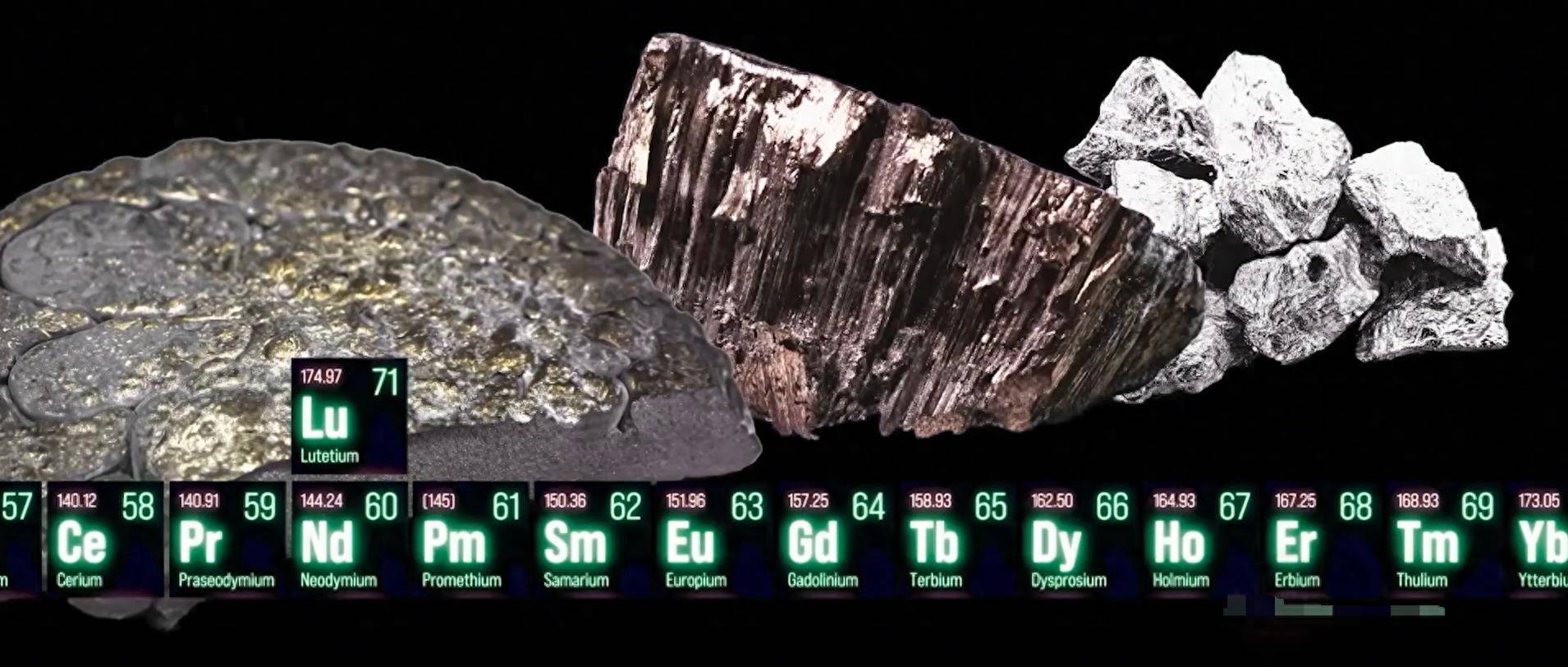
稀土储量超铜,却卡住全球产业,中国握关键一步,美砸30亿难赶超
Sou Hu Cai Jing· 2025-10-21 01:38
Core Insights - The recent rare earth export controls by China have significantly impacted the global automotive industry, leading to production halts and a 65% increase in neodymium-iron-boron magnet prices within three weeks [1][3][10] - Despite the abundant global rare earth reserves, the difficulty in processing these materials into usable forms has created a chokehold on the supply chain, particularly for industries reliant on high-performance magnets [10][12][19] Industry Impact - The automotive sector, particularly electric vehicle manufacturers, faced immediate challenges as demand for rare earth magnets surged by 32% following the export restrictions, resulting in major companies like Volkswagen and Ford missing production targets [3][5] - Other industries, including wind energy and high-precision machinery, also experienced disruptions due to their reliance on rare earth materials, with significant reductions in production capabilities [3][5] Supply Chain Challenges - China's partial easing of export licenses has led to uncertainty, with lengthy approval processes and short validity periods for permits, causing companies to hesitate in making long-term investments [5][27] - Historical context shows that past disruptions in rare earth supply, such as the 2010 China-Japan dispute, have led to significant price spikes and supply chain vulnerabilities [5][10] Technical and Environmental Barriers - The complexity of extracting and purifying rare earth elements involves numerous chemical processes, with high environmental costs, making it difficult for other countries to replicate China's processing capabilities [12][19] - The U.S. and other nations are attempting to re-establish their rare earth supply chains but face significant hurdles, including environmental regulations and technological gaps [25][27][31] Geopolitical Dynamics - The U.S. once dominated the rare earth market but lost its position due to regulatory challenges and environmental costs, allowing China to capture a significant share of the global market [19][23] - Current efforts by the U.S. to revive its rare earth industry, including investments in mining and processing facilities, are still far from meeting domestic demand, highlighting the challenges of rebuilding a competitive supply chain [25][31] Future Outlook - Companies are exploring alternative technologies and materials to reduce reliance on rare earths, but these solutions have not yet proven viable for large-scale production [33] - The ongoing competition for rare earth resources underscores the importance of technological advancement and supply chain integration, which China has developed over decades, making it difficult for other nations to catch up quickly [33]