
ROE

Search documents
辉煌科技(002296.SZ):2025年中报净利润为1.35亿元、较去年同期上涨19.50%
Xin Lang Cai Jing· 2025-07-30 01:40
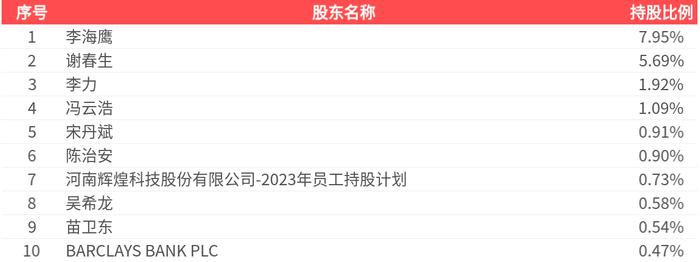
Core Insights - The company reported a total revenue of 404 million yuan for the first half of 2025, an increase of 71.08 million yuan compared to the same period last year, marking a year-on-year growth of 21.34% [1] - The net profit attributable to shareholders reached 135 million yuan, up by 21.96 million yuan from the previous year, reflecting a year-on-year increase of 19.50% [1] - The company achieved a net cash inflow from operating activities of 55.27 million yuan [1] Financial Metrics - The latest debt-to-asset ratio stands at 25.02% [2] - The gross profit margin is reported at 57.34% [3] - Return on equity (ROE) is at 5.67%, an increase of 0.38 percentage points compared to the same period last year [3] - The diluted earnings per share (EPS) is 0.35 yuan, an increase of 0.06 yuan year-on-year, representing a growth of 18.95% [3] - The total asset turnover ratio is 0.13 times, remaining stable compared to the previous year, with a year-on-year increase of 2.26% [3] - The inventory turnover ratio is 0.34 times, an increase of 0.10 times from the previous year, reflecting a year-on-year growth of 41.51% [3] Shareholder Information - The number of shareholders is 41,800, with the top ten shareholders holding a total of 80.91 million shares, accounting for 20.77% of the total share capital [3] - The largest shareholder is Li Haiying, holding 7.95% of the shares [3]


国邦医药(605507.SH):2025年中报净利润为4.56亿元
Xin Lang Cai Jing· 2025-07-30 01:13
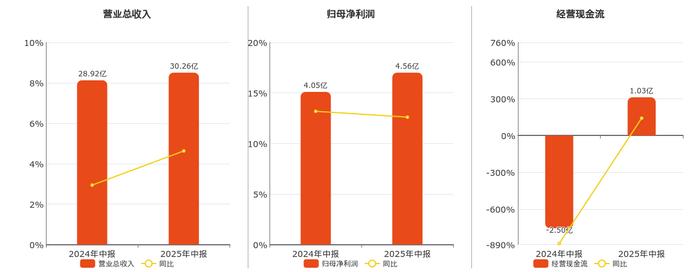
Core Insights - Guobang Pharmaceutical (605507.SH) reported its 2025 mid-year financial results, highlighting a total revenue of 3.026 billion yuan and a net profit attributable to shareholders of 456 million yuan [2]. Financial Performance - The company's total revenue reached 3.026 billion yuan, with a net profit of 456 million yuan [2]. - Operating cash flow showed a net inflow of 103 million yuan [2]. - The latest gross profit margin was recorded at 26.85%, while the return on equity (ROE) stood at 5.65% [5]. - The diluted earnings per share were reported at 0.82 yuan [6]. Balance Sheet Metrics - The current asset-liability ratio is 25.41%, which reflects an increase of 0.52 percentage points compared to the same period last year [4]. - The total asset turnover ratio remained stable year-on-year, although it decreased by 0.88% compared to the previous year [6]. - The inventory turnover ratio was 1.55 times, showing a decrease of 0.02 times year-on-year, which is a decline of 0.97% compared to the same period last year [6]. Shareholder Structure - The number of shareholders is approximately 25,000, with the top ten shareholders holding a total of 357 million shares, accounting for 63.85% of the total share capital [6]. - The largest shareholder is Xinchang Ander Trading Co., Ltd., holding 23.08% of the shares [6].

金杯电工(002533.SZ):2025年中报净利润为2.96亿元
Xin Lang Cai Jing· 2025-07-30 01:10
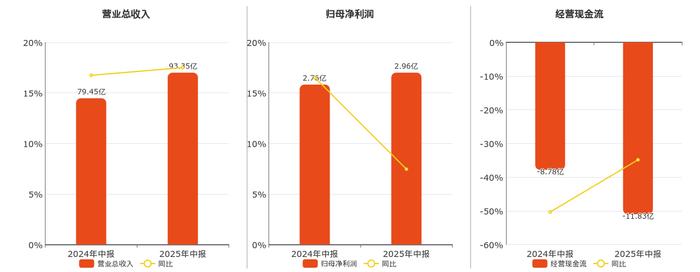
Core Insights - The company reported a total operating revenue of 9.335 billion yuan and a net profit attributable to shareholders of 296 million yuan for the first half of 2025 [1] - The company experienced a significant decrease in cash flow from operating activities, with a net outflow of 1.183 billion yuan, a reduction of 306 million yuan compared to the same period last year [1] Financial Performance - The latest asset-liability ratio stands at 59.63%, which is an increase of 3.55 percentage points from the previous quarter and an increase of 7.41 percentage points year-on-year [3] - The company's gross profit margin is 10.32%, reflecting a decrease of 0.67 percentage points compared to the same period last year [4] - The return on equity (ROE) is reported at 7.22% [4] - The diluted earnings per share (EPS) is 0.40 yuan [5] - The total asset turnover ratio is 0.86 times, a decline of 0.03 times or 3.40% year-on-year [5] - The inventory turnover ratio is 5.15 times [5] Shareholder Structure - The number of shareholders is 43,800, with the top ten shareholders holding a total of 313 million shares, accounting for 42.67% of the total share capital [5] - The largest shareholder is Shenzhen Nengxiang Investment Development Co., Ltd., holding 15.69% of the shares [5]

银行业行情复盘2005:从顺周期到红利
Huafu Securities· 2025-07-29 11:57
Investment Rating - The industry investment rating is "Outperform the Market" (maintained) [1] Core Viewpoints - The banking sector has experienced six distinct phases of absolute and relative returns from 2005 to 2025, with four phases driven by cyclical factors and two by dividend factors [2][3] - The current market trend has shifted from a dividend-driven logic to a return on equity (ROE)-driven logic as of 2025 [106] Summary by Sections Historical Performance Analysis - From November 2005 to November 2007, the banking sector was characterized by absolute returns during a period of rapid economic growth and a bull market in A-shares [2] - The period from January 2009 to July 2009 saw initial absolute returns followed by relative returns due to macroeconomic recovery and liquidity easing post-financial crisis [25] - The phase from December 2012 to February 2013 was marked by a marginal improvement in economic expectations, leading to a rebound in banking valuations [37] - Between October 2014 and January 2015, the banking sector experienced a recovery driven by policy support and a decline in risk premiums, resulting in a rise in valuations [56] - The period from February 2016 to September 2018 was characterized by a recovery in the banking sector driven by macroeconomic stabilization, although regulatory tightening affected relative returns [76] - Since October 2022, the banking sector has seen a recovery after nearly four years of adjustment, with high dividend yields and a shift in market focus from large banks to smaller banks [2][106] Current Market Dynamics - As of October 2022, the banking sector's price-to-book (PB) ratio was at 0.49, reflecting a pessimistic outlook on risks and profitability [95] - The current market is witnessing a decline in dividend yields, driven by falling risk premiums and interest rates, which is crucial for the ongoing market rally [101] - The market is seeing a shift in focus from large state-owned banks to smaller banks, with high dividend strategies gaining traction [102] - The demand for banking stocks is being driven by passive funds and institutional investors, leading to increased allocation in the sector [108]
2024年度寿险公司加权薪保比指标排行榜,薪保比已创近15年来历史新低!
13个精算师· 2025-07-28 11:46
Core Viewpoint - The 2024 life insurance industry has seen a decline in employee compensation and a historical low in the salary-to-premium ratio, indicating potential challenges in operational efficiency and profitability [2][14]. Group 1: Salary and Premium Ratio Analysis - In 2024, the total employee compensation in the life insurance industry was 108.5 billion yuan, a decrease of 4.6% year-on-year, with a salary-to-premium ratio of 3.4%, down 0.5 percentage points, marking a 15-year low [2][14]. - The "TOP7+1" companies (including major players like China Life and Ping An) had a salary-to-premium ratio of 3.3%, which is significantly lower than that of small and medium-sized insurance companies, which stood at 3.7% [17][18]. - The average salary-to-premium ratio for 70 life insurance companies over the past five years was 4.0%, with a median of 4.9%, and 11 companies exceeding 10% [5][28]. Group 2: Impact on Return on Equity (ROE) - The salary-to-premium ratio has a significant negative impact on a company's ROE, with each 1 percentage point increase in the ratio leading to a 0.37 percentage point decrease in ROE [24][25]. - The empirical model constructed to analyze this relationship included variables such as company size and channel type, confirming the negative correlation between salary-to-premium ratio and ROE [24][25]. Group 3: Historical Trends - The salary-to-premium ratio has shown a declining trend since 2018, with a notable acceleration in the decline for small and medium-sized insurance companies since 2019 [16][18]. - The ratio increased from 4.2% in 2010 to a peak of 5.3% in 2015, followed by a steady decline to the current levels [16][18]. Group 4: Employee Compensation Insights - The life insurance industry employed approximately 345,000 individuals in 2023, with an average compensation and benefits level of 330,000 yuan [10][22]. - The fluctuation in employee numbers has shown a slight decline, while average compensation has seen minor increases over recent years [10][22].




民生策略周论
2025-07-16 06:13
Summary of Conference Call Notes Industry Overview - The discussion revolves around the Chinese stock market (A-shares) and its comparison with the U.S. stock market, particularly focusing on capital returns and economic recovery trends in both regions [1][2][3]. Key Points and Arguments 1. **Capital Return Trends**: Over the past five years, China has encouraged supply and capital investment, leading to a decline in capital returns. In contrast, Western governments have provided demand subsidies, resulting in a strong capital return but also potential safety risks [1]. 2. **Currency and Market Movements**: Recently, the U.S. dollar has rebounded, and during this period, both the Chinese yuan and stocks have strengthened alongside U.S. stocks, while other markets lagged [1]. 3. **Expectations for Capital Returns**: There is a growing expectation for capital returns in China, particularly in the equity market, as the bond market yields have become competitive with overseas markets post-exchange rate adjustments [2]. 4. **A-shares vs. U.S. Stocks**: The A-share market is expected to experience a reversal in the downward trend of Return on Equity (ROE), while the U.S. market may face pressures due to high ROE levels amidst economic downturns [2][3]. 5. **Manufacturing Recovery**: Signs of recovery in U.S. manufacturing could positively impact China's economy, as the global manufacturing sector begins to rebound, which may lead to increased demand for Chinese exports [4][6]. 6. **Debt Cycle and Financial Stability**: The debt cycle in China is nearing its end, with companies increasingly repaying debts, which is a sign of financial stability despite current economic challenges [6][7]. 7. **Valuation Metrics**: Current Price-to-Book (PB) ratios align with historical ROE levels, indicating that while valuations may appear low, the potential for recovery in earnings could lead to significant upside [7][8]. 8. **Sector Disparities**: There is a notable disparity in valuations across sectors, with banks and high-end manufacturing (TMT) showing higher valuations, while many stocks remain undervalued [8][9]. 9. **Investment Opportunities**: The potential for a gradual recovery in Chinese corporate earnings is highlighted, driven by global manufacturing investments and a focus on capital efficiency [9][10]. 10. **Cautious Optimism**: While there is optimism regarding the bottoming out of capital returns in China, there is a warning about increasing structural differentiation among industries, suggesting that a bull market may not be uniform across sectors [11]. Other Important Insights - The discussion emphasizes the importance of monitoring structural adjustments in the market, particularly the shift from speculative to more sustainable investments [11]. - The potential for a gradual recovery in corporate earnings is linked to the performance of the global manufacturing sector and the efficiency of capital utilization in China [9][10].
A股策略周报:齿轮开始转动-20250713
SINOLINK SECURITIES· 2025-07-13 11:44
Group 1 - The report highlights that both Chinese and US stock markets are experiencing a strong upward trend, driven by optimistic investor expectations regarding future corporate capital returns. A-shares are pricing in a stabilization of ROE at historical lows, while US stocks are anticipating continued growth in ROE from already high levels [3][12][14] - Since Q4 2021, A-shares have faced declining capital returns due to intense competition amid trends of "de-financialization" and "de-real estate," while US stocks have benefited from government debt expansion stimulating demand, resulting in higher ROE [3][14][17] - The report anticipates a shift in trends, with US capital returns potentially facing downward pressure due to tax policies encouraging manufacturing investment and capital repatriation, while A-shares may see a recovery in capital returns driven by anti-involution policies, stronger overseas manufacturing activity, and a halt in debt contraction [3][4][17] Group 2 - Three key catalysts for the stabilization and recovery of A-share capital returns are identified: anti-involution policies, overseas manufacturing activity surpassing service sector growth, and the end of the debt repayment cycle [4][23][31] - The report provides an example from the cement industry, where current operational rates are at their lowest since 2019, and a rebound in price indices is expected by late 2024, indicating a potential recovery in ROE [4][23][25] - The report notes that the demand for domestic capital goods and intermediate products is expected to rise due to stronger overseas manufacturing activity compared to services, with significant rebounds in excavator sales and steel exports observed [4][27][29] Group 3 - The current market pricing indicates that short-term stock prices have outpaced ROE, necessitating a buffer for uncertainty in recovery rhythms. The report emphasizes that the internal industry structure is more critical than the overall market [5][36] - The report discusses the historical context of PB (Price-to-Book) ratios, noting that the current PB levels are not extreme compared to historical standards, but the low absolute level of ROE may affect the pace of PB recovery [5][36][38] - A significant reduction in the proportion of stocks with low PB ratios has been observed, particularly in sectors like TMT (Technology, Media, and Telecommunications), high-end manufacturing, and banking, while traditional industries still show a high percentage of low PB stocks [5][38][40] Group 4 - The report suggests that the dynamics of capital returns are shifting, with domestic capital returns expected to stabilize and rise, while overseas capital returns may decline. This shift positions A-shares as more attractive compared to other markets [6][46] - Recommendations for asset allocation include focusing on upstream resource products benefiting from increased overseas demand and domestic anti-involution policies, as well as emphasizing equity over debt investments [6][46]
国金证券:中美镜像下,资本回报的齿轮开始转动
智通财经网· 2025-07-13 11:15
Group 1 - The core viewpoint is that the current strong resonance between Chinese and American stock markets reflects optimistic expectations for future corporate capital returns, with A-shares stabilizing from historical lows and U.S. stocks maintaining high ROE levels [1][2] - The three main catalysts for stabilizing and recovering capital returns in A-shares are: (1) anti-involution leading to stabilization in industries previously constrained by excessive capital expansion, (2) overseas manufacturing demand exceeding service sector demand, and (3) the end of debt contraction cycles [2][3] - The current market pricing indicates that short-term stock prices are ahead of ROE, which aligns with historical bottoming characteristics, and while the absolute level of PB is not extreme, the low absolute level of ROE affects the elasticity and pace of PB recovery [3][4] Group 2 - The future state of capital returns is expected to shift, with domestic capital returns stabilizing and overseas capital returns potentially declining due to the combination of anti-involution, cessation of debt contraction, and the development of overseas manufacturing [4][5] - The relative advantage of the "barbell strategy" may diminish as ROE gradually recovers, with traditional industries such as coal, oil, steel, and utilities showing a higher proportion of low PB stocks compared to TMT and high-end manufacturing sectors [3][4] - Recommendations for asset allocation include focusing on upstream resource products and capital goods benefiting from increased overseas demand and domestic anti-involution policies, as well as exploring opportunities in new consumption sectors like hospitality and retail [5]

红利国企ETF(510720)涨超1.1%,降准背景下红利资产性价比引关注
Sou Hu Cai Jing· 2025-07-10 06:33
Group 1 - BeiGene announced its first positive GAAP operating profit in Q1 2025, with a net profit of $1.27 million, and reaffirmed its full-year revenue guidance of $4.9-5.3 billion, primarily driven by the increase in global market share of its flagship product, Zanubrutinib [1] - TCL Technology forecasted a year-on-year increase of 81%-101% in net profit attributable to shareholders for the first half of 2025, estimating it to be between 1.8 billion to 2 billion yuan [1] - The Shanghai Stock Exchange emphasized the need for listed companies to increase dividend payouts and frequency, as well as to enrich the dividend index product system to enhance market investment value [1] Group 2 - Guosen Securities pointed out that traditional dividend indices are facing a shift from "true dividends" to "pseudo dividends," with the banking, coal, and transportation sectors accounting for 56% of the index, leading to a high concentration of cyclical stocks [1] - Current dividend assets hold allocation value in a broadly declining interest rate environment, with a recommendation to focus on stocks with a dividend yield above 3% and low ROE volatility, particularly in sectors like refining trade, home appliances, and infrastructure that have seen declines of over 4% since the beginning of the year [1] - Bank stocks have undergone a systemic revaluation, transitioning from a "high-yield undervalued area" to a "dynamic benchmark ballast," making them a core allocation direction among dividend assets due to their low volatility and dividend yields exceeding 6% [1] - Resource-related dividends (such as coal and oil) and financial stability dividends (such as operators) with expected dividend yields greater than 4% are also worth exploring [1] Group 3 - The National State-Owned Enterprise Dividend ETF tracks the China Securities State-Owned Enterprise Dividend Index (code: 000824), which selects stable dividend-paying state-owned enterprises from the Shanghai and Shenzhen markets [2] - The index focuses on financially sound and high-dividend-capable state-owned enterprises, covering multiple industries but leaning towards traditional economic sectors to reflect the overall market performance of high-dividend state-owned enterprises [2]
银行股配置重构系列五:破局1xPB与4%股息率?
Changjiang Securities· 2025-07-06 09:42
Investment Rating - The industry investment rating is "Positive" and is maintained [12]. Core Viewpoints - The recent market focus on the upper limit of bank stock valuations is less important than the investment logic, which suggests that 1x PB and a 4% dividend yield do not constitute valuation constraints [2][6]. - The core investment logic for bank stocks is based on policy support for maintaining major risk thresholds, which supports stable earnings and dividends [6][8]. - The report categorizes bank stocks into two types: state-owned banks, which are seen as bond-like assets with stable earnings, and high ROE city commercial banks, which are expected to have significant valuation upside [7][9]. Summary by Sections Valuation Discussion - The report argues that traditional frameworks using PB and dividend yield to discuss valuations are inadequate, as the absolute valuation levels for bank stocks have been very low historically [6]. - The average dividend yield for state-owned banks is approximately 3.94% in A-shares and 5.08% in H-shares, with the ten-year government bond yield at around 1.6% [8]. - If government bond yields decline further, it could lead to an increase in the valuations of state-owned banks and a decrease in dividend yields [8]. Performance of Different Bank Types - State-owned banks are characterized as bond-like assets where the dividend yield and government bond yield spread are key pricing factors [8]. - High ROE city commercial banks, such as Hangzhou Bank and Chengdu Bank, are expected to maintain a ROE of around 15% over the next three years, indicating significant undervaluation at 1x PB [9][10]. - The report highlights that the average ROE for stable industries is about 12.1%, with a PB valuation of around 2x, suggesting that banks with ROE above 10% have substantial room for valuation recovery [9]. Economic Context and Growth Potential - The macroeconomic environment is shifting, with major economic provinces showing credit growth that outpaces national averages, providing growth opportunities for leading city commercial banks [10]. - The report emphasizes that city commercial banks have better asset quality and resilience in earnings due to their client structure, which contributes to their high ROE [10][21].