
ROE

Search documents
[7月2日]指数估值数据(红利指数强势;主动基金表现好坏跟什么有关呢)
银行螺丝钉· 2025-07-02 13:58
Core Viewpoint - The article discusses the current market trends, emphasizing the performance of different investment strategies and the importance of selecting fundamentally strong companies for long-term investment success [8][28]. Market Overview - The market experienced slight declines today, with minimal volatility, maintaining a rating of 4.9 stars [1]. - Large-cap stocks like the CSI 300 showed little fluctuation, while small-cap stocks faced more significant declines [2]. - Value style investments overall saw an increase, with dividend and value indices performing strongly [3][4]. Investment Strategy Performance - In the first half of the year, both active selection and index enhancement strategies outperformed the broader market indices, with active selection rising by 5% while the CSI 300 remained flat [8]. - Active selection strategies have shown a historical tendency to outperform the market approximately 60% of the time, indicating a cyclical nature of performance [9]. Stock Selection Criteria - The active selection strategy focuses on choosing stocks with strong profitability, measured by Return on Equity (ROE) [12][15]. - Companies are categorized based on their ROE into three indices: loss-making stocks (negative ROE), marginally profitable stocks (positive but below market average), and quality stocks (positive and above market average) [18]. - Historical data indicates that strong profitability leads to better long-term returns, despite occasional surges in loss-making stocks during specific market conditions [19][25]. Market Dynamics - There have been instances of speculative trading in loss-making stocks, notably in 2014-2015 and projected for late 2024, which can lead to short-term underperformance for quality-focused strategies [19][21]. - Such speculative trends are typically short-lived, reinforcing the notion that long-term stock performance is driven by underlying company profitability [22][24]. Long-term Investment Philosophy - The company advocates for a long-term investment approach, prioritizing companies with solid earnings over engaging in short-term speculative trading [28]. - A quote from Graham highlights the distinction between short-term market fluctuations and long-term value realization, emphasizing the importance of company fundamentals [30][31]. New Features and Tools - A new feature in the "Today Stars" app allows users to access core data and real-time valuations of mainstream ETFs, aiding in identifying undervalued investment opportunities [32][34].

【十大券商一周策略】市场不缺钱!心虽“躁动”,但下手不宜太“激动”!短期或维持震荡
券商中国· 2025-06-29 15:41
Core Viewpoints - The current market valuation may not support a purely liquidity-driven rally, but unexpected interest rate cuts by the Federal Reserve and the People's Bank of China could act as catalysts for market sentiment [1] - Structural opportunities will be a key topic during the mid-year reporting season, while index opportunities may need to wait until late Q3 or Q4 [1] - The electrification process is accelerating globally, with a focus on the full industrial chain's monetization capabilities in the electrification and AI sectors [1] Group 1: Market Dynamics - Recent market changes indicate that there is no shortage of money, with trading volumes reaching approximately 1.5 trillion yuan [2] - The market is poised for potential upward movement, contingent on three triggers: attractive valuations, strong current and future fundamental expectations [2][3] - The market is expected to maintain a volatile yet upward trend, supported by the influx of medium to long-term funds and favorable policies [7][11] Group 2: Sector Focus - Key investment themes include domestic consumption, domestic substitution, and sectors that have been underweighted by funds [5][7] - The technology sector is anticipated to regain market attention, particularly with the upcoming IPOs of tech companies and innovations in AI and military industries [1][6] - The focus on high-dividend assets and the technology sector, especially those related to AI capital expenditures, is expected to provide investment opportunities [16] Group 3: Economic Indicators - The market is currently experiencing a phase of structural improvement, but it is not yet at the level of a bull market [6][10] - The potential for a bull market is contingent on either a positive shift in earnings or policy direction by Q3 [10] - The overall economic recovery is expected to be driven by domestic consumption and export growth, with a cautious outlook on external risks [4][10]

中信银行(601998):ROE更早企稳,被低估的底部股份行
Shenwan Hongyuan Securities· 2025-06-27 14:41
上 市 公 司 2025 年 06 月 27 日 中信银行 (601998) ——ROE 更早企稳,被低估的底部股份行 | 基础数据: | 2025 年 03 月 31 日 | | --- | --- | | 每股净资产(元) | 12.64 | | 资产负债率% | 91.61 | | 总股本/流通 A 股(百万) | 55,645/40,763 | | 流通 B 股/H 股(百万) | -/14,882 | 一年内股价与大盘对比走势: -20% 0% 20% 40% 06-27 07-27 08-27 09-27 10-27 11-27 12-27 01-27 02-27 03-27 04-27 05-27 06-27 中信银行 沪深300指数 (收益率) 证券分析师 郑庆明 A0230519090001 zhengqm@swsresearch.com 林颖颖 A0230522070004 linyy@swsresearch.com 冯思远 A0230522090005 fengsy@swsresearch.com 研究支持 报告原因:强调原有的投资评级 买入(维持) | 市场数据: | 2025 年 0 ...

ROE重要性提升!券商分类评价规则修订,最新解读!
证券时报· 2025-06-23 08:47
Core Viewpoint - The recent revision of the "Securities Company Classification Evaluation Regulations" aims to optimize the classification evaluation system, emphasizing functional orientation and promoting differentiated development for small and medium-sized securities firms, aligning with the new "National Nine Articles" and the financial "Five Major Articles" requirements [1] Group 1: Functional Orientation - The revised regulations prioritize guiding securities firms to better perform their functional roles and enhance professional capabilities, incorporating the evaluation of "functional performance" into the existing framework [2][3] - The new evaluation framework shifts from traditional pillars of "risk management + compliance + business development" to a new system that includes "risk management capability + sustained compliance + business development and functional performance" [3] Group 2: Differentiated Development - The regulations eliminate the revenue-based bonus points, reducing repetitive scale-based incentives, while increasing the emphasis on return on equity (ROE) to encourage firms to focus on operational efficiency rather than mere scale expansion [5][6] - The adjustment in evaluation criteria encourages small and medium-sized firms to explore differentiated paths based on their resource endowments, reinforcing the orientation towards specialized operations [7][8] Group 3: Regulatory Enhancements - The revised regulations enhance the punitive measures and risk mitigation strategies, expanding the scope for rating downgrades to include significant violations, and optimizing the penalty mechanisms [9][10] - The introduction of a self-rescue incentive mechanism allows for reduced penalties for firms that proactively rectify issues, thereby encouraging responsible behavior [10]

买入时市赚率相同,未来收益也会一样吗?
雪球· 2025-06-19 08:01
Core Viewpoint - The article emphasizes that even with the same price-to-earnings ratio (P/E) to return on equity (ROE) ratio at the time of purchase, companies with higher ROE will outperform in the long run in the U.S. stock market [1][19]. Group 1: ROE and Market Performance - High ROE is indicative of a strong economic moat and a guarantee of higher returns over the long term [2]. - Apple's ROE was around 33% before 2018, but after that, its debt ratio increased, distorting ROE [2]. - Walmart's ROE is approximately 22%, while Coca-Cola's ROE ranges between 30% and 40% [2]. Group 2: Market Capitalization Growth - On June 19, 2020, Apple and Walmart had similar price-to-earnings ratios of 1.02 and 1.03, respectively [5]. - Over five years, Apple's market value grew by 130%, while Walmart's increased by 97% [7]. - On February 11, 2011, both Apple and Walmart had the same price-to-earnings ratio of 0.56 [8]. - Over fourteen years, Apple's market value increased by 8 times, compared to Walmart's 3 times [9]. Group 3: Comparison with Coca-Cola - On April 29, 2021, Apple and Coca-Cola had close price-to-earnings ratios of 0.84 and 0.86, respectively [11]. - In the following five years, Apple's market value grew by 34%, while Coca-Cola's increased by 30% [12]. - On November 25, 2011, Apple's price-to-earnings ratio was 0.32, compared to Coca-Cola's 0.28 [13]. - Over fourteen years, Apple's market value grew by 8 times, while Coca-Cola's only increased by 1.1 times [17]. Group 4: Walmart's Position - Walmart's ROE is lower than Coca-Cola's, and its market value has been below Coca-Cola's for most of the time [15]. - In 2023, Walmart's market value began to significantly surpass Coca-Cola's, but its price-to-earnings ratio remains higher than Coca-Cola's, which is not sustainable in the long term [15].


GuruFocus Back-testing Tool Explained: Test Before You Invest
GuruFocus· 2025-06-17 21:24
Back Testing Methodology - Back testing involves using pre-existing screeners, such as a high-quality screener, with filters already set [1] - The process includes selecting a number of stocks, exemplified by selecting 20 stocks in this case [2] - Ranking is based on factors like return on equity and 10-year median, with options for largest or smallest values over the last three years [3] - Rebalancing can be set at intervals, such as every 12 months [3] - The system calculates performance over each rebalance period, generating performance charts [3] Performance Metrics - The back testing tool calculates alpha, beta, and Sharpe ratio [4] - Parameters can be adjusted based on existing screeners, allowing for modification [4]
环保行业深度报告:垃圾焚烧板块的提分红逻辑验证:从自由现金流增厚看资产质量的改善
Soochow Securities· 2025-06-11 00:23
Investment Rating - The report maintains an "Accumulate" rating for the waste incineration sector [1] Core Insights - The report emphasizes analyzing waste incineration assets from a cash flow perspective, highlighting that improvements in asset quality are reflected in increased free cash flow and enhanced ROE. The marginal changes in cash flow represent variations in asset valuation within DCF models, supporting the potential for increased dividends [10][1] - The waste incineration sector is expected to see a steady increase in dividend potential due to declining capital expenditures and improved cash flow management, with projected dividends for 2024 showing significant increases across various companies [3][24] Summary by Sections Cash Flow Analysis - The waste incineration sector has experienced a decline in capital expenditures, leading to a positive trend in free cash flow. The operating cash flow net amount for 2024 is projected to be 15% higher than the previous year, reaching 157 billion [21][19] - Free cash flow is expected to increase significantly, from 27 billion in 2023 to 66 billion in 2024, indicating a robust capacity for dividend distribution [21][24] ROE and Profitability - The report notes a recovery in ROE and PB ratios, with 2024 ROE projected at 11.53%, a slight increase from 11.32% in 2023. This recovery is attributed to reduced capital expenditures and improved operational efficiency [2][40] - The waste incineration sector's total revenue for 2024 is estimated at 457 billion, with a 1% increase year-on-year, and a net profit of 88 billion, reflecting a 13% growth [30][35] Investment Recommendations - The report suggests that the solid waste sector has significant potential for increased dividends, with companies like Green Power and Hanlan Environment expected to raise their dividends substantially in 2024 [3][24] - The analysis indicates that several companies within the sector could achieve dividend potentials exceeding 100%, with specific companies identified for their strong dividend capabilities [15][14]


机构:A股盈利周期有望重现,500质量成长ETF(560500)盘中上涨
Xin Lang Cai Jing· 2025-06-03 05:38
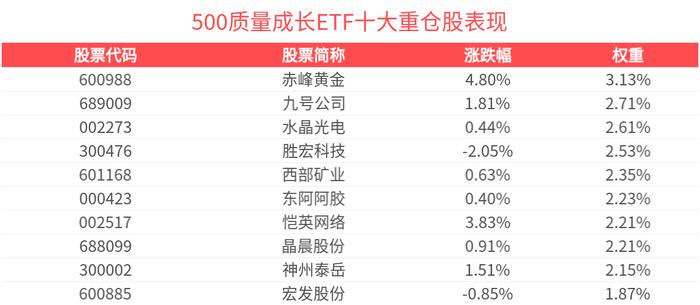
Core Viewpoint - The recovery of A-share earnings growth in Q1 2025 alleviates previous investor concerns about a prolonged decline in the earnings cycle, suggesting a potential rebound in the earnings cycle driven by stabilizing high-dimensional variables such as capacity and real estate cycles [1] Group 1: Index Performance - As of June 3, 2025, the CSI 500 Quality Growth Index (930939) increased by 0.55%, with notable gains from constituent stocks such as Debang Co., Ltd. (603056) up 10.00%, Huahai Pharmaceutical (600521) up 6.94%, and BeiDa Pharmaceutical (300558) up 6.76% [1] - The CSI 500 Quality Growth ETF (560500) rose by 0.32%, with the latest price at 0.94 yuan [1] Group 2: Top Holdings - As of May 30, 2025, the top ten weighted stocks in the CSI 500 Quality Growth Index accounted for 23.79% of the index, including Chifeng Gold (600988) and Ninebot Company (689009) [2] - The top ten stocks by weight include Chifeng Gold (3.13%), Ninebot Company (2.71%), and Shenghong Technology (2.53%) among others [3]

Banco Macro S.A.(BMA) - 2025 Q1 - Earnings Call Transcript
2025-05-29 16:00
Financial Data and Key Metrics Changes - In Q1 2025, Banco Macro's net income totaled ARS 45.7 billion, a decrease of 59% or ARS 65.3 billion compared to Q4 2024 [4] - The annualized return on average equity was 3.81% and the return on average assets was 1.2% [5] - Net operating income before general and administrative expenses was ARS 801 billion, down 9% or ARS 82.6 billion from Q4 2024 [5] - Provision for loan losses increased by 60% or ARS 25.3 billion compared to Q4 2024, totaling ARS 66 billion [6] - Net interest income was ARS 579.2 billion, ARS 1 billion higher than Q4 2024, and up 122% or ARS 318 billion year-on-year [6][10] Business Line Data and Key Metrics Changes - Interest income totaled ARS 866.7 billion, down 3% or ARS 22.6 billion from Q4 2024 [7] - Income from interest on loans increased by 9% or ARS 49.6 billion compared to the previous quarter, but decreased by 18% or ARS 132.2 billion year-on-year [7][8] - Fee income was ARS 169.8 billion, a decrease of 1% or ARS 943 million from Q4 2024, but increased by 29% year-on-year [11] - Net income from financial assets and liabilities at fair value through profit or loss was ARS 66.4 billion, down 55% from Q4 2024 [12] Market Data and Key Metrics Changes - Banco Macro's market share over private sector loans reached 9.5% as of March 2025 [16] - Total deposits increased by 5% or ARS 485.4 billion quarter-on-quarter, totaling ARS 9.6 trillion, and increased by 23% year-on-year [16] - Nonperforming loans ratio was 1.44%, with a coverage ratio of 163.34% [17] Company Strategy and Development Direction - The bank aims to utilize its excess capital of ARS 3.2 trillion, with a capital adequacy ratio of 34.3% and a Tier one ratio of 33.6% [18] - The focus is on organic growth, with potential for future M&A opportunities as the number of banks in Argentina may shrink [26][27] Management's Comments on Operating Environment and Future Outlook - Management expects real loan growth of 60% for 2025 and deposits to grow at 45% [24] - Inflation is forecasted at around 30% for 2025, with a declining trend in domestic interest rates anticipated [35] - Operating expenses are expected to grow close to inflation, around 30% [36] Other Important Information - The effective income tax rate was 43% higher than in Q4 2024 [14] - The bank's liquidity remains strong, with a liquid assets to deposits ratio of 68% [18] Q&A Session Summary Question: Update on guidance for loan growth, deposits, and ROE - Management maintains a 60% loan growth forecast for 2025, with deposits expected to grow at 45% and ROE revised to 8% to 10% [24][25] Question: Expectations on macroeconomic factors - GDP growth is forecasted at 5% for 2025, with inflation at 30% and a declining trend in interest rates [35] Question: Loan to deposit ratio and capital ratio - The loan to deposit ratio is expected to increase, with loans representing 48% of total assets in Q1 2025 [37] Question: Bond portfolio positioning - The bank prefers high exposure to inflation-linked securities to hedge equity, aiming to maintain a stable level of available-for-sale bonds [46][48]

光大期货金融期货日报(2025 年 05 月 27 日)-20250527
Guang Da Qi Huo· 2025-05-27 09:34
1. Report Industry Investment Rating - No investment rating information is provided in the report. 2. Core Viewpoints - For stock indices, the revenue growth rate of A-shares excluding finance in Q1 2025 was -0.33% year-on-year, rising for two consecutive quarters, indicating that the asset-side earnings of listed companies are bottoming out. The central bank cut interest rates to narrow the negative carry of enterprises and bring the index back to a slow bull trend. The net profit growth rate was 3.4% year-on-year, showing a positive change from previous quarters. However, it remains to be seen whether enterprises can maintain this level under the background of the tariff war, and the accounts receivable ratio is still rising. The ROE is at the bottoming stage of the downward cycle since Q2 2021, significantly affected by the low PPI. The net profit margin and gross profit margin have slightly increased, while the asset turnover has declined, and the equity multiplier has remained basically flat. Overall, the Q1 earnings data of the A-share market are mixed, indicating that the profitability of listed companies is still bottoming out but showing signs of recovery. The valuation of A-shares is at a historical median, and future quasi-stabilization funds are expected to maintain the overall stability of A-share valuations. The growth indicators of small-cap indices have turned positive [1]. - For treasury bonds, the tariff negotiation's negative impact on the bond market has basically ended, and the dominant factors have returned to the capital and fundamental aspects. The economic and financial data in April show that the effect of the stable growth policy is continuously emerging, but the problem of weak real financing demand still exists. In the short term, the economic fundamentals will continue to recover moderately, and the capital side will lack the impetus for significant fluctuations after the double cuts. It is expected that the short-term bond market will continue to fluctuate within a range [2]. 3. Summary by Relevant Catalogs 3.1 Daily Price Changes - **Stock Index Futures**: On May 26, 2025, IH was at 2,684.4, down 8.6 or -0.32% from May 23; IF was at 3,831.2, down 15.0 or -0.39%; IC was at 5,594.6, up 32.8 or 0.59%; IM was at 5,925.0, up 53.0 or 0.90% [3]. - **Stock Indices**: The Shanghai Composite 50 was at 2,699.4, down 12.4 or -0.46% from May 23; the CSI 300 was at 3,860.1, down 22.2 or -0.57%; the CSI 500 was at 5,669.5, up 16.4 or 0.29%; the CSI 1000 was at 6,028.8, up 39.1 or 0.65% [3]. - **Treasury Bond Futures**: On May 26, 2025, TS was at 102.43, up 0.022 or 0.02% from May 23; TF was at 106.06, up 0.01 or 0.01%; T was at 108.86, up 0.005 or 0.00%; TL was at 119.76, up 0.16 or 0.13% [3]. 3.2 Market News - The People's Bank of China conducted 382 billion yuan of 7-day reverse repurchase operations today, with the operating rate remaining flat at 1.40%. There were 135 billion yuan of reverse repurchases maturing today, resulting in a net investment of 247 billion yuan [4]. 3.3 Chart Analysis - **Stock Index Futures**: The report provides charts of the trends and basis of IH, IF, IC, and IM main contracts, as well as the trends of the Shanghai Composite 50, CSI 300, CSI 500, and CSI 1000 stock indices [6][7][10]. - **Treasury Bond Futures**: The report includes charts of the trends of treasury bond futures main contracts, treasury bond spot yields, basis, inter - period spreads, cross - variety spreads, and capital interest rates [13][16][18]. - **Exchange Rates**: The report presents charts of the central parity rates of the US dollar, euro, and other currencies against the RMB, as well as forward exchange rates and currency indices [21][22][25].