
内需主导

Search documents
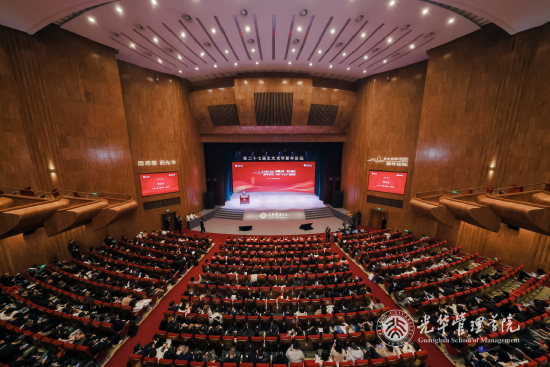
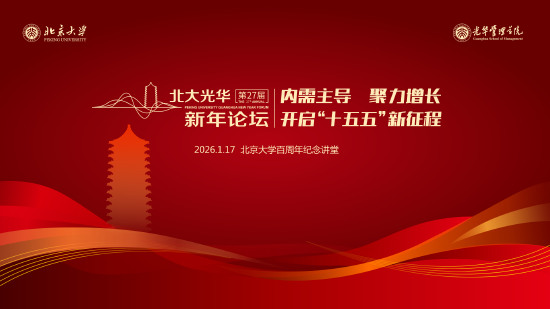
内需主导,聚力增长丨第二十七届北大光华新年论坛圆满举行
Xin Lang Cai Jing· 2026-01-17 13:45
Core Viewpoint - The 27th Peking University Guanghua New Year Forum focuses on "domestic demand-led growth" as a key theme, aligning with the central economic work conference's emphasis on strengthening the domestic market for the new phase of the 14th Five-Year Plan [1][19]. Group 1: Forum Overview - The forum was held on January 17, 2026, at Peking University, featuring prominent speakers including university officials and industry representatives [3][21]. - The event aims to contribute to the theoretical framework for the 14th Five-Year Plan and stimulate discussions on building a robust domestic market [1][19]. Group 2: Keynote Speeches - Liu Shijun discussed the shift from supply constraints to demand constraints in China's economic growth, emphasizing the need for a focus on consumption and human capital investment [7][24]. - Gao Peiyong highlighted the importance of stimulating residents' consumption as a key driver of economic growth, addressing challenges such as weak consumer confidence and the need for systemic reforms [10][26]. - Liu Qiao analyzed the paradox of low consumer spending in relation to high per capita consumption, suggesting policy reforms to enhance disposable income and consumer rates [12][29]. Group 3: Roundtable Discussion - The roundtable featured discussions on how new supply can create new demand, with industry leaders addressing the structural mismatches in consumer markets [14][32]. - Ma Tiemin pointed out the need for agricultural product market reforms to address supply-demand mismatches, advocating for digital tools and innovative production methods [15][33]. - Other participants emphasized the importance of understanding consumer behavior shifts and the need for companies to adapt their strategies to meet evolving market demands [16][34][35]. Group 4: Future Directions - Zhang Zheng summarized that creating new demand through new supply is a comprehensive process involving value creation, technological empowerment, and supply chain upgrades [18][36]. - The forum underscored the necessity for collaborative efforts among policymakers, capital providers, and entrepreneurs to foster a sustainable environment for innovation and growth [18][36].

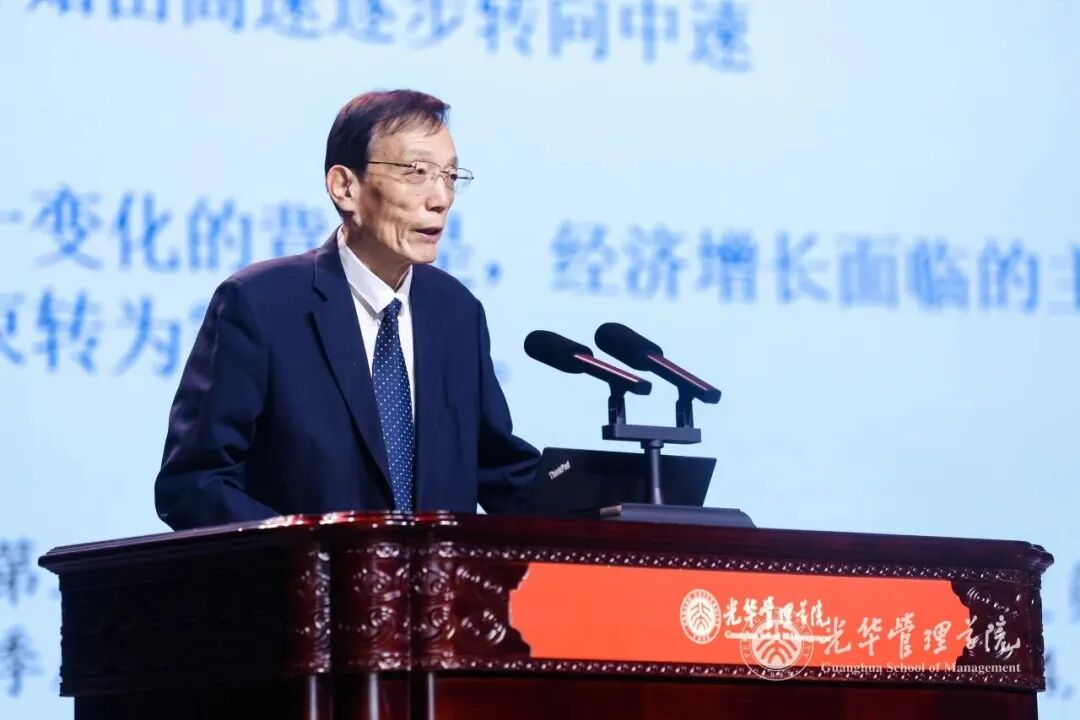
刘世锦:从旧框架转向新框架
Xin Lang Cai Jing· 2026-01-17 13:36
Core Viewpoint - China's economic growth is shifting from investment and export-driven to innovation and consumption-driven, emphasizing the importance of terminal demand in the economic structure [1][3]. Group 1: Economic Transition - The focus should shift from supply-side investment in material capital to demand-side investment in consumption and human capital [1]. - Terminal demand, primarily driven by consumer spending and non-productive investments, is crucial for economic stability and growth [1][2]. - Recent statistics indicate a 2.6% year-on-year decline in fixed asset investment from January to November 2025, with private investment down by 5.3% [1]. Group 2: Human Capital Investment - Emphasis on developing new types of consumption, particularly in services such as education, healthcare, and social security, which are seen as investments in human capital [2][6]. - Enhancing human capital through education and healthcare is essential for sustaining innovation and economic growth [2][6]. Group 3: Innovation and Demand - Economic growth can be understood through two dimensions: height (productivity improvements) and width (demand matching supply) [3]. - Innovation alone cannot replace the need for expanding demand; a stable and growing terminal demand is necessary for translating innovation into economic growth and employment [3]. Group 4: Consumption and Currency Strategy - A new strategy for achieving a balance in imports and exports is recommended, focusing on increasing imports settled in RMB while maintaining export competitiveness [4][8]. - Accelerating the internationalization of the RMB is crucial, with a goal to enhance the currency's global standing and facilitate consumer access to better imported goods [4][9]. - The construction of a strong consumer economy is essential for achieving growth targets and enhancing the quality of life for residents [4][5].
理响中国·聚焦2026中国经济|吃、穿、用、行……开局之年,绿色消费增长点如何培育?
Yang Guang Wang· 2026-01-15 14:06
Core Viewpoint - The Central Economic Work Conference emphasizes the importance of domestic demand, the construction of a strong domestic market, the implementation of special actions to boost consumption, and the leadership of "dual carbon" initiatives to promote comprehensive green transformation [1] Group 1: Domestic Demand and Market Construction - The conference highlights the need to prioritize domestic demand as a driving force for economic growth [1] - There is a focus on building a robust domestic market to support sustainable economic development [1] Group 2: Consumption Boosting Actions - The implementation of special actions aimed at stimulating consumption is a key agenda item [1] - These actions are expected to enhance consumer confidence and spending [1] Group 3: Green Transformation - The conference underscores the commitment to "dual carbon" goals, which will guide the transition towards a greener economy [1] - There is an emphasis on expanding the green consumption market during the "14th Five-Year Plan" period [1]
第二十六届北大光华新年论坛将于2026年1月17日举行
Xin Lang Cai Jing· 2026-01-14 09:54
Group 1 - The 27th Peking University Guanghua New Year Forum will be held on January 17, 2026, with the theme "Demand-led Growth: Starting a New Journey for the 14th Five-Year Plan" [1][3] - The global economic landscape is evolving rapidly, and domestic development is entering a new phase, with the central economic work conference prioritizing "demand-led growth and building a strong domestic market" as the main task for 2026 [1][3] - The forum will focus on national strategic deployment, discussing new logic, new dynamics, new paths, and new ecosystems for building a strong domestic market, aiming to empower a steady start for the 14th Five-Year Plan through enhanced domestic demand [1][3]
理响中国·聚焦2026中国经济丨实现“十五五”良好开局 如何抓好八项“重点任务”
Yang Guang Wang· 2026-01-12 07:13
Group 1 - The Central Economic Work Conference held in Beijing at the end of 2025 summarized the economic work of 2025 and deployed tasks for 2026, focusing on ensuring a good start for the "14th Five-Year Plan" [1] - The total retail sales of social consumer goods reached 45.6 trillion yuan in 2025, with a growth of 4.0% from January to November [4] - A total of 5 billion yuan is allocated, with 3 billion yuan for supporting the replacement of consumer goods, an increase of 1.5 billion yuan from the previous year [6] Group 2 - The cumulative production and sales of automobiles reached 31.23 million and 31.12 million units, respectively, with year-on-year growth of 11.9% and 11.4% [7] - The express delivery business volume reached 199 billion pieces in 2025, showing a year-on-year growth of 13.7% [8] - The total import and export value of goods reached 4.12076 trillion yuan from January to November 2025, with a year-on-year growth of 3.6% [18] Group 3 - The economic output of China's top 100 counties and cities reached 13.7 trillion yuan, contributing over 10% of the national GDP with less than 2% of the country's land area [21] - The grain planting area reached 1.791 billion mu, an increase of 1.348 million mu from the previous year, maintaining growth for six consecutive years [22] - The grain output reached 1.42975 trillion jin, an increase of 16.75 billion jin from the previous year [23] Group 4 - The national recycling of renewable resources reached approximately 380 million tons in 2025, with a series of measures introduced to promote green consumption [28] - The comprehensive meteorological observation system has been established, improving the monitoring rate of hazardous weather to 83% [28] - The focus on "dual carbon" initiatives is seen as a strategic choice to foster new productive forces and shape new international competitive advantages [29] Group 5 - Policies aimed at improving people's livelihoods include measures to stabilize employment, promote consumption, and enhance social welfare [33] - By mid-September 2025, over 90% of hospital discharges were under a disease-based payment system, with 114 new drugs added to the list, totaling 3,253 [34] - The central government allocated 500 billion yuan from local government debt limits to support investment and debt reduction efforts [39]

迟福林:促进供给和需求良性互动的实践逻辑与实现路径
Bei Jing Ri Bao Ke Hu Duan· 2026-01-11 23:41
Core Viewpoint - The article emphasizes the importance of building a strong domestic market in China, focusing on "demand-led, consumption-driven, and endogenous growth" as a strategic choice to adapt to economic changes and enhance resilience against international challenges [1]. Group 1: Domestic Market Development - Building a strong domestic market is crucial for achieving high-quality development and requires addressing structural contradictions between consumption and investment [1][3]. - The current economic situation shows a significant imbalance characterized by strong supply and weak demand, particularly in consumer spending [3]. - The transformation of "Chinese manufacturing" and "Chinese consumption" is essential for unlocking the potential of the vast domestic market, with manufacturing accounting for nearly 30% of global output by 2024 [2]. Group 2: Consumption Trends - China's retail sales are projected to reach 48.3 trillion yuan in 2024, which is 2.4 times that of 2012, indicating rapid growth in consumer spending [2]. - The contribution of final consumption to economic growth is expected to be 44.5% in 2024, showing a decline compared to 2023, highlighting the need to boost consumer spending [3]. - The service consumption sector is becoming a key driver of economic growth, with its share of total consumption rising from 39.7% in 2013 to 46.1% in 2024 [5]. Group 3: Service Consumption Potential - Enhancing service consumption is vital for achieving a dynamic balance between supply and demand, with a potential increase in consumer spending of approximately 800 billion yuan for every 1% rise in the consumption rate [4]. - By 2030, service consumption is expected to exceed 50% of total consumption, contributing an additional 40 trillion yuan to consumer demand [6]. - The shift towards comprehensive, international, and intelligent service consumption is anticipated to drive innovation and transformation in various industries, including healthcare and tourism [6][7]. Group 4: Structural Reforms - Structural reforms are necessary to resolve the contradictions between investment and consumption, with a focus on "investing in people" to stimulate demand [9]. - Urbanization and equalization of basic public services are critical to addressing the lag in urbanization compared to industrialization, which could significantly boost consumer spending [10]. - The government plays a crucial role in facilitating economic transformation by optimizing the relationship between effective markets and proactive government policies [11].
为新就业形态劳动者撑起保障伞
Xin Lang Cai Jing· 2026-01-09 19:44
Core Viewpoint - The Central Economic Work Conference emphasizes the importance of people's livelihoods and encourages flexible employment workers to participate in social insurance, signaling a focus on the rights of new employment forms and addressing the challenges in the labor market [1][2]. Group 1: Economic Development and Domestic Demand - The eight key tasks for economic work in 2026 include prioritizing domestic demand and building a strong domestic market, which is crucial for addressing the current issues of overcapacity and insufficient domestic demand [1]. - The relationship between domestic demand and livelihood security is highlighted, indicating that stable income and a sense of security are essential for consumer confidence [1]. Group 2: New Employment Forms and Labor Market - The rise of the gig economy has led to a significant increase in new employment form workers, such as delivery riders and couriers, who now constitute about 50% of urban employment in China [2]. - New employment form workers often lack formal labor relationships, making it difficult for them to access labor laws and social security benefits like the "five insurances and one fund" [2][3]. Group 3: Social Insurance Participation - Younger gig workers, such as delivery riders averaging 35 years old and manufacturing gig workers averaging 25 years old, show a low willingness to participate in social insurance [3]. - Some platform companies are exploring subsidies for social insurance for gig workers, but increasing participation rates remains challenging [3]. Group 4: Policy Implications and Future Directions - The focus on social security for new employment form workers has both substantive and symbolic significance, indicating a potential shift towards more formal employment identities and rights protections [3]. - Recommendations include encouraging platforms to enhance awareness of policy benefits among gig workers to build confidence in the social security system [4]. Group 5: Economic Stability and Innovation - The conference's policy direction emphasizes stability and quality improvement, with a focus on maintaining economic stability while fostering new growth points through technological innovation and industrial upgrades [5]. - The deployment of the eight tasks reflects a combination of stability and progress, with a particular emphasis on livelihood security and innovation-driven growth [5].
坚持内需主导,如何充分发挥铁路优势?
Zhong Guo Jing Ji Wang· 2026-01-08 03:48
Group 1 - The central economic work conference emphasizes the importance of domestic demand and aims to build a strong domestic market, with the national railway group setting a target of 4.402 billion passengers and 4.13 billion tons of cargo by 2026, reflecting a year-on-year growth of 3.5% and 1.5% respectively [1] - The national railway's total revenue has historically surpassed 1 trillion yuan, reaching 1.0204 trillion yuan, with record highs in passenger and cargo volumes, as well as railway investments, highlighting the strong role of infrastructure investment in stimulating domestic demand [1] - The railway department focuses on enhancing connectivity and strengthening supply chains through the "eight vertical and eight horizontal" high-speed rail network, which will support regional coordinated development and industrial upgrades [1] Group 2 - The railway sector aims to optimize supply-side capabilities by implementing reforms such as the "single order" and "single container" multi-modal transport systems, enhancing the role of leading railway enterprises in the supply chain [2] - Safety remains a fundamental priority for the railway sector, especially with the upcoming 2026 Spring Festival travel season, where effective risk management and quality service will be critical for ensuring passenger safety and satisfaction [2] - The modernization of the railway system is closely linked to high-quality economic development, with improvements in railway operations contributing to job stability and enhanced living standards, thereby injecting vitality into the domestic market [3]
天天学习丨中南海月刊(2025.12)
Yang Shi Wang· 2026-01-07 12:30
Group 1 - The year 2025 is highlighted as significant for China's modernization journey, with a focus on commemorating historical events and expanding high-level openness to the world [3][8] - The Central Economic Work Conference set a growth target of approximately 5% for 2025, with the total economic output expected to reach around 140 trillion yuan [10][12] - The conference emphasized a policy shift towards "quality improvement and efficiency enhancement," marking a transition from scale expansion to industrial upgrading [10][13] Group 2 - Eight key tasks for economic work in 2026 were outlined, including a focus on domestic demand, innovation-driven growth, and high-quality development [13][15] - Central enterprises are recognized as crucial to national economic development, with significant investments in strategic emerging industries and substantial contributions to tax revenue [13][14] - The establishment of the Hainan Free Trade Port is seen as a major strategic initiative to enhance China's openness and attract foreign investment, with actual foreign capital utilization reaching 102.5 billion yuan [21][24] Group 3 - The emphasis on innovation and technology is underscored by the expansion of international innovation centers in Beijing and Shanghai, aimed at fostering original innovation [27][28] - The focus on rural revitalization and agricultural modernization is highlighted, with specific measures to improve farmers' livelihoods and promote sustainable rural development [14][16] - The commitment to maintaining a strong anti-corruption stance and improving party conduct is reiterated as essential for economic and social development [16][17]
科学把握消费与投资的关系
Sou Hu Cai Jing· 2026-01-07 02:27
Core Viewpoint - The article emphasizes the importance of promoting a positive interaction between consumption and investment as essential for enhancing domestic economic circulation and achieving high-quality economic development [1][4]. Group 1: Relationship Between Investment and Consumption - Traditional economic theories often view consumption and investment as opposing forces, but modern economic growth theories suggest they are complementary and mutually reinforcing [2][3]. - Investment serves as the foundation for consumption by increasing capital formation and production capacity, which in turn raises household income and stimulates demand [2][3]. - Stable consumer demand provides clear direction and return expectations for investment, encouraging businesses to expand capacity and innovate [3][4]. Group 2: Economic Growth and Stability - The synergy between investment and consumption enhances the stability and sustainability of economic growth, transitioning the economy from being externally driven to being led by domestic demand [4][5]. - In the context of global economic uncertainty, leveraging the dual engines of investment and consumption is crucial for stabilizing total demand and expanding domestic consumption [4][5]. Group 3: Structural Optimization - Promoting the coordinated development of investment and consumption is vital for dynamically matching supply and demand structures [5][6]. - The shift towards high-quality development necessitates a focus on optimizing investment structures to better align with diverse consumer needs, while evolving consumer demands shape new market opportunities [5][6]. Group 4: Enhancing Quality and Adaptability - Improving supply quality and enhancing the adaptability of supply to meet consumer needs are key to fostering a positive cycle between investment and consumption [7][8]. - The expansion of consumption scenarios and new business models is essential for unlocking the potential of diverse consumer demands, integrating various elements such as culture and tourism [8][9]. Group 5: Investment in Human Capital - Focusing on human investment is crucial for aligning supply structures with the diverse needs of residents, thereby enhancing the sustainability of consumption capacity [9][10]. - Increased investment in education, healthcare, and social services can improve living conditions and boost consumer confidence, leading to a more robust consumption environment [9][10].