
消费市场

Search documents
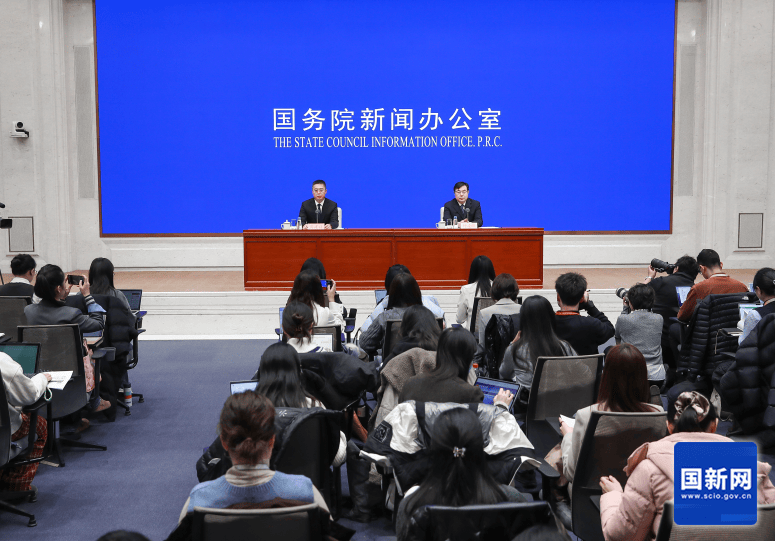
国家统计局:居民消费能力和信心有待进一步提升
Sou Hu Cai Jing· 2025-12-15 04:38
Core Viewpoint - The overall consumer market in November remains stable, with continued expansion in consumption scale and rapid growth in service consumption, indicating a trend of consumption quality improvement and upgrade [1][5]. Group 1: Consumer Market Overview - In the first eleven months, the total retail sales of consumer goods increased by 4% year-on-year, surpassing both the growth rate of the same period last year and the overall growth rate for the entire previous year [3]. - The recent slowdown in the growth rate of retail sales is attributed to a high base from the previous year [3]. - Service consumption has shown rapid growth, with service retail sales increasing by 5.4% year-on-year, outpacing the growth of goods retail sales [3][5]. Group 2: Service Consumption - The growth in service consumption is reflected in the development of cultural and sports consumption, with retail sales in this category maintaining double-digit growth [4]. - The retail sales of communication and information services increased by over 10% year-on-year [4]. - New consumption scenarios and supply in cultural and sports activities, such as ice and snow sports, have contributed to the rapid growth of related service retail [3][4]. Group 3: Goods Consumption - The consumption of goods continues to expand, with significant growth in quality consumption driven by promotional policies [4]. - In November, retail sales of cultural and office supplies and communication equipment increased by 11.7% and 20.6% year-on-year, respectively [4]. - Retail sales of food and basic living necessities also saw a notable increase, with grain and oil food retail sales growing by 6.1% [4]. Group 4: New Consumption Trends - New consumption models such as instant retail and live e-commerce are rapidly growing, with online retail sales of physical goods increasing by 5.7% year-on-year, outpacing the overall retail sales growth by 1.7 percentage points [5]. - The share of online retail in total retail sales reached 25.9% [5]. - Emerging trends in digital, green, and health consumption are becoming new hotspots, indicating a shift in consumer preferences [5].

首次突破1800亿件!我国快递年业务量再创新高
Xin Hua She· 2025-12-02 13:50
前10个月,我国中部、西部地区快递业务收入占全国比重同比分别上升0.6个和0.3个百分点;快递业务 量占全国比重分别上升1.1个和0.6个百分点。 0:00 国家邮政局监测数据显示,截至今年11月30日,我国快递年业务量首次突破1800亿件。来自广东深圳市 的一名市民网购的智能学习机,成为今年我国第1800亿件快递。 月均超160亿件,单日最高7.77亿件,每秒超6200件……1800亿件"小包裹"量质齐升,为消费市场注入 强劲发展动能,折射出中国经济蓬勃活力。 透过快递这扇窗口,可以看见一个从"大市场"向"强市场"稳步转变的中国——1天之内,有超过1万列铁 路旅客列车在神州大地上穿梭开行,近340亿元实物商品在网上交易买卖;过去4年,最终消费对经济增 长的平均贡献率达到56.2%,比"十三五"期间提高8.6个百分点;稳居全球第二大消费市场、第一大网络 零售市场、第二大进口市场…… 新华社音视频部制作 ...
今年1-10月,东莞外贸进出口总额同比增长14.7%
Nan Fang Du Shi Bao· 2025-11-26 12:59
Economic Overview - Dongguan's economy showed overall stability in the first ten months of 2025, with a focus on high-quality development and the implementation of various policy measures [2] Industrial Production - The industrial added value of enterprises above designated size increased by 4.2% year-on-year. Key industries such as electronic information manufacturing, electrical machinery and equipment manufacturing, and chemical manufacturing saw increases of 7.5%, 8.5%, and 10.8% respectively [3] - New momentum industries performed well, with advanced manufacturing and high-tech manufacturing added value growing by 6.4% and 7.9% respectively. High-tech product output also saw significant growth, with integrated circuits, smartwatches, servers, and sensors increasing by 78.4%, 34.2%, 28.8%, and 24.6% respectively [3] Foreign Trade - The total foreign trade import and export volume reached 12,982.4 billion yuan, a year-on-year increase of 14.7%, with imports at 5,056.2 billion yuan (up 25.4%) and exports at 7,926.2 billion yuan (up 8.7%). In October, the total foreign trade volume grew by 17.3% year-on-year [4] Consumer Market - The total retail sales of social consumer goods amounted to 3,597.63 billion yuan, reflecting a year-on-year growth of 1.6%. Notable growth was seen in dining revenue (up 2.4%) and retail of goods (up 1.4%). Certain essential and upgraded goods experienced strong sales, with retail sales of staple food, hardware, and sports entertainment goods increasing by 50.0%, 26.6%, and 26.1% respectively [5] - Online consumption also surged, with retail sales through public networks increasing by 19.6% year-on-year [5] Fixed Asset Investment - Total fixed asset investment decreased by 3.2% year-on-year, but the decline narrowed by 1.9 percentage points compared to the previous nine months. Excluding real estate development investment, fixed asset investment grew by 16.9% [6][7] - Investment in advanced manufacturing and high-tech manufacturing saw significant increases of 51.2% and 66.0% respectively, while real estate development investment fell by 49.2% [7] Financial Market - By the end of October, the balance of deposits in financial institutions reached 28,929.77 billion yuan, a year-on-year increase of 2.1%, while the balance of loans was 19,917.25 billion yuan, up 3.4% [8] Consumer Price Index - The Consumer Price Index (CPI) decreased by 1.0% year-on-year, with six categories of goods and services experiencing price declines. Notably, transportation and communication prices fell by 3.1%, while medical care prices rose by 1.5% [9]

罗志恒:“供给配不配、时间够不够”,把居民消费率从40%推向更高水平
Di Yi Cai Jing Zi Xun· 2025-11-25 11:08
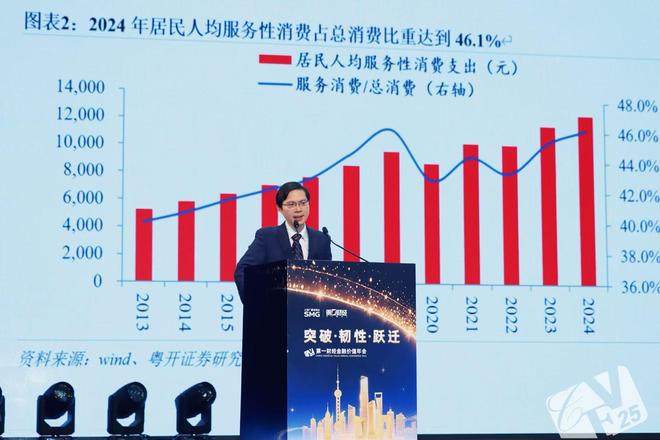
Core Viewpoint - The increase of the resident consumption rate is a key goal in China's economic and social development, aiming to elevate it from the current 40% to a higher level, which is crucial for domestic circulation and transforming China from a "world factory" to a "world market" [1] Group 1: Current Consumption Rate Analysis - China's current resident consumption rate is relatively low, at 39.6% in 2024, which is 28 percentage points lower than the United States, and 30 percentage points lower than its peak in the 1970s [3] - The service consumption ratio in China is significantly lower than that of the United States, with only 46% of resident consumption being service-related, compared to higher averages in similarly developed countries [3][4] Group 2: Factors Limiting Consumption Rate Improvement - The limited consumption capacity of residents is a major constraint, with only 60% of national income distribution going to residents, compared to 75%-80% in developed countries [5] - The disparity in social security systems, particularly in pension coverage between urban and rural residents, leads to cautious consumer behavior among lower-income groups [5] - The slow urbanization process restricts household consumption potential, as many migrant workers are unable to relocate their families, limiting demand for services and large consumer goods [6] Group 3: Policy Recommendations for Enhancing Consumption - Reforming the fiscal and tax system is essential, shifting from production-based to consumption-based tax sharing to encourage local governments to promote consumption [7] - Increasing residents' financial income through stabilizing the real estate and capital markets, and improving pension benefits for urban and rural residents is necessary to enhance consumption capacity [7] - Accelerating the urbanization of migrant workers and addressing welfare provision based on the household registration system is crucial for boosting consumption [7] - Optimizing time allocation by increasing public holidays and improving the holiday adjustment system can also enhance consumer spending [8]
前10月陕西经济运行平稳向好
Shan Xi Ri Bao· 2025-11-19 00:16
Economic Overview - The economic operation of Shaanxi province remains generally stable and shows a positive development trend, with production supply overall stable and domestic demand potential continuously released [1] Industrial Production - The industrial added value of enterprises above designated size increased by 8.1% year-on-year. The mining industry saw a growth of 9.9%, manufacturing increased by 6.4%, and the production and supply of electricity, heat, gas, and water rose by 4.2% [1] - Key sectors such as coal mining and washing increased by 11.4%, while oil and gas extraction grew by 4%. Equipment manufacturing saw a significant increase of 9.9%, with electrical machinery and equipment manufacturing up by 34.1% and automobile manufacturing up by 23.8% [1] - Production volumes for automobiles increased by 5.9%, solar cell production rose by 9.4%, and engine production surged by 49.3% [1] Fixed Asset Investment - Fixed asset investment grew by 0.6% year-on-year, with industrial investment showing significant growth of 15.5%, surpassing the overall investment growth rate by 14.9 percentage points [2] - Manufacturing investment increased by 16.6%, and industrial technological transformation investment rose by 28.5%. Private investment also showed vitality, growing by 7.4%, with manufacturing private investment up by 14.3% [2] - Notable growth in private investment was observed in information transmission, software, and IT services at 30.4%, and in transportation, warehousing, and postal services at 40% [2] Consumer Market - Retail sales of consumer goods in enterprises above designated size increased by 8.2% year-on-year, with commodity retail sales up by 8.8% and catering revenue increasing by 1.6% [2] - The "old-for-new" effect in consumer goods was significant, with sales of household appliances and audio-visual equipment rising by 42.2%, and sales of energy-efficient products (grades 1 and 2) increasing by 73.2% [2] - Online retail saw rapid growth, with retail sales through public networks increasing by 25.3%, accounting for 23% of total retail sales in enterprises above designated size [2] Trade Performance - The total value of goods import and export reached 420.95 billion yuan, a year-on-year increase of 12.2%. Exports amounted to 291.621 billion yuan, growing by 15.3%, while imports were 129.329 billion yuan, up by 5.7% [3] - The export structure continued to optimize, with high-tech product exports increasing by 15.4%, and computer and communication technology exports rising by 24.7% [3] - The "new three samples" products saw a 26.8% increase in exports, with lithium-ion batteries growing by 120% and electric vehicles increasing by 67.7% [3]
11月18日投资避雷针:平潭发展、海峡创新今起停牌核查
Xin Lang Cai Jing· 2025-11-18 00:13
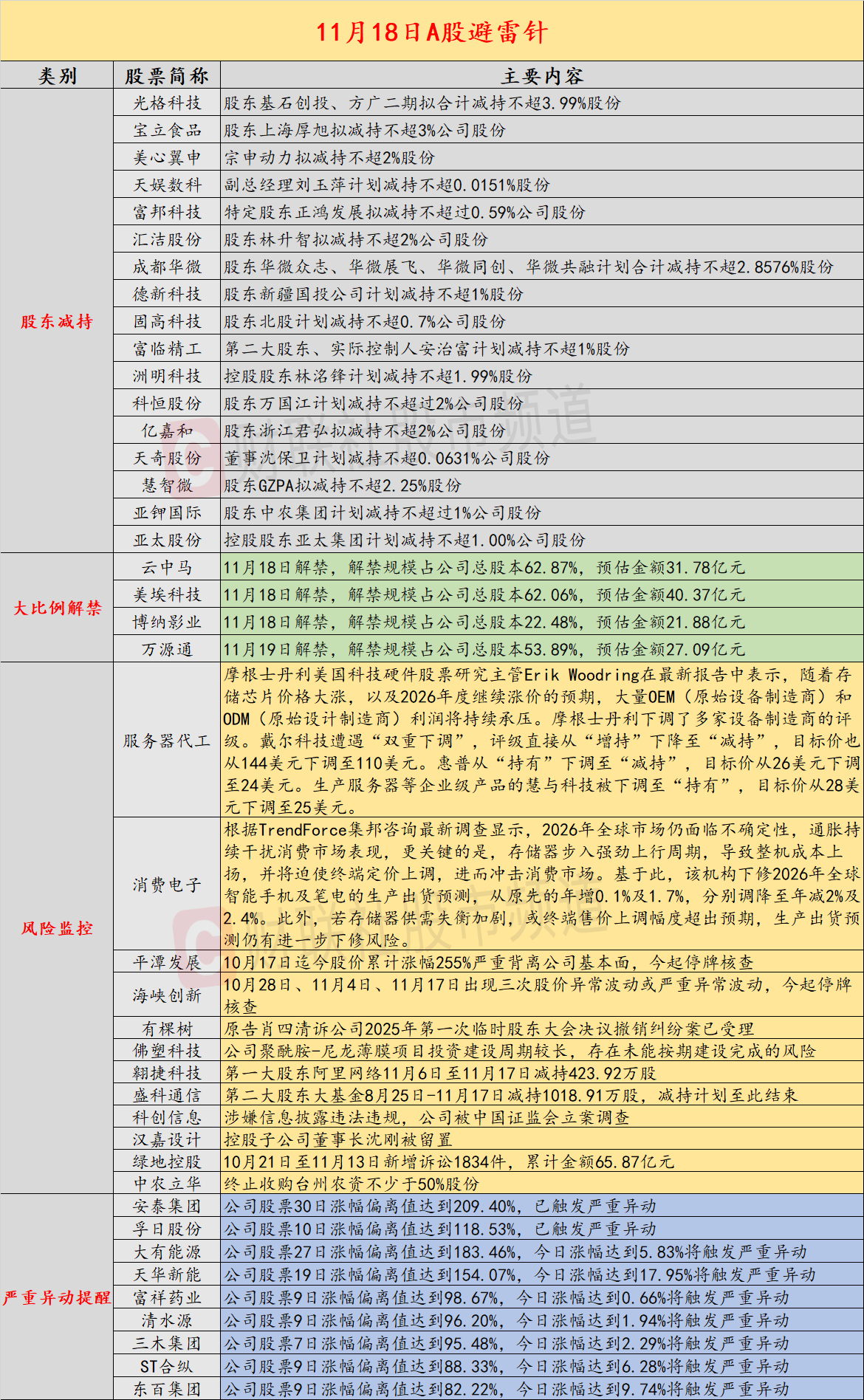
Economic Information - Domestic commodity futures showed mixed results, with iron ore up 0.32%, coking coal down 3.19%, and coke down 2.39% [2] - In October, the total retail sales of consumer goods reached 46,291 billion yuan, a year-on-year increase of 2.9%. Automotive consumption was 4,255 billion yuan, down 7% year-on-year [2] Company Alerts - Pingtan Development's stock price increased by 255% since October 17, significantly diverging from its fundamentals, leading to a suspension for investigation [5] - Haixia Innovation experienced three instances of abnormal stock price fluctuations on October 28, November 4, and November 17, resulting in a suspension for investigation [5] Overseas Alerts - The three major U.S. stock indices collectively fell, with the Dow Jones down 1.18%, S&P 500 down 0.92%, and Nasdaq down 0.84%. The S&P 500 index fell below 6,700 points, ending a ten-week upward trend [4] - Major technology stocks mostly declined, with AMD and Intel down over 2%, while Google saw a rise of over 3% [4] Stockholder Reduction Plans - Multiple companies announced stockholder reduction plans, including Guangge Technology, Baoli Food, and Meixin Yishen, with reductions ranging from 0.0151% to 3.99% of shares [7][8] - Significant stock unlocks are scheduled for November 18, including Yunzhongma and Meai Technology, with estimated amounts of 3.178 billion yuan and 4.037 billion yuan respectively [7] Market Predictions - Morgan Stanley reported that rising storage chip prices are expected to pressure OEM and ODM profits, leading to downgrades for several manufacturers, including Dell and HP [6] - TrendForce revised down its 2026 global smartphone and laptop production forecasts, predicting declines of 2% and 2.4% respectively due to inflation and rising component costs [6]


多项数据全球第一!数说我国消费大市场的“世界之最”
Sou Hu Cai Jing· 2025-11-17 14:35
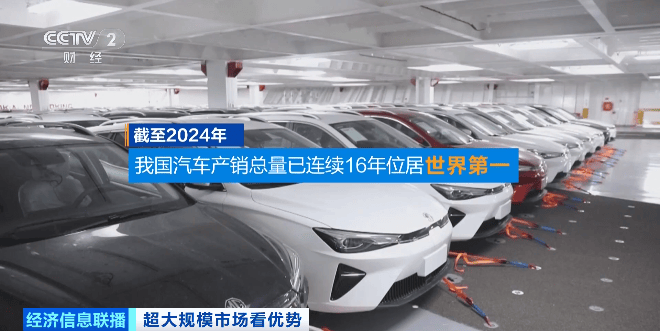
Group 1 - The core viewpoint emphasizes the importance of fully unleashing the market potential of a consumer powerhouse like China to drive high-quality economic development and enhance endogenous growth momentum [1] Group 2 - As of 2024, China's total automobile production and sales have ranked first in the world for 16 consecutive years, with home appliance sales such as air conditioners, washing machines, and refrigerators also leading globally [3] - China has the largest number of movie screens in the world, creating the largest film screening network globally, and is the largest single domestic tourism market, with domestic residents traveling 4.998 billion times in the first three quarters of this year, a year-on-year increase of 18% [5] Group 3 - In the digital consumption sector, China has the largest online retail market in the world, with online retail sales reaching 12.79 trillion yuan in the first ten months of this year, a year-on-year growth of 9.6% [7] - China leads globally in digital consumption and innovative payment methods, with mobile payment transaction volume expected to reach 563.7 trillion yuan in 2024 [9]
毕马威发布2025年四季度《中国经济观察》报告
Zheng Quan Ri Bao Wang· 2025-11-14 13:26
本报讯 (记者毛艺融)11月14日,毕马威发布2025年四季度《中国经济观察》报告(以下简称"报告")。报告指出,2025 年前三季度,中国经济实际GDP同比增长5.2%,高于去年同期0.4个百分点,完成全年5%左右增长目标的进度良好。 产出方面,报告提到,展望下一阶段,内需回升将带动生产修复。伴随政策性金融工具的投放与使用,制造业投资、基建 投资需求回升,相关投资所需设备器具、上游建材等产品有望迎来新一轮生产扩张。 (编辑 郭之宸) 消费方面,报告提到,前三季度服务消费表现维持较强韧性。此外,新型消费业态蓬勃发展,数字消费增长强劲。展望四 季度,在线上"双十一""双十二"等促销活动与线下中秋国庆等假期消费的共同提振下,消费市场仍有一定支撑。预计服务消费 仍是四季度消费增长的重要拉动力。 投资方面,报告提到,展望下一阶段,制造业投资表现有望在四季度迎来修复。在政策支持引导下,基建投资与房地产投 资也将逐步回升,步入新稳态。 ...
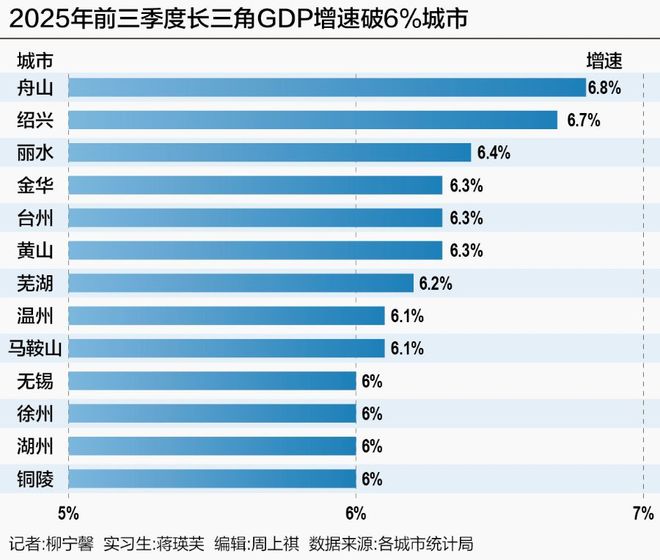
长三角三季报暗藏玄机:浙江5城“霸榜”增速榜,江苏为何失落?
2 1 Shi Ji Jing Ji Bao Dao· 2025-11-03 13:08
Economic Overview - The Yangtze River Delta (YRD) accounts for approximately 25% of China's GDP, with a total GDP of 251,797.17 billion yuan in the first three quarters of this year [1][5] - Among the 41 cities in the YRD, 28 cities outpaced the national average GDP growth rate of 5.2%, with 13 cities exceeding 6% [1][5] Economic Growth by Region - Zhejiang led the YRD with a GDP growth rate of 5.7%, followed by Shanghai, Jiangsu, and Anhui at 5.5%, 5.4%, and 5.4% respectively [5] - Jiangsu had the highest GDP total at 102,811 billion yuan, followed by Zhejiang at 68,495 billion yuan, Shanghai at 40,721.17 billion yuan, and Anhui at 39,770 billion yuan [6] Industrial Development - Advanced manufacturing is a key support for Jiangsu's economy, with significant contributions from high-tech manufacturing and digital core product manufacturing, both maintaining double-digit growth [4][12] - In Shanghai, the AI and integrated circuit sectors saw double-digit growth in output value, while Jiangsu's high-tech manufacturing increased by 27.8% [4][12] Consumption Trends - The consumption market in the YRD is steadily recovering, with policies like "old for new" driving sales in appliances, automobiles, and electronics [14] - Jiangsu's sports events, such as "Su Chao," have significantly boosted local consumption, with a 13% increase in sports service revenue [14][15] City-Specific Insights - Among the 13 cities with GDP growth exceeding 6%, all top five are from Zhejiang, indicating a strong manufacturing base and rapid advancement in traditional industries [6][7] - Shanghai's service sector, particularly information services, contributed significantly to its economic growth, with the tertiary industry accounting for 79.1% of its GDP [10][12] Future Directions - The YRD is focusing on enhancing traditional industries through digital transformation and innovation, with policies promoting smart factory development [8][12] - There is a strong emphasis on integrating consumption scenarios with digital economy advancements, particularly in Zhejiang, which is leveraging its e-commerce and digital payment systems [15][16]
武汉2025年前三季度GDP公布
Chang Jiang Ri Bao· 2025-10-29 12:36
Economic Overview - The GDP of Wuhan for the first three quarters reached 15,537.82 billion yuan, with a year-on-year growth of 5.6% [2] - The primary industry added value was 370.81 billion yuan, growing by 3.7%; the secondary industry added value was 5,068.39 billion yuan, growing by 4.8%; and the tertiary industry added value was 10,098.62 billion yuan, growing by 6.0% [2] Agricultural Sector - The total output value of agriculture, forestry, animal husbandry, and fishery was 608.38 billion yuan, with a year-on-year increase of 3.9% [3] - Major agricultural products showed growth, with summer grain and early rice production totaling 120,500 tons, an increase of 0.6% compared to last year [3] Industrial Sector - The industrial added value for large-scale enterprises grew by 5.4%, accelerating by 0.3 percentage points compared to the first half of the year [4] - High-tech manufacturing saw a significant increase of 16.3%, accounting for 25.2% of the industrial added value [4] Service Sector - The service sector's added value increased by 6.0%, with transportation, warehousing, and postal services growing by 10.8% [6] - The revenue of large-scale service enterprises rose by 11.6% from January to August [6] Investment Trends - Fixed asset investment grew by 2.0%, with industrial investment increasing by 12.0% [7] - High-tech industry investment rose by 2.9%, with high-tech service and manufacturing investments growing by 13.2% and 0.4%, respectively [7] Consumer Market - The total retail sales of consumer goods reached 6,299.74 billion yuan, with a year-on-year growth of 5.5% [8] - The "old-for-new" policy positively impacted retail sales, particularly in home appliances and building materials, which grew by 28.6% and 21.0%, respectively [8] Trade and Finance - The total import and export volume was 3,369.6 billion yuan, with exports growing by 18.1% [9] - By the end of September, the balance of deposits in financial institutions was 42,864.83 billion yuan, reflecting a year-on-year growth of 5.1% [9] Income and Prices - The per capita disposable income reached 46,107 yuan, with urban and rural incomes growing by 4.6% and 5.9%, respectively [11] - The consumer price index increased by 0.3% year-on-year, with food prices decreasing by 0.5% [11] Conclusion - Overall, Wuhan's economy showed stable growth in the first three quarters, with a focus on maintaining progress amid external uncertainties [12]