
美国经济数据

Search documents
机构:美元可能受到疲弱美国数据的影响
Sou Hu Cai Jing· 2025-12-23 13:17
XTB分析师Hani Abuagla在报告中称,如果美国第三季经济成长数据逊于预期,美元将非常脆弱。任何 经济降温的迹象都可能强化美联储明年进一步降息的预期,从而拉低收益率,进一步削弱美元。年末流 动性的减少以及近期全球货币政策的变化,可能会加剧这种敏感性。特别是日本央行最近的加息可能会 鼓励资本流入日元,如果美国经济数据令人失望,将进一步打压美元。 来源:滚动播报 ...
Dollar Falls Ahead of U.S. Data
Barrons· 2025-12-23 09:19
The dollar was hovering near a one-week low ahead of a slew of U.S. economic data in holiday-thinned trade.The delayed third-quarter U.S. economic growth report and durable goods orders for October will be released at 8:30 a.m. Eastern time. Industrial production data for November are due at 9:15 a.m. ET while the Richmond Fed's manufacturing survey for December and Conference Board's consumer confidence survey for December are at 10 a.m. ET.Any weakness in the data could add to U.S. rate-cut expectations, ...
除非农外,美国经济数据均弱于预期——海外周报第119期
一瑜中的· 2025-12-22 15:23
Core Viewpoint - The article discusses the recent economic data from the US, Eurozone, and Japan, highlighting that most data points are below expectations, indicating potential economic weakness and areas to monitor in the upcoming weeks [2][3][5]. Group 1: US Economic Data - November non-farm payrolls exceeded expectations, but other key economic indicators such as October retail sales, November CPI, and Michigan consumer confidence index fell short [2][11]. - Upcoming data to watch includes October durable goods orders, November industrial output, and December consumer confidence index [2][11]. - Weekly economic activity index in the US remained stable, while the German index showed a rising trend [17]. Group 2: Eurozone Economic Data - Eurozone data released this week, including the December monetary policy meeting results and October industrial output, met expectations, while December PMI for manufacturing and services fell short [3][12]. - No significant data releases are scheduled for the upcoming week in the Eurozone [4][12]. Group 3: Japanese Economic Data - Japan's economic indicators, including the quarterly manufacturing index and November CPI, aligned with expectations, while the December PMI showed improvement compared to the previous month [5][13]. - Key upcoming data includes December Tokyo CPI, November unemployment rate, and November industrial output [5][14]. Group 4: Employment and Demand - Initial jobless claims in the US decreased to 224,000, slightly better than expected, while continuing claims rose but remained below forecasts [24]. - The commercial retail sales growth in the US showed a year-on-year increase of 6.2%, indicating a recovery in consumer demand [20]. Group 5: Price and Financial Conditions - Commodity prices have declined, and US gasoline prices continued to drop, with the average price at $2.77 per gallon [32][33]. - Financial conditions in the Eurozone improved slightly, while those in the US remained stable [35]. - The spread-to-worst for high-yield US corporate bonds remained largely unchanged, indicating stable credit conditions [41]. Group 6: Fiscal Spending - As of December 18, total federal spending in the US reached approximately $7.537 trillion, reflecting a year-on-year growth of 6%, compared to 3% in the same period last year [46].


TMGM官网:美国CPI数据公布后,金价为何仍显疲态?
Sou Hu Cai Jing· 2025-12-19 09:11
Core Viewpoint - Gold prices (XAU/USD) have declined for the second consecutive day, retreating from historical highs due to easing inflation pressures indicated by the latest U.S. CPI data, which has diminished gold's appeal as a safe-haven asset [2][3] Fundamental Analysis - The latest U.S. Consumer Price Index (CPI) report shows an overall year-on-year increase of 2.7% in November, below the expected 3.1%. The core CPI, excluding food and energy, rose by 2.6%, also lower than market consensus [3] - Economists suggest that the data may be distorted due to the U.S. government shutdown, but the signals of cooling inflation have weakened gold's safe-haven demand. The dollar has seen a rebound in buying for three consecutive days, reaching near weekly highs, which typically suppresses gold demand priced in dollars, further intensifying downward pressure on gold prices [3] - Market expectations regarding future monetary policy are characterized by a dual dynamic. Current expectations for easing policies have not been significantly diminished by the inflation data, with traders still betting on a potential adjustment of 63 basis points by 2026, which could provide some support for gold prices. However, the rising expectations for easing have also increased market risk appetite, leading to a shift of funds from the gold market to higher-risk assets, counteracting some of the support for gold and facilitating short-term depreciation [3] - Short-term focus is on upcoming U.S. economic data and statements from relevant officials. Data on existing home sales, revised University of Michigan consumer sentiment index, and comments from key policymakers are likely to impact the dollar's movement, creating short-term trading opportunities for gold [3] Technical Analysis - Last Friday, gold experienced a false breakout in the $4350-$4355 range and fell below the 100-hour simple moving average, which is favorable for bearish positions [4] - However, there are conflicting signals in the oscillators on the hourly and daily charts. A cautious strategy is recommended, waiting for sustained selling below $4300 before considering deeper adjustments. A confirmed break below this level could test the weekly low of $4272-$4271 and support levels of $4260-$4255, with a potential further decline to the $4200 psychological level [6] Resistance Levels - Immediate resistance is found in the $4338-$4340 range. A breakthrough could challenge the historical high near $4380, and surpassing the $4400 mark may extend the previous strong trend [7]

ATFX策略师:黄金逼近历史高位!多头狂欢,还是风险前夜?
Sou Hu Cai Jing· 2025-12-18 09:14
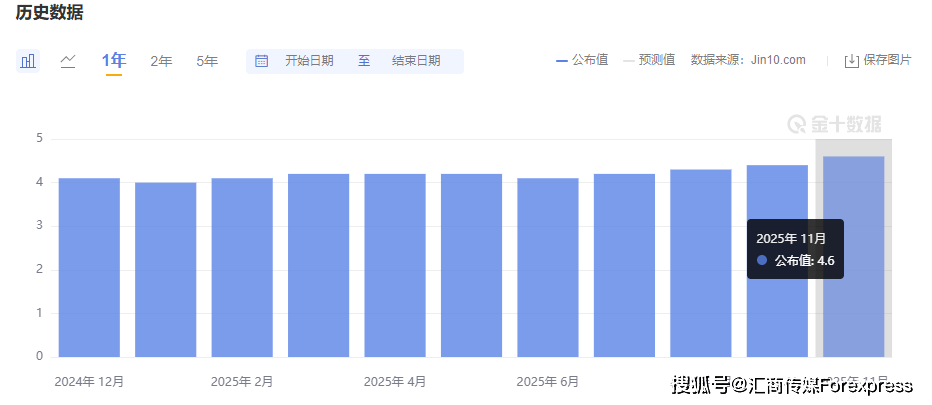
Core Viewpoint - The international gold price is rising significantly, approaching historical highs, driven by weakening U.S. economic data, renewed expectations for Federal Reserve rate cuts, and escalating geopolitical risks [1][4]. Group 1: U.S. Economic Indicators - The U.S. labor market shows signs of divergence, with November's unemployment rate unexpectedly rising to 4.6%, the highest in nearly four years, despite job additions exceeding expectations [4]. - The increase in unemployment raises doubts about the feasibility of a "soft landing" for the U.S. economy, leading to heightened expectations for future rate cuts by the Federal Reserve [4]. - Lower interest rates or expectations of rate cuts reduce the opportunity cost of holding gold, prompting a return of funds to the precious metals market, which is a key driver of rising gold prices [4]. Group 2: Geopolitical Risks - Escalating geopolitical tensions, particularly regarding Venezuela, have amplified demand for safe-haven assets like gold, as investors worry about energy supply and regional stability [4]. - Historical trends indicate that military or political conflicts involving energy-exporting countries often lead to a premium on gold prices, which is evident in the current market dynamics [4]. Group 3: Market Dynamics - The simultaneous decline in the U.S. stock market, particularly in the tech sector due to uncertainties around AI investment returns, has shifted some funds towards defensive assets like gold [5]. - The surge in silver and platinum prices indicates a rotation within the precious metals sector, with silver breaking historical highs, reinforcing the consensus on a cyclical strengthening of precious metals [5]. Group 4: Future Uncertainties - Gold bulls face uncertainties, including potential short-term rebounds in the U.S. dollar index and internal disagreements within the Federal Reserve regarding future policy paths [7]. - Upcoming U.S. CPI and PCE inflation data will significantly impact market expectations for monetary policy, with potential for gold price fluctuations based on inflation outcomes [7]. - The current high gold price environment is characterized by both risks and uncertainties, with geopolitical and macroeconomic expectations providing support, but short-term volatility may increase ahead of key data releases [7].
ATFX:多重风险共振 金价逼近历史高位
Xin Lang Cai Jing· 2025-12-18 08:27
Core Viewpoint - The international gold price has been rising significantly, reaching above $4,348, approaching historical highs, driven by weakening U.S. economic data, renewed expectations for Federal Reserve rate cuts, and escalating geopolitical risks, highlighting gold's appeal as a safe-haven and inflation hedge [1][7]. Economic Indicators - The U.S. labor market shows signs of divergence, with November's unemployment rate unexpectedly rising to 4.6%, the highest in nearly four years, despite job additions exceeding expectations. This shift raises concerns about the U.S. economy's "soft landing" and fuels speculation about potential rate cuts by the Federal Reserve [4][10]. - The rising unemployment rate questions the justification for maintaining high interest rates, leading to increased market expectations for future rate cuts. In a low-rate environment, the opportunity cost of holding gold decreases, prompting a return of funds to the precious metals market, which is a key driver of rising gold prices [4][10]. Geopolitical Risks - Escalating geopolitical tensions, particularly regarding Venezuela, have heightened demand for safe-haven assets. Concerns over energy supply and regional stability due to U.S. actions against sanctioned oil tankers and speculation about potential military actions have intensified investor interest in gold [4][10]. - Historical trends indicate that military or political conflicts involving energy-exporting countries often lead to a premium on gold prices, which has been evident in the current surge [4][10]. Market Dynamics - The simultaneous decline in U.S. stock markets, particularly in the technology sector due to uncertainties surrounding AI investment returns, has reduced the attractiveness of risk assets, leading some investors to shift towards gold and other defensive assets [4][10]. - The rise of silver and platinum alongside gold indicates a notable rotation within the precious metals sector, with silver breaking historical highs, reinforcing market consensus on a cyclical strengthening of precious metals [4][10]. Future Outlook - Gold prices are currently at high levels, with risks and uncertainties coexisting. Short-term support for gold prices is expected from geopolitical and macroeconomic factors, with potential for prices to test historical highs if risk events escalate [12]. - However, volatility may increase ahead of key U.S. CPI and PCE inflation data, which will directly impact market expectations for monetary policy. If inflation exceeds expectations, gold prices may face profit-taking pressure [14].
【环球财经】纽约金价16日微跌
Xin Hua Cai Jing· 2025-12-17 05:27
自2015-2016年低点开始上涨以来,黄金和白银价格的飙升已接近尾声。一些市场分析人士认为,尽管 未来几个月价格仍有可能进一步上涨,但投资者应开始为可能最早于明年开始的多年调整做好准备。 技术层面,2月黄金期货多头的下一个上涨目标是突破4433美元历史高点的强劲阻力价位。空头的下一 个短期下跌目标是跌破4200美元强劲技术支撑价位。 新华财经纽约12月16日电(记者徐静)纽约商品交易所黄金期货市场交投最活跃的2026年2月黄金期价 16日下跌0.07%,收于每盎司4332.2美元。 美国一系列经济数据16日发布,显示美国经济既没有过热,也没有快速降温。数据公布后,黄金、白银 收复隔夜走弱失地,小幅上涨。 美国劳工部16日发布数据显示,美国11月非农就业人数增加6.4万人,此前10月减少了10.5万人,这加剧 了近几个月来美国劳动力市场的波动。美国整体失业率升至4.6%,高于市场预期的4.5%。 美国商务部16日发布数据显示,10月份美国零售销售额变化不大,汽车经销商销售额下降和汽油收入减 少抵消了其他类别支出的强劲增长。 标普全球16日公布的数据显示,其采购经理人指数(PMI)综合产出指数初值降至53,此前 ...
非农分化+零售核心强劲 黄金冲高受阻短线偏多
Jin Tou Wang· 2025-12-17 02:10
Group 1 - The core viewpoint of the news highlights the mixed signals from recent economic data, particularly the non-farm payrolls and retail sales, which are crucial for assessing the U.S. economic momentum and predicting Federal Reserve policy direction [2] - The non-farm payroll data for November showed an increase of 64,000 jobs, exceeding market expectations, indicating a temporary recovery in the job market, while the October data was revised down to 105,000, reflecting pressure on employment [2] - The unemployment rate rose to 4.6% in November, the highest since September 2021, suggesting a deepening of labor market slack and an imbalance in supply and demand [2] Group 2 - Retail sales data showed a mixed performance, with overall retail sales remaining flat month-on-month in October, failing to meet market expectations, indicating a lack of vitality in consumer spending [2] - However, the core control group retail sales, excluding certain items, increased by 0.8% month-on-month, significantly surpassing expectations, indicating stable consumer spending in core areas, which is crucial for economic growth [2] - In the gold market, prices faced resistance despite positive non-farm data, with gold prices peaking near $4,440 before dropping to around $4,293, indicating a lack of bullish momentum [3]
就在今晚!非农报告罕见“二合一”发布,失业率存飙升可能
Jin Shi Shu Ju· 2025-12-16 05:52
Economic Data Release - The upcoming non-farm payroll report for November is set to be released on Tuesday at 9:30 PM Beijing time, amidst a flurry of economic data including retail sales and inflation reports [2] - The November non-farm payroll is expected to show an increase of 50,000 jobs, with the unemployment rate projected to reach 4.4% [2][7] Impact of Government Shutdown - The report will include data from October, as the Labor Statistics Bureau could not collect unemployment data for that month due to the government shutdown [4] - Economists predict that the October employment numbers may show a decline due to the Deferred Resignation Program affecting government workers, with estimates suggesting a loss of 70,000 jobs in October and a further decrease of 10,000 jobs in November [4][5] Employment Trends - Despite the potential negative impact from the government shutdown, most economists expect a positive job growth in November, with predictions ranging from a decrease of 20,000 to an increase of 127,000 jobs [4] - The healthcare and private education sectors are anticipated to drive job growth in November [4] Unemployment Rate Insights - Although the October unemployment rate will not be published, the November rate is expected to be around 4.4%, with some forecasts suggesting it could rise to 4.5% or even 4.6% due to federal employment declines [7][8] Additional Economic Indicators - The internal details of the establishment and household surveys will provide critical insights into the performance of various sectors in the U.S. economy [8] - Economists are particularly focused on employment growth in the goods-related sectors, while healthcare and possibly the restaurant industry are expected to continue leading job growth [8] Retail Sales and Consumer Spending - The U.S. Department of Commerce will also release October retail sales data, with a modest growth forecast of 0.1% [9] - The upcoming consumer price index (CPI) report for November will be affected by the government shutdown, leading to a focus on year-over-year indicators for inflation signals [9]
美指微跌震荡美联储政策分歧
Jin Tou Wang· 2025-12-15 02:57
Core Viewpoint - The USD index is experiencing a narrow trading range due to uncertainties surrounding the Federal Reserve's policy direction and mixed economic data from the U.S. [1] Group 1: Federal Reserve Policy - The Federal Reserve completed its third rate cut of the year on December 10, lowering the federal funds rate target range by 25 basis points to 3.5%-3.75% [1] - There is significant internal division among Fed officials, with over half of the 19 forecasting members favoring maintaining rates until 2026, while a minority advocates for further easing [1] - Fed Chair Powell's hawkish signals suggest a potential pause in the rate-cutting cycle, but mixed signals from other officials have led to a slight decline in the USD index [1] Group 2: Long-term Dollar Pressure - The long-term depreciation pressure on the USD remains, with challenges from the Fed's easing cycle and increasing fiscal deficits [2] - The current U.S. tariff policy is disrupting global capital flows, further weakening the USD's safe-haven status [2] - While most institutions maintain a bearish outlook on the USD, some express cautious optimism due to the relative resilience of the U.S. economy compared to Europe and Japan [2] Group 3: Technical Analysis - The USD index is currently trading within a range of 98.34 to 98.478, with 98.34 acting as a key support level [3] - A break below this support could lead to further declines, while a successful breach of 98.478 may open up a slight rebound opportunity [3] - Key factors influencing the USD index include U.S. economic data, Fed officials' statements, and U.S. tariff policies [3] Group 4: Medium to Long-term Outlook - The USD index's future largely depends on the Fed's policy independence and the U.S. fiscal situation [4] - If the Fed becomes a political tool and is forced to expand easing, the USD could depreciate more rapidly [4] - The pace of changes in the international monetary system and geopolitical risks will also play significant roles in the USD's valuation [4]