
逆向投资

Search documents
超70亿市值的基石限售股即将解禁,三花智控(02050)能否顶住新一轮抛压?
智通财经网· 2025-12-15 03:33
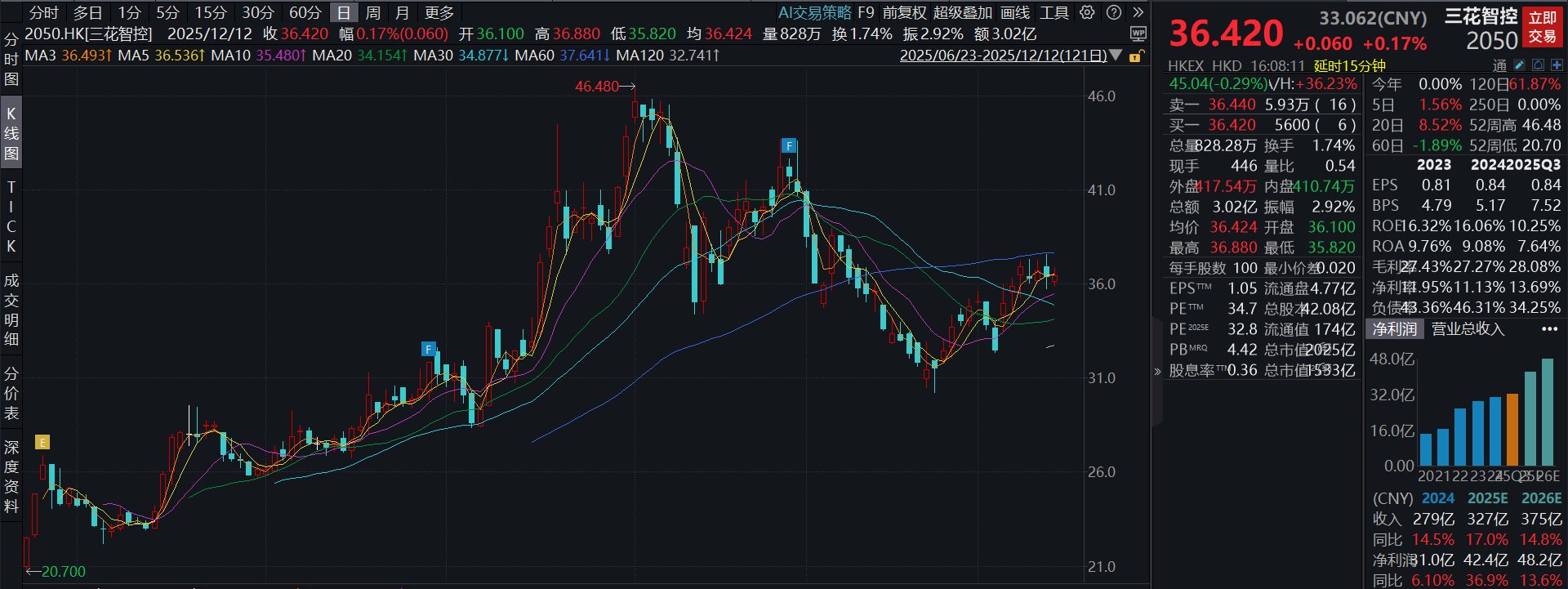
Core Viewpoint - The stock price of Sanhua Intelligent Control (02050) surged by 124.54% to a peak of HKD 46.48 per share within three months after its listing on June 23, 2025, but has since experienced a significant decline, raising concerns about the upcoming lock-up expiration for cornerstone investors [1][3][11]. Market Performance - After reaching its peak, Sanhua's H-shares fell by 35% over 36 trading days, forming a "M-top" pattern before a brief rebound of nearly 20% following a "golden needle bottom" on November 24 [3]. - The stock is currently constrained by the 60-day moving average and has not formed a significant breakout [3]. - The upcoming expiration of cornerstone investors' lock-up on December 23 may lead to increased selling pressure, particularly as these investors have substantial unrealized gains [3][11]. Investment Dynamics - The rapid price increase of Sanhua's H-shares was driven by a combination of a strong capital market, supportive policies, and industry news [4]. - The company was significantly oversubscribed during its IPO, with a subscription rate of 747.92 times, making it the second most popular new stock in 2025 [5][6]. - On the first trading day, the stock experienced a nearly 7% drop in the dark market, with a final closing decline of 3.91% [7][8]. Business Fundamentals - Sanhua Intelligent Control reported a revenue of CNY 24.03 billion for the first three quarters of 2025, a year-on-year increase of 16.8%, and a net profit of CNY 3.24 billion, up 40.8% [12]. - The growth is attributed to the performance of its refrigeration and automotive parts businesses, as well as cost-reduction initiatives [12]. - The company's robot business is emerging as a key growth area, with ongoing investments in technology and production capacity [12][13]. Industry Outlook - The robot business is expected to become a core driver of valuation fluctuations for Sanhua, with optimistic market expectations regarding future technological advancements and order fulfillment [14]. - The production timeline for Tesla's third-generation Optimus robot will significantly influence market sentiment; any delays could negatively impact stock performance [15].


超70亿市值的基石限售股即将解禁,三花智控能否顶住新一轮抛压?
Zhi Tong Cai Jing· 2025-12-15 03:32
作为特斯拉机器人概念股的核心标的,三花智控(02050)自2025年6月23日在港股上市后,其股价在短短三个月内最高涨至46.48港元每股,最大涨幅 124.54%。 但自10月初开始,三花智控H股股价见顶回落,在高位构建了一个左高右低的"M顶"之后加速下跌,36个交易日内从高位累计下跌35%。在11月24日"金针探 底"后才迎来了一波近20个点的反弹。 尽管近期反弹暂缓了三花智控H股的下行颓势,但其股价目前仍受制于60日均线压制,尚未形成有效突破。更值得关注的是,三花智控H股将于12月23日迎 来基石投资者限售股解禁。鉴于基石投资者短期内已积累可观浮盈,解禁后兑现收益的动机较强,这在流动性本就欠佳的H股市场,或将引发显著的短期抛 压,从而对股价构成下行压力。然而,从逆向投资视角来看,若此次解禁能带来股价的充分回调,或为长线投资者提供一个难得的逢低布局良机。 基石投资者小而散,若"抢跑"出现或令股价明显承压 三花智控H股三个月股价翻倍的背后,其实是资本市场走强、政策鼓励以及产业消息刺激等多重因素协同共振的结果。 而在产业消息层面,MWC上海2025展会、杭州国际人形机器人与机器人技术展览会均在6月举办,相关消 ...
硅谷顶级投资人纳瓦尔的66条生命哲学——财富、判断力与幸福方法
首席商业评论· 2025-12-12 05:07
Core Insights - The article emphasizes the importance of balancing wealth and inner peace, as articulated by Naval Ravikant, who suggests focusing on oneself, one's finances, and maintaining inner tranquility [2]. Group 1: Wealth - Wealth should be pursued over money or status, defined as assets that generate income while one sleeps [4][5]. - Achieving financial freedom requires ownership of equity rather than merely trading time for money [5]. - Providing society with in-demand goods or services and scaling them is a pathway to wealth [5]. - Choosing industries with long-term growth potential and collaborating with reliable partners is crucial [5]. - The internet has expanded career opportunities, yet many have not fully recognized this [5]. - Cultivating an iterative mindset is essential, as returns in life come from compounding [5]. - Individuals should arm themselves with expertise, a sense of responsibility, and leverage [5][7]. Group 2: Judgment - Spending time on saving money does not lead to wealth; instead, time should be spent on earning [9]. - In an era of leverage, a single correct decision can yield significant rewards [9]. - Clear thinking is more valuable than mere intelligence, as it establishes authority [9][10]. Group 3: Happiness - Happiness is defined as the absence of pain and desire, embracing the present moment [11][12]. - Accepting reality and not being overly attached to desires leads to true happiness [12][13]. - The article suggests that happiness is a choice, stemming from inner peace rather than external circumstances [12][13]. - Good habits and the company of positive individuals significantly influence happiness [14][16]. Group 4: Life Formula - Naval's formula for success includes happiness as a function of health, wealth, and good relationships [16]. - Health is determined by exercise, diet, and sleep, while wealth is a product of income, responsibility, leverage, and expertise [16].

白酒低迷、AI订单排队,景林高云程,投资得学会“两边下注”
Sou Hu Cai Jing· 2025-12-11 17:37
Core Viewpoint - The market is experiencing a dichotomy, with traditional industries like high-end liquor and real estate facing significant challenges, while new economies such as AI and renewable energy are thriving [2][6]. Group 1: Traditional Industries - High-end liquor wholesale prices have been declining for six months, with distributors reporting minimal profits [2]. - The real estate market is seeing record-high listings, but buyers are cautious and negotiating aggressively, leading to frustration among sellers [2]. - The consumer sector is also under pressure, with companies in the food delivery space suffering significant losses despite heavy subsidies [7]. Group 2: New Economy - Companies in the AI supply chain are rapidly expanding production capacity, with some operating 24/7 to meet demand [4]. - The renewable energy sector is booming, with local governments proactively seeking partnerships for storage projects [4]. - AI technology is advancing quickly, with companies leveraging AI for efficiency gains, such as reducing meeting documentation time from two hours to ten minutes [9]. Group 3: Investment Strategies - The company is focusing on a framework called "MCGF," which identifies five key sectors for investment: social platforms, chip industry, scarce resources, AI models with public cloud integration, and outdoor brands [13][15]. - The strategy emphasizes investing in companies with strong economic moats, ensuring long-term viability regardless of market fluctuations [15][17]. - The company advises against trying to time the market, instead recommending a focus on companies with consistent returns on equity and reasonable valuations [17]. Group 4: Market Outlook - The company anticipates a challenging market in 2026, suggesting investors lower their return expectations and focus on fundamental research [18][19]. - There is an opportunity for reverse investment strategies, targeting companies that are undervalued but fundamentally sound [21]. - The market is viewed as a "淘汰赛" (elimination race), where only companies with strong technology and profitability will survive [23].




大成基金苏秉毅:“固收+”走红源于供需共振 投资秉承均值回归理念
Zhong Zheng Wang· 2025-12-11 14:25
在回撤控制方式上,可能和市场上很多基金经理不太一样的是,他不会选择在价格跌破安全垫时减仓甚 至砍仓,而是在入场时就做好准备,在相对低位建仓,等到价格上涨再去兑现,而不是追高后再试图在 更高的位置卖出。对于不同"固收+"产品,会设置不同的回撤控制目标。 中证报中证网讯(记者 张韵)12月11日晚间,大成元瑞诚利拟任基金经理苏秉毅在做客中国证券报"中 证点金汇"直播间时表示,近年来"固收+"产品的走红主要源于供给和需求两方面的推动。供给端,权益 市场走强,带动"固收+"产品业绩显著提升;需求端,低利率环境里,许多存款理财产品的收益率下 行,居民在稳健基础上寻求更高收益的需求大幅提升。 在产品投资上,他表示,其在各类产品管理上均秉承均值回归的理念。交易偏左侧,根据市场情绪适当 逆向调整仓位。在操作上,量化与主观相结合,量化辅助风格及股票筛选,量化筛选核心指标为超跌 (反转因子),辅助基本面、技术面等指标,不同阶段指标权重主观调整;主观负责股票买卖与交易环 节。 以中波"固收+"的投资为例,他投资时设置的权益中枢通常为15%,市值维度对标中证1000指数,严格 控制个股与行业集中度,坚持"抄底等待修复",赚估值回归的 ...
This Stock Just Hit a 17-Year Low. Could It Be the Ultimate Contrarian Buy for 2026?
The Motley Fool· 2025-12-11 03:30
Core Viewpoint - FMC's stock has significantly declined, losing over 70% of its value this year, and is now trading at levels not seen since 2008, raising concerns about the company's fundamentals and future prospects [3][11]. Financial Performance - FMC reported a net loss of $532 million over the trailing 12 months, indicating serious challenges in its financial health [5]. - The company's top line decreased by 11% for the third quarter ending September 30, exacerbated by divestments and ongoing operational restructuring [8]. - FMC's total debt stands at $4.5 billion, which is substantially higher than its cash and trade receivables totaling $2.8 billion [10]. Dividend Cut - FMC announced an 86% reduction in its quarterly dividend, from $0.58 to $0.08, which has negatively impacted investor confidence [9][11]. - The company stated that the dividend cut is part of a broader strategy to address challenges and prioritize debt reduction [10]. Market Reaction - Following the earnings report and dividend cut, FMC's stock price dropped to less than half of its previous value, trading around $13.62 [11][12]. - Despite the current yield being above average at 2.5%, the drastic cut in dividends has diminished its appeal to income-seeking investors [11]. Future Outlook - The company is facing cautious customer purchasing behavior, indicating potential ongoing challenges in the near future [13]. - Given the uncertainty surrounding FMC's ability to manage its debt and generate strong results, there are concerns about the possibility of further dividend cuts [14].


招银国际:PHEV逆袭与电池涨价成关键变量 整车板块首选吉利汽车
Zhi Tong Cai Jing· 2025-12-10 06:44
Group 1 - The core viewpoint is that China's passenger car retail and wholesale sales are expected to reach historical highs in 2025, surpassing market expectations from last year [1][2] - In 2026, the automotive industry may face a more complex landscape due to the phasing out of "trade-in" subsidies and reductions in purchase tax exemptions, leading to increased competition and battery price risks [1][3] Group 2 - The automotive industry's resilience is anticipated to be stronger than market expectations, with retail sales expected to remain stable year-on-year and wholesale sales projected to grow by 2.9% due to increased exports [2] - Retail sales of new energy passenger vehicles are expected to grow by 15.5% year-on-year to 14.93 million units in 2026, with a market share increase to 61.8% [2] - Wholesale sales of new energy passenger vehicles are projected to rise by 18.5% year-on-year to 18.5 million units, benefiting from a 40% increase in new energy vehicle exports [2] Group 3 - The competition in the automotive industry is expected to intensify in 2026, driven by a record number of new model releases and aggressive pricing strategies from some manufacturers [3] - The demand for energy storage batteries is expected to improve, leading to rising battery prices that may erode profit margins for car manufacturers [3] - The introduction of plug-in hybrid electric vehicles (PHEVs) is expected to regain growth momentum in 2026, alongside the phasing out of trade-in subsidies [3] Group 4 - The competition in the new energy vehicle sector is entering a new phase in 2026, with narrowing valuation premiums between new entrants and traditional automakers [4] - The competitive landscape is expected to expand beyond vehicle manufacturing to include AI applications such as Robotaxi and robotics [4] - Foreign brands are accelerating the launch of new energy models, gaining a deeper understanding of the Chinese market [4] Group 5 - The preferred stock in the automotive sector is Geely Automobile, which has solid fundamentals and attractive valuations, with potential for continued growth in new energy sales [5] - The high-margin models expected to launch in the second half of 2025, combined with accelerated new energy exports, are likely to boost profit margins for Geely [5] - In the battery sector, attention is drawn to the new player Zhengli New Energy, which has achieved industry-leading profit margins and is expected to benefit from an optimized customer structure and potential battery price increases [5]

所有商品都将“像黄金一样”!美银Hartnett:做多大宗商品是明年最佳“火热交易”
美股研究社· 2025-12-09 10:53
Group 1 - The core view is that by 2026, going long on commodities will be the best trading theme, with all commodity price trends expected to rise similarly to gold [2][3] - The shift in global economic policy from "monetary easing + fiscal tightening" to "fiscal easing + de-globalization" post-pandemic is a key factor driving this outlook [2][6] - The report highlights that the current environment favors commodities, particularly oil and energy, as the best contrarian investment opportunity due to anticipated economic policies and geopolitical changes [3][9] Group 2 - The report indicates that the structural opportunity for commodities arises from the paradigm shift in global economic policies, which has changed the performance dynamics between bonds and commodities [6][11] - Latin American stock markets have shown significant growth, up 56% year-to-date, indicating a broader market trend towards natural resources and metals [7][9] - Historical patterns suggest that bond markets are cautious about "hot" economic policies, with a tendency for yields to rise following the nomination of a new Federal Reserve Chair [10][13] Group 3 - The report notes that while commodities are favored, there is caution regarding the bond market, particularly with the potential for rising yields due to economic interventions and labor market weaknesses [11][17] - The stock market is experiencing a complex differentiation, with liquidity peaks corresponding to credit spread lows, indicating a shift in investment focus towards AI capital expenditures [19][21] - Specific sectors such as cyclical stocks related to "Main Street" (housing, retail, transportation) are viewed as having the best relative upside potential, driven by expected economic stimulus policies [22]

Marvell: The Bull Case Revolves Around Optics, Not ASICs
Seeking Alpha· 2025-12-08 20:25
Core Viewpoint - The individual investor adopts a contrarian investment style, focusing on deep value opportunities, particularly in stocks that have recently experienced sell-offs due to non-recurrent events, while also considering insider buying as a positive signal [1] Investment Strategy - The investment portfolio is split approximately 50%-50% between shares and call options, indicating a balanced approach to risk and potential returns [1] - The investor's timeframe for holding positions typically ranges from 3 to 24 months, suggesting a medium-term investment horizon [1] - Fundamental analysis is employed to assess the health of companies, including their leverage and financial ratios compared to sector and industry averages [1] Stock Selection Criteria - The investor screens thousands of stocks, primarily in the US, looking for those that have undergone recent sell-offs, particularly when insiders are buying shares at lower prices [1] - Professional background checks are conducted on insiders who purchase shares post-sell-off, adding a layer of due diligence to the investment process [1] Technical Analysis - Technical analysis is utilized to optimize entry and exit points, with a focus on support and resistance levels on weekly charts, employing multicolor lines for clarity [1] - Trend lines are drawn in multicolor patterns, indicating a systematic approach to technical analysis [1]


第二层思维,要敢于去接下落的刀子
Xin Lang Cai Jing· 2025-12-08 12:25
Group 1 - The core concept of "second-level thinking" is to engage in contrarian thinking that differs from the prevailing market views [1][35] - The first level of thinking leads to similar conclusions among investors, while achieving superior results requires questioning the reasons for being ahead [36][35] - Investing is fundamentally about responding to the future, with the acknowledgment that risk is unavoidable [36][1] Group 2 - Two key rules are identified: most things are cyclical, and significant loss opportunities arise when others forget this cyclical nature [2][37] - The cyclical nature of markets is attributed to human participation, which introduces variability and emotional responses [3][38] - The extremes of cycles are primarily driven by human emotions and weaknesses, leading to irrational market behaviors [4][39] Group 3 - Investor emotions oscillate between extremes, affecting market pricing and risk attitudes [6][40] - The main risks in investing are categorized as the risk of loss and the risk of missing opportunities [7][42] - Bull and bear markets are described in three stages each, highlighting the psychological shifts among investors [8][44][46] Group 4 - The concept of market inefficiency is introduced, where mispricing creates opportunities for superior performance [14][41] - The psychological factors influencing investment decisions include greed, fear, and the tendency to follow the crowd [15][48] - Recognizing and resisting these psychological influences is crucial for successful investing [50][49] Group 5 - Exceptional investors possess the ability to identify undervalued qualities that are not reflected in prices [54][52] - The process of building a portfolio involves selling weaker investments to make room for stronger ones [55][56] - Identifying "cheap" investments requires a clear understanding of their intrinsic value and market perception [57][58] Group 6 - Patience in waiting for investment opportunities, rather than chasing them, is emphasized as a superior strategy [60][61] - The importance of understanding market cycles is highlighted, with a focus on recognizing the current stage of the cycle [68][67] - The recommendation is to act contrary to the crowd: be aggressive in downturns and cautious in upturns [69][70]