
AI科技革命

Search documents
有色“超级周期”气势如虹,再刷历史新高!
Mei Ri Jing Ji Xin Wen· 2026-01-16 02:25
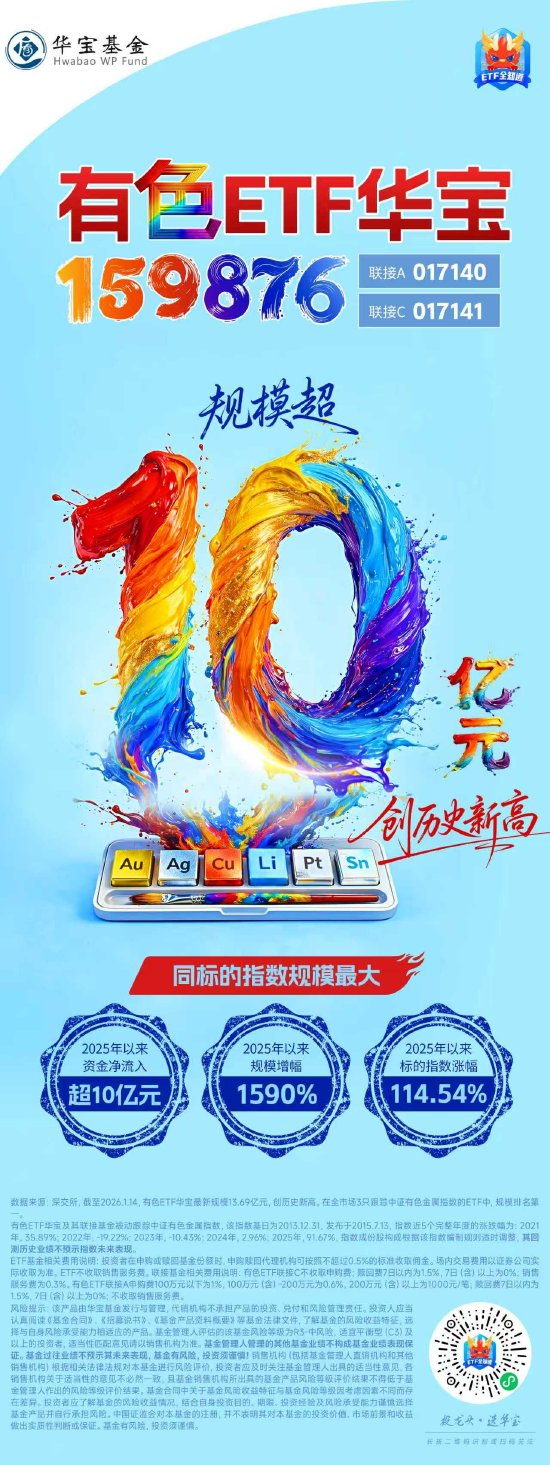
Group 1 - The core viewpoint is that the non-ferrous metal sector is experiencing a strong rally, driven by multiple factors including global capital expenditure cycles, manufacturing recovery, enhanced monetary attributes, and improved domestic macro expectations [1] - The non-ferrous ETF Huabao (159876) has seen significant inflows, with a real-time net subscription of 57 million units and a total net inflow of 473 million yuan over the past 10 days [1] - Analysts suggest that the current non-ferrous metal supercycle is influenced by the "AI leap" and "century change," with historical parallels to significant macro narratives [1] Group 2 - The non-ferrous ETF Huabao (159876) and its linked fund (017140) cover a wide range of metals including copper, aluminum, gold, rare earths, and lithium, providing risk diversification compared to investing in single metal sectors [2] - As of January 15, the latest scale of the non-ferrous ETF Huabao (159876) reached 1.453 billion yuan, marking a historical high and ranking first among three ETFs tracking the non-ferrous metal index in the market [2]
ETF盘中资讯|铜资源争夺加剧!力拓专供亚马逊,AI大战抢完芯片抢铜矿!有色ETF华宝(159876)再涨2.2%创历史新高!
Sou Hu Cai Jing· 2026-01-16 02:18
Core Viewpoint - The non-ferrous metal sector is experiencing a strong upward trend, with significant capital inflows and record high ETF performance, indicating a bullish outlook for the industry in the coming years [1][4]. Group 1: Market Performance - The non-ferrous ETF Huabao (159876) saw a peak intraday increase of 2.2%, currently up 1.41%, reaching a new all-time high since its listing [1]. - As of January 15, the latest scale of the non-ferrous ETF Huabao is 1.453 billion, marking a historical high, and it ranks first among three ETFs tracking the CSI Non-Ferrous Metal Index [1]. - The ETF has attracted a net subscription of 50.4 million units, with a total net inflow of 473 million over the past ten days [1]. Group 2: Stock Performance - Key stocks in the non-ferrous sector include Hunan Silver, which surged over 6%, and other companies like Chihong Zn & Ge, Jiangxi Copper, and Jinchuan Group, all rising over 5% [6]. - The total market capitalization of leading stocks in the sector varies, with notable companies like Jiangxi Copper at 196 billion and Chihong Zn & Ge at 48.2 billion [2]. Group 3: Industry Outlook - Analysts predict that the non-ferrous metal sector will continue to thrive due to factors such as global capital expenditure cycles, manufacturing recovery, and improved domestic macro expectations [4]. - China Galaxy Securities suggests that copper prices have significant upward potential, driven by historical trends and the current global economic landscape [3]. - The demand for strategic metals is expected to rise due to new technological revolutions and geopolitical factors, indicating a new cycle for strategic metal demand [3]. Group 4: Investment Opportunities - The non-ferrous ETF Huabao and its linked funds cover a wide range of metals, including copper, aluminum, gold, rare earths, and lithium, allowing investors to capture the overall sector's performance [5]. - The industry is anticipated to benefit from the convergence of AI advancements and global economic shifts, creating a "super cycle" for non-ferrous metals [3][4].


AI科技革命+全球秩序重塑,有色战略意义远超预期!有色ETF华宝(159876)规模超10亿元创历史新高!
Xin Lang Cai Jing· 2026-01-16 00:56
Group 1 - The article discusses the formation of MACD golden cross signals, indicating a positive trend for certain stocks [4][7]
帝科股份(300842) - 2026年1月15日投资者关系活动记录表
2026-01-16 00:54
Financial Performance - The company expects a net profit loss of 200 million to 300 million yuan for 2025, compared to a profit of 360 million yuan in the previous year [2] - The net profit after deducting non-recurring gains and losses is projected to be between 160 million and 240 million yuan, a year-on-year decrease of 63.56% to 45.34% from 439 million yuan [2] Product Development and Market Strategy - The company is focusing on three battery technologies: mature P-type PERC, mid-term P-type HJT, and long-term perovskite tandem battery technology, with leading conductive paste products already in commercial use [3] - The storage chip business achieved approximately 500 million yuan in revenue, with a significant increase in both revenue and profitability, especially in Q4 with about 230 million yuan in revenue [4] - The company plans to increase its shipment target for 2026 to between 30 million and 50 million units, leveraging existing capacity and price increases to expand revenue and net profit [4] Risk Management - The company employs a production model based on sales orders and a procurement model based on production plans, mitigating risks from silver price fluctuations through hedging strategies [5] - The rapid increase in silver prices has led to significant non-recurring losses, but does not affect the company's long-term operational capabilities [5] Strategic Layout - The company is transitioning its strategic focus from enabling the "energy revolution" to empowering the "technology revolution," expanding its product range into space photovoltaic and commercial aerospace sectors [7] - Through acquisitions, the company has established a comprehensive industry chain in the storage business, aiming to become a leading third-party DRAM storage module enterprise in the next two to three years [7]
资金积极涌入有色板块,有色金属ETF(512400)盘中交投活跃涨近2%,有色金属或迎超级周期
Xin Lang Cai Jing· 2026-01-15 06:08
Core Viewpoint - The recent performance of the non-ferrous metal ETF (512400) indicates a strong upward trend, driven by significant capital inflows and favorable macroeconomic conditions, particularly in the context of U.S. inflation data and expectations for interest rate cuts by the Federal Reserve [1][2]. Group 1: Market Performance - As of January 15, 2026, the non-ferrous metal ETF (512400) rose by 1.82%, marking its fifth consecutive increase, with a trading volume of 1.964 billion yuan and a turnover rate of 6.22% [1]. - The ETF has seen continuous net inflows over the past eight days, surpassing a total scale of 30 billion yuan [1]. - Key stocks within the index, such as Huayou Cobalt, rose by 6.77%, while other notable performers included Zhong Rare Earth (up 4.92%) and Chihong Zn & Ge (up 4.67%) [1]. Group 2: Economic Indicators - On January 13, 2026, the U.S. Labor Department reported that the Consumer Price Index (CPI) for December 2025 increased by 2.7% year-on-year, with the core CPI rising by 2.6%, both figures below market expectations [1]. - The lower-than-expected inflation data has strengthened the market's anticipation of interest rate cuts by the Federal Reserve, with the probability of a rate cut in April rising to 42% [1]. Group 3: Industry Outlook - China Galaxy Securities suggests capitalizing on the "AI leap + century change" resonance, indicating a super cycle in non-ferrous metals driven by the "AI technology revolution" and "global order reshaping" [2]. - Historical patterns show that each super copper cycle corresponds with strong macro narratives, and the current cycle is expected to have significant strategic implications [2]. - The non-ferrous metal index, which tracks 50 listed companies in the sector, reflects the overall performance of the industry, with major constituents including Zijin Mining, Luoyang Molybdenum, and Northern Rare Earth [2].






超130亿元主力加速涌入有色!有色ETF华宝(159876)逆市大涨3.3%再刷历史新高
Sou Hu Cai Jing· 2026-01-15 02:53
Group 1 - The core viewpoint of the articles highlights the strong performance of the non-ferrous metals sector, driven by multiple factors including global capital expenditure cycles, manufacturing recovery, enhanced monetary attributes, and improved domestic macro expectations [1][2] - The non-ferrous ETF Huabao (159876) has seen a significant inflow of funds, with over 400 million shares net subscribed in real-time and a total of 4.4 billion yuan raised in the last 10 days, indicating strong investor interest [1] - The non-ferrous metals sector is currently leading among 31 primary industries in terms of net capital inflow, with over 13 billion yuan from major funds [1] Group 2 - The duration of the non-ferrous metals super cycle is expected to last until at least 2026, contingent on the recovery of US dollar credit, strategic stockpiling progress, and the effectiveness of "anti-involution" policies [2] - The non-ferrous ETF Huabao (159876) and its linked fund (017140) cover a broad index including copper, aluminum, gold, rare earths, and lithium, making it a suitable option for risk diversification in investment portfolios [2] - As of January 14, the latest scale of the non-ferrous ETF Huabao (159876) is 1.369 billion yuan, making it the largest ETF among three tracking the same index in the market [2]
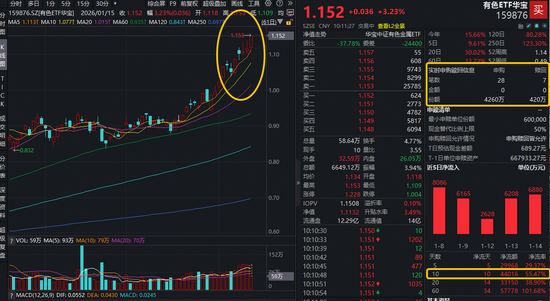
有色逆市狂飙!资金积极抢筹!有色ETF华宝(159876)盘中猛拉3%,冲击5连涨!此前10日狂揽4.4亿元!
Xin Lang Cai Jing· 2026-01-15 02:32
Core Viewpoint - The non-ferrous metal sector is experiencing significant growth, with the popular ETF, Huabao Non-ferrous ETF (159876), hitting a new historical high and attracting substantial capital inflow [1][9]. Group 1: Market Performance - The Huabao Non-ferrous ETF (159876) saw an increase of 3.23% and 2.69%, marking five consecutive days of gains and setting a new historical high [1][9]. - As of the report, the ETF received a net subscription of 38.4 million units, accumulating a total of 440 million yuan in the past ten days [1][9]. Group 2: Sector Analysis - In the gold sector, Xian Financial Securities suggests that the U.S. faces recession pressures, high sovereign debt, and trade deficits, which weaken the dollar's credibility, leading to increased focus on gold as a global asset [2][10]. - For copper, China Galaxy Securities indicates that there is still significant upward potential for copper prices, as historical data shows that current prices, adjusted for inflation, have not reached previous supercycle highs [3][11]. - Strategic metals like tungsten, molybdenum, titanium, and rare earths are expected to see increased demand due to technological revolutions and supply chain security concerns, as noted by CITIC Securities [3][11]. Group 3: Stock Performance - Key stocks in the non-ferrous metal sector include Huaxi Non-ferrous, Hunan Silver, and Huayou Cobalt, all of which have surged over 7% [4][12]. - Other notable performers include Ganfeng Lithium, which rose over 6%, and several other stocks that experienced significant gains [4][12]. Group 4: Future Outlook - The industry is expected to enter a supercycle driven by the convergence of AI advancements and global order restructuring, with historical parallels drawn to significant macroeconomic events [5][13]. - Institutions predict a bullish market for non-ferrous metals, with expectations of a synchronized upward trend in currency, demand, and supply by 2026 [5][13].


杨德龙:不忘初心 坚定价值投资理念
Xin Lang Cai Jing· 2026-01-14 08:34
Market Overview - The market has experienced continuous growth at the beginning of 2026, with trading volume reaching a historical record of 3.6 trillion yuan [1][6] - Margin trading balances have surpassed 2.6 trillion yuan, indicating increased market activity [1][6] - January is typically the month with the highest credit issuance, estimated between 3 trillion to 4 trillion yuan, which may contribute to capital market growth [1][6] Monetary and Fiscal Policy - China's monetary policy is expected to remain moderately accommodative, with measures such as interest rate cuts and reserve requirement ratio reductions to support low interest rates and liquidity [2][7] - The fiscal policy will be more proactive, with initiatives to boost investment and consumption, including a new subsidy policy for replacing old consumer goods [2][7] - A 12 trillion yuan local government debt relief plan is set to be implemented, easing interest payment pressures and allowing more funds for public welfare and growth [2][7] International Economic Context - The U.S. Federal Reserve is likely to continue its rate-cutting cycle in 2026, with expectations of at least two 25 basis point cuts due to weak economic data [2][8] - The U.S. inflation rate has fallen below 3%, indicating a shift in focus towards stabilizing employment rather than solely controlling inflation [2][8] Currency and Investment Trends - The dollar index has shown a downward trend, raising concerns about U.S. dollar credit, especially with the national debt exceeding 38 trillion dollars and annual interest payments over 1 trillion dollars [9] - China's central bank is reducing U.S. Treasury holdings while increasing gold reserves as a strategy to mitigate dollar credit risks [4][9] - The international influence of the dollar is expected to decline, while the internationalization of the renminbi is anticipated to progress, potentially leading to a renminbi appreciation against the dollar [10] Stock Market Dynamics - The U.S. stock market is experiencing high valuations, with major indices near historical peaks, but the AI technology revolution is supporting genuine business models [11] - Volatility in the U.S. stock market is expected to increase in 2026, with potential short-term corrections in tech stocks, but significant downturns similar to the 2001 internet bubble are unlikely [11] - A-shares and Hong Kong stocks are viewed as attractive investment opportunities due to their valuation advantages, independent of U.S. market fluctuations [11]
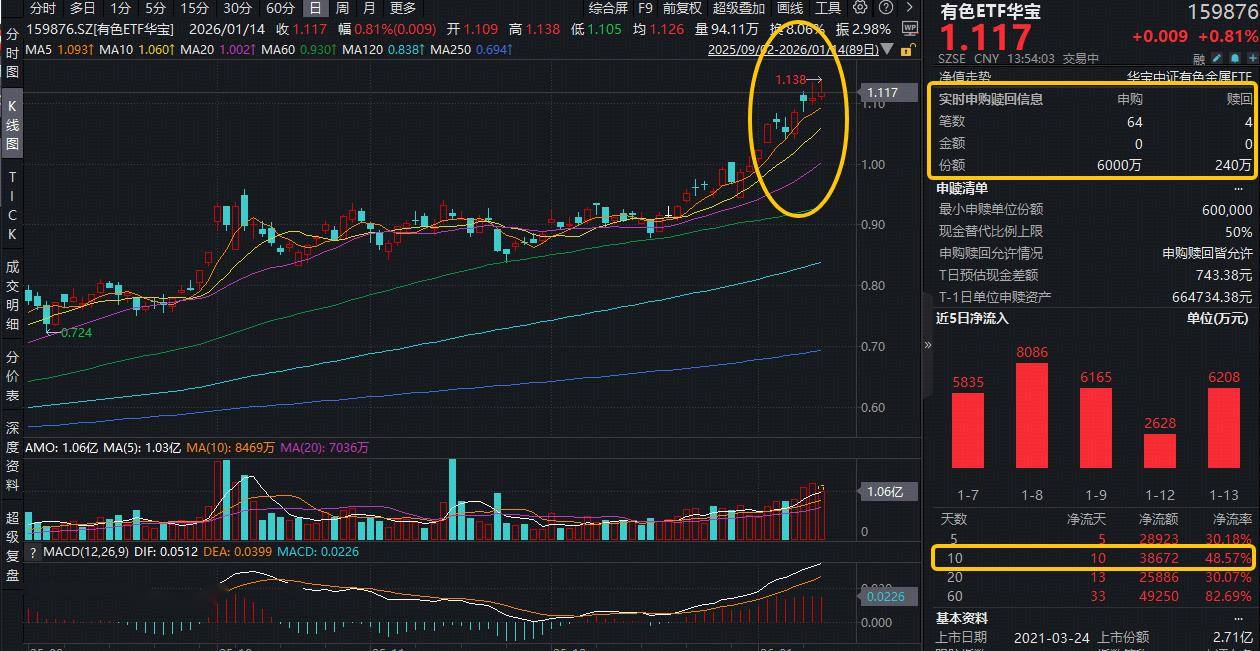
ETF盘中资讯|战略金属将“主导未来”? 有色ETF华宝(159876)盘中上探2.7%续创历史新高!获资金实时净申购5760万份!
Sou Hu Cai Jing· 2026-01-14 06:18
Group 1 - The non-ferrous metal sector continues to show strong upward momentum, with the popular ETF, Huabao Non-Ferrous ETF (159876), reaching a historical high, with an intraday increase of 2.71% and a current rise of 0.81% [1] - The technical analysis indicates a bullish trend, as the MACD indicator has achieved a golden cross, suggesting that the market's buying power remains dominant and the upward momentum of stock prices has not shown significant signs of weakening [1] - There has been significant capital inflow into the Huabao Non-Ferrous ETF, with a net subscription of 57.6 million units reported, accumulating a total of 387 million yuan over the past ten days [1] Group 2 - The report highlights that copper prices have considerable room for upward movement, as historical analysis shows that adjusted for inflation, current copper prices have not yet reached the heights of previous super cycles [2] - The ongoing global monetary order reshaping is weakening the dollar's role as a price anchor for major assets, with the current copper-to-gold ratio still at a historical low [2] - The investment community is optimistic about the non-ferrous metal sector, anticipating a bull market driven by monetary, demand, and supply factors, with projections indicating a potential bull market in 2026 [3][4] Group 3 - The Huabao Non-Ferrous ETF and its linked funds cover a wide range of sectors including copper, aluminum, gold, rare earths, and lithium, allowing for better exposure to the entire sector's beta performance [4] - Key stocks in the sector have shown significant gains, with Hunan Silver reaching the daily limit, and other companies like Steel Research High-Tech and Silver Non-Ferrous also experiencing substantial increases [5]
杨德龙:2026年市场行情开局良好
Xin Lang Cai Jing· 2026-01-13 09:32
Core Viewpoint - The market in 2026 is expected to continue the trends of 2025, with a more diversified performance across various sectors, moving away from the "barbell" strategy observed in 2025, where low-valuation, high-dividend sectors like banks and high-performing tech stocks dominated [1][10]. Group 1: Market Trends and Investor Behavior - In 2025, the market exhibited a "barbell" characteristic, with significant gains in low-valuation sectors and standout performance in tech stocks, while traditional sectors showed lackluster performance [1][10]. - Many investors did not achieve satisfactory returns in 2025 due to inadequate allocation towards the two main investment themes, leading to lower overall returns and even losses [1][10]. - The strong performance of the market in 2026 is anticipated to enhance investor confidence and improve the overall market sentiment [1][8]. Group 2: Capital Market Dynamics - A significant shift in resident savings is expected, with a large influx of funds into the capital market, driven by declining savings rates and limited investment opportunities in traditional sectors [2][11]. - In 2025, new fund issuance exceeded 1 trillion yuan, primarily in equity funds, marking a notable shift where equity fund sales surpassed fixed-income products for the first time [2][11]. - The number of new stock accounts opened in 2025 reached over 27 million, indicating strong investor interest and engagement in the capital market [2][11]. Group 3: Economic Impact and Consumer Behavior - The capital market's recovery is seen as a crucial mechanism for boosting consumer spending, as families recover from significant wealth losses due to declining real estate values [3][12]. - The market's performance is expected to help stabilize the real estate sector, particularly in core areas of first-tier cities, while many regions still face oversupply issues [3][12]. - The ongoing bull market is viewed as a vital tool for enhancing household financial health and increasing disposable income, thereby stimulating consumption [3][12]. Group 4: Technological Innovation and Investment Opportunities - The strengthening of the stock market is projected to facilitate a resurgence in IPOs, allowing more tech innovation companies to access capital [4][13]. - The focus of the "14th Five-Year Plan" aligns with sectors that performed well in 2025, such as semiconductors and quantum technology, indicating significant opportunities for growth in these areas [4][13]. - The AI technology sector is still in its early stages, with substantial potential for growth as it moves towards large-scale commercialization [5][14]. Group 5: Investment Strategy and Sector Differentiation - Investment in tech stocks in 2026 will require a more differentiated approach, focusing on companies with core technologies and real application potential, as opposed to those that are merely conceptual [6][15]. - The human-robotics sector is expected to shift from a phase of expectation to one of actual order fulfillment, with companies securing contracts from leading manufacturers likely to see greater growth [6][15]. - Other tech sectors are anticipated to follow a similar trajectory, with software companies and data-related enterprises poised for growth as the industry evolves [7][15]. Group 6: Overall Market Sentiment - The market is expected to see an increase in profitability and investor satisfaction, contributing to a sustained recovery in market confidence [8][16].