人民币国际化

Search documents
交通银行金融市场部副总经理唐建伟:人民币已告别单边贬值预期,企业顺势结汇或为关键变量
Sou Hu Cai Jing· 2026-01-06 07:00
Core Viewpoint - The roundtable discussion at Fudan University highlighted a significant shift in market expectations regarding the RMB exchange rate, indicating a transition from a one-sided depreciation to a dual-directional fluctuation pattern supported by fundamentals and policy expectations [1][4]. External Environment Analysis - The expansion of the U.S. fiscal deficit and the debt burden from the "Great Beautiful Act" will likely force the Federal Reserve to lower interest rates and halt balance sheet reduction, weakening the long-term credit support for the dollar [2]. - Global capital is flowing out of dollar assets due to differentiated monetary policies among developed economies and the high valuation of U.S. stocks facing risks of disillusionment [2]. - China's economic growth target remains stable, with exports showing unexpected resilience under tariff pressures, supported by a healthy current account surplus [2]. Internal Factors - The RMB's attractiveness is increasing, leading to a trend of capital inflow that will further strengthen the RMB's performance [2]. - The RMB exchange rate is expected to exhibit "moderate appreciation, dual-directional fluctuation, and range-bound operation" in the future [2]. RMB Exchange Rate Characteristics - In 2025, the RMB is expected to show an overall appreciation against the dollar, driven by a fundamental reversal in market expectations [4]. - The RMB's volatility is characterized by a high-to-low pattern, with implied volatility decreasing significantly in the latter half of the year [6]. - The convergence of onshore and offshore RMB prices indicates a strengthened market expectation for a stable and slightly stronger RMB [8]. Future Outlook for RMB Exchange Rate - The dollar is expected to remain weak in 2026 due to ongoing fiscal pressures and the need for the Federal Reserve to align with fiscal policy through interest rate cuts [9][10]. - China's economic resilience is anticipated to support a stronger RMB, with a GDP growth target around 5% and continued positive export growth [10][11]. - The People's Bank of China aims to maintain the RMB at a reasonable and balanced level, using policy tools to prevent one-sided betting behavior in the market [11]. Strategies for Managing Exchange Rate Fluctuations - Companies are advised to adopt a risk-neutral approach, focusing on core business and managing exchange rate risks through professional financial tools [15]. - Innovative financing and hedging solutions should be developed to lower the cost of currency risk management for small and medium-sized enterprises [15]. - A proactive approach to asset-liability management and trading strategies is recommended, avoiding one-sided bets and focusing on range trading opportunities [15]. Long-term Considerations - The sustainable appreciation of the RMB is contingent upon the stability and resilience of the real economy, emphasizing the need for a strong macroeconomic foundation [16][18].



北京社科院副院长范文仲:推动数字人民币与香港合规稳定币协同跨境支付
Xin Lang Cai Jing· 2026-01-06 06:01
Core Viewpoint - The article discusses the collaboration between Central Bank Digital Currency (CBDC), represented by digital renminbi (e-CNY), and compliant stablecoins from Hong Kong, which is reshaping the cross-border payment paradigm [1] Group 1: Digital Currency and Stablecoin Collaboration - The collaboration aims to expand the cross-border coverage of digital renminbi and enhance its usage in real trade, promoting the internationalization of the renminbi [1] - The initiative is expected to strengthen Hong Kong's position as an international financial center, creating the world's first "CBDC + compliant stablecoin" integration hub [1] - The approach does not seek complete unification of the underlying ledgers but focuses on establishing regulated and standardized interaction interfaces for secure value exchange and circulation [1]

花旗:人民币汇率预计未来6-12个月将升向6.8
Xin Lang Cai Jing· 2026-01-06 03:16
Core Viewpoint - Citigroup forecasts that the Chinese yuan (CNY) will appreciate against the US dollar (USD) to 6.8 by the end of the year, with potential fluctuations in the interim [1] Summary by Relevant Sections Currency Forecast - Citigroup economists, including Xiangrong Yu, predict that the CNY/USD exchange rate will rise to 6.8 within the next 6-12 months, with expected fluctuations around 6.9 in the next three months [1] Volatility and Management - The bank indicates that the volatility of the yuan may increase by 2026, but the overall trend is expected to be appreciation [1] - Citigroup suggests that the central bank may have partially influenced the exchange rate to stabilize expectations amid external fluctuations, and this strategy may no longer be necessary by 2026, potentially leading to a "managed appreciation" [1] Internationalization and Trade Tensions - The goals of advancing the internationalization of the yuan and easing trade tensions are seen as supportive factors for the yuan's strength [1]
中国银行连续十二年蝉联熊猫债承销榜首
Xin Lang Cai Jing· 2026-01-05 10:21
Core Insights - The Panda bond market in 2025 is characterized by increased volume, broader participation, and higher quality, with a total issuance of 173.3 billion yuan, and foreign institutions accounting for 50% of the issuance [1][3] Group 1: Market Performance - The total issuance scale of the Panda bond market reached 173.3 billion yuan in 2025, reflecting strong confidence from global issuers in the Chinese market [1][3] - The share of foreign institutions in the Panda bond issuance rose significantly to 50%, with new issuers from markets such as the United States and the United Kingdom emerging [1][3] Group 2: China Bank's Role - China Bank maintained its position as the leading underwriter in the Panda bond market with an underwriting scale of nearly 38 billion yuan in 2025, marking its twelfth consecutive year at the top [1][3] - The bank has participated in over 90% of foreign Panda bond underwriting, achieving a global presence across all five continents [1][3] Group 3: Milestone Projects - China Bank led the issuance of 8.3 billion yuan in Panda bonds for the Asian Development Bank, enhancing the international influence of China's capital market [1][3] - The bank assisted the African Export-Import Bank in issuing 2.2 billion yuan in Panda bonds, marking a breakthrough for African multilateral development institutions [1][3] - It facilitated Hungary's issuance of 5 billion yuan in Panda bonds, setting a record for sovereign Panda bond issuance [1][3] - The bank successfully executed a 2 billion yuan Panda bond for Morgan Stanley, breaking ground for U.S. financing entities in the Panda bond market [1][3] - It supported the Sharjah government in returning to the Panda bond market with a 2 billion yuan issuance, deepening China-Arab financial cooperation [1][3] - The bank helped CIMB Bank issue 3 billion yuan in Panda bonds, achieving the largest Panda bond amount in the Malaysian market [1][3] - It completed Barclays Bank's first 2 billion yuan Panda bond issuance, marking the first appearance of a UK issuer in the Panda bond market [1][3] Group 4: Cumulative Achievements - To date, China Bank has assisted 77 overseas quality clients in issuing 309 Panda bonds, participating in over half of the market's issuance work, with a total underwriting scale exceeding 270 billion yuan [2][4] - The bank aims to leverage its global service network and cross-border financial advantages to enhance the international use of the renminbi and contribute to the dual opening of financial markets [2][4]

对话中国(上海)自贸区研究院刘斌:进入“十五五”,人民币国际化进程有望明显提速
Xin Lang Cai Jing· 2026-01-05 02:56
Core Viewpoint - The upcoming "15th Five-Year Plan" period marks a significant historical juncture for China's financial system, emphasizing the construction of a financial powerhouse and the development of high-quality financial infrastructure to support the real economy [1][20]. Group 1: Digital Currency and Cross-Border Payment - Over 90% of central banks globally have been exploring Central Bank Digital Currencies (CBDCs) in the past decade, with China leading the way since 2014 [6][25]. - The digital yuan pilot has expanded to cover 26 regions across 17 provinces, with cumulative transaction amounts reaching 7.3 trillion yuan by July 2024 and projected to reach 14.2 trillion yuan by September 2025 [6][25]. - The "Digital Currency Bridge" (m-Bridge) is highlighted as a significant platform for cross-border applications of the digital yuan, showcasing China's advancements in this area [6][26]. Group 2: RMB Internationalization - The internationalization of the RMB has been relatively moderate during the "14th Five-Year Plan," but the "15th Five-Year Plan" is expected to bring more favorable changes due to external and internal conditions [1][21]. - A weakening US dollar may create a temporary trend that encourages global funds to diversify into assets including the RMB, thereby increasing demand for related currencies [21][33]. - The attractiveness of RMB assets has risen significantly in sectors like technology, new energy, and manufacturing, which is crucial for the internationalization of the RMB [21][33]. Group 3: Financial Infrastructure and Policy Support - China is building its financial infrastructure, such as the Cross-Border Interbank Payment System (CIPS), to support the internationalization of the RMB and national strategies [7][26]. - The country's proactive policies, including bilateral currency swap arrangements with multiple central banks, provide foundational conditions for the overseas use of the RMB [34]. - Expanding the scenarios for RMB pricing and settlement in commodities and energy trade is expected to significantly promote RMB internationalization [34]. Group 4: Challenges and Future Outlook - The digital yuan's classification as M0 and its non-interest-bearing nature may hinder commercial banks' enthusiasm for participation, necessitating adjustments in promotion mechanisms [36]. - The development of a robust domestic ecosystem for the digital yuan is essential for its successful cross-border application, as a lack of investment opportunities may deter foreign entities from using RMB for settlement [36][38]. - The internationalization of the RMB is a complex process that requires a balance between micro-level asset availability and macro-level capital flow management [37].

离岸人民币升破7关口 离岸金融迈向“结构优化”的内涵式发展
Xin Lang Cai Jing· 2026-01-04 12:49
Core Viewpoint - The recent appreciation of the Renminbi (RMB) against the US dollar is attributed to multiple macroeconomic factors and market dynamics, with the offshore RMB breaking the 7 mark being a significant event that enhances its attractiveness in global markets [1][2]. Group 1: Factors Influencing RMB Appreciation - The weakening of the US dollar index, which fell below 100, is a primary driver of the RMB's strength, influenced by expectations of continued interest rate cuts by the Federal Reserve in 2026 [1][2]. - Increased demand for currency settlement by enterprises as the year-end approaches has contributed to the seasonal strengthening of the RMB [1]. - The sustained appreciation of the RMB has improved market sentiment, further pushing up its value [1]. Group 2: Implications for Offshore RMB Assets - The RMB's rise above 7 enhances the valuation attractiveness of offshore RMB assets, improving liquidity in offshore markets [2]. - The appreciation reduces the actual debt servicing costs for bonds issued in RMB, encouraging foreign institutions to issue "dim sum bonds" [2]. - A narrowing or even inversion of the interest rate differential between China and the US lowers the opportunity cost of holding RMB-denominated assets [2]. Group 3: Future Trends in Offshore Markets - If the RMB continues to appreciate moderately in 2026, the offshore market is expected to transition from a "liquidity market" to a "deep allocation market," with more diverse issuers seeking low-cost financing [3]. - The offshore RMB interest rate curve is anticipated to become smoother, and the range of derivative products will expand, indicating a shift towards quality improvement in RMB internationalization [3]. - Recent reports indicate a slight increase in China's offshore financial index, with growth in offshore bond issuance and cross-border RMB transactions, reflecting a structural upgrade in the offshore financial system [3]. Group 4: Strategic Development of Offshore Financial Markets - The demand for offshore RMB is driven by China's growing economic and political status globally, positioning it as a central player in international finance [4]. - Future developments in offshore finance will require institutional openness to attract relevant factors and enhance the internationalization of the RMB [4][5].
【金融发展】2025年国债市场年鉴:筹资精准服务国家战略 收益率于预期交织中锚定“新平衡”
Xin Lang Cai Jing· 2026-01-04 11:30
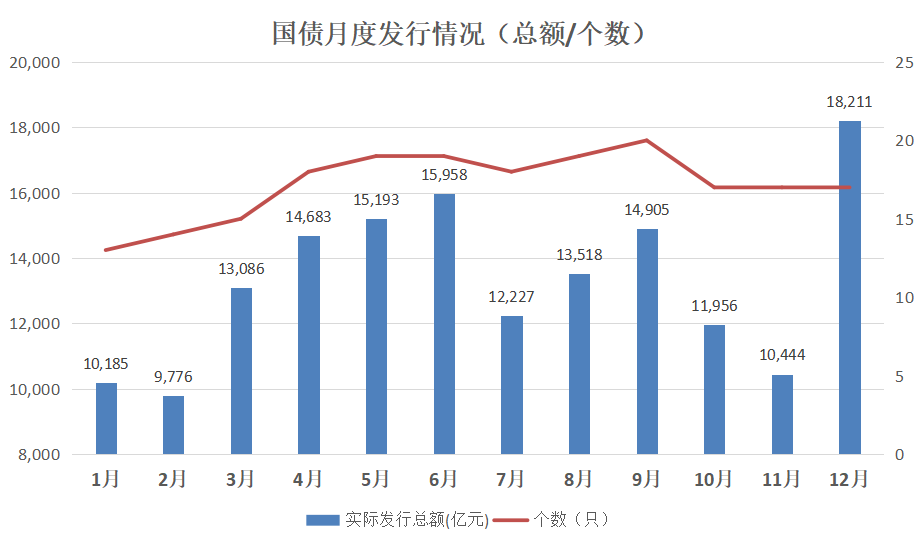
Core Viewpoint - The 2025 Chinese government bond market has undergone deep calibration amid frequent macro narratives and intense long-short logic battles, characterized by record supply and a proactive issuance pace in the primary market, effectively supporting active fiscal policies while the secondary market experienced a narrow range of fluctuations in the 10-year bond yield, which gradually shifted downward throughout the year [1][13]. Group 1: Primary Market Dynamics - In 2025, the primary market for government bonds achieved a historic leap under the theme of "active fiscal policy moderately strengthened, quality improved," with notable features including increased supply scale, scientifically advanced issuance pace, and continuous optimization of maturity structure [2][15]. - The total issuance of government bonds reached a historic high of 16,014.02 billion yuan, a significant increase of 28.37% compared to 12,474.83 billion yuan in 2024, with 206 bonds issued throughout the year [2][15]. - The issuance of special bonds focused on long-term funding for national strategic security areas and key projects, with the issuance of ultra-long special bonds reaching 1.3 trillion yuan, expected to significantly boost annual GDP growth [5][19]. Group 2: Interest Rate Trends - The overall issuance interest rates of government bonds declined, effectively guiding the financing costs across society. The short-term interest rates (1-3 years) ranged from 1.16% to 1.79%, while the 10-year bond issuance rate stabilized around 1.78% [6][19]. - The systematic decline in issuance costs of government bonds, as a risk-free rate anchor, directly contributed to the reduction of comprehensive financing costs in the bond market and the real economy, achieving efficient unity between fiscal sustainability and financial benefits to the real sector [6][19]. Group 3: Secondary Market Developments - The secondary market for government bonds in 2025 was characterized by complex dynamics, with the 10-year bond yield fluctuating between approximately 1.6% and 1.9%, undergoing a "four-round game" of expectations that ultimately established a new oscillating equilibrium [7][21]. - The first round saw a rapid correction of overly optimistic expectations regarding monetary easing, with yields rebounding nearly 40 basis points by mid-March [9][21]. - The fourth round featured a key institutional benefit with the central bank's announcement to restart government bond trading operations, which was interpreted as a significant step in enhancing liquidity management tools and stabilizing long-term expectations [10][22]. Group 4: Strategic Role of Government Bonds - The evolution of the government bond market in 2025 transcended mere financing and trading, extending its functions to monetary policy operations, financial openness, and the construction of the national credit system [11][23]. - The "stabilizer" and "attractiveness" roles of RMB assets have strengthened, with foreign investors steadily increasing their holdings, leading to broader inclusion of government bonds in major global bond indices [11][23]. - The modernization of government bond management, including the incorporation of bond trading into the central bank's regular monetary policy toolbox, marks a significant milestone in establishing a modern central banking system [11][23]. Group 5: Future Outlook - The government bond market is expected to continue evolving under the overarching theme of "high-quality development," balancing necessary government financing, reducing debt costs, and maintaining financial system stability [12][24]. - As market depth, product innovation, and institutional openness progress, the yield curve of government bonds will increasingly serve as a benchmark for asset pricing across society [12][24]. - Market participants will need to shift from merely chasing interest rate trends to developing a deeper understanding of macro logic, seizing structural opportunities, and effectively managing interest rate risks to succeed in the new balanced market [12][24].
特朗普宣布“控制”委内瑞拉总统,石油人民币结算遇阻?S-300为何“失明”?
Sou Hu Cai Jing· 2026-01-04 09:01
Group 1 - The U.S. military operation in Venezuela, named "Operation Justice Mission," signifies a shift in the geopolitical landscape of Latin America and highlights the U.S. strategies in energy dominance, monetary systems, and military technology [2] - Venezuela, holding approximately 300 billion barrels of oil, has seen its oil production plummet to under 1 million barrels per day due to U.S. sanctions, which has severely impacted its economy and energy sector [2] - The U.S. plans to take control of Venezuela's oil industry and revert to a dollar-based settlement system, potentially nullifying existing agreements with China and jeopardizing China's investments in Venezuela [2] Group 2 - The failure of the Russian S-300 air defense system during the U.S. operation underscores the vulnerabilities of traditional military systems in modern electronic warfare, as the system became inoperable under U.S. electronic jamming [2] - The S-300's operational readiness was only 60% due to a lack of Russian technical support, which has been exacerbated by U.S. sanctions, revealing the critical need for countries to develop independent electronic warfare capabilities [2] - The incident reflects a broader trend where smaller nations without robust military technology face significant challenges against technologically advanced adversaries [2] Group 3 - The U.S. actions in Venezuela indicate a growing anxiety regarding its control over the "Global South," with potential repercussions for leftist regimes in the region and an acceleration of de-dollarization efforts in countries like Brazil and Argentina [2] - The crisis may lead to increased cooperation among China, Russia, and Iran, emphasizing the resilience of non-Western alliances and the potential for a shift in global power dynamics [2] - Following the Venezuelan incident, shipping insurance costs in the Caribbean surged by 300%, prompting some shipowners to switch to renminbi settlements, which could further undermine the credibility of the dollar system [3] Group 4 - China is advised to diversify its energy security, expand the reach of its cross-border payment system (CIPS), and enhance its military technology capabilities in response to the dual pressures from the U.S. and the evolving geopolitical landscape [3] - The Venezuelan crisis presents both challenges and opportunities for China to reform and potentially lead a consensus for a "de-hegemonization" movement among Global South nations, paving the way for a multipolar order [3] - The U.S. operation is characterized as a preventive strike to maintain its hegemonic status, yet it may inadvertently accelerate the fragmentation of global power structures [3]

数字人民币需突破支付局限,开拓数字新格局
Sou Hu Cai Jing· 2026-01-04 07:49
数字人民币支付场景走通已不是问题,重点在于解决个人和机构的持有和应用意愿、调动商业银行推广 的积极性、明确各类相关者的义务和利益、处理好与银行账户的关系,保证跨境支付结算的顺畅平滑 文|刘晓春 最后,实现真正的支付即结算。由于数字人民币是法定货币,支付即时到账,不需要再进行其他兑换或 托收操作。而稳定币等只是支付凭证,不是货币本身,支付后收款人还需兑换或托收法定货币才能真正 实现结算。 以上只是就业务应用角度谈成绩,数字人民币在技术创新应用方面也有许多可圈可点之处。 推广应用中存在不足 然而,虽然进行了大规模的试点,但数字人民币在推广应用中还是存在一些不足之处。这主要表现在: 民众使用的主动性不够,企事业单位持有意愿不强,商业银行缺乏推广积极性,跨境支付尚不流畅等。 究其原因,主要有以下几方面: 数字人民币自开始研究到逐步扩大试点规模,至今已经走过十个年头,取得了巨大的成就,在全球央行 数字货币领域绝无仅有。 首先,支付场景全面。数字人民币支持1000多万个场景的支付结算,可以说几乎覆盖了目前所有的支付 需求。 其次,方便性优于第三方支付等支付方式。数字人民币在支付环节的操作上,一般环境下与第三方支付 等其他 ...
中美贸易逆差洗牌,中国巨额抛美债,美元储备时代落幕信号
Sou Hu Cai Jing· 2026-01-04 00:52
Group 1 - The core point of the article highlights that while the U.S. trade deficit with Mexico has surpassed that with China in August, China remains the largest trade deficit country for the U.S. when considering cumulative data [1][3] - In the first three quarters, China's trade surplus with the U.S. reached $124 billion, while Mexico's was $116.2 billion, indicating that short-term data can be misleading [3] - The article emphasizes that the trade deficit is a reflection of the structural issues in U.S. manufacturing competitiveness, as both China and Mexico contribute significantly to the U.S. trade deficit [10][15] Group 2 - China has sold off $70.3 billion in U.S. Treasury bonds in the first ten months of the year, with a recent reduction of $11.8 billion, indicating a shift in its investment strategy [5][6] - The reduction in U.S. Treasury holdings suggests a decreasing reliance on the dollar, as China's foreign exchange reserves amount to $3.4 trillion, but the proportion of dollar assets is shrinking [8] - The article discusses the broader implications of this trend, suggesting a move towards a more diversified reserve system and the acceleration of the internationalization of the renminbi [8][16] Group 3 - The increase in the trade deficit with Mexico is attributed to the tight cooperation within the North American supply chain and the benefits of the USMCA agreement, which poses challenges for China [10] - The ongoing trade tensions, technological restrictions, and political dynamics between the U.S. and China complicate their financial relationship, necessitating strategic flexibility for China [11] - The article concludes that the reduction of U.S. Treasury holdings by China signals a changing global financial landscape, with a trend towards "de-dollarization" and a more multipolar international monetary system [13][16]