
货币政策

Search documents
央行开展1万亿买断式逆回购操作,流动性投放量为三个月内最高
Sou Hu Cai Jing· 2026-02-13 03:07
Group 1 - The People's Bank of China (PBOC) announced a 1 trillion yuan reverse repo operation to maintain ample liquidity in the banking system, with a fixed quantity and multi-price bidding method, set for February 13, 2026, with a term of 6 months [1] - The PBOC will achieve a net liquidity injection of 500 billion yuan due to the maturity of a 6-month reverse repo in February, alongside an additional 800 billion yuan 3-month reverse repo operation conducted on February 4, leading to a total net liquidity injection of 600 billion yuan for the month [1] - This marks the ninth consecutive month that the PBOC has injected medium-term liquidity into the market through reverse repos, reflecting a continuation of the "moderately accommodative" monetary policy stance [1] Group 2 - Analysts suggest that the PBOC's actions through reverse repos and Medium-term Lending Facility (MLF) operations have effectively maintained market liquidity and improved the maturity structure of liquidity, ensuring stability in the financial market at the year's end [2] - It is anticipated that the PBOC will conduct an MLF operation around February 25, likely maintaining or slightly increasing the amount injected [2]

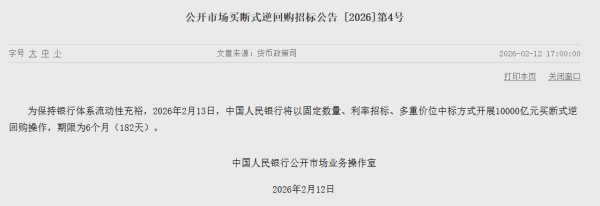
央行开展10000亿元买断式逆回购操作,加量规模5000亿
Guan Cha Zhe Wang· 2026-02-13 02:37
Group 1 - The People's Bank of China (PBOC) will conduct a 10 trillion yuan reverse repurchase operation on February 13, 2026, to maintain ample liquidity in the banking system, with a term of 6 months (182 days) [1] - In February, there will be a net liquidity injection of 500 billion yuan due to the maturity of a previous 500 billion yuan 6-month reverse repurchase operation, alongside an 800 billion yuan 3-month reverse repurchase operation conducted on February 4 [2] - This marks the 9th consecutive month of increased reverse repurchase operations by the PBOC, with a net injection scale increasing by 300 billion yuan compared to the previous month, reaching the highest net injection in three months [2] Group 2 - The PBOC's actions through reverse repurchase and Medium-term Lending Facility (MLF) operations have effectively maintained market liquidity and ensured stable financial market operations at the year's end [3] - It is anticipated that the PBOC will conduct an MLF operation around February 25, likely maintaining or slightly increasing the current liquidity levels [3]
今晚九点半,美国1月CPI登场:通胀故事进入“慢节奏”?
Jin Shi Shu Ju· 2026-02-13 02:35
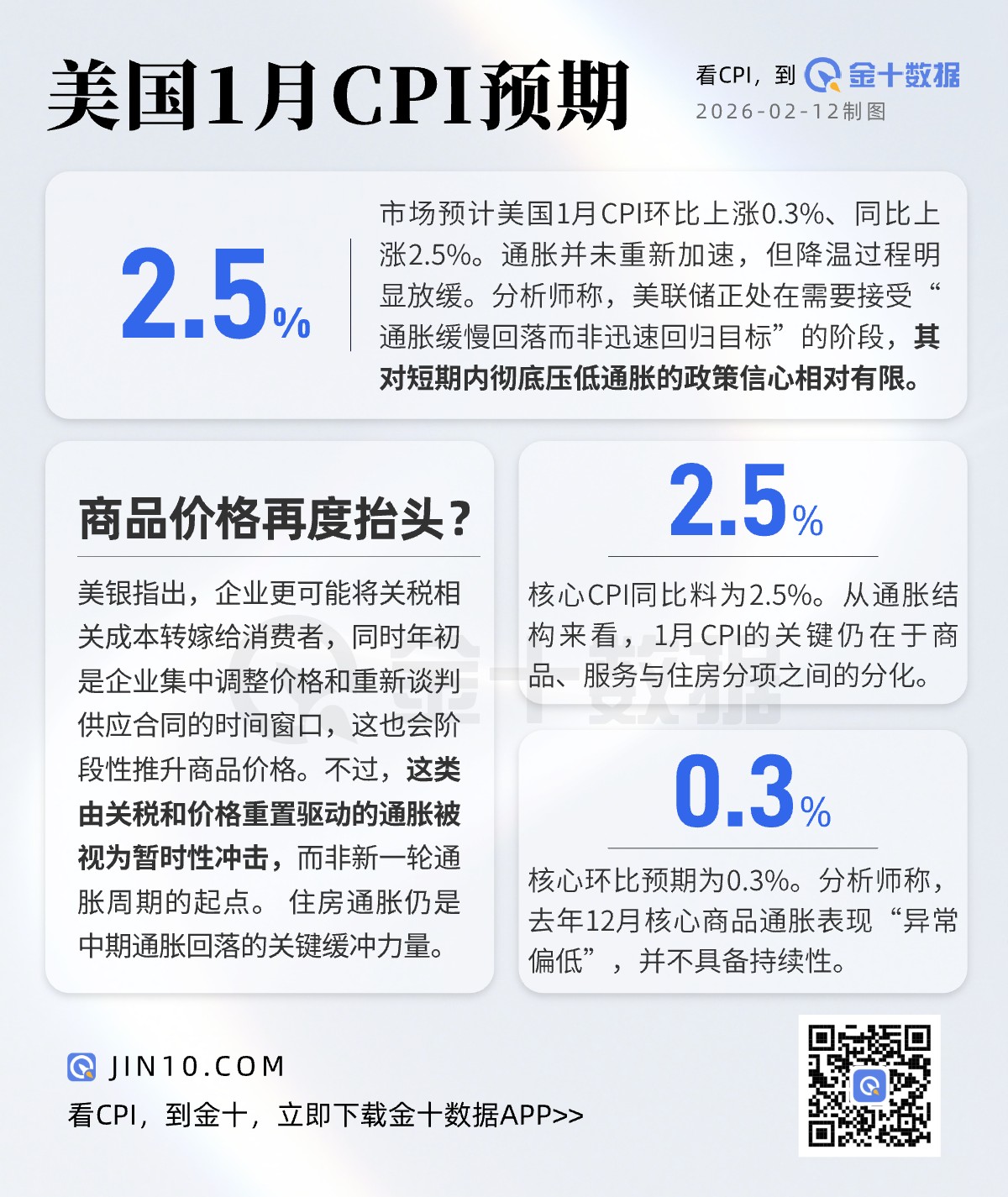
Core Viewpoint - The January Consumer Price Index (CPI) is expected to show a stabilization of high inflation levels, indicating that inflation is controlled but not rapidly declining, which will influence the assessment of the U.S. inflation trajectory and monetary policy environment for 2026 [1][4]. Inflation Trends - The January CPI is projected to increase by 0.3% month-over-month, remaining stable compared to December, while the year-over-year growth rate is expected to decline to around 2.5% [4]. - Core CPI, excluding food and energy, is also anticipated to rise by 0.3% month-over-month, with a slight year-over-year decrease to 2.5% from 2.6% [4]. Price Pressures - Despite the stabilization, price pressures persist, keeping inflation above the Federal Reserve's 2% target [4]. - Economists suggest that the Federal Reserve may need to accept a slow decline in inflation rather than a rapid return to target levels [4]. Commodity Prices - The January CPI will reflect a divergence among goods, services, and housing, with core commodity prices expected to exert upward pressure on overall inflation [5]. - Factors such as tariffs and seasonal price adjustments at the beginning of the year are likely to contribute to a temporary increase in commodity prices [5]. Housing Market Dynamics - Housing remains a critical buffer for mid-term inflation, with rental prices showing a year-over-year decline of 1.4% and a significant drop from peak levels [6]. - The rental market is experiencing increased vacancy rates and longer average vacancy times, indicating a potential continuation of downward pressure on rents [6]. Future Inflation Outlook - Short-term inflation may see a temporary rise due to inventory replenishment and increased transportation costs, but this is expected to be predictable and phase-based [7]. - The Federal Reserve's focus is shifting towards the labor market, with recent strong employment data influencing market expectations regarding interest rate decisions [7].
宏观金融类:文字早评2026/02/13星期五-20260213
Wu Kuang Qi Huo· 2026-02-13 01:49
Report Industry Investment Rating No information provided in the report. Core Views - In the medium to long term, the policy's supportive attitude towards the capital market remains unchanged. The strategy is to buy on dips. For the bond market, it is expected to be in a strong and volatile trend. For precious metals, they are in a high - level volatile pattern, and the market focus has shifted to the upcoming US CPI data. For various commodities, their price trends are affected by factors such as supply - demand relationships, seasonal factors, and policy impacts, and corresponding trading strategies are proposed for each commodity [4][7][9]. Summary by Directory Macro - Financial Category Index - **Market Information**: On February 13, the central bank conducted 100 billion yuan of outright reverse repurchase operations; the European Central Bank Executive Committee will expand the scope of application of the euro back - up financing mechanism; many car companies disclosed their solid - state battery technology paths and industrial plans; some companies made progress in 3D printing technology and PCB production [2]. - **Basis Annualized Ratio**: Presented the basis annualized ratios of IF, IC, IM, and IH for different contract periods [3]. - **Strategy View**: Due to the intensifying divergence in US monetary policy expectations, the risk appetite of the capital market is suppressed, and the US stocks and precious metals are highly volatile. Domestically, the liquidity is tightened seasonally approaching the Spring Festival. The strategy is to buy on dips [4]. Treasury Bonds - **Market Information**: On February 13, the central bank conducted 100 billion yuan of 6 - month outright reverse repurchase operations, with an incremental scale of 50 billion yuan compared to the maturity amount. In 2025, commercial banks' net profit was 2.4 trillion yuan, and the average capital profit rate and average asset profit rate were 7.78% and 0.60% respectively. The central bank's net injection on Thursday was 44.8 billion yuan [5][6]. - **Strategy View**: The central bank emphasizes the coordination of monetary and fiscal policies, and the capital market is expected to remain loose. The economic recovery foundation is not solid, and the bond market is expected to be in a strong and volatile trend [7]. Precious Metals - **Market Information**: On Thursday, precious metals tumbled. The decline was due to the decline of US technology stocks, investors' forced liquidation, and profit - taking. The US initial jobless claims and continuing jobless claims data were released, and the US existing home sales in January decreased by 8.4% month - on - month [8]. - **Strategy View**: Although short - term monetary policy expectations suppress precious metals, they are still in a high - level volatile pattern. The market is waiting for the US CPI data. The strategy is to wait and see, with the reference ranges of 950 - 1100 yuan/gram for Shanghai gold and 18500 - 21000 yuan/kilogram for Shanghai silver [9][10]. Non - Ferrous Metals Category Copper - **Market Information**: Before the domestic long holiday, funds were cautious. Overnight silver and US stocks declined, and copper prices fell after rising. LME copper inventory increased, and the domestic electrolytic copper social inventory also increased [12][13]. - **Strategy View**: Although the market sentiment is affected by the decline of precious metals, the strong manufacturing in Europe and the US provides support. The copper price is expected to be in a high - level volatile pattern during the long holiday, with reference ranges of 99000 - 103000 yuan/ton for Shanghai copper and 12500 - 13200 US dollars/ton for LME copper [14]. Aluminum - **Market Information**: The Mozambique aluminum smelter is expected to shut down for maintenance in March. Aluminum prices rose and then fell. The domestic aluminum ingot and aluminum rod inventories increased, and the LME aluminum inventory decreased [15]. - **Strategy View**: The domestic demand is weak, but the low LME inventory and high US aluminum spot premium support the price. The aluminum price is expected to be in a volatile and upward trend during the long holiday, with reference ranges of 23200 - 23600 yuan/ton for Shanghai aluminum and 3050 - 3140 US dollars/ton for LME aluminum [16]. Zinc - **Market Information**: The zinc index rose slightly. The domestic zinc ingot social inventory started to accumulate, and the downstream enterprise operation was average [17]. - **Strategy View**: The zinc mine inventory accumulation slowed down, and the zinc concentrate TC stabilized. Although the domestic zinc industry is weak, the strong US PMI may drive the zinc price to rise, and there is still a risk of price fluctuations during the Spring Festival [17][18]. Lead - **Market Information**: The lead index fell slightly. The lead ingot social inventory increased, and the waste battery inventory was higher than that in 2025 [19]. - **Strategy View**: The lead ore inventory is still higher than the same period in previous years, and the lead concentrate processing fee is low. The lead price is near the lower edge of the long - term shock range, and whether it can stabilize depends on the post - holiday restocking willingness of downstream enterprises [19]. Nickel - **Market Information**: The nickel price fluctuated. The spot premium of nickel was stable, and the nickel ore price was stable. The price of nickel iron rose slightly [20]. - **Strategy View**: After the second decline of precious metals and risk assets, there is a short - term rebound demand, but the nickel price is expected to be in a wide - range volatile pattern due to fundamental pressure. The approved nickel ore production quota has little impact on the price, with reference ranges of 120,000 - 150,000 yuan/ton for Shanghai nickel and 16,000 - 18,000 US dollars/ton for LME nickel [20]. Tin - **Market Information**: The tin price fluctuated. The smelter's production in Yunnan was stable, and that in Jiangxi was low due to the shortage of waste tin raw materials. The downstream demand was weak [21]. - **Strategy View**: The tin price may rebound with the stabilization of precious metals, but it is expected to be in a wide - range volatile pattern in the short term due to the marginal relaxation of supply - demand and the increase in inventory. It is recommended to wait and see, with reference ranges of 350,000 - 410,000 yuan/ton for the domestic main contract and 46,000 - 50,000 US dollars/ton for LME tin [23]. Lithium Carbonate - **Market Information**: The lithium carbonate spot index rose, and the futures price fell slightly. The inventory decreased [24]. - **Strategy View**: The supply has decreased, and the demand is expected to be strong. The short - term supply - demand pattern is tight. The upstream has more bargaining power after the holiday. The reference range for the Guangzhou Futures Exchange's lithium carbonate 2605 contract is 143,000 - 157,000 yuan/ton [25]. Alumina - **Market Information**: The alumina index fell slightly, and the trading volume decreased. The spot price in Shandong was at a discount to the main contract [26]. - **Strategy View**: There is a strike in the Guinea bauxite mine area, and the alumina smelting capacity is in excess. It is recommended to wait and see, with the reference range of 2750 - 3000 yuan/ton for the main contract AO2605 [27]. Stainless Steel - **Market Information**: The stainless steel main contract fell. The spot price was stable, and the inventory increased [29]. - **Strategy View**: The supply pressure is controllable, and the demand is weak before the Spring Festival. It is recommended to buy on dips, with the reference range of 13,500 - 14,500 yuan/ton for the main contract [29]. Cast Aluminum Alloy - **Market Information**: The cast aluminum alloy price rebounded slightly, and the trading volume increased. The inventory increased [30]. - **Strategy View**: Although the demand is average, the price is supported by supply - side disturbances and seasonal raw material shortages [31]. Black Building Materials Category Steel - **Market Information**: The prices of rebar and hot - rolled coil decreased slightly. The rebar inventory started to accumulate, and the hot - rolled coil inventory increased slightly [33]. - **Strategy View**: The carbon emission trading policy may increase the cost of the steel industry. The steel market is in a bottom - game stage, and it is expected to be in a weak and volatile pattern in the short term. Attention should be paid to inventory inflection points and policy changes [35]. Iron Ore - **Market Information**: The iron ore main contract fell slightly. The overseas iron ore shipment decreased, and the port inventory decreased [36]. - **Strategy View**: The overseas iron ore shipment is in the off - season, and the iron water production is in a recovery trend. The ore price is expected to be in a weak and volatile pattern before the festival. Attention should be paid to overseas shipments and domestic terminal demand after the festival [37]. Coking Coal and Coke - **Market Information**: The prices of coking coal and coke fell slightly. The spot prices of coking coal and coke were at a premium to the futures prices [38]. - **Strategy View**: Overseas coal - related disturbances have a positive impact on sentiment, but the short - term upward drive of coking coal is not strong. The downstream replenishment is coming to an end, and there is a risk of price correction after the festival. Coking coal may have a better performance from June to October [40][42]. Glass and Soda Ash - **Glass** - **Market Information**: The glass main contract fell. The inventory increased, and the downstream demand was weak [44]. - **Strategy View**: The glass market is expected to be in a volatile and sorted pattern, with the reference range of 1030 - 1120 yuan/ton for the main contract [45]. - **Soda Ash** - **Market Information**: The soda ash main contract fell. The inventory increased, and the demand for heavy soda ash was weak [46]. - **Strategy View**: The soda ash market is in a weak and stable volatile pattern, with the reference range of 1140 - 1230 yuan/ton for the main contract [46]. Manganese Silicon and Ferrosilicon - **Market Information**: The prices of manganese silicon and ferrosilicon fell. The spot prices were at a premium to the futures prices [47]. - **Strategy View**: The long - term commodity market is expected to be bullish, but the short - term market sentiment is affected by precious metals. The supply - demand pattern of manganese silicon is loose, and that of ferrosilicon is balanced. Attention should be paid to the cost push of manganese ore and the supply contraction of ferrosilicon [48][49]. Industrial Silicon and Polysilicon - **Industrial Silicon** - **Market Information**: The industrial silicon futures price fell. The supply is expected to decrease, and the demand is weak [50]. - **Strategy View**: The industrial silicon market is in a situation of weak supply and demand in February. The price is expected to be in a weak and volatile pattern, and attention should be paid to market sentiment [51]. - **Polysilicon** - **Market Information**: The polysilicon futures price fell. The supply decreased, and the inventory is expected to decrease slightly [52]. - **Strategy View**: The polysilicon market is expected to be in a volatile pattern. It is recommended to wait and see, and attention should be paid to post - holiday demand and spot prices [53]. Energy and Chemical Category Rubber - **Market Information**: The rubber price fluctuated with the commodity market. The tire enterprise operating rate decreased, and the inventory increased [56][57]. - **Strategy View**: It is recommended to reduce risks before the Spring Festival, trade short - term on the disk, and hold a hedging position during the festival [58]. Crude Oil - **Market Information**: The crude oil futures price rose slightly. The US crude oil commercial inventory increased, and the diesel and fuel oil inventories decreased [59]. - **Strategy View**: The current oil price has priced in a high geopolitical premium. It is recommended to take profits on rallies and focus on medium - term layout [61]. Methanol - **Market Information**: The methanol spot price changed slightly, and the futures price decreased [62]. - **Strategy View**: Methanol has priced in many negative factors. It is recommended to stop losses on short positions and wait and see in the short term [63]. Urea - **Market Information**: The urea spot price was stable, and the futures price rose [64]. - **Strategy View**: The import window has opened, and the fundamental outlook is negative. It is recommended to short - sell [65]. PVC - **Market Information**: The PVC futures price fell. The supply was high, and the demand was weak. The inventory increased [66]. - **Strategy View**: The PVC market has a situation of strong supply and weak demand. The short - term price is supported by electricity price expectations and export rush, and attention should be paid to capacity and operating rate changes [67]. Ethylene Glycol - **Market Information**: The ethylene glycol futures price fell. The supply was high, and the demand was weak. The inventory increased [68]. - **Strategy View**: The ethylene glycol market needs to reduce production to improve the supply - demand pattern. There is a risk of price rebound due to geopolitical factors and coal price rebound [69]. PTA - **Market Information**: The PTA futures price fell. The supply was high, and the demand was weak. The inventory increased [70]. - **Strategy View**: The PTA market is in the Spring Festival inventory - accumulation stage. The processing fee is expected to be stable at a high level, and there is an opportunity to buy on dips after the Spring Festival [71]. p - Xylene - **Market Information**: The p - xylene futures price fell. The supply was high, and the demand from downstream PTA was weak. The inventory increased [72]. - **Strategy View**: The p - xylene market is expected to accumulate inventory before the maintenance season. The valuation is expected to rise after the Spring Festival, and there is an opportunity to buy on dips following the crude oil price [73][74]. Agricultural Products Category Live Pigs - **Market Information**: The domestic pig price fluctuated. The trading volume decreased approaching the Spring Festival [76]. - **Strategy View**: The short - term pig price is under pressure due to large supply and high inventory. It is recommended to short - sell on rallies. The long - term price may be supported by seasonal factors and demand recovery [77]. Eggs - **Market Information**: The egg price was stable in most markets approaching the Spring Festival [78]. - **Strategy View**: The egg market is in the inventory - accumulation period. The short - term price is under pressure, and it is recommended to short - sell. The long - term price trend depends on capacity reduction [79]. Soybean and Rapeseed Meal - **Market Information**: The domestic soybean meal price was stable, and the rapeseed meal price rose. The global soybean supply and demand were slightly adjusted in the USDA report [80]. - **Strategy View**: The short - term protein meal price is expected to be in a volatile pattern due to the increase in US soybean procurement expectations and the rise in import costs [81]. Oils and Fats - **Market Information**: The domestic soybean oil price rose, the palm oil price fell, and the rapeseed oil price was stable. The global palm oil supply and demand data were released [82][83]. - **Strategy View**: The consumption growth of oils and fats is greater than the production growth this year. It is recommended to wait for a pull - back to go long [84]. Sugar - **Market Information**: The domestic sugar price fell. The domestic and foreign sugar production and sales data were released [85][86]. - **Strategy View**: The international sugar price may rebound after the northern hemisphere's harvest is completed. The domestic sugar price has limited downward space. It is recommended to wait and see [87]. Cotton - **Market Information**: The domestic cotton price rose. The domestic and foreign cotton supply and demand data were released in the USDA report [88][89]. - **Strategy View**: The USDA report is neutral. It is recommended to try to go long at the lower edge of the shock range after the Spring Festival, and attention should be paid to the downstream operating rate and the new cotton target price policy [90].
建信期货国债日报-20260213
Jian Xin Qi Huo· 2026-02-13 01:30
1. Report Information - Report Name: Treasury Bond Daily Report [1] - Date: February 13, 2026 [2] - Researchers: He Zhuoqiao, Huang Wenxin, Nie Jiayi [3] 2. Core Viewpoints - The current fundamental situation is weak, with the January PMI falling more than seasonally. In February, affected by the Spring Festival, the economic indicators are expected to decline further. However, structural interest rate cuts have been implemented, and the central bank's bond - buying scale is low, so the market's expectation of monetary easing is not strong. The planned issuance of local bonds in the first quarter is high, causing concerns about supply pressure [11]. - The current yield level of 10 - year treasury bonds around 1.8% does not fully price in the potential easing space. There is support from allocation demand at the beginning of the year, and the central bank is actively maintaining the money market, so the upside space of interest rates is limited. In February, the bond market is in a situation of mixed long - and short - term factors and may continue to fluctuate within a range [11][12]. - Before the Spring Festival, the central bank will actively maintain the cross - festival money market, and the supply pressure of government bonds is controllable, so the market environment is relatively warm. After the Spring Festival, the supply pressure will increase. Although the return of cash will supplement liquidity, the central bank usually withdraws funds, which may be unfavorable for short - term bonds. The market is more likely to bet on holiday economic data and important meetings and policies in March, and long - term bonds may be more advantageous. This week is the last trading week before the Spring Festival, trading is expected to be light, and short - term bonds should have stronger support [12] 3. Summary by Directory 3.1 Market Review and Operation Suggestions - **Market Conditions on the Day**: The money market improved slightly but remained in a tight balance. Treasury bond futures fluctuated within a narrow range [8]. - **Interest Rate Bonds**: The yields of major interest rate bonds in the inter - bank market declined across the board, with a larger decline in long - term interest rates. By 16:30, the yield of the 10 - year treasury bond active bond 250016 was reported at 1.774%, a decrease of 1.2bp [9]. - **Money Market**: The inter - bank money market improved marginally but remained in a tight balance. The net reverse repurchase injection in the open market was 448 billion yuan. The inter - bank money sentiment index was high in the morning and slightly declined in the afternoon. The overnight DR in the inter - bank deposit market fluctuated narrowly around 1.37%, the 7 - day funds rate fell about 1.3bp to around 1.53%, and the medium - and long - term funds were stable. The 1 - year AAA certificate of deposit rate fluctuated narrowly around 1.6% [10] 3.2 Industry News - The People's Bank of China released the "Fourth - Quarter 2025 China Monetary Policy Implementation Report" on February 10. The report proposed that the central bank will conduct counter - cyclical and cross - cyclical adjustments, support the good start of the "15th Five - Year Plan", and continue to implement a moderately loose monetary policy. It also introduced three ways of coordination between monetary policy and fiscal policy [13]. - Japanese Prime Minister Takamachi Sanae said she is open to dialogue with China. The Chinese Foreign Ministry Spokesperson Lin Jian responded that such "dialogue" is unacceptable [13]. - US President Trump said he is considering sending another aircraft carrier strike group to the Middle East in case the negotiation with Iran fails. The US and Iran restarted negotiations in Oman last Friday, and the second - round negotiation is expected to be held next week [14]. - Before the Spring Festival, the competition among banks for deposits has heated up again. Small and medium - sized banks mainly attract customers by raising the interest rates of specific deposit products, while large banks use methods such as giving points and reward vouchers. Multiple institutions and industry insiders believe that the matured time - deposit funds in 2026 are likely to circulate within the banking system and flow more to low - risk assets such as bank wealth management, money market funds, and insurance [14] 3.3 Data Overview - **Treasury Bond Futures Market**: The report provides trading data of treasury bond futures on February 12, including the previous settlement price, opening price, closing price, settlement price, change, change percentage, trading volume, open interest, and change in open interest of various contracts [6] - **Money Market**: The report includes information such as the SHIBOR term structure change, SHIBOR trend, change in the weighted average interest rate of inter - bank pledged repurchase, and change in the pledged repurchase rate of inter - bank deposits [29][33] - **Derivatives Market**: The report shows the Shibor3M interest rate swap fixing curve (mean) and the FR007 interest rate swap fixing curve (mean) [35]
国际金融市场早知道:2月13日
Sou Hu Cai Jing· 2026-02-13 00:57
Group 1 - The Trump administration has officially rescinded the 2009 "greenhouse gas endangerment finding" by the Environmental Protection Agency, which is expected to save $1.3 trillion in regulatory costs and help lower car prices [1] - The U.S. House of Representatives passed a resolution to terminate punitive tariffs on Canadian goods, while the Senate blocked a funding bill for the Department of Homeland Security, risking a potential government shutdown [2] - U.S. Treasury Secretary agreed to transfer the investigation authority over Federal Reserve Chairman Powell from the Justice Department to the Senate Banking Committee, aiming to facilitate the nomination of a new Fed chair [2] Group 2 - The Reserve Bank of Australia Chairman warned that an inflation rate above 3% is unacceptable and indicated readiness to raise interest rates again if inflation remains stubborn [3] - The UK economy is projected to grow by 1.3% in 2025, with a quarterly GDP growth of only 0.1% in Q4 2025, which is below expectations [3] - The Turkish central bank will maintain a tight monetary policy to ensure inflation decreases, with expectations for inflation to fall between 15% and 21% by the end of 2026 [3] Group 3 - U.S. stock indices closed lower, with the Dow Jones down 1.34% to 49,451.98 points, the S&P 500 down 1.57% to 6,832.76 points, and the Nasdaq down 2.03% to 22,597.15 points [4] - International precious metal futures saw significant declines, with COMEX gold futures down 3.08% to $4,941.4 per ounce and COMEX silver futures down 10.62% to $75.01 per ounce [5] - U.S. oil futures fell by 2.66% to $62.91 per barrel, while Brent oil futures dropped by 2.61% to $67.59 per barrel [5]
央行加量续作5000亿元买断式逆回购,降准可能性降低|快讯
Sou Hu Cai Jing· 2026-02-13 00:24
Group 1 - The central bank announced a significant increase in the scale of reverse repos, with a planned operation of 1 trillion yuan (approximately 100 billion) on February 13, aimed at maintaining ample liquidity in the banking system [1] - The operation includes a 6-month reverse repo, which is a continuation of the previous month's operations, indicating a cumulative net injection of 600 billion yuan (approximately 60 billion) for February, marking the ninth consecutive month of liquidity injection through reverse repos [1] - Analysts suggest that February is a month with concentrated bank credit issuance, and the increase in liquidity demand is influenced by factors such as increased cash withdrawals before the Spring Festival [1] Group 2 - The central bank's actions are seen as a proactive measure to ensure liquidity and stabilize the financial market, with expectations of further operations, including MLF, around February 25 [2] - The use of both reverse repos and MLF reflects the continuation of a moderately loose monetary policy, aiming to keep liquidity abundant [2] - The increase in reverse repo net injection in February suggests a reduced likelihood of a reserve requirement ratio (RRR) cut in the near term [2]
央行10000亿买断式逆回购来了 延续流动性宽松
2 1 Shi Ji Jing Ji Bao Dao· 2026-02-12 23:50
Core Viewpoint - The People's Bank of China (PBOC) announced a 10 trillion yuan reverse repurchase operation to maintain liquidity in the banking system, indicating a continued supportive monetary policy stance [1][4]. Group 1: Reverse Repo Operations - On February 13, the PBOC will conduct a 10 trillion yuan buyout reverse repo operation with a term of 6 months, marking the sixth consecutive month of increased operations [2][5]. - The operation will utilize a fixed quantity, interest rate bidding, and multiple price levels, with eligible collateral including government bonds, local government bonds, financial bonds, and corporate credit bonds [1][4]. - In February, there will be a 5 trillion yuan 6-month reverse repo maturing, resulting in a net liquidity injection of 5 trillion yuan [5][6]. Group 2: Market Liquidity and Economic Support - Analysts suggest that the PBOC's actions are aimed at ensuring funding for key projects and supporting economic recovery, especially with the early issuance of local government debt limits for 2026 [2][6]. - The combined net injection from the 6-month and 3-month reverse repos in January was 6 trillion yuan, a 3 trillion yuan increase from the previous month, reflecting a sustained effort to inject medium-term liquidity into the market [6][7]. - The PBOC's approach indicates a commitment to maintaining a stable and ample liquidity environment ahead of the Spring Festival, which is crucial for government bond issuance and financial institution credit support [3][7]. Group 3: Future Expectations - Looking ahead, the PBOC is expected to continue using reverse repos and Medium-term Lending Facility (MLF) tools to inject liquidity, with a potential 3 trillion yuan MLF maturing in February [7]. - The increase in net reverse repo injections suggests a reduced likelihood of interest rate cuts in the near term, as the monetary policy remains in an observation phase following a structural policy package introduced on January 15 [7].
英国央行副行长Breeden预计英国在4月底前降息25个基点
Sou Hu Cai Jing· 2026-02-12 14:53
英国央行政策制定者Sarah Breeden表示,"有理由预计"央行在4月底前将再降息25个基点。这位负责金 融稳定事务的副行长在接受采访时表示,现在是"松开货币刹车"的时候,通过降低借贷成本为经济提供 更多支持。本月早些时候,英国央行以微弱投票优势将利率维持在3.75%。货币政策委员会以5比4的结 果决定按兵不动,行长安德鲁·贝利投下决定性的一票。Breeden是主张降息的四名委员之一。她表示, 她更关注增长放缓和失业率上升的下行风险。她说:"我并不确信我们会看到经济活动回升。因此,我 认为适度松开货币刹车、为经济提供更多支持是合适的。" ...
【环球财经】土耳其央行预计2026年底通胀率将降至15%至21%区间
Xin Hua Cai Jing· 2026-02-12 14:25
Core Viewpoint - The Central Bank of Turkey expects inflation to decrease to a range of 15% to 21% by the end of 2026, maintaining a tight monetary policy stance to support this process [1] Group 1: Inflation Forecast - The Central Bank predicts that by the end of 2027, inflation could further decline to a range of 6% to 12% [1] - Recent data indicates a reduction in inflationary pressure in certain service categories, particularly a decrease in rental price pressures, which is seen as a key factor for the next phase of inflation decline [1] Group 2: Monetary Policy Stance - The Central Bank emphasizes the importance of a "prudent, data-driven" monetary policy stance due to multiple risks affecting the inflation outlook [1] - The Central Bank will decisively utilize all available policy tools in the future to ensure the continued positive effects of tight monetary policy on inflation [1] Group 3: Current Inflation Data - As of January 2026, Turkey's consumer price index increased by 30.65% year-on-year and 4.84% month-on-month [1]