
国产替代

Search documents
存储巨头业绩超预期,半导体设备ETF(561980)领涨,国产替代逻辑再强化
Sou Hu Cai Jing· 2026-02-13 02:46
Group 1 - The semiconductor equipment and materials sectors are leading the market due to dual drivers of supply-demand dynamics and an upward economic cycle, with the semiconductor equipment ETF (561980) rising nearly 2% in early trading and closing up 1.92% [2] - Kioxia, a major global memory chip manufacturer, reported a significant increase in its annual revenue and net profit targets, exceeding analyst expectations by approximately 35% to 60%, driven by strong demand for high-performance storage products from AI servers and the high-end smartphone market [4] - South Korean semiconductor exports surged to $6.73 billion in the first 10 days of February, marking a year-on-year increase of 137.6%, with Samsung Electronics' stock reaching record highs [4] Group 2 - The semiconductor industry is experiencing a price surge in memory chips from 2025 to 2026, positively impacting the profitability of chip design companies and wafer manufacturers, which in turn is expected to boost orders for upstream semiconductor equipment and materials [6] - The semiconductor equipment ETF (561980) tracks the CSI Semiconductor Industry Index, with over 90% weight in equipment, materials, and design, and the top ten constituent stocks accounting for about 75% [6] - Global semiconductor sales are projected to reach $78.88 billion by December 2025, reflecting a year-on-year growth of 37.1%, with China's semiconductor sales at $21.29 billion, showing a 34.1% increase year-on-year [8]

海外存储巨头业绩爆表,半导体设备ETF(561980)高开领涨,国产替代逻辑再强化!
Sou Hu Cai Jing· 2026-02-13 02:40
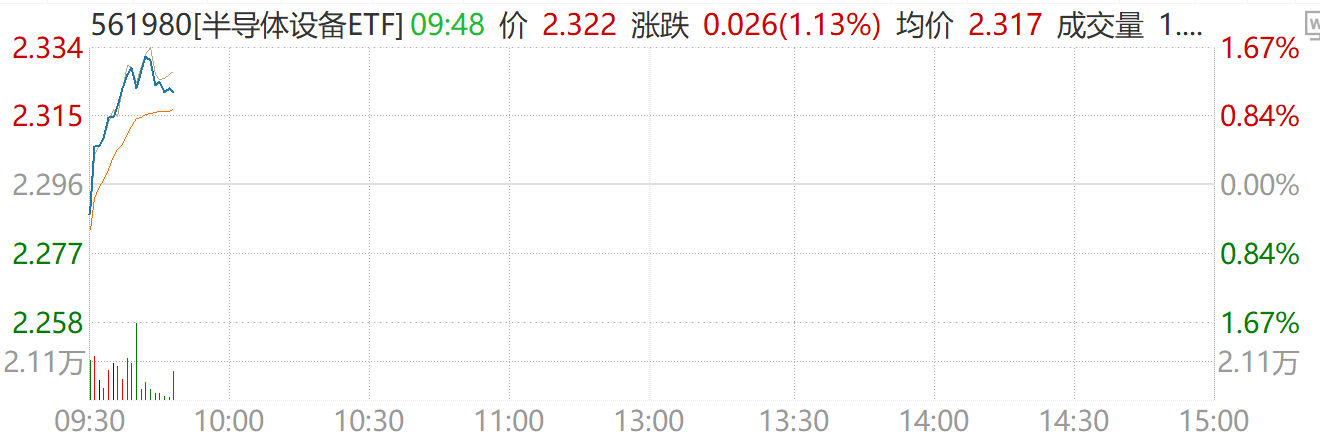
Core Viewpoint - The semiconductor equipment and materials sectors are experiencing significant market gains driven by both supply-demand dynamics and an upward economic cycle, with a notable performance from the semiconductor equipment ETF (561980) [1][3]. Group 1: Market Performance - The semiconductor equipment ETF (561980) opened over 1% higher and rose by 1.26% to a latest scale of 3.515 billion yuan, with net inflows of funds on the previous trading day [1]. - Key stocks in the sector, such as Rich Technology and Tuojing Technology, saw gains exceeding 5% and 4% respectively, while other companies like Chipone, Northern Huachuang, and Huafeng Measurement Control also experienced increases [1]. Group 2: Catalysts for Growth - The strong performance in the equipment and materials sectors is primarily attributed to overseas storage companies reporting high growth and the positive impact of the South Korean semiconductor market reaching new highs [3]. - Kioxia, a major global storage chip manufacturer, reported a significant increase in its annual revenue and net profit targets, exceeding analyst expectations by approximately 35% to 60%, driven by robust demand for high-performance storage products from AI servers and the high-end smartphone market [3]. Group 3: Industry Trends - The semiconductor industry is witnessing a price surge in storage chips from 2025 to 2026, which is expected to enhance the profitability of chip design companies and wafer manufacturers, thereby increasing their willingness to expand production and capital expenditures [5]. - The semiconductor equipment ETF (561980) tracks the CSI Semiconductor Industry Index, with over 90% weight in upstream sectors, and the top ten constituent stocks accounting for about 75% [5]. Group 4: Sales Data and Localization - According to SIA, global semiconductor sales are projected to reach $78.88 billion by December 2025, reflecting a year-on-year growth of 37.1% and a quarter-on-quarter increase of 2.7%, marking 26 consecutive months of positive year-on-year growth [8]. - China's semiconductor sales are expected to reach $21.29 billion, with a year-on-year growth of 34.1% and a quarter-on-quarter growth of 3.8%, indicating an overall upward cycle [8]. - The domestic semiconductor equipment industry in China is transitioning from "catching up" to "keeping pace," with a projected increase in localization rates for wafer manufacturing equipment from 25% in 2024 to 30% by 2026 [8].
未知机构:伟创电气重要提示电子布喷气织机电控系统放量迅速公司主业伺服-20260213
未知机构· 2026-02-13 02:35
Summary of Conference Call Notes Company and Industry Overview - The company discussed is **伟创电气 (Weichuang Electric)**, which operates primarily in the servo and variable frequency drive sectors, including overseas and domestic distribution. The key industry lines focus on textiles, machine tools, and port machinery [1][1]. - The global market for **jet weaving machines** exceeds **$10 billion**, with high-end machines concentrated in Japan. Domestic competitors include **日发纺机 (Rifa Textile Machinery)**, **海佳 (Haijia)**, **星耀 (Xingyao)**, and **红旗 (Hongqi)**, none of which are publicly listed [1][1]. Core Insights and Arguments - In **2024**, the company's textile revenue is projected to exceed **¥1 billion**, with a slight decline expected in **2025**, but a forecasted acceleration in growth for **2026** [1][1]. - The company is transitioning from **water jet looms** to **jet looms** in **2025**, driven by increased demand for textiles and electronic fabrics [1][1]. - The demand for jet weaving machines is rapidly increasing due to the rising needs in textiles and electronic fabrics, with current price increases in electronic fabrics being constrained by the insufficient loom supply [1][1]. - The company has received a significant order for the **jet loom control system** from **津田驹 (Tsudakoma)**, with expectations of **500-600 units** needed in **2026**, amounting to over **¥10 million** in order value [1][1]. Financial Projections - The company anticipates a profit of **¥270 million** in **2025** and **¥350 million** in **2026**, with a market capitalization of **¥100 billion** for its main business [3][3]. - The electric control segment is crucial in the textile industry, accounting for **15-20%** of the value, but could represent **30-50%** of the market cap due to its core importance and potential for domestic substitution [2][2]. - The company is positioned as a leader in the **robotic arm and joint motor** market, with a market share exceeding **60%** in hand motors, projecting a market cap of **¥300 billion**. The optimistic long-term contribution from the jet loom control segment is estimated to add **¥200-300 million** in profit, leading to a combined market cap projection of **¥500 billion** [3][3]. Additional Important Points - The company faces challenges from rumors affecting its reputation, but remains confident in its leadership position and growth potential [3][3].

前次募资两度延期且未用完 冠石科技再投光掩膜版项目合理性遭问询
2 1 Shi Ji Jing Ji Bao Dao· 2026-02-13 02:18
Core Viewpoint - Shanghai Stock Exchange has issued an inquiry letter regarding Guanshi Technology's refinancing, focusing on the rationale for raising funds again while previous funds remain unutilized and the ongoing construction of the photomask project [1] Group 1 - The previous fundraising project, "Functional Structural Components, Ultra-High Definition LCD Panels, and R&D Center," has experienced two delays and partial changes in purpose [1] - As of June 30, 2025, the revised investment in the "Photomask Manufacturing Project" is planned to be 282 million yuan, with 184 million yuan already invested [1] - Guanshi Technology stated that the change in the use of previous funds was due to changes in the industry environment and lower-than-expected downstream demand [1] Group 2 - The necessity of the current fundraising is emphasized, as photomasks are critical in lithography processes, requiring high quality and supply stability [2] - The current fundraising will enhance investment in key process backup and testing equipment to strengthen production capabilities [2] - The previous fundraising was for initial project construction, while the current fundraising focuses on purchasing lithography machines and testing equipment for 28nm and above processes, with clear boundaries between the two investments [2]

电子气体-半导体需求有望加速扩张-国产替代或重塑供给格局
2026-02-13 02:17
Summary of Conference Call on Electronic Gases Industry Industry Overview - The electronic gases market in China is projected to grow from 9.2 billion RMB in 2016 to 19.5 billion RMB by 2024, driven by global semiconductor expansion and technological advancements [2][4] - The global wafer fab equipment spending is expected to reach 374 billion USD from 2026 to 2028, with China leading at 94 billion USD due to policy support, significantly increasing the demand for high-purity electronic gases, especially specialty gases [2][5] Key Insights and Arguments - The complexity of etching processes is increasing geometrically due to advancements in technology, leading to a significant rise in the consumption of high-purity fluorocarbon specialty gases [2][6][7] - By 2030, the market size for specialty gases in China's semiconductor sector is expected to soar from 7.9 billion RMB in 2024 to 39.4 billion RMB, indicating a long-term upward trend in the industry [2][9] - The overall electronic gases market in China, including other sectors, is projected to reach approximately 42 billion RMB by 2024, with bulk electronic gases market size expected to reach 28.8 billion RMB by 2030 [9][10] Competitive Landscape - The global specialty gases market is dominated by four major international players: Linde Group, Air Liquide, Taiyo Nippon Sanso, and Air Products, which hold over 70% of the market share [9][10] - Domestic companies have made significant progress in replacing mid-to-low-end products but still lag in high-end categories, covering only 20%-30% of the required categories for integrated circuit manufacturing [10][11] Policy Impact - Recent policies from the Ministry of Commerce, including restrictions on the export of key semiconductor materials, have increased compliance costs for cross-border procurement, prompting downstream wafer fabs to accelerate the validation of local suppliers [11][12] - These policies create opportunities for domestic companies with high-purity production capabilities to increase market share [11] Investment Considerations - The long-term outlook for China's electronic specialty gases industry is positive, supported by the expansion of wafer fabs, advanced processes, and the growth of 3D NAND technology [12] - Investors are advised to monitor companies like Guanggang, China Shipbuilding, and Jinghong, which have core competitive advantages [12] - Risks to consider include potential underperformance in wafer fab expansions, raw material supply risks, and the lengthy validation period for domestic replacements [12]
兆易创新涨超5% 铠侠业绩指引远超市场预期 市场存储芯片需求激增
Zhi Tong Cai Jing· 2026-02-13 02:07
Core Viewpoint - The stock of Zhaoyi Innovation (603986) has seen a significant increase, driven by positive market sentiment following Kioxia's strong annual performance forecast, which exceeded analyst expectations by approximately 35% to 60% in terms of revenue and net profit [1] Group 1: Company Performance - Kioxia's forecast indicates robust demand in the flash memory market, particularly from data centers and enterprise-level AI applications, which is expected to outpace supply [1] - The strong performance of Kioxia has positively impacted related companies such as SanDisk and Micron Technology, which experienced sharp gains in after-hours trading [1] Group 2: Industry Trends - The global AI competition is intensifying, leading to a surge in demand for storage chips [1] - Market analysis suggests that due to significant investments from large tech companies, the semiconductor supply-demand imbalance is likely to persist until 2026 [1] - Deutsche Bank analysts predict that the tight supply of DRAM will continue until 2027 or even 2028, driven by the AI boom increasing demand for high-bandwidth memory (HBM) [1] Group 3: Investment Outlook - Tianfeng Securities highlights Zhaoyi Innovation as a platform chip design company benefiting from a triple resonance of "AI + domestic substitution + storage cycle upturn," indicating strong growth momentum and resilient performance in the forecast period [1]

未知机构:东吴电子陈海进裕太微车载SerDes芯片量产在即网通车载双侧驱动成长-20260213
未知机构· 2026-02-13 02:00
Summary of Conference Call Notes Company Overview - **Company**: 裕太微电子 (Yutai Microelectronics) - **Industry**: Automotive and Networking Chipsets Key Points Automotive Sector - The YT78/79 series of automotive SerDes chips is on track for mass production in 2026, based on the HSMT public protocol from the automotive standards committee [1] - The chips have successfully completed interoperability testing with domestic competitors and are expected to receive certification from the China Automotive Chip Interoperability in Q2 [1] - The product supports data rates of 2-6.4 Gbps, with ESD protection up to 8kV and BCI interference resistance at 200mA [1] - The company is transitioning from single-point chips to system-level solutions, aiming to become a rare platform for domestic automotive high-speed communication chips [1] Networking Sector - The company’s 2.5G PHY chips are projected to generate over 140 million yuan in revenue in 2024, becoming a core growth driver due to the adoption of WiFi 7 [2] - The chips are being mass-produced for leading clients such as Huawei and Xiaomi, with the YT9230 series of switch chips set for full domestic production by the end of 2024 [2] - The new switch chips are designed to match international first-tier standards, filling the gap in the domestic mid-to-high-end switch chip market [2] Investment Outlook - The imminent mass production of automotive SerDes chips is expected to complete the "PHY+Switch+SerDes" communication matrix for vehicles [2] - Continuous development of networking products, including 2.5G PHY and multi-port switches, indicates a broad space for domestic replacement, reinforcing the company's unique market position [2] Additional Important Information - The company is enhancing its capabilities across the automotive data link upgrade spectrum, covering critical scenarios such as ADAS, LiDAR, and 360-degree surround view systems [1]

未知机构:深度策略政策共振确立华为主导深圳AI芯片新政的战略意图与产业红利-20260213
未知机构· 2026-02-13 02:00
Summary of Key Points from the Conference Call Industry Overview - The document discusses the AI chip industry in Shenzhen, particularly focusing on Huawei's role as a leading player in the semiconductor sector following the release of the "Artificial Intelligence+" advanced manufacturing action plan on February 12 [1][2]. Core Insights and Arguments - The Shenzhen government has officially recognized AI chips as a breakthrough in the semiconductor industry, indicating a strategic focus on domestic alternatives, particularly targeting Huawei's Ascend series [1]. - The policy aligns closely with Huawei's technology roadmap, emphasizing the development of AI terminal SoC main control chips, automotive-grade intelligent driving chips below 14nm, and new architectures for integrated computing and storage, which correspond with Huawei's Ascend series and Kirin automotive chips [1]. - The document highlights that the policy is tailored to support Huawei's ecosystem, particularly in AI smartphones, AI glasses, and intelligent robots, indicating a strong governmental backing for Huawei's products [1]. Quantitative Backing - The Shenzhen Development and Reform Commission has quantitatively endorsed the Ascend 910 series, stating it meets international mainstream standards [2]. - A significant project in Guangming Science City has allocated 155 million yuan for intelligent computing, explicitly stating that the Ascend 910C will be the core architecture, rejecting imported alternatives, which shows the policy's implementation is moving into the budget execution phase [2]. - Huawei's roadmap indicates that by Q1 2026, the Ascend 950PR will achieve a computing power of 1 PFLOPS (FP8), representing a more than 2.5 times improvement over the 910C [2]. Industry Dynamics - The strategy of pushing for chip iteration through terminal applications is expected to unlock the commercial potential of the Ascend series [3]. - The Ascend chip is noted as the only domestic AI chip that achieves full coverage across "cloud-edge-end" scenarios with a self-developed instruction set [3]. - The essence of the current policy is to use Shenzhen as a testing ground to establish a domestic AI computing replacement system centered around Huawei [3]. - The industry benefits are anticipated to extend beyond individual chips to encompass the entire supply chain, including EDA tools, advanced packaging, and computing center construction [3]. Valuation Shift - The valuation logic for Huawei and its supply chain is transitioning from being event-driven to being fundamentally driven, indicating a more stable and predictable growth outlook [4].
半导体早参 | 深圳:以AI芯片为突破口做强半导体产业;中芯国际表示存储器、BCD供不应求,都在涨价
Mei Ri Jing Ji Xin Wen· 2026-02-13 01:59
Industry Overview - The Shenzhen Municipal Bureau of Industry and Information Technology has issued the "Artificial Intelligence + Advanced Manufacturing Action Plan (2026-2027)", aiming to promote the application of AI technology in key areas of the semiconductor industry, enhancing efficiency in chip design and software coding [1] - The plan focuses on developing high-performance, energy-efficient SoC chips for various AI terminal demands, including AI smartphones and intelligent robots, and supports the domestic replacement of automotive-grade AI chips for the new energy vehicle market [1] Company Updates - SMIC announced that its memory and BCD products are in high demand, leading to price increases [2] - Hua Hong Semiconductor reported a record high sales revenue of $659.9 million in Q4, a year-on-year increase of 22.4% and a quarter-on-quarter increase of 3.9%. The gross margin was 13.0%, up 1.6 percentage points year-on-year but down 0.5 percentage points quarter-on-quarter. The company expects Q1 2026 sales revenue to be between $650 million and $660 million, with a gross margin of 13% to 15% [2] - Aerospace Zhizhuang stated that it has provided chips for the GW-A2 constellation but is unclear about the specific launch mission's usage. The company cannot estimate the impact of the launch on its Q1 2026 operations [2] - Debon Securities noted that the semiconductor upstream sector showed overall growth in 2025, with semiconductor equipment performing better than materials and components, and packaging and testing outperforming wafer foundry [2] Related ETFs - The Sci-Tech Semiconductor ETF (588170) tracks the Shanghai Stock Exchange Sci-Tech Board Semiconductor Materials and Equipment Index, focusing on semiconductor equipment (60%) and materials (25%) [3] - The Semiconductor Equipment ETF (Hua Xia, 562590) also emphasizes semiconductor equipment (63%) and materials (24%), benefiting from the demand surge driven by the AI revolution and advancements in lithography technology [3]



深圳:以AI芯片为突破口做强半导体产业;中芯国际表示存储器、BCD供不应求,都在涨价
Mei Ri Jing Ji Xin Wen· 2026-02-13 01:57
Industry Insights - Shenzhen Municipal Bureau of Industry and Information Technology has issued the "Artificial Intelligence + Advanced Manufacturing Action Plan (2026-2027)", aiming to promote the application of AI technology in key areas of the semiconductor industry, enhancing efficiency in chip design and software coding [2] - SMIC announced that its memory and BCD products are in short supply, leading to price increases [2] - Hua Hong Semiconductor reported a record high sales revenue of $659.9 million in Q4, a year-on-year increase of 22.4% and a quarter-on-quarter increase of 3.9%. The gross margin was 13.0%, up 1.6 percentage points year-on-year but down 0.5 percentage points quarter-on-quarter. The net profit attributable to shareholders was $17.5 million, compared to a loss of $25.2 million in the same period last year [2] Company Developments - Aerospace Intelligence stated that it has provided chips for the GW-A2 constellation, but the specific usage for the launch mission is unclear. The company cannot estimate the impact of the launch on its Q1 2026 operations [3] - Debon Securities noted that the semiconductor upstream sector showed overall growth in 2025, with semiconductor equipment performing better than materials and components, and packaging and testing outperforming wafer foundry [3] Related ETFs - The Sci-Tech Semiconductor ETF (588170) and its linked funds track the Sci-Tech Board Semiconductor Materials and Equipment Index, focusing on semiconductor equipment (60%) and materials (25%) [3] - The Semiconductor Equipment ETF Huaxia (562590) and its linked funds emphasize semiconductor equipment (63%) and materials (24%), targeting the upstream semiconductor sector [3]