指数化投资

Search documents
中银理财:持续布局指数产品,以收益特征吸引客户长期投资
Cai Jing Wang· 2025-05-28 10:17
Core Viewpoint - The article emphasizes the importance of long-term investment and value investing in stabilizing the capital market, particularly in light of new policies aimed at promoting long-term funds entering the market [1][4]. Group 1: Policy and Market Environment - In April 2024, new policies were introduced to encourage long-term funds to enter the capital market, which is seen as crucial for the healthy and stable development of the market [1]. - The banking wealth management sector, with a scale of 30 trillion, is expected to inject significant liquidity into the capital market under these supportive policies [1]. Group 2: Company Strategy and Product Development - China Bank Wealth Management is focusing on enhancing its product offerings, including launching index-enhanced products to attract long-term investments [2][5]. - The company aims to balance risk and return through a diversified product line that includes various index tracking strategies, covering themes like dividends, technology, and large-cap value [1][4]. Group 3: Investment Approach and Research Capabilities - The company has established a comprehensive system for rights-bearing products, categorized into fixed income enhancement, mixed, and equity types, aligning with national policies [9]. - A dual approach of quantitative and active management is being adopted to strengthen research capabilities, which is essential for enhancing the competitiveness of rights-bearing products [10]. Group 4: Client Engagement and Market Positioning - The company is working to improve client understanding of product features and reduce anxiety related to short-term volatility, thereby encouraging long-term investment in rights-bearing products [12]. - Marketing efforts are being intensified to promote the benefits of rights-bearing products and enhance service levels to support client engagement [12][14].
指数增强ETF扩容,景顺长城沪深300增强策略ETF正在发行
Zhong Guo Jing Ji Wang· 2025-05-26 01:13
Core Insights - Index-enhanced ETFs are rapidly developing as a new category within index products, combining passive investment with active management to capture market beta while striving for alpha returns [1][2] - As of May 15, 2025, there are 35 index-enhanced ETFs in the A-share market, with a total scale of 6.72 billion [1] - The recent launch of the CSI 300 Enhanced Strategy ETF by Invesco Great Wall Fund reflects the growing interest in this investment vehicle [1][2] Group 1: Market Characteristics - Passive investment offers high transparency and diversification, effectively reflecting the overall performance of the A-share market [2] - The A-share market still presents opportunities for excess returns due to structural market conditions and frequent sector rotations [2] - The U.S. market has seen significant growth in actively managed ETFs, with 1,696 active ETFs totaling 857.9 billion, accounting for 8.09% of the total ETF market size as of the end of 2024 [2] Group 2: Fund Details - The CSI 300 Enhanced Strategy ETF tracks a high-quality index composed of 300 large-cap, liquid stocks, which collectively represent 55.82% of the total market capitalization, 60.74% of revenue, and 80.68% of net profit in the A-share market [2][3] - The fund employs a combination of active selection and quantitative strategies to capture alpha, utilizing a proprietary stock research platform and quantitative risk models to manage exposure [2][3] Group 3: Management and Performance - The fund is co-managed by Zhang Xiaonan, an experienced passive investor, and Guo Lin, a new generation active equity fund manager, showcasing a blend of expertise [3] - The previous performance of the CSI 500 Enhanced Strategy ETF, managed by the same team, achieved a net value growth rate of 10.49%, significantly outperforming the benchmark index's increase of 5.46% [3] - The current market conditions, supported by favorable policies and capital inflows, position the CSI 300 index as a high-value opportunity for capturing beta returns while also aiming for excess returns through factor optimization and active management [3]
上证科创板计算机主题指数明日发布 A股指数“上新”加速 市场指数供给步入“快车道”
Zheng Quan Ri Bao· 2025-05-25 16:07
Group 1 - The core viewpoint of the news is the launch of the Shanghai Stock Exchange Science and Technology Innovation Board Computer Theme Index, which adds to the growing number of A-share indices, reaching 402 this year, a 24.01% increase year-on-year [1] - The development of the index system is guided by policies such as the "Action Plan for Promoting High-Quality Development of Index Investment in Capital Markets," which aims to enhance the quality and diversity of index offerings [1][2] - The A-share market has seen a significant increase in the number of new indices, particularly in the bond category, with 154 new bond indices launched this year, marking a 42.59% increase compared to the previous year [2] Group 2 - The new indices reflect a deep alignment with national development strategies, focusing on sectors like biotechnology and semiconductors, which are part of the "new quality productivity" strategy [3] - The index compilation logic has become more refined, emphasizing "theme deepening + scenario segmentation," allowing for a more precise capture of micro-level industry upgrades [3] - Future index product innovations are expected to accelerate, expanding from broad-based indices to more specialized thematic indices and incorporating a wider range of asset classes [4] Group 3 - The structural optimization of A-share indices is closely tied to national strategies, with a clear framework established by the China Securities Regulatory Commission's "Action Plan" [5] - Since the release of the "Action Plan," 114 new ETF products have been launched by 35 fund companies, indicating a robust response from market participants [5] - Collaborative efforts, such as the partnership between Shenzhen Securities Information Co. and Hang Seng Indexes, aim to create cross-border investment indices to meet investor needs [6] Group 4 - The initiatives are transforming the index investment ecosystem from a "single product supply" model to a "full-chain capability building" approach, fostering a positive cycle of policy guidance, market response, and ecological feedback [7] - Index investment is positioned as a foundational element driving high-quality development in the capital market, serving not only as an investment tool but also as a means to support national strategies [7]
获批!卡塔尔控股拿下华夏基金10%股权,成第三大股东;公募今年派发889亿元“大红包” | 券商基金早参
Mei Ri Jing Ji Xin Wen· 2025-05-23 02:31
Group 1 - Qatar Holding has successfully acquired a 10% stake in Huaxia Fund, becoming its third-largest shareholder, which will enhance the fund's international perspective and resource integration capabilities [1] - The entry of foreign capital is expected to attract more international investments, potentially leading to increased competition and consolidation within the fund industry [1] - Overall, the continuous inflow of foreign capital is likely to optimize the domestic capital market structure and enhance market vitality and internationalization [1] Group 2 - Public funds have distributed a total of 889.7 billion yuan in dividends this year, marking a 40% increase compared to 635.67 billion yuan in the same period last year, setting a new high for 2023 [2] - The increase in dividend distribution indicates improved profitability for fund companies and heightened investor confidence, which may attract more capital inflows [2] - The strong performance of ETF products suggests a growing recognition of index-based investments, potentially boosting the activity in related sectors [2] Group 3 - A total of 139 funds have announced early closure of fundraising this year, with equity funds making up over 50% of these, reflecting a growing preference for equity assets among investors [3] - The increase in early closures indicates a positive outlook from fund companies regarding future market conditions, which may help stabilize overall market liquidity [3] Group 4 - The appointment of Zhao Huiwen as the compliance director of Guotai Haitong has been recognized by the relevant regulatory authority, indicating an improvement in the company's governance structure [4] - The new compliance director is expected to strengthen the company's compliance management, enhancing market confidence [4] - Improved compliance within the brokerage sector is likely to contribute to the overall healthy development of the industry [4]

利好!连续七年超千亿元
新浪财经· 2025-05-23 00:44
Core Viewpoint - The newly issued ETF scale has exceeded 100 billion yuan this year, marking the seventh consecutive year of surpassing this threshold, with equity ETFs being the main contributors to this growth [1][2][3]. ETF Issuance and Market Trends - As of May 22, 2023, a total of 133 ETFs have been established this year, with a total issuance scale of 101.24 billion yuan, significantly higher than the 64 ETFs and 38.006 billion yuan from the same period last year [3]. - Equity ETFs have dominated the issuance, with 124 equity ETFs established, accounting for 78.53 billion yuan of the total issuance [3]. - Notable equity ETFs include Ping An CSI A500 ETF, E Fund Sci-Tech Innovation Index ETF, and others, each with issuance scales around 2 billion yuan [3]. - The bond market is also seeing a rise in index-based investments, with the first batch of 8 benchmark credit bond ETFs launched in January, totaling 21.71 billion yuan [3]. Investor Participation - Long-term funds are actively entering the ETF market, with institutional investors such as private equity, brokerages, and insurance companies frequently participating [4]. - Public funds are also purchasing their own ETFs, with Morgan Fund investing 30 million yuan in its own Morgan CSI A500 Enhanced Strategy ETF [5]. Future Outlook - The ETF market is expected to continue expanding, with a focus on both broad-based and thematic indices covering sectors like technology, consumption, finance, and cyclical industries [6][11]. - The rapid approval process for new ETFs is evident, with 11 ETFs currently in issuance and 6 more set to launch soon, including various equity-focused products [8][9]. - The demand for index-based investment tools is increasing, particularly among long-term investors such as pension and insurance funds, which is expected to drive market growth [11].

指数化浪潮中,沪深300增强策略ETF成高性价比选择?
Cai Jing Wang· 2025-05-22 09:32
Core Viewpoint - Index-enhanced ETFs are rapidly developing as a new category of index products, combining the advantages of passive investment and active management to capture market beta while striving for alpha returns [1][2]. Group 1: Market Overview - As of May 15, 2025, there are 35 index-enhanced ETFs in the A-share market with a total scale of 6.72 billion yuan [1]. - The first index-enhanced strategy ETF was launched in December 2021, indicating a growing acceptance of index-based investment strategies [1]. Group 2: Product Characteristics - Index-enhanced ETFs combine index tracking with the potential for excess returns, offering features such as trading flexibility, transparency in holdings, and relatively low fees [2]. - In the U.S. market, as of the end of 2024, there are 1,696 actively managed ETFs with a total scale of 857.9 billion USD, accounting for 8.09% of the total ETF market [2]. Group 3: Specific Product Insights - The newly issued Hu-Shen 300 Enhanced Strategy ETF (159238) tracks the Hu-Shen 300 index, which consists of 300 large-cap, liquid stocks that contribute significantly to the A-share market's total market value, revenue, and net profit [3]. - The Hu-Shen 300 index accounts for 55.82% of the total market value, 60.74% of revenue, and 80.68% of net profit in the A-share market [3]. Group 4: Management Strategy - The fund employs a "passive + active" management model, co-managed by experienced passive investor Zhang Xiaonan and emerging active equity fund manager Guo Lin [4]. - The previous performance of the index-enhanced ETF managed by the same team showed a net value growth rate of 10.49% in 2024, outperforming the benchmark index's increase of 5.46% during the same period [4].
共探ETF投资密钥 深交所“ETF大讲堂”走进青岛
Xin Lang Ji Jin· 2025-05-21 08:02
Core Viewpoint - The event "ETF Lecture Hall" in Qingdao aims to enhance understanding of ETF investment strategies and promote long-term investment through systematic investment plans, contributing to the high-quality development of the capital market [1][3]. Group 1: ETF Characteristics and Market Trends - ETFs are characterized by diversification, good liquidity, low cost, and high transparency, leading to a significant increase in their recognition and acceptance due to ongoing policy benefits and market optimization [3]. - The Shenzhen Stock Exchange (SZSE) is expanding its index toolbox to meet diverse risk preferences, focusing on transforming ETF systematic investment from a niche strategy to a mainstream tool for investors [3][5]. Group 2: Investment Strategies and Insights - The fund manager from Harvest Fund shared insights on asset performance and allocation strategies in different market environments, emphasizing the importance of asset allocation in the current era of scarce alpha [3]. - The concept of systematic investment in index funds, as advocated by Warren Buffett, is gaining traction among ordinary investors, with ETF systematic investment strategies expected to play a crucial role in fostering long-term investment mindsets [3][5]. Group 3: Industry Engagement and Investor Education - The SZSE is committed to investor-centric initiatives, conducting activities like "Walking into Component Stock Companies" to enhance communication between investors and listed companies, thereby supporting the development of a modern industrial system [5]. - The collaboration between SZSE and Harvest Fund in these educational activities is part of a broader effort to implement inclusive finance and build a robust ETF ecosystem [5][6].

鹏华香港银行指数(LOF):从市场稀缺性看鹏华Ashares全面化发展
Zhong Guo Jing Ji Wang· 2025-05-20 08:56
聚焦到业绩表现,尽管近年市场波动加剧,鹏华香港银行指数(LOF)展现出较强的抗风险能力。Wind数 据显示,鹏华香港银行指数(LOF)A自2021年以来至2024年,分别以3.28%、5.52%、1.02%和33.62%的 净值增长率实现"四连阳",同期恒生指数与沪深300指数仅在2024年获得正回报。 展望未来,银行板块依旧值得期待。如银河证券指出,2025Q1银行业绩短期受非息收入扰动,但核心 收入增速改善延续,净息差降幅收窄,增量信贷投放空间打开。一揽子金融政策出台,降准降息落地, 结构性工具加力引导银行信贷结构优化。银行基本面积极因素持续积累,有望迎来业绩拐点。中长期资 金入市有望加速银行红利价值兑现。 作为市场稀缺性指数,HK银行(CNY)拥有不少显著优势。一方面,指数涵盖香港上市的大型银行,当 前十大权重股包括汇丰控股、建设银行、工商银行和中国银行等,这些银行通常具有稳健的资本充足 率、成熟的经营模式和稳定的分红传统,盈利稳定性较强。另一方面,该指数以人民币计价,适合内地 投资者直接参与,可有效避免单独持有港币资产的汇率波动风险。 (责任编辑:叶景) 在指数化投资浪潮中,鹏华基金旗下指数品牌"鹏华 ...
每日市场观察-20250519
Caida Securities· 2025-05-19 04:06
Market Overview - On May 19, 2025, the market experienced a slight decline with a trading volume of 1.12 trillion, down approximately 70 billion from the previous trading day[1] - The automotive, machinery, and pharmaceutical sectors saw the largest gains, while beauty care, finance, food and beverage, and oil sectors faced the most significant losses[1] - Despite more than half of the stocks rising, the gains were primarily in small-cap stocks, indicating a trend of short-term speculative trading[1] Sector Performance - The automotive sector's rise was mainly driven by the completion of the AEBS mandatory national standard, with gains concentrated in small-cap companies[2] - Similar short-term trading characteristics were observed in the chemical and transportation sectors, while the technology sector showed clearer long-term logic[2][3] Index Performance - On May 16, the three major indices experienced slight declines: the Shanghai Composite Index fell by 0.4%, the Shenzhen Component Index decreased by 0.07%, and the ChiNext Index dropped by 0.19%[4] Capital Flow - On May 16, net inflows were recorded at 5.914 billion in the Shanghai Stock Exchange and 4.449 billion in the Shenzhen Stock Exchange[5] - The top three sectors for capital inflow were automotive parts, chemical products, and general equipment, while the sectors with the largest outflows included securities, liquor, and state-owned large banks[5] Economic Policies - The Ministry of Commerce emphasized the importance of enhancing the coverage and attractiveness of the tax refund policy for inbound consumption, aiming to boost overall consumption and economic recovery[6][7] - The European Central Bank indicated that the current interest rate cut cycle is nearing its end, contingent on inflation returning to the 2% target[8] Industry Trends - In April, China's express delivery development index grew by 6.5% year-on-year, reflecting enhanced collaboration between express companies and modern agriculture[10] - Xinhua Fund announced a self-purchase of 10 million in its fund, joining 13 other fund managers with a total self-purchase amount exceeding 5.5 billion since April 8[14]
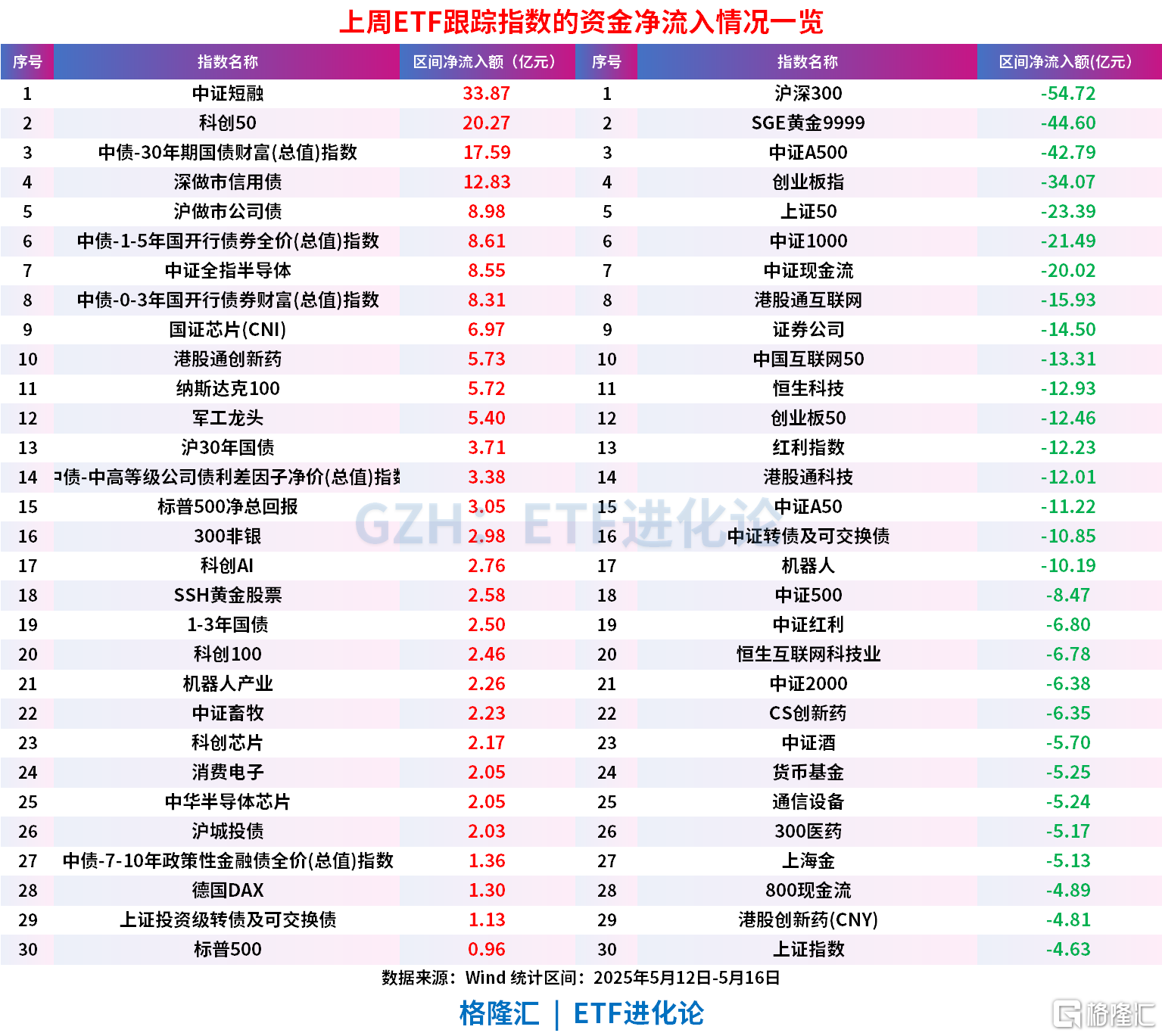
上周股票ETF净流出超380亿元,债券型ETF“吸金”超90亿,科创50ETF连续第二周获资金净申购
Ge Long Hui· 2025-05-19 03:30
一、市场概况 上周沪深300、中证A500、创业板指、科创板50涨跌幅分别为1.12%、0.81%、1.38%、-1.10%。行业上看,上周美容护理、非银金融、汽车涨跌幅居前,分 别为3.08%、2.49%、2.40%。计算机、国防军工、传媒涨跌幅居后,分别为-1.26%、-1.18%、-0.77%。 二、资金流向 上周ETF市场净流出350.3亿元,其中股票ETF净流出387.4亿元,商品型基金净流出49.85亿元,货币基金小幅净流出5.25亿元,债券型基金净流入92.2亿元。 从指数角度来看,多只利率债、信用债相关指数上周获得资金净申购,中证短融、中债-30年期国债财富(总值)指数、深做市信用债、沪做市公司债、中 债-1-5年国开行债券全价(总值)指数、中债-0-3年国开行债券财富(总值)指数、沪30年国债、中债-中高等级公司债利差因子净价(总值)指数上周分别净流入 33.87亿元、17.59亿元、12.83亿元、8.98亿元、8.61亿元、8.31亿元、3.71亿元、3.38亿元。 | 序号 | 指数名称 | 区间净流入额(亿元) | 序号 | 指数名和 | | --- | --- | --- | -- ...