
积极财政政策

Search documents
2025年8月经济数据点评:充分释放政策效应,经济仍偏平稳
Shanghai Securities· 2025-09-16 12:21
Economic Performance - In August, the industrial production growth rate was 5.2%, a decrease of 0.5 percentage points compared to the previous month[10] - Fixed asset investment from January to August was 326,111 billion CNY, with a year-on-year growth of 0.5%, down from 1.6%[10] - Retail sales of consumer goods in August totaled 39,668 billion CNY, growing by 3.4% year-on-year, a decline of 0.3 percentage points from the previous month[10] Investment Trends - Infrastructure investment decreased by 1.2 percentage points, while manufacturing investment growth fell by 1.1 percentage points[18] - Real estate development investment from January to August was 60,309 billion CNY, down 12.9% year-on-year, with the decline expanding by 0.9 percentage points[19] - The first industry investment grew by 5.5%, while the second industry saw a growth of 7.6%[18] Consumption Patterns - Urban retail sales grew by 3.2%, while rural retail sales increased by 4.6% in August[21] - Jewelry sales saw a significant increase, and automotive consumption turned positive after previous declines[22] - The decline in retail sales growth was primarily influenced by a drop in commodity retail sales, despite a rebound in dining consumption[25] Policy Outlook - The macroeconomic policy is expected to remain proactive, with continued support for infrastructure and real estate investments to stabilize the economy[29] - The government aims to effectively release domestic demand potential, which is crucial for economic recovery[29] Risk Factors - Potential risks include worsening geopolitical events, changes in international financial conditions, and unexpected shifts in US-China policies[30]
国务院部署七大财政重点工作
Di Yi Cai Jing· 2025-09-16 11:43
Core Viewpoint - The report emphasizes the need for a more proactive fiscal policy to support economic development and social stability, with a focus on timely adjustments based on changing circumstances [1][2]. Group 1: Fiscal Policy Deployment - The report outlines seven key areas for future fiscal policy, with the first being the effective utilization of a more proactive fiscal policy [1]. - A significant increase in government debt is noted, with a total new government debt scale of 11.86 trillion yuan this year, an increase of 2.9 trillion yuan compared to the previous year [1]. Group 2: Consumer Support and Employment Stability - The report highlights the implementation of interest subsidy policies for personal consumption loans and service sector loans to boost consumption [2]. - It stresses the importance of supporting employment and foreign trade, including enhancing public employment services and vocational training [2]. Group 3: Social Welfare and Risk Management - The report emphasizes improving and safeguarding people's livelihoods, including subsidies for elderly care and childcare [3]. - It outlines the need to prevent and mitigate risks in key areas, such as addressing hidden debt risks and ensuring basic livelihood protections [3][4]. Group 4: Financial Governance and Efficiency - The report calls for enhancing fiscal governance effectiveness, including reforms in fiscal resource allocation and tax policy adjustments [4]. - It mentions the ongoing zero-based budgeting reforms aimed at breaking the rigid patterns of fiscal spending [4]. Group 5: Fiscal Discipline - The report stresses the importance of adhering to frugal spending practices, ensuring that new projects align with economic and fiscal capabilities [4].
宏观数据观察:东海观察8月经济数据普遍继续回落且不及预期
Dong Hai Qi Huo· 2025-09-15 06:18
Report Industry Investment Rating No relevant content provided. Core View - The economic data in August generally continued to decline and fell short of expectations, with economic growth continuing to slow down. The overall domestic demand economic data in August continued to slow down, with investment continuing to slow down and slightly lower than market expectations, consumption growth slightly declining and lower than market expectations, and industrial production slowing down in the short term. The short - term investment side continued to slow down, and the domestic commodity demand as a whole slowed down and was lower than market expectations. The supply side also slowed down due to factors such as domestic demand slowdown and anti - involution. The short - term domestic commodity supply - demand side showed a state of weak demand and relatively abundant supply, which weakened the support for the prices of domestic - demand - oriented bulk commodities. The data announced this time continued to slow down and were lower than market expectations, which was short - term negative for the domestic - demand - oriented bulk commodity market. In the medium and long term, with the implementation of more active fiscal policies and moderately loose monetary policies, as well as the promotion of the "anti - involution" work, it was positive for the recovery of the domestic market. Overseas, the higher - than - expected US tariffs might lead to a slowdown in global growth expectations, but the increasing expectation of the Fed's interest rate cut supported the prices of external - demand - oriented commodities such as non - ferrous metals and energy [3][6]. Summary by Related Catalogs Industrial Production - In August, the year - on - year growth rate of the added value of large - scale industrial enterprises nationwide was 5.2%, lower than the expected 5.7% and the previous value of 5.7%, a decrease of 0.5 percentage points from the previous value. Mainly due to strong external demand, but also affected by domestic anti - involution and environmental protection production restrictions, the operating rate of industrial enterprises declined, and the industrial production growth rate decreased slightly but remained at a relatively high level. By major categories, in August, the added value of the mining industry increased by 5.1% year - on - year, the manufacturing industry increased by 5.7%, and the production and supply of electricity, heat, gas, and water increased by 2.4%. In the second half of the year, as the US replenishment demand gradually weakened, the overall industrial production growth rate in China might decline but was expected to remain at a relatively high level [3][4]. Domestic Consumption - In August, the total retail sales of consumer goods increased by 3.4% year - on - year, lower than the expected 3.9% and the previous value of 3.7%, a decrease of 0.3 percentage points from the previous value. This was mainly due to the slowdown in the subsidy intensity of the consumer goods trade - in policy. Currently, the effect of the consumer goods trade - in policy has weakened, and the retail sales of commodities in categories such as household appliances and audio - visual equipment, furniture, automobiles, and sports and entertainment products by units above the designated size have slowed down, but service consumption has rebounded. In the later stage, with the continuous implementation and effectiveness of domestic consumption stimulus policies and the recovery of residents' wealth effect, domestic consumption will pick up [4]. Fixed - Asset Investment - From January to August, fixed - asset investment was 0.4%, far lower than the expected 1.4% and a significant drop of 1.1% from the previous value of 1.6%. Among them, the growth rate of manufacturing investment continued to decline, the growth rate of infrastructure investment slowed down significantly in the short term, and real estate investment remained weak [4]. Real Estate - In August, the year - on - year growth rate of real estate development investment was - 19.9%, with the decline expanding by 2.9 percentage points from the previous month. The year - on - year growth rate of the commercial housing sales area was - 11%, with the decline expanding by 2.6 percentage points from the previous value, and the year - on - year growth rate of commercial housing sales was - 14.8%, with the decline expanding by 0.7 percentage points from the previous value. This was mainly due to the high - base effect formed by the "5.17 real estate new policy" last year and the weakening of the effect of real estate policy stimulus. The real estate market continued to recover slowly, and the real estate prosperity remained low and had slowed down for five consecutive months. However, with the slowdown of the real estate market, more incremental real estate policies were expected to be introduced [4]. Infrastructure Investment - In August, the year - on - year growth rate of infrastructure investment was - 5.9%, with the decline expanding by 0.8 percentage points from the previous value of - 5.1%. Although the issuance speed of special bonds accelerated, due to the influence of high - temperature and rainy weather and poor fund arrival, the growth rate of infrastructure investment continued to decline [4]. Manufacturing Investment - In August, the year - on - year growth rate of manufacturing investment was - 1.3%, with the decline expanding by 1 percentage point from the previous value of - 0.3%. It slowed down significantly due to the high base effect last year and domestic anti - involution. Currently, high - tech industries maintained a high - growth level, and the large - scale equipment renewal policy continued to take effect, which provided strong support for manufacturing investment. In the future, on the one hand, with the implementation of the "anti - involution" policy and the exit of backward production capacity, manufacturing enterprise profits were expected to gradually bottom out and recover, and the willingness of enterprises to make capital expenditures might increase; on the other hand, the possible slowdown of the US replenishment demand in the second half of the year would weaken the short - term driving force for manufacturing investment [5]. Impact on Bulk Commodities - In the short term, the domestic - demand - oriented bulk commodity market was negatively affected as the data continued to slow down and were lower than market expectations. In the medium and long term, with the implementation of more active fiscal policies and moderately loose monetary policies, as well as the promotion of the "anti - involution" work, it was positive for the recovery of the domestic market. Overseas, the higher - than - expected US tariffs might lead to a slowdown in global growth expectations, but the increasing expectation of the Fed's interest rate cut supported the prices of external - demand - oriented commodities such as non - ferrous metals and energy [3][6].
【省财政厅】守底线 保民生 促发展 陕西财政加力护航经济发展
Shan Xi Ri Bao· 2025-09-13 01:46
Core Viewpoint - The Shaanxi Provincial Government is actively implementing a series of financial policies to support economic growth, enhance public welfare, and ensure fiscal stability amid ongoing challenges [1][2][6]. Financial Policy and Economic Support - Shaanxi has effectively released fiscal policy efficiency, with general public budget expenditure reaching 466.09 billion yuan in the first eight months, with significant increases in spending on science and technology (39.9%), energy conservation and environmental protection (4.7%), social security and employment (4.5%), and education (4.4%) [2]. - The province has utilized various financial tools, including special bonds and subsidies, to support investment and consumption, securing an additional 94 billion yuan in special bonds for key projects [2]. - Structural tax reductions and refunds amounting to 29 billion yuan have been implemented to support technological innovation and manufacturing [2]. Investment in Innovation - Shaanxi has established a 10 billion yuan Science and Technology Innovation Fund to attract long-term investments in hard technology, with four new sub-funds totaling 5.17 billion yuan set up this year [3]. Social Welfare and Employment - The provincial government has allocated 2.48 billion yuan for employment subsidies and vocational training, aiming to stabilize employment [4]. - A total of 27.2 billion yuan has been dedicated to improving educational infrastructure and teacher capabilities, supporting high-quality education initiatives [4]. - Social security standards have been steadily increased, with pension and healthcare subsidies for retirees being raised [4]. Agricultural and Rural Development - Shaanxi has allocated 5.79 billion yuan to support grain production and implement subsidies for farmland protection and agricultural machinery purchases [4]. - An additional 12.71 billion yuan has been earmarked for developing advantageous industries in poverty-stricken areas to enhance local economic resilience [4]. Ecological Protection Initiatives - The province has invested 13.2 billion yuan in ecological protection and restoration projects, focusing on key areas such as the Qinling Mountains and the Yellow River [5]. - A new ecological compensation agreement with Hubei has been signed to enhance cross-province environmental protection efforts [5]. Fiscal Reform and Risk Management - Shaanxi is committed to deepening fiscal reforms to enhance governance and mitigate debt risks, with 73.2 billion yuan in special bonds issued for debt resolution this year [6]. - The province is focusing on improving the efficiency of fiscal management and ensuring that more funds are directed towards public welfare [6].
国泰君安期货:锌:区间震荡
Guo Tai Jun An Qi Huo· 2025-09-11 08:03
Report Summary 1) Report Industry Investment Rating - The investment rating for the zinc industry is "Range-bound" [1] 2) Core View of the Report - The zinc market is expected to experience range-bound fluctuations, with a current trend strength of 0, indicating a neutral outlook [1][3] 3) Summary by Relevant Catalogs Fundamental Tracking - **Prices**: The closing price of the Shanghai Zinc main contract was 22,215 yuan/ton, up 0.41% from the previous day, while the LME Zinc 3M electronic disk closed at 2,867 dollars/ton, down 0.21% [1] - **Trading Volume**: The trading volume of the Shanghai Zinc main contract was 83,724 lots, a decrease of 16,741 lots, and the LME Zinc trading volume was 9,280 lots, an increase of 215 lots [1] - **Open Interest**: The open interest of the Shanghai Zinc main contract was 103,054 lots, a decrease of 5,145 lots, and the LME Zinc open interest was 201,219 lots, an increase of 1,496 lots [1] - **Premiums and Discounts**: Shanghai 0 zinc premium/discount was -70 yuan/ton, down 5 yuan/ton; LME CASH - 3M premium/discount was 17.62 dollars/ton, up 1.16 dollars/ton [1] - **Inventories**: Shanghai Zinc futures inventory was 44,329 tons, an increase of 1,648 tons, and LME Zinc inventory was 50,825 tons, a decrease of 200 tons [1] News - Chinese Finance Minister Lan Fo'an stated that the government will focus on strengthening the domestic market, implement more proactive fiscal policies, and carry out key tasks such as supporting employment and foreign trade, cultivating new growth drivers, and improving people's livelihoods [2] - In August, China's CPI turned negative year-on-year, down 0.4%, while the core CPI increased to 0.9%. The PPI's year-on-year decline narrowed to 2.9%. The decrease in CPI was mainly due to a high base last year and lower-than-seasonal food price increases [2][3] Trend Intensity - The zinc trend intensity is 0, indicating a neutral outlook, with the value ranging from -2 (most bearish) to 2 (most bullish) [3]

财政部长蓝佛安部署下一步工作重点
Di Yi Cai Jing Zi Xun· 2025-09-11 03:32
Core Viewpoint - The report emphasizes the need for a more proactive fiscal policy to stimulate economic growth and improve budget execution efficiency [1][2]. Fiscal Policy and Spending - In the first seven months of the year, the broad fiscal expenditure reached approximately 21.5 trillion yuan, reflecting a year-on-year growth of about 9.3%, significantly outpacing the fiscal revenue growth of around 0% [2]. - The acceleration of budget execution is aimed at increasing investments in areas such as livelihood, technology, and major projects to stimulate overall economic demand [2]. Government Debt and Financing - The net financing of government bonds in the first seven months amounted to 8.9 trillion yuan, an increase of 4.88 trillion yuan year-on-year [3]. - The issuance of new special bonds by local governments reached approximately 3.3 trillion yuan in the first eight months, marking a year-on-year increase of 27%, which constitutes about 75% of the planned annual issuance [3]. Consumer and Service Sector Support - The government plans to implement policies to boost consumption, including personal consumption loan interest subsidies and service industry loan interest subsidies, with a subsidy rate of 1 percentage point [3]. - These policies aim to lower the credit costs for residents and service industry operators, thereby stimulating consumption potential [3]. Future Fiscal Focus Areas - The report outlines key fiscal priorities, including supporting employment and foreign trade, fostering new growth drivers, improving livelihood, managing risks in key areas, and enhancing fiscal governance [4].
宏观政策发力显效 推动经济稳中有进
Yang Shi Wang· 2025-08-25 11:50
Group 1 - The implementation of personal consumption loan interest subsidies and service industry loan interest subsidies is set to begin on September 1, with an annual subsidy rate of 1% to support consumption [1] - The monetary policy has been moderately eased, with a 0.5% reduction in the reserve requirement ratio, releasing approximately 1 trillion yuan in long-term liquidity, and a 0.1% decrease in policy interest rates, keeping loan costs low for enterprises and individuals [1] - By the end of June, the amount of loans signed for technological innovation and technological transformation exceeded 2 trillion yuan, which is 2.4 times the amount at the end of 2024, supporting 1.8 million technology-based SMEs in obtaining their first loans [1] Group 2 - The central government has allocated approximately 90 billion yuan in the budget this year to support local governments in issuing childcare subsidies, benefiting over 20 million families with infants and young children [2] - Starting from the autumn semester, kindergarten tuition fees will be waived for children in the final year, benefiting around 12 million children and reducing the financial burden on families by approximately 20 billion yuan [2]
更加积极财政政策陆续落地
Di Yi Cai Jing Zi Xun· 2025-08-22 05:12
Core Viewpoint - The article highlights the implementation of more proactive fiscal policies in China, which are contributing to stable economic performance, as evidenced by the fiscal data for the first seven months of the year [2][6]. Fiscal Revenue and Expenditure - In the first seven months of this year, the total broad fiscal revenue was approximately 15.9 trillion yuan, remaining stable compared to the same period last year [2]. - Broad fiscal expenditure reached about 21.5 trillion yuan, showing a year-on-year increase of approximately 9.3% [2]. - The gap between fiscal expenditure and revenue was about 5.6 trillion yuan, which is a year-on-year increase of approximately 47% [2]. Tax Revenue Trends - Tax revenue saw a decline of 3.5% in the first quarter, but this was followed by four months of growth, narrowing the decline to 0.3% for the first seven months [3]. - The increase in tax revenue is attributed to stable growth in VAT and significant increases in securities transaction stamp duty due to active stock market trading [3]. Land Revenue and Local Government Financing - Land transfer revenue for the first seven months was approximately 1.7 trillion yuan, reflecting a year-on-year decline of 4.6% [5]. - To maintain expenditure levels, both central and local governments accelerated bond issuance, with net financing of government bonds reaching 8.9 trillion yuan, an increase of 4.88 trillion yuan year-on-year [5]. Social Spending and Policy Focus - Fiscal spending in the social welfare sector has been prioritized, with expenditures on social security, education, and healthcare growing faster than overall spending [6]. - Recent policies, such as pension increases and childcare subsidies, indicate a focus on investing in human capital [6]. Future Fiscal Policy Outlook - The Central Political Bureau meeting emphasized the need for continued macroeconomic policy support in the second half of the year, with a focus on implementing proactive fiscal policies and maintaining efficient fund usage [6]. - There is a belief that even without extraordinary fiscal measures, the real support for the economy in the second half could match that of the first half, with adjusted fiscal expenditure growth projected between 4.1% and 6.7% [6]. Preparedness for Economic Uncertainty - The Ministry of Finance has indicated that it retains sufficient policy space and tools to respond to potential uncertainties in the economy [7]. - The focus remains on stabilizing employment, businesses, markets, and expectations to support economic development and social stability [7].


7月财政数据的四大特征
Sou Hu Cai Jing· 2025-08-22 03:28
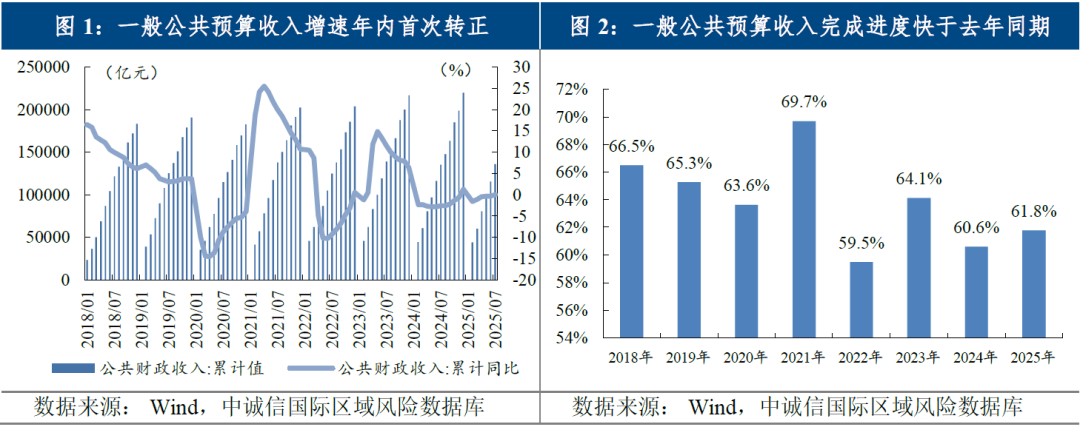
Core Insights - The general public budget revenue has shown significant recovery, with a year-on-year growth of 0.1% from January to July, marking the first positive growth this year, indicating economic resilience [2][4][14] - The land market remains sluggish, with government fund budget revenue growth weak, reflecting ongoing challenges in the real estate sector [2][8] - Fiscal expenditure has ramped up, with a broad fiscal expenditure growth rate of 9.3%, the highest level in recent years, driven primarily by central government spending [3][10][14] - The structure of fiscal expenditure is optimizing, with a focus on social welfare and education, alongside new policies aimed at supporting families and boosting consumption [3][12] Revenue Analysis - From January to July, the general public budget revenue growth rate turned positive for the first time this year, with July showing a 2.6% increase, the highest monthly growth rate [2][4] - Tax revenue recovery is a key driver, with personal income tax, domestic VAT, and domestic consumption tax showing year-on-year growth rates of 8.8%, 3.0%, and 2.1% respectively [6][8] Land Market Insights - The government fund budget revenue saw a year-on-year decline of 0.7% from January to July, with July's growth rate slowing significantly to 8.9% [2][8] - Real estate investment continues to decline, with a 12% year-on-year drop in property development investment from January to July [8][10] Expenditure Insights - Broad fiscal expenditure growth reached 9.3%, significantly higher than the previous year's decline of 2.0%, with central government expenditure growing by 33.9% [3][10] - The issuance of government bonds is at a rapid pace, with a total of 9.11 trillion yuan issued from January to July, a 33.8% increase year-on-year [10][12] Policy and Structural Changes - Recent fiscal policies have focused on social welfare, with expenditures in social security, education, and health exceeding 6 trillion yuan, reflecting a commitment to improving living standards [12][14] - New initiatives such as childcare subsidies and free preschool education have been introduced to stimulate consumption and support families [12][14]
前7个月广义财政支出超21万亿元 更加积极财政政策落地
Sou Hu Cai Jing· 2025-08-21 17:04
Group 1 - The core viewpoint of the articles emphasizes the implementation of more proactive fiscal policies to support stable economic operations in China [1][3][5] - In the first seven months of this year, the total revenue from broad finance was approximately 15.9 trillion yuan, remaining stable compared to the same period last year, while expenditures reached about 21.5 trillion yuan, reflecting a year-on-year growth of approximately 9.3% [1][2] - The fiscal expenditure exceeded revenue by about 5.6 trillion yuan, marking a year-on-year increase of approximately 47%, indicating a significant expansion of fiscal policy [1][2] Group 2 - Tax revenue, often referred to as the "economic barometer," has shown improvement, with stable growth in VAT and a significant increase in securities transaction stamp duty due to active stock market transactions [2][3] - Local government land transfer income has also shown signs of recovery, with land transfer revenue for the first seven months amounting to approximately 1.7 trillion yuan, down 4.6% year-on-year, indicating a narrowing decline [2][3] - The net financing of government bonds reached 8.9 trillion yuan in the first seven months, supporting broad fiscal expenditures, particularly in the areas of social security, education, and healthcare [3][4] Group 3 - The central government has accelerated the issuance of special bonds and policy financial tools, which is expected to maintain a certain level of fiscal expenditure [3][4] - The fiscal policy is projected to continue supporting economic growth, with adjusted fiscal expenditure growth rates estimated between 4.1% and 6.7% for the second half of the year, aligning with economic growth targets of 4.7% to 4.8% [4][5] - The Ministry of Finance has indicated that it will utilize more proactive fiscal policies and reserve tools to address uncertainties and stabilize employment, businesses, and market expectations [5]