
绿色转型

Search documents
国家统计局:PPI环比涨幅扩大 同比降幅收窄
Sou Hu Cai Jing· 2026-01-09 02:36
Group 1 - The Producer Price Index (PPI) for industrial producers increased by 0.2% month-on-month in December 2025, marking the third consecutive month of growth, with the year-on-year decline narrowing to 1.9% [1] - Key industries such as coal mining and lithium-ion battery manufacturing saw price increases, with coal mining prices rising by 1.3% and lithium-ion battery prices by 1.0%, both continuing their upward trend for three months [1][2] - Seasonal demand increases contributed to price rises in gas production and supply, as well as electricity and heat production, with respective increases of 1.2% and 1.0% [1] Group 2 - Domestic prices in the non-ferrous metals and petroleum sectors showed divergence due to external factors, with non-ferrous metal mining and smelting prices rising by 3.7% and 2.8% respectively, while oil extraction and refining prices fell by 2.3% and 0.9% [2] - The narrowing year-on-year decline in PPI reflects the effectiveness of macroeconomic policies, with certain industries experiencing positive price changes [2] - The construction of a unified national market is progressing, leading to a continuous reduction in year-on-year price declines across various industries [2] Group 3 - Consumer potential is being effectively released, driving price increases in related industries, with prices for arts and crafts manufacturing rising by 23.3% and sports ball manufacturing by 4.0% [3] - The implementation of special actions to boost consumption has led to rapid growth in cultural and quality-related consumption [3]
国家统计局:12月份CPI上涨0.8%,PPI环比上涨0.2%涨幅比上月扩大0.1个百分点
Jin Rong Jie· 2026-01-09 02:30
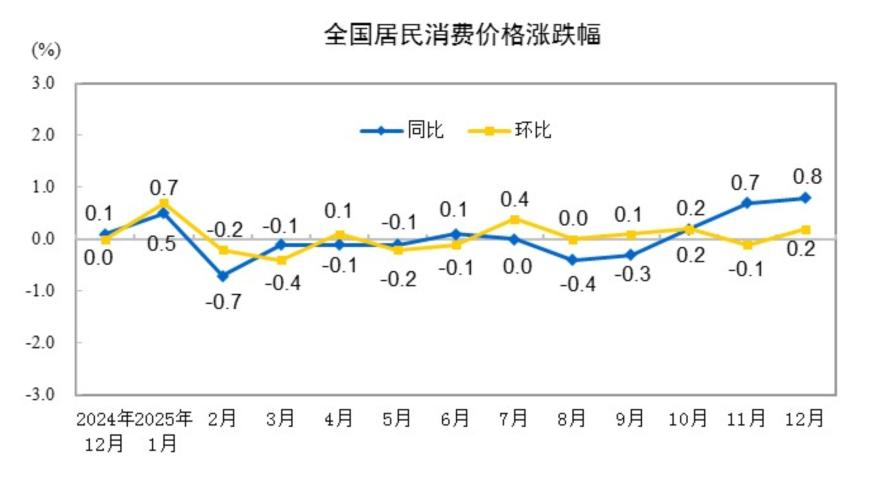
Core Insights - In December 2025, the national consumer price index (CPI) increased by 0.8% year-on-year, with urban areas rising by 0.9% and rural areas by 0.6% [3][20] - The producer price index (PPI) for industrial producers decreased by 1.9% year-on-year, with a narrowing decline compared to the previous month [12][25] CPI Analysis - The CPI rose by 0.2% month-on-month in December, driven by increased consumer demand ahead of the New Year [20][21] - Food prices increased by 1.1% year-on-year, significantly impacting the CPI, with fresh vegetable prices soaring by 18.2% [6][23] - Core CPI, excluding food and energy, rose by 1.2%, maintaining a growth rate above 1% for four consecutive months [20][23] PPI Analysis - The PPI saw a month-on-month increase of 0.2%, marking the third consecutive month of growth [24][25] - The decline in PPI year-on-year was less severe than in previous months, indicating a potential stabilization in industrial pricing [12][25] - Key industries such as coal mining and lithium-ion battery manufacturing experienced price increases, reflecting improved supply-demand dynamics [24][25] Price Movement by Category - In December, food and beverage prices rose by 0.8% year-on-year, contributing approximately 0.24 percentage points to the CPI [6][11] - The prices of production materials decreased by 2.1% year-on-year, with significant declines in mining and raw materials sectors [14][19] - The prices of durable consumer goods fell by 3.5%, while general daily necessities saw a price increase of 1.4% [14][19]

国家统计局:12月份CPI同比上涨0.8% PPI降幅收窄
Sou Hu Cai Jing· 2026-01-09 02:25
Group 1: Consumer Price Index (CPI) Insights - In December, the CPI increased by 0.2% month-on-month and 0.8% year-on-year, with the core CPI rising by 1.2% year-on-year, indicating a recovery in consumer demand driven by policies to boost consumption and the upcoming New Year holiday [1][2] - The rise in CPI was primarily influenced by a 1.1% increase in food prices, with fresh vegetables and fruits seeing significant price hikes of 18.2% and 4.4% respectively, contributing to a greater upward impact on the CPI [2] - Energy prices decreased by 3.8%, with gasoline prices dropping by 8.4%, while the core CPI has maintained a growth rate above 1% for four consecutive months [2] Group 2: Producer Price Index (PPI) Insights - The PPI rose by 0.2% month-on-month, marking the third consecutive month of increases, with a narrowing year-on-year decline of 1.9%, indicating improvements in supply-demand dynamics in certain industries [3][4] - Key industries such as coal mining and lithium-ion battery manufacturing experienced price increases, with coal mining prices rising for five consecutive months [3] - Input factors led to a mixed price trend in the domestic non-ferrous metals and petroleum sectors, with domestic prices for non-ferrous metals rising due to international price increases, while oil extraction and refining prices fell due to declining international crude oil prices [3][4]
CPI同比回升至2023年3月以来最高
Di Yi Cai Jing· 2026-01-09 02:08
Group 1 - The core CPI has maintained a growth rate of over 1% for four consecutive months, driven by increased consumer demand and effective policies to boost consumption [1][4] - In December, the CPI rose by 0.8% year-on-year, with food prices contributing significantly to this increase, particularly fresh vegetables and fruits [4] - The core CPI, excluding food and energy, rose by 1.2%, indicating stable inflationary pressures in the economy [1][4] Group 2 - The PPI increased by 0.2% month-on-month, marking a continuous rise for three months, while the year-on-year decline narrowed to 1.9% [3][9] - Positive changes in PPI are attributed to ongoing macroeconomic policies and improvements in market competition, with certain industries experiencing reduced price declines [7][8] - The prices of key industries such as coal mining and lithium-ion battery manufacturing have shown signs of recovery, with price declines narrowing over several months [7][8] Group 3 - Economic experts predict that with the implementation of demand expansion policies, prices are expected to recover moderately, potentially returning to positive growth by 2026 [5] - The development of the digital economy and new materials is driving price increases in related sectors, indicating a shift towards a more dynamic economic environment [7]
韩文亚:绿色转型方向不变力度不减
Jing Ji Ri Bao· 2026-01-09 00:03
Group 1 - The 2025 Central Economic Work Conference emphasizes "adhering to 'dual carbon' leadership and promoting comprehensive green transformation" as one of the eight key tasks for economic work in 2026, signaling a consistent and strong policy direction for green low-carbon development in China [1] - The advancement of the "dual carbon" goals represents a fundamental transformation of the traditional high-carbon development paradigm, requiring three types of policy tools: regulatory control through strict carbon emission standards, innovation-driven technological empowerment, and market incentives for price discovery [1] - As of October 2025, China's total installed capacity for renewable energy generation reached 2.22 billion kilowatts, accounting for nearly 60% of the national total, with over one-third of electricity consumption coming from green power [1] Group 2 - The restructuring of the industrial system injects new momentum into the green transition, with China leading the world in new energy vehicle production and sales for ten consecutive years and establishing the largest electric vehicle charging network globally [2] - The scale of the green low-carbon industry has reached approximately 11 trillion yuan, supported by the establishment of 6,430 green factories and 491 green industrial parks [2] - The national carbon emission trading market has expanded its coverage to include over 60% of carbon emissions, making it the largest carbon market globally, while 27 provinces have implemented carbon inclusive policies to promote quantifiable and redeemable public green behaviors [2] Group 3 - The green transition is recognized as a core strategy within China's modernization framework, with the goal of achieving significant progress in building a "Beautiful China" as outlined in the 15th Five-Year Plan [3] - The "dual carbon" initiative is seen as a strategic choice to address resource and environmental constraints while fostering new productive forces and shaping new international competitive advantages [3]
【中国石化(600028.SH/0386.HK)】二十五载风雨兼程,国之柱石再启航——动态跟踪报告(赵乃迪/蔡嘉豪/王礼沫)
光大证券研究· 2026-01-08 23:04
Core Viewpoint - The company is positioned as a key player in China's energy strategy, celebrating its 25th anniversary of H-share listing in 2025, showcasing its evolution and commitment to energy security and green transformation [4]. Group 1: Business Overview - The company is one of the largest oil and gas producers and refiners in China, with a robust oil and gas output and extensive oil reserve system, forming a reliable defense for national energy security [4]. - The company is transitioning from a traditional fossil fuel giant to a leader in green transformation, actively embracing changes under the "dual carbon" goals [4]. Group 2: Integrated Business Model - Upstream: The company focuses on "increasing reserves and production," with shale oil production exceeding 1 million tons and proven shale gas reserves over 1 trillion cubic meters, while establishing overseas operations in 23 countries [5]. - Midstream: The company has built globally leading refining and intelligent refining bases, with a terminal network covering 30,000 gas stations and over 28,000 convenience stores, driving high-quality development through differentiated strategies [5]. - Downstream: The company implements "oil transformation" and "oil specialty" strategies, optimizing refining structures to adapt to demand changes, while exploring hydrogen energy, charging and swapping stations, and photovoltaic industries [5][6]. Group 3: Future Growth Engines - The company is enhancing its refining structure through "oil transformation" and increasing the proportion of chemical products and high-end specialty oils, achieving technological breakthroughs at bases like Jingmen Petrochemical [6]. - The company is accelerating digital transformation by establishing smart factories and developing new business formats such as automotive services and dining through its online platform [6]. Group 4: Governance and Reform - The company is advancing state-owned enterprise reform by optimizing governance efficiency and implementing market-oriented management mechanisms, which enhances organizational vitality and provides institutional support for quality and efficiency improvements [7]. - The company's ESG performance is improving, with a clear "dual carbon" implementation path and leading ESG ratings in the industry, attracting long-term capital [7].


中国石化与中国航油实施重组 有利于提升航煤产业链韧性 保障航空业能源安全
Ren Min Ri Bao· 2026-01-08 22:37
本报北京1月8日电记者从国务院国资委获悉:经报国务院批准,中国石油化工集团有限公司与中国航空 油料集团有限公司实施重组。 据介绍,中国石化是全球第一大炼油公司和我国第一大航油生产商,中国航油是亚洲最大的集航空油品 采购、运输、储存、检测、销售、加注于一体的航空运输服务保障企业。业内人士分析,中国石化和中 国航油"强强联手",有利于提升航煤产业链韧性,保障航空业能源安全。 有预测显示,"十五五"时期,我国航空燃料需求预计年均增长4%左右,2030年将达5000万吨左右、 2040年约为7500万吨。两家企业重组后,可发挥炼化一体化优势,减少中间环节,降低供应成本,为我 国航空业能源安全提供坚强保障。 中国石化和中国航油"强强联手",还有利于增强我国航空燃料产业国际竞争力。目前国际较大的航空燃 料服务商主要为一体化石油化工公司,而我国航空燃料生产、销售、加注等业务分属不同企业,整体竞 争能力还有待提升。两家企业重组后,有利于实现优势互补,助力航空燃料产业进一步做强做优做大, 提高竞争力。 特别是在绿色转型方面,中国石化是亚洲首家拥有生物航煤自主研发生产技术并实现商业化生产的企 业,拥有国内首套生物航煤生产装置;中 ...
在低碳转型中重构企业竞争力
Jing Ji Ri Bao· 2026-01-08 21:46
Core Viewpoint - The recent issuance of the "Guidelines for Enterprises to Fulfill Social Responsibility Overseas" by the Ministry of Commerce emphasizes accelerating the green transformation of enterprises, establishing green development strategies, and enhancing green compliance systems, positioning green transformation as a crucial strategy for Chinese enterprises and a response to climate change [1] Group 1: Green Transformation Strategy - The essence of enterprise green transformation is to deeply integrate green development concepts into all processes and value chain segments, enhancing resource efficiency and reducing environmental burdens through technological innovation and governance optimization [1] - This systemic change is essential for advancing industries towards greening, high-end development, and intelligence, serving as a significant measure to address resource and environmental constraints and global climate change [1] Group 2: Current Trends in Green Transformation - China's enterprise green transformation is characterized by dual drivers of policy and market, collaborative carbon reduction across the entire supply chain, and deep integration of digital technologies [2] - Government regulations and incentive policies effectively guide enterprises towards green innovation, while the construction of a closed-loop system from green design to recycling is progressively advancing [2] - The integration of big data, IoT, and AI technologies is significantly enhancing the green competitiveness of Chinese enterprises [2] Group 3: Challenges and Recommendations - Chinese enterprises face challenges in key green technologies, supply chain management, and compliance with international green trade barriers, necessitating a more systematic and robust support framework for green transformation [3] - It is crucial to strengthen top-level design and strategic guidance, integrating green transformation into investment and operational decision-making, and establishing a green standard and certification system that aligns with international norms [3] - Companies should enhance compliance and innovation, creating a comprehensive green compliance management system and promoting green technology innovation to lower transformation costs and improve resource efficiency [3] Group 4: Market Incentives and Financial Support - The gradual establishment of a national carbon market and the expansion of industry coverage are essential for stimulating carbon asset value [4] - Promoting green electricity trading and green certificate initiatives, as well as guiding green products and services to "go global," are key strategies for enhancing the supply of green low-carbon products and services [4]
节能改造催生新机遇
Jing Ji Ri Bao· 2026-01-08 21:45
Group 1: New Energy System and Investment Opportunities - The construction of a new energy system is a core engine for the "dual carbon" transition and a focus for capital market layout, emphasizing the importance of clean energy sources like solar, wind, and hydrogen, as well as supporting sectors such as new energy storage and smart grids [1] - The "dual carbon" goals present systemic opportunities primarily along two main lines: the first being the clean energy revolution, which has moved from demonstration to large-scale application, and the second being the empowerment of industrial transformation through energy-saving renovations and innovations in the new energy vehicle supply chain [1] - The carbon management and circular economy sectors are emerging as significant growth areas, with the national carbon market expanding and carbon pricing mechanisms maturing, leading to increased demand for carbon asset management, carbon capture, utilization, and storage (CCUS), and resource recycling [1] Group 2: Structural Opportunities in Traditional Industries - The resonance between green transformation and "anti-involution" policies is creating structural opportunities for traditional high-energy-consuming industries, such as coal and steel, which can achieve green transformation through technological upgrades [2] - The continuous improvement of the green finance system provides capital support for industrial transformation, with the 2025 version of the Green Finance Support Project Directory standardizing definitions for green projects, guiding funds towards low-carbon sectors [2] - Capital markets should collaborate across standards, products, and partnerships to seize opportunities, including establishing mandatory environmental information disclosure frameworks and developing green equity financing and innovative transition bonds [2] Group 3: Role of Financial Institutions in Green Transition - Securities firms are encouraged to evolve from traditional financial intermediaries to "enablers" and "catalysts" for green transformation, creating a comprehensive service system covering the entire lifecycle of green projects [3] - Three main pathways for securities firms include acting as a "capital engine" by expanding green bond underwriting and establishing green industry funds, creating an "innovation hub" by enhancing carbon market research and developing ESG indices, and forming an "intellectual hub" by assembling specialized research teams to develop ESG rating models [3]
绿色转型方向不变力度不减
Jing Ji Ri Bao· 2026-01-08 21:45
Group 1 - The 2025 Central Economic Work Conference emphasizes "adhering to 'dual carbon' leadership and promoting comprehensive green transformation" as one of the eight key tasks for economic work in 2026, signaling a consistent and strong policy direction for green and low-carbon development in China [1] - The advancement of the "dual carbon" goals represents a fundamental transformation of the traditional high-carbon development paradigm, requiring three types of policy tools: regulatory control through strict carbon emission standards, innovation-driven technological empowerment, and market incentives for price discovery [1] - As of October 2025, China's total installed capacity for renewable energy generation reached 2.22 billion kilowatts, accounting for nearly 60% of the national total, with over one-third of electricity consumption coming from green power [1] Group 2 - The restructuring of the industrial system injects new momentum into the green transition, with China leading the world in new energy vehicle production and sales for ten consecutive years and establishing the largest electric vehicle charging network globally [2] - The scale of the green low-carbon industry has reached approximately 11 trillion yuan, supported by the establishment of 6,430 green factories and 491 green industrial parks [2] - The national carbon emission trading market has expanded its coverage to include over 60% of national carbon emissions, becoming the largest carbon market globally, with over ten national standards for product carbon footprints established [2] Group 3 - The green transition is recognized as a core strategy within China's modernization efforts, with significant progress in building a "Beautiful China" as a major goal outlined in the 15th Five-Year Plan [3] - The "dual carbon" initiative is seen as a strategic choice to address resource and environmental constraints while fostering new productive forces and shaping new international competitive advantages [3]