
套期保值

Search documents
汇鸿集团: 2025年第一次临时股东大会会议资料
Zheng Quan Zhi Xing· 2025-08-10 08:16
Core Viewpoint - Jiangsu Highhope International Group Corporation is convening its first extraordinary general meeting of shareholders in 2025 to discuss a proposal regarding its subsidiaries engaging in hedging activities and related transactions [1][2]. Group 1: Meeting Details - The meeting is scheduled for August 18, 2025, at 14:00 in Nanjing [2]. - The agenda includes voting on the proposal for subsidiaries to conduct hedging activities [2][3]. - Voting will be conducted through both on-site and online methods, with each share carrying one vote [2]. Group 2: Proposal Overview - The proposal involves subsidiaries Jiangsu Suhao Zhongjin Development Co., Ltd. and Jiangsu Suhao Zhongtian Holdings Co., Ltd. engaging in hedging through Hongye Futures Co., Ltd. [3][4]. - The hedging activities aim to mitigate risks associated with price fluctuations of raw materials and metals relevant to their operations [3][4]. - The maximum margin required for these hedging activities will not exceed 4% of the company's latest audited net assets [3]. Group 3: Transaction Details - The hedging will be conducted on domestic exchanges and will not involve overseas futures or derivatives [4]. - The authorization for these activities will be valid for 12 months from the date of approval by the shareholders [4][5]. - The funding for these transactions will come from the subsidiaries' own funds, avoiding the use of raised capital or bank loans [3]. Group 4: Approval Process - The proposal has been reviewed and approved by the Audit, Compliance, and Risk Control Committee, as well as the Independent Directors and the Supervisory Board [5][6]. - The committee believes that the hedging activities will enhance the company's risk management capabilities and are in the best interest of all shareholders [5][6]. Group 5: Related Party Transactions - Hongye Futures is a subsidiary of the controlling shareholder Suhao Holdings Group, establishing a related party relationship [6][7]. - The transaction is deemed to follow fair market principles and will not harm the interests of minority shareholders [6][10]. Group 6: Financial Impact and Accounting Treatment - The hedging activities are expected to support the company's operational stability without affecting its main business development [13]. - The company will adhere to relevant accounting standards for financial reporting related to these hedging activities [13].

海证期货刘飚:构建期货市场服务实体经济新生态
Zhong Guo Zheng Quan Bao· 2025-08-09 00:44
Core Viewpoint - The futures market is taking on a new mission to serve the real economy under the policy backdrop of "stabilizing expectations, strengthening confidence, and expanding domestic demand" [1] Group 1: Challenges Faced by the Real Economy - The real economy is facing significant challenges due to the volatility of commodity prices and weak demand, leading to increased operational risks for enterprises [2][3] - Enterprises are experiencing greater uncertainty in orders and pricing, which affects their production planning, raw material procurement, and financial preparations [2][3] Group 2: Role of the Futures Market - The futures market plays a crucial role in stabilizing expectations through its three core functions: price discovery, risk management, and resource allocation [3] - An example is provided where a company used futures contracts to hedge against the price volatility of lithium carbonate, ensuring stable production and timely delivery despite market fluctuations [3] Group 3: Difficulties in Utilizing Futures Tools - The basis risk is a major difficulty for enterprises when using futures tools for hedging, as the price movements of raw materials and finished products do not always align with futures prices [4] - Other challenges include funding pressures, a shortage of professional talent, and insufficient understanding of futures market rules and trading strategies [4] Group 4: Expectations from the Futures Industry - Enterprises expect more personalized and professional risk management solutions tailored to their specific industry characteristics and risk tolerance [5] - There is a demand for enhanced training and guidance on futures knowledge to improve understanding and capabilities within enterprises [5] - Innovation in service models and products is also sought, such as risk management contracts linked directly to spot market needs [5] Group 5: Innovations in Service Models - Hai Zheng Futures has introduced innovative service models like rights-linked trade and warehouse receipt swapping to better meet the needs of enterprises [6][7] - The rights-linked trade model allows enterprises to have options based on market price fluctuations, providing flexibility in risk management [6] - The warehouse receipt swapping service addresses mismatches between the required and actual warehouse receipt brands, enhancing the flexibility of enterprises in futures delivery [7] Group 6: Recommendations for Improving Futures Services - There are several identified bottlenecks in the futures market's service to the real economy, including unregulated warehouses leading to credit risks [8] - Recommendations include enhancing government oversight of social warehousing, focusing on specific commodity chains, and increasing support for risk subsidiaries within futures companies [8][9]
海证期货刘飚: 构建期货市场服务实体经济新生态
Zhong Guo Zheng Quan Bao· 2025-08-08 21:17
Core Viewpoint - The futures market is taking on a new mission to serve the real economy amid the current policy backdrop of "stabilizing expectations, strengthening confidence, and expanding domestic demand" [1] Group 1: Challenges Faced by Real Enterprises - Real enterprises are facing significant challenges due to the volatility of commodity prices, which has become a norm, leading to increased procurement costs and reduced profit margins [2] - Demand weakness and order uncertainty are also major risks, as global market demand shrinks and domestic competition intensifies, complicating production planning and increasing operational costs [2] Group 2: Role of Futures Market - The futures market plays a crucial role in stabilizing expectations through three core functions: price discovery, risk management, and resource allocation [3] - An example is provided where a company used futures contracts to hedge against the price volatility of lithium carbonate, ensuring stable production and timely delivery despite market fluctuations [3] Group 3: Difficulties in Utilizing Futures Tools - Basis risk is a primary difficulty for enterprises using futures tools for hedging, as the price movements of raw materials and finished products do not always align with futures prices [4] - Other challenges include funding pressures, a shortage of professional talent, and insufficient understanding of futures market rules and trading strategies [4] Group 4: Expectations from the Futures Industry - Enterprises expect more personalized and professional risk management solutions tailored to their specific industry characteristics and risk tolerance [5] - There is a demand for enhanced training and guidance on futures knowledge to improve understanding and capability within enterprises [5] - Innovation in service models and products is also anticipated, such as risk management contracts linked directly to spot market needs [6] Group 5: Innovations in Service Models - The introduction of innovative service models like rights-based trading and warehouse receipt swapping has been highlighted as a significant breakthrough to better meet the needs of real enterprises [7][8] - These models provide more flexible risk management solutions and enhance the collaboration between futures companies and enterprises [8] Group 6: Recommendations for Improving Futures Services - There are several identified bottlenecks in the futures market's service to the real economy, including credit risks from unregulated warehouses and limited coverage of spot products by risk subsidiaries [9] - Recommendations include increasing government oversight of social warehousing, focusing risk subsidiaries on specific commodity chains, and enhancing support for risk subsidiaries from industry associations [10][11]
构建期货市场服务实体经济新生态
Zhong Guo Zheng Quan Bao· 2025-08-08 21:03
Core Viewpoint - The futures market is taking on a new mission to serve the real economy under the current policy backdrop of "stabilizing expectations, strengthening confidence, and expanding domestic demand" [1] Group 1: Challenges Faced by Real Enterprises - Real enterprises are facing significant challenges due to the volatility of commodity prices and weak market demand, leading to increased operational risks and costs [1][2] - The fluctuation in commodity prices has become a norm, causing uncertainty in procurement costs and sales prices, which can squeeze profit margins and potentially lead to losses [1][2] - Demand is weakening, with reduced overseas orders and intensified domestic competition, making it difficult for enterprises to secure stable orders and affecting production planning and resource procurement [1][2] Group 2: Role of Futures Market - The futures market plays a crucial role in stabilizing expectations through its three core functions: price discovery, risk management, and resource allocation [2] - An example is provided where a company used futures contracts to hedge against the price volatility of lithium carbonate, ensuring stable production and timely delivery despite market fluctuations [2] Group 3: Difficulties in Risk Hedging - The basis risk in futures contracts is a major difficulty for enterprises, as the price movements of their raw materials and finished products do not always align with futures prices, affecting the effectiveness of hedging [3] - Other challenges include funding pressures, a shortage of professional talent, and insufficient understanding of futures market rules and trading strategies [3] Group 4: Expectations from the Futures Industry - Enterprises expect more personalized and professional risk management solutions tailored to their specific industry characteristics and operational models [4] - There is a demand for enhanced training and guidance on futures knowledge to improve understanding and capabilities within enterprises [4] - Innovation in service models and products is sought, including risk management contracts linked directly to spot market needs [4][6] Group 5: Breakthrough Service Models - Innovative service models such as "contingent trade" and "warehouse receipt exchange" have been introduced to provide more flexible risk management solutions for enterprises [6] - The contingent trade model allows enterprises to have options based on market price fluctuations, while the warehouse receipt exchange service addresses mismatches in delivery requirements [6] Group 6: Addressing Service Blockages - Current blockages in the futures market's service to the real economy include non-standardized warehouses leading to credit risks and limited coverage of spot products by risk subsidiaries [7][8] - Recommendations include enhancing regulatory oversight of storage facilities, focusing on specific commodity chains, and increasing support for risk subsidiaries to improve service capabilities [8]
“锂” 尽风波:期货工具如何化解价格过山车式风险?
Sou Hu Cai Jing· 2025-08-08 16:20
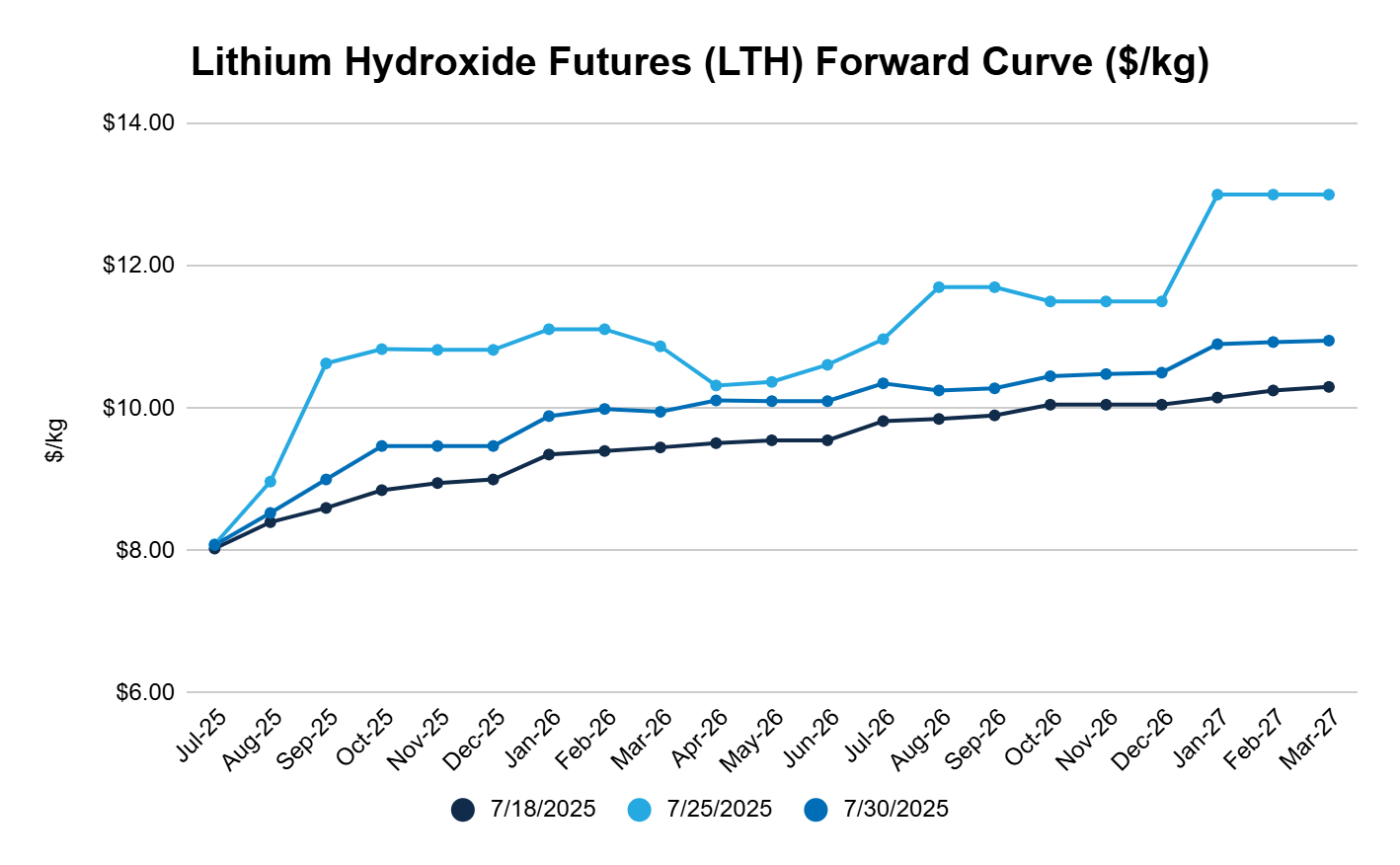
Group 1: Market Overview - The lithium carbonate futures market has experienced significant volatility, with the main contract fluctuating from over 80,000 yuan/ton to a drop of 67,840 yuan/ton within a month [1] - The average price of battery-grade lithium carbonate has decreased from 72,833 yuan/ton to 70,833 yuan/ton, while industrial-grade products saw a decline of 3.06% [1] - The lithium hydroxide futures market has also reacted to these fluctuations, indicating market concerns over future supply and demand balance [1][4] Group 2: Supply Dynamics - Major lithium supply sources globally include Australia, South American salt lakes, and emerging regions in Africa, with Australian production showing a 13% quarter-on-quarter decrease but a 22% year-on-year increase [5] - Domestic lithium resources are concentrated in Jiangxi and Qinghai, with recent regulatory actions leading to expectations of supply contraction [5] - The production status of enterprises has been affected, with a notable decline in purchasing willingness from downstream cathode material manufacturers due to high prices [5] Group 3: Demand Trends - Despite strong performance in the energy storage market, the growth rate of electric vehicles is slowing, with global lithium demand expected to grow by 18% to 1.5 million tons LCE by 2025, significantly lower than previous years [6] - Current lithium prices are approaching cost levels, with an estimated supply of 1.34 million tons LCE at 80,000 yuan/ton, while projected demand for 2025 is 1.43 million tons LCE [6] - The influx of speculative funds into the futures market has significantly influenced price movements, with a notable increase in trading volumes [6] Group 4: Risk Management Tools - The Chicago Mercantile Exchange's lithium hydroxide futures (LTH) have become a key tool for hedging price risks in the industry, particularly for high-end material companies [8] - LTH contracts directly connect with the procurement pricing systems of high-end supply chain companies, mitigating cross-hedging discrepancies [9] - Companies can effectively lock in future sales prices or procurement costs through hedging operations in the LTH market, thus protecting profit margins [12] Group 5: Market Strategies - Market participants can engage in cross-market arbitrage between lithium carbonate and lithium hydroxide futures, with recent price spreads indicating potential trading opportunities [14] - Seasonal expectations suggest a potential downturn in the fourth quarter, with strategies like long positions in near-term contracts yielding returns [15] - The lithium market is closely tied to macroeconomic conditions, with global economic growth impacting demand for electric vehicles and energy storage [16]

纯苯期货和期权上市在即 企业表态将积极参与交易
Zheng Quan Ri Bao· 2025-08-08 07:27
Core Viewpoint - The launch of pure benzene futures and options on July 8 by Dalian Commodity Exchange is expected to provide effective risk management tools for the pure benzene industry, with companies eager to participate in initial trading [1][4]. Industry Overview - Pure benzene is a key organic chemical raw material with downstream applications in various sectors including electrical appliances, construction materials, packaging, and fiber materials. China is the largest producer and consumer of pure benzene globally [2][3]. - The rapid changes in the supply-demand structure of the spot market have increased uncertainties for companies in the pure benzene industry, highlighting the urgent need for suitable risk management tools [2]. Challenges Faced by Companies - Companies face several operational challenges, including a lack of pricing power in the domestic pure benzene market, increased credit risk due to price volatility, and mismatched product liquidity between pure benzene and its derivatives [3]. - The reliance on traditional methods such as long-term contracts and inventory adjustments for risk management is insufficient, especially during extreme market fluctuations [2][3]. Futures and Options Details - The first batch of pure benzene futures will consist of four contracts, with a trading unit of 30 tons per contract and physical delivery [4]. - Initial trading limits are set at 7% of the previous day's settlement price, with a 14% limit on the first trading day. The margin requirement is 8% of the contract value [4]. Participation and Expectations - Companies have expressed strong interest in participating in the futures and options market to enhance their risk management capabilities and improve price discovery [5]. - The expectation is that the futures market will enhance liquidity, optimize the structure of market participants, and attract more industry clients and financial institutions [5].
我国“商品期货重器”如何护航黄金产业发展
Zheng Quan Ri Bao· 2025-08-08 07:20
本报记者 邢 萌 王 宁 今年以来,在复杂多变的国际形势下,市场避险情绪高涨,黄金价格居高不下。伦敦金长期处于 3300美元/盎司以上,国内金饰价格一度突破1000元/克。受高金价影响,金饰销售低迷,终端消费动力 不足,产业发展面临挑战。 在此背景下,黄金衍生品有望成为支撑产业稳健运行的安全阀。近日,记者深入调查北京、深圳、 山东等地黄金加工销售市场,通过采访线下金店、产业公司、期货公司、业内专家等多方人士了解到, 高金价下,黄金期货、黄金期权在助力金企应对价格波动风险、推进稳健经营方面发挥了重要作用,推 动中国黄金市场从传统现货交易市场迈向更加成熟的现代金融衍生品市场。 新形势下,中国期货市场对外开放力度持续加大,业界期待黄金期货能加快国际化步伐,不断优化 跨境交易机制,吸引国际机构广泛参与,从而提高我国黄金市场的国际影响力,增强话语权。 产业链企业避险需求上升 尽管黄金价格持续走高,但并未带来想象中的产业"盛宴"。事实上,由于高金价抑制了消费需求, 近期产业链企业库存资产避险需求上升。 记者调查发现,黄金销售疲态渐显正在中国最大的黄金珠宝交易市场深圳水贝、矿脉资源极为丰富 的"中国金都"山东招远、北京规模 ...
航宇科技: 中信证券股份有限公司关于贵州航宇科技发展股份有限公司及控股子公司开展金融衍生品交易业务的核查意见
Zheng Quan Zhi Xing· 2025-08-07 11:22
Core Viewpoint - The company, Guizhou Hangyu Technology Development Co., Ltd., plans to engage in foreign exchange financial derivatives trading to mitigate financial risks associated with currency fluctuations and enhance financial stability [2][3][7]. Summary by Sections 1. Overview of Trading Activities - The company aims to conduct foreign exchange derivatives trading due to the increasing scale of its international business, which primarily involves transactions in foreign currencies like USD and EUR [2]. - The maximum amount for foreign exchange derivatives trading is set at 300 million RMB (or equivalent in other currencies), with the approval valid for 12 months from the board's decision [2][3]. 2. Trading Instruments and Methods - The trading activities will include spot, forward, swap, and options products, focusing on underlying assets such as interest rates, exchange rates, and currencies [2][3]. 3. Counterparties and Funding Sources - The trading counterparties will be stable and reputable state-owned and joint-stock banks, with no related party transactions involved [3]. - The funding for these trading activities will come from the company's own funds, without using raised capital [3]. 4. Approval Process - The board of directors approved the trading activities on August 7, 2025, and authorized the management to execute specific trading operations within the approved limits [3][7]. 5. Risk Analysis and Control Measures - The company will adhere to principles of hedging and will not engage in speculative trading, although risks from international political and economic factors remain [4][5]. - Risk control measures include establishing internal control systems, defining approval authority, and implementing risk reporting procedures [5][6]. 6. Impact on the Company - Engaging in foreign exchange derivatives trading is expected to reduce risks from currency and interest rate fluctuations, improve capital efficiency, and safeguard shareholder interests [6][7]. 7. Accounting Treatment - The company will follow relevant accounting standards for financial instruments and hedge accounting to reflect the trading activities in its financial statements [6][7].


中能化工:用金融智慧为煤化工产业护航
Qi Huo Ri Bao Wang· 2025-08-06 18:20
Core Viewpoint - The company has successfully integrated financial tools such as futures and options into its operations to manage risks and enhance profitability in the coal chemical industry, particularly in urea and methanol production. Group 1: Company Overview - Anhui Jincheng Coal Chemical Co., Ltd. (referred to as the company) has evolved from Linquan Fertilizer Plant since its establishment in 1970, becoming a comprehensive coal chemical enterprise with a focus on fertilizers, chemicals, and power generation [1] - The company currently has a urea production capacity of 3.6 million tons and methanol production capacity of 700,000 tons [1] Group 2: Risk Management Strategies - The company has actively participated in national fertilizer reserve projects, taking on a task to store 50,000 tons of urea in Anhui for the 2023-2024 period [2] - In January 2024, the company anticipated a price drop in urea due to increased supply from national reserves and utilized futures contracts to hedge against potential losses [2][3] - The company sold 300 contracts of urea futures at an average price of 2,238 CNY/ton, effectively locking in the value of its inventory [2] Group 3: Financial Tool Utilization - The company has successfully implemented a combination of futures and options to enhance its financial strategies, with a focus on selling out-of-the-money call options to increase revenue without affecting hedging effectiveness [4][5] - In June 2024, the company generated additional income of 124,400 CNY through selling out-of-the-money call options [5] Group 4: Methanol Business and Arbitrage - The company has developed a unique risk management model for its methanol business, utilizing futures as the primary tool and options as a supplementary strategy [6] - In December 2024, the company executed an arbitrage operation by shipping methanol to Jiangsu, realizing a profit of 100 CNY/ton before the shipment even arrived at the port [6] Group 5: Industry Collaboration and Market Impact - The company aims to empower the entire industry chain by sharing its risk management experiences with upstream and downstream partners, enhancing overall market stability [8][9] - In November 2024, the company engaged in a hedging operation to lock in costs and mitigate risks during a downward price trend in the urea market [9] Group 6: Future Outlook - The company plans to focus on collaborative risk management, combining various financial tools, and responding quickly to market changes, aiming to enhance the profitability of the entire coal chemical industry [10]
神农集团: 云南神农农业产业集团股份有限公司2025年第三次临时股东会会议资料
Zheng Quan Zhi Xing· 2025-08-06 16:09
云南神农农业产业集团股份有限公司 云南神农农业产业集团股份有限公司 Yunnan Shennong Agricultural Industry Group Co.,LTD. 会议资料 股票代码:605296 股票简称:神农集团 中国 昆明 二〇二五年八月 云南神农农业产业集团股份有限公司 为维护全体股东的合法权益,确保云南神农农业产业集团股份有限公司(以 下简称"公司")股东会的正常秩序和议事效率,保证股东会的顺利进行,根据 《中华人民共和国公司法》 《中华人民共和国证券法》 《公司章程》及《股东会议 事规则》的规定,特制定本次股东会须知如下: 一、为能够及时统计出席会议的股东(或股东代表)所代表的持股总数,请 现场出席股东会的股东和股东代表于会议开始前 30 分钟到达会议地点,并携带 身份证明、股东账户卡、加盖法人公章的《营业执照》复印件(法人股东)、授 权委托书(股东代理人)、持股凭证等原件,以便签到入场;参会资格未得到确认 的人员,不得进入会场。 二、为保证本次会议的正常秩序,除出席会议的股东(或股东代表)、董事、 监事、高级管理人员、见证律师以及公司邀请的人员以外,公司有权拒绝其他人 员进入会场。 三 ...
