价值风格

Search documents
内需政策利好来袭,低估资产备受关注
Sou Hu Cai Jing· 2025-12-23 05:44
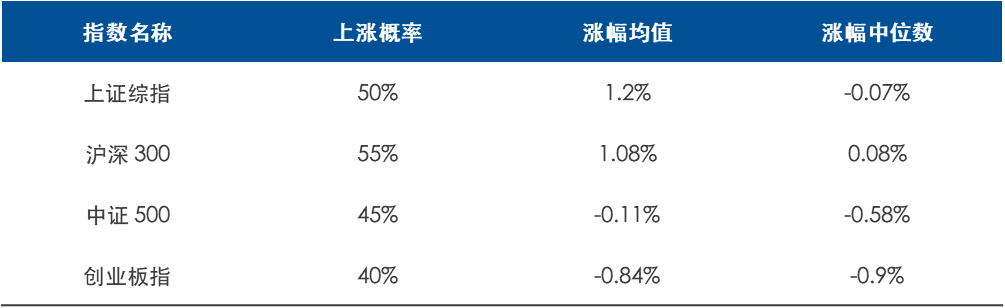
Group 1 - The central economic work conference has prioritized domestic demand expansion, which is expected to support the consumption sector and cyclical assets, with a focus on large-scale equipment updates and consumer goods replacement programs [2] - A special long-term bond of 500 billion yuan will be issued to support domestic demand expansion, alongside plans to increase residents' income through stable employment and pension improvements [2] - The National Value 100 Index aligns well with policy directions, with its top three sectors—home appliances, banking, and non-ferrous metals—accounting for nearly 50% of the index, making it a potential beneficiary of the new policies [2] Group 2 - Historical data shows that the value style has outperformed growth style in the second half of December, with the Shanghai Composite Index having a 50% probability of rising and an average increase of 1.2% [3][4] - The National Value 100 Index is expected to benefit from both improved earnings fundamentals in cyclical industries and the year-end calendar effect, leading to a dual boost in profitability and valuation [4] Group 3 - The National Value 100 Index offers a dual advantage of dividends and long-term performance, with a current dividend yield of 5.1%, higher than the 4.6% of the CSI Dividend Index and 3.3% of the National Free Cash Flow Index [5] - Since its inception, the National Value 100 Index has achieved an annualized return of 17.3%, outperforming other indices in terms of risk-return ratio [5][7] - Recent performance indicates that the National Value 100 Index has been effective as a "dividend+" strategy, with significant gains since October, highlighting its stability and representativeness in the value style [7][9]

红利品种,为何容易出现低估?|第423期直播回放
银行螺丝钉· 2025-12-19 14:03
Core Viewpoint - The article discusses the performance and risk of dividend indices, highlighting their long-term advantages over the market, including lower volatility and consistent returns [3][5]. Group 1: Long-term Performance - Dividend indices have historically outperformed the market with lower volatility, typically exhibiting 60%-70% of the market's volatility [3]. - From November 14, 2014, to December 17, 2025, the annualized return of the Shanghai-Hong Kong-Shenzhen dividend low-volatility total return index reached 13%, with a maximum drawdown of -33.19%, while the CSI All Share Total Return Index had an annualized return of 6.21% and a maximum drawdown of -55.78% [3]. Group 2: Sources of Returns - The returns from dividend index funds can be broken down into three main sources: undervalued purchases leading to valuation gains, annual profit growth of approximately 6%-7% from underlying companies, and dividend income closely tied to the purchase time's dividend yield [5]. Group 3: Conditions for Underperformance - Dividend indices may underperform the market under certain conditions, such as when bond yields are high. In 2024, U.S. bond yields reached 4%-4.5%, while the dividend yield of U.S. dividend index funds was around 4%, making them less attractive [6]. - Another scenario for underperformance is during growth style bull markets, where indices like the ChiNext Index have shown significantly higher gains compared to the dividend low-volatility index [8]. Group 4: Investment Principles - Investing in dividend index funds should focus on undervalued purchases to reduce holding period volatility, enhance future valuation upside, and increase the attractiveness of dividend yields [10]. - Buying during undervalued phases provides a safety cushion against market fluctuations, making it easier for investors to maintain their positions [12]. Group 5: Attractiveness of Dividend Indices - Dividend indices are often easier to find at undervalued levels due to their strategy of selecting high dividend yield stocks, which typically have lower price-to-earnings and price-to-book ratios [19]. - Regular rebalancing of dividend indices tends to favor the inclusion of undervalued stocks and the exclusion of overvalued ones, effectively implementing a buy low, sell high strategy [20]. Group 6: Comparison with Other Strategy Indices - Similar to dividend indices, other strategy indices such as value, low volatility, and free cash flow indices also exhibit defensive characteristics and are likely to present undervalued investment opportunities [22].

价值风格表现占优,价值ETF(159263)受市场关注,盘中净申购达8700万份
Mei Ri Jing Ji Xin Wen· 2025-12-15 07:01
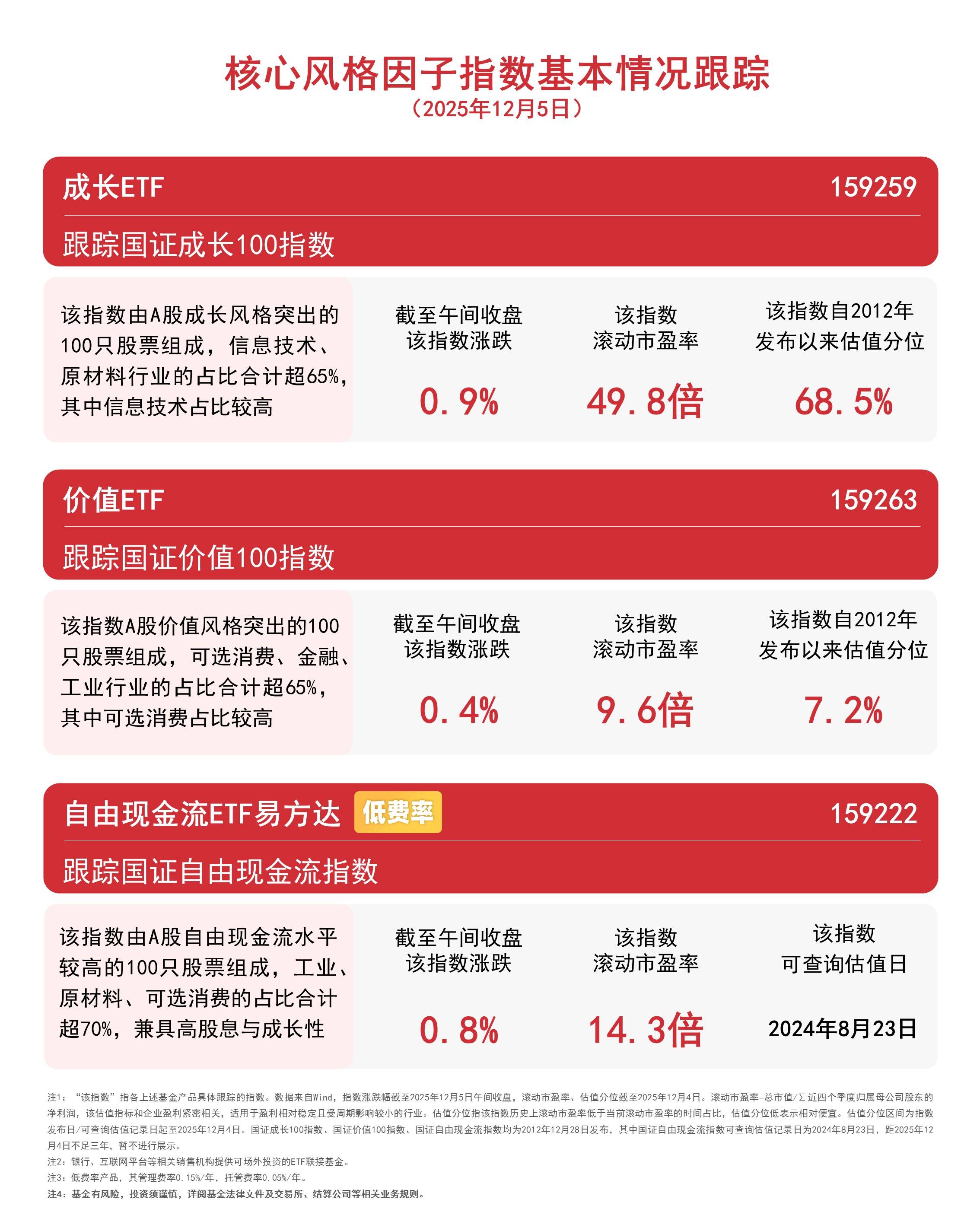
Group 1 - The market experienced fluctuations with the banking sector showing a low opening but recovering, while domestic demand-related sectors led the gains. As of 14:00, the Guozheng Value 100 Index rose by 0.4%, accumulating nearly 7% since October, outperforming similar value style indices. The value ETF (159263) saw a net subscription of 87 million units today, indicating high investor interest [1] - Three government departments jointly issued 11 policy measures to boost consumption, reinforcing the focus on expanding domestic circulation. Market views suggest that the expectations and pricing for domestic and external demand products differ significantly from last year, and if domestic demand-related products exceed expectations, there could be substantial valuation elasticity [1] - The Guozheng Value 100 Index focuses on deep value, utilizing a screening system based on "high dividends + high free cash flow + low PE" to select core value stocks in the market. The top three industries in the index are home appliances, banking, and automobiles, collectively accounting for over 45%. Since its launch in 2012, the index has achieved an annualized return of over 12%. The value ETF (159263) is currently the only ETF tracking this index, facilitating investors in accessing undervalued quality assets in the market [1]
[12月12日]指数估值数据(A股港股上涨;价值风格回调,风险如何呢;港股指数估值表更新;抽奖福利)
银行螺丝钉· 2025-12-12 13:58
Core Viewpoint - The article discusses the recent performance of the A-share and Hong Kong stock markets, highlighting the rotation between growth and value styles, and the implications of upcoming index adjustments. Group 1: Market Performance - The overall market rose today, closing at a rating of 4.2 stars [1] - Both large, medium, and small-cap stocks increased, with small-cap stocks showing slightly higher gains [2] - The cash flow and value styles saw an uptick [3] - Growth styles also experienced an overall increase [4] - Hong Kong stocks outperformed A-shares today [7] Group 2: Style Rotation - Recent fluctuations in value styles are linked to the rotation of styles in A-shares [10] - A-shares frequently exhibit rotations between growth and value styles [11] - In Q3 of this year, growth styles were particularly strong, with the ChiNext Index achieving its largest quarterly gain in the last decade [12][13] - Value styles also rose in Q3, but not as significantly as growth styles [14] - From October to November, growth styles experienced a significant pullback, with the ChiNext Index dropping from 3331 points to 2892 points, a decline of 13.2% [15][16] - The STAR 50 Index saw a more pronounced fluctuation, with a 20% pullback during the same period [17] - Value styles remained relatively stable during this time, with slight declines in value and dividend indices, while the free cash flow index even saw a slight increase [18][19] Group 3: Future Outlook - In December, after a sharp decline, growth styles began to rebound, attracting market attention and capital inflow [20][21] - Value styles have been somewhat sluggish recently, with dividend low volatility indices experiencing a pullback of approximately 5.6% from November highs to December 9 [22][23] - The free cash flow index also saw a pullback of about 4.2% during the same period [24] - The fluctuations in dividend and cash flow indices are considered normal [25] - The volatility of these indices in Q4 is significantly lower than that of broad market and growth style indices [26] - The performance of growth and value styles will continue to show strength and weakness in phases, which is characteristic of A-shares [27][28] Group 4: Risk and Volatility - Generally, small-cap and growth styles exhibit higher volatility risk compared to the broader market indices [30] - Growth styles can experience fluctuations of 20-30% within a year, which is common [32] - From 2021 to 2024, many growth style indices have seen maximum declines of around 70% [33] - Broad indices like CSI 300, CSI 500, and others represent the average risk of A-shares [34][35] - Value style indices typically have lower volatility than broad indices, usually around 60-70% of the volatility of the broader market [36][39] - However, value indices still experience volatility, and investors should be prepared for this risk [41] Group 5: Hong Kong Market Valuation - The article provides a summary of the valuation of Hong Kong indices for reference [9] - Hong Kong stocks have seen a more substantial increase than A-shares this year, returning to a rating of over 3 stars [42] - The article includes a detailed valuation table for various Hong Kong indices, including PE ratios, dividend yields, and other metrics [43]
中欧基金王培:展望2026,周行不殆,科技迭新
Zheng Quan Shi Bao Wang· 2025-12-11 09:05
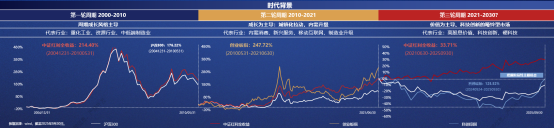
Core Viewpoint - The current market is transitioning from high growth to moderate growth, with a trend of convergence between technology and value sectors in the new cycle [1] Group 1: Market Cycle Analysis - Understanding cyclical changes is essential for future market judgments, with significant shifts observed over the past two decades [2] - The first phase (2000-2010) was dominated by cyclical growth, benefiting heavy industries, resource sectors, and low-end manufacturing [3] - The second phase (2010-2021) saw a shift towards growth, driven by urbanization and the rise of consumer demand and emerging services, with the ChiNext index experiencing rapid growth [3] - Since 2021, the market has gradually shifted back to moderate growth, with value styles regaining dominance, as evidenced by the performance of the STAR Market index compared to the CSI Dividend Index [3] - Long-term migration of industry weights indicates structural upgrades, with technology, consumer healthcare, and cyclical finance gaining share in the CSI 300 over the past 16 years [3] Group 2: Future Outlook for 2026 - The outlook for 2026 is summarized by three keywords: technology leading, value following, and returning to leaders, based on long-term industry structural evolution [4] - The current AI narrative, represented by the STAR Market, mirrors the technology cycle from 2011 to 2015, but with different supporting backgrounds such as demographic changes and geopolitical factors [4] - Key signals for market improvement include PPI and inventory conditions, with expectations for corporate performance to improve in mid-2024 following a low PPI point [4][5] Group 3: Investment Directions - The market is witnessing a recovery in value sectors, which may present structural opportunities in 2026, especially after a year of significant underperformance compared to growth sectors [6] - Investment focus will include cyclical industries (oil, coal, basic metals), non-banking sectors (insurance, brokerage), high ROE industries (internet, traditional consumption), and new cycle industries (new energy, power equipment) [6] - Continuous themes may emerge in CXO, innovative pharmaceuticals, AI applications, and humanoid robotics, although market volatility is expected to increase [6] Group 4: Research and Investment Strategy - The exponential growth of fund numbers, asset management scale, and listed companies has increased information density, posing challenges for research and investment [7] - The company is developing a systematic investment approach through professional division of labor and industrialized production lines to meet client needs [7] - AI is anticipated to become a core capability in active management, fundamentally reshaping the research and investment chain over the next three years [7]
基金“专业买手”把脉2026年大类资产配置!
天天基金网· 2025-12-08 02:02
上天天基金APP搜索777注册即可领500元券包,优选基金10元起投!限量发放!先到先得! 国泰基金曾辉: 国内 A 股可能明年上半年继续震荡,下半年在经济复苏预期的推动下再上一 个台阶。 诺德基金郑源: 在香港上市的内地企业股价或将会同时受益于国内经济上行、全球流动性宽 松,以及估值优势,值得关注。 平安基金吴心洋: 展望 2026 年,对国内权益、海外权益、黄金等商品、美债均偏乐观,国 内债市预计震荡为主。 嘉实基金赵迁: 2026 年最大的不确定性因素来自海外 AI 叙事的持续性和通胀背景下的美联 储决策。 华商基金孙志远: 2026 年更倾向于配置中国的权益资产,尤其是与价格相关度高的板块。 预计政策端将积极发力 2025 年临近尾声, 2026 年大类资产配置提上日程。 2026 年, A 股市场将呈现怎样的走 势?哪类资产性价比更高?该如何构建组合以把握机会、抵御潜在风险? 为此,中国基金报记者采访了东方红资产管理董事总经理、多元投资部总经理、基金经理邓 炯鹏,国泰基金多资产配置部负责人曾辉,诺德基金 FOF 投资总监郑源,华商基金资产配置 部总经理、华商安远稳进一年持有混合( FOF )基金经理 ...

A股市场关键时刻,最新研判
Zhong Guo Ji Jin Bao· 2025-12-08 01:37
Core Viewpoint - The investment outlook for 2026 suggests a focus on equity assets, particularly those with high price correlation, as the macroeconomic environment stabilizes and policy support continues [9][14][12]. Group 1: Macroeconomic Outlook - The macroeconomic environment is expected to maintain stability, with a key focus on whether the real estate market can stabilize and support further economic recovery [10][11]. - The A-share market may experience continued fluctuations in the first half of 2026, with potential upward movement in the second half driven by economic recovery expectations [3][10]. - The policy environment is anticipated to remain supportive, particularly as the "14th Five-Year Plan" begins [9][10]. Group 2: Asset Allocation Strategy - The preference for asset allocation in 2026 leans towards equities over fixed income, with a focus on sectors that are expected to perform well based on price dynamics [12][14]. - The ranking for asset allocation is suggested as commodities over Hong Kong stocks, which in turn are preferred over A-shares, followed by bonds [14][21]. - The equity market is expected to offer better value compared to fixed income assets, which may face challenges due to rising inflation and valuation constraints [13][14]. Group 3: Sector and Style Preferences - Growth styles are expected to outperform value styles in 2026, particularly in sectors related to AI and technology [15][16]. - There is a balanced outlook for both growth and value styles, with specific attention to sectors that are closely tied to price movements, such as new energy and consumer services for growth, and chemicals and construction materials for value [17][18]. - The cyclical sector is anticipated to perform well due to low price-to-book ratios and expected improvements in profit growth [12][18]. Group 4: Fixed Income Market Insights - The bond market is expected to experience fluctuations, with a focus on short to medium-duration bonds as the preferred investment choice [19][20]. - The current low yield environment for bonds suggests limited upside potential, making careful selection of bond funds crucial [20][21]. - The anticipated rise in inflation may impact the performance of long-duration bonds, leading to a preference for short-duration strategies [19][20]. Group 5: Commodity and Global Market Considerations - Commodities, particularly precious metals like gold and silver, are expected to remain attractive due to global liquidity conditions and potential price recovery [21][22]. - The performance of Hong Kong stocks, especially those of mainland companies, is likely to benefit from domestic economic growth and favorable global liquidity [5][21]. - The outlook for U.S. Treasuries is positive, especially in the context of a slowing U.S. economy, which may enhance their appeal as a safe-haven asset [23][24].

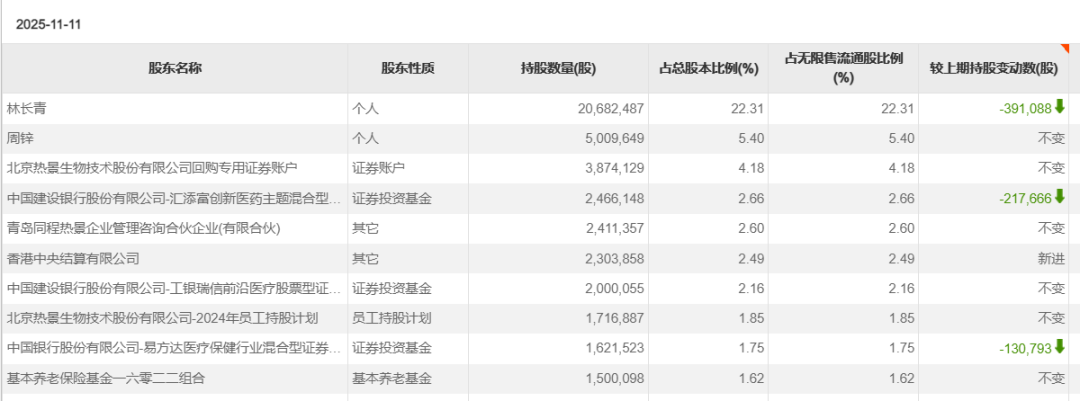
机构调仓路径曝光
Shang Hai Zheng Quan Bao· 2025-12-07 11:28
| 股东名称 | 股东性质 | 持股数量(股) | 占总股本比例(%) | 占无限售流通股比例 | 较上期持股受动数(股) | | --- | --- | --- | --- | --- | --- | | | | | | (%) | | | 林长青 | 个人 | 20,682,487 | 22.31 | 22.31 | -391,088 | | 周锌 | 个人 | 5.009.649 | 5.40 | 5.40 | 不变 | | 北京热暑生物技术股份有限公司回购专用证券账户 | 证券账户 | 3,874,129 | 4.18 | 4.18 | 不变 | | 中国建设银行股份有限公司 汇交营创新医药主题混合型 | 证券投资基金 | 2.466.148 | 2.66 | 2.66 | -217.666 | | 青岛同程热景企业管理咨询合伙企业(有限合伙) | 其它 | 2,411,357 | 2.60 | 2.60 | 不变 | | 香港中央结算有限公司 | 其它 | 2.303.858 | 2.49 | 2.49 | 新进 | | 中国建设银行股份有限公司-工银瑞信前沿医疗股票型证 | 证券投资基金 | 2. ...
国泰海通|金工:综合量化模型信号和日历效应,12月建议超配大盘风格、价值风格
国泰海通证券研究· 2025-12-05 10:48
Core Insights - The report suggests an overweight allocation to large-cap and value styles for December based on quantitative model signals and calendar effects [1][2]. Size and Style Rotation Monthly Strategy - The latest quantitative model signal for the end of November is -0.17, indicating a preference for large-cap stocks. Historically, large-cap stocks have outperformed in December, leading to a recommendation for an overweight allocation in December [1]. - The year-to-date return for the size rotation quantitative model is 24.71%, with an excess return of 1.5% compared to an equal-weight benchmark of 23.21% [1]. - The combined strategy, incorporating subjective views, has yielded a return of 26.1%, with an excess return of 2.89% [1]. Value and Growth Style Rotation Monthly Strategy - The monthly quantitative model signal is -0.33, indicating a preference for value stocks. Historically, value style has slightly outperformed in December, leading to a recommendation for an overweight allocation in December [2]. - The year-to-date return for the value-growth style rotation model is 20.37%, with an excess return of 2.99% compared to an equal-weight benchmark of 16.88% [2]. Style Factor Performance Tracking - Among eight major factors, dividend and quality factors showed high positive returns in November, while large-cap and momentum factors exhibited high negative returns [2]. - For the year, volatility and growth factors had high positive returns, while liquidity and large-cap factors had high negative returns [2]. - In November, residual volatility, short-term reversal, and earnings quality factors had high positive returns, while momentum, profitability, and large-cap factors had high negative returns [2]. Factor Covariance Matrix Update - The report updates the latest factor covariance matrix as of November 28, 2025, which is essential for predicting stock portfolio risks using a multi-factor model [3].

价值风格震荡上行,关注价值ETF(159263)投资机会
Sou Hu Cai Jing· 2025-12-05 05:20
Core Viewpoint - The market is experiencing a strong performance in sectors such as non-ferrous metals and insurance, driving the value style upward, with significant interest in related products [1] Group 1: Market Performance - The Guozheng Growth 100 Index increased by 0.9% [1] - The Guozheng Free Cash Flow Index rose by 0.8% [1] - The Guozheng Value 100 Index saw an increase of 0.4% [1] Group 2: Investment Products - The value ETF (159263) recorded a net subscription of 3 million units in the morning session [1] - The Guozheng Value 100 Index employs a three-dimensional screening system focusing on "high dividends + high free cash flow + low price-to-earnings ratio" to select value stocks [1] - The value ETF (159263) tracks this index, providing investors with opportunities to capitalize on value style investments [1]