定投

Search documents
线上黄金投资走俏,年轻投资者热衷分散配置“新三金”
Guo Ji Jin Rong Bao· 2025-10-24 13:01
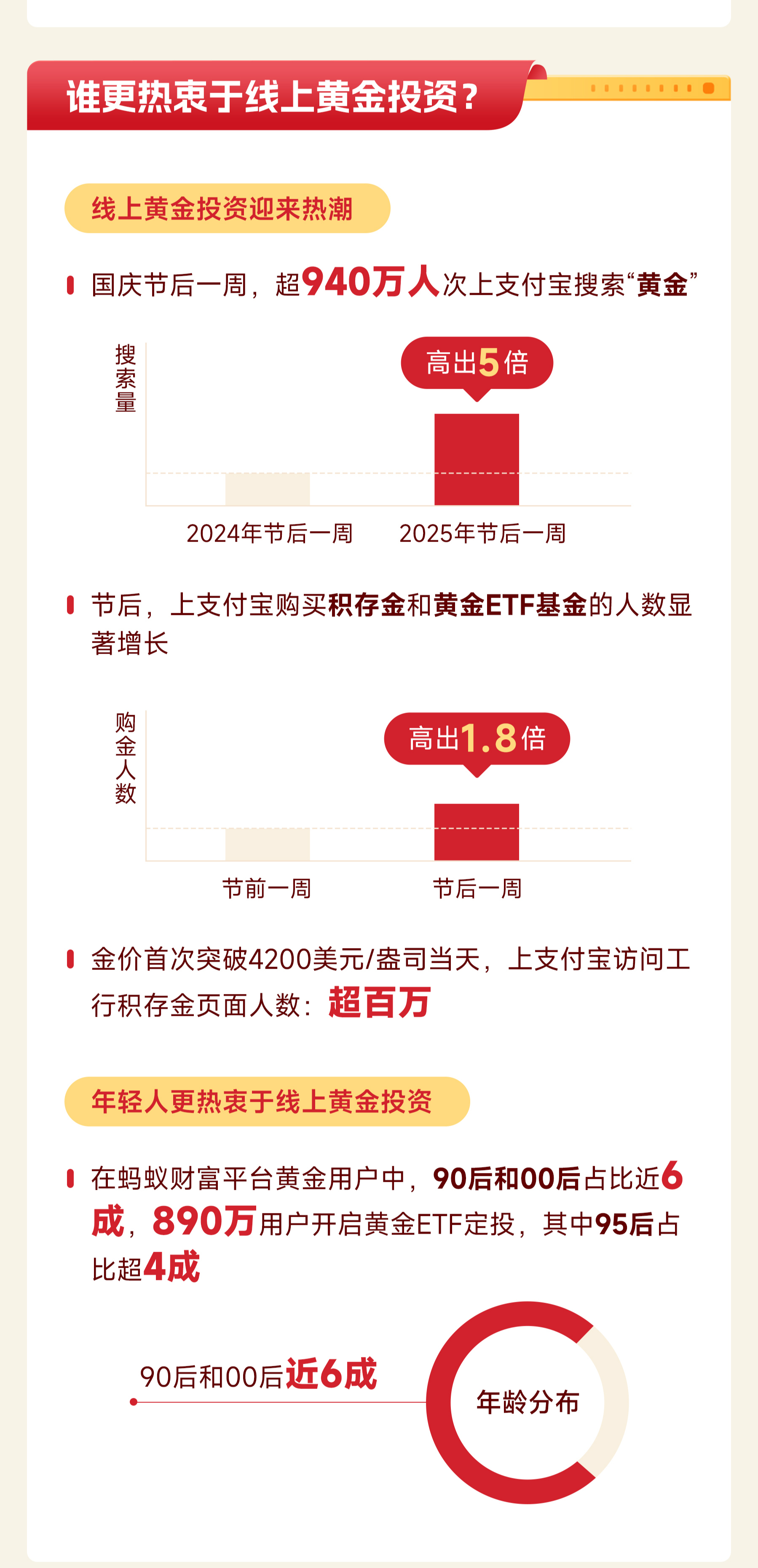
Core Insights - Gold prices are experiencing high volatility, yet the investment enthusiasm remains strong, particularly among younger investors who favor rational investment strategies like regular contributions and asset allocation [1][7][9] Group 1: Investment Trends - Over 8.9 million users have initiated gold ETF regular investments on the Ant Wealth platform, with over 40% of these users being born after 1995 [1][9] - The number of young investors (those born in the 90s and 00s) diversifying their portfolios with money market funds, bond funds, and gold funds, referred to as the "new three golds," has reached nearly 10 million [1][9] - Following the National Day holiday, over 9.4 million searches for "gold" were recorded on Alipay, a fivefold increase compared to the same period last year [7][8] Group 2: Market Dynamics - On October 14, gold prices surpassed $4,200 per ounce for the first time, leading to over a million visits to the Industrial and Commercial Bank's gold accumulation page on Alipay [7][8] - The popularity of online AI services has contributed to the growth of online gold investment, with inquiries about gold to the AI financial assistant increasing by 180% after the National Day holiday [8] - Global central banks have increased their gold reserves, surpassing U.S. Treasury holdings, driven by factors such as currency overproduction and rising U.S. debt, which enhances gold's appeal as a risk-free asset [8] Group 3: Investor Behavior - Young investors are increasingly adopting systematic investment approaches, with an average holding period of 1,750 days for gold ETF investors on the Ant Wealth platform [9] - A case study of a user who began investing in gold ETFs two years ago shows a return exceeding 40%, highlighting the potential for long-term gains despite short-term price fluctuations [9][10] - Financial experts recommend that investors should make decisions based on their investment goals and risk tolerance, advocating for diversified portfolios that include low-risk assets alongside gold [10]

市场波动大,2个方法,帮你更好投资|投资小知识
银行螺丝钉· 2025-10-23 13:56
Group 1 - The article emphasizes the importance of adhering to a self-established investment plan to avoid deviations that could lead to poor decision-making [2] - It suggests that when engaging in systematic investment, one should consider their psychological tolerance and the amount of capital invested, as higher investments can lead to increased psychological pressure [3] - The article recommends using long-term idle funds for investment, which should be an amount that one can afford to lose without feeling distressed, making it easier to maintain a long-term investment strategy [3]

黄金对阵白银:84%涨幅背后的风险差异!现在该买哪个?避免踩坑必看
Sou Hu Cai Jing· 2025-10-20 05:03
Group 1 - The recent surge in gold prices, which increased from over $2,600 at the beginning of the year to above $4,300, represents a 60% rise, driven by structural changes rather than just inflation or safe-haven demand [3][8] - Central banks, especially in emerging markets, have significantly increased their gold purchases, with net purchases exceeding 1,000 tons annually for three consecutive years, reflecting a decline in confidence in the US dollar [3][10] - The US federal debt has surpassed $37 trillion and is growing at a rate of $1.5 to $2 trillion per year, leading investors to seek protection in gold [5][10] Group 2 - The Federal Reserve's shift towards a dovish monetary policy, with expectations of interest rate cuts, reduces the opportunity cost of holding non-yielding assets like gold, enhancing its attractiveness [6][10] - Major financial institutions have made bullish predictions for gold prices, with Goldman Sachs forecasting $4,900 per ounce by December 2026 and Bank of America predicting a rise to $6,000 in the spring of next year [8][10] - Historical data suggests that gold prices could potentially double in the coming years, with projections indicating a peak of $5,800 per ounce by 2027 based on the relationship between US debt and gold prices [10] Group 3 - Silver has outperformed gold with an 84% increase year-to-date, driven by both gold's rise and strong industrial demand [12][13] - The demand for silver is being propelled by its use in solar panels, electric vehicles, and 5G technology, leading to a widening supply-demand gap [13] - Silver's market size is only one-ninth that of gold, making it more susceptible to price volatility and less supported by central bank demand [13] Group 4 - Different investment strategies are recommended for various types of investors in the current market, including holding positions for long-term investors and using dollar-cost averaging for those looking to enter the market [15][17] - Conservative investors are advised to consider gold ETFs for gradual investment, while aggressive investors may look into gold mining stocks to capitalize on both production and consumption opportunities [17] - Despite significant price increases in gold over the past two years, less than 30% of investors have realized actual profits, highlighting the risks of impulsive trading strategies [17]

[10月14日]指数估值数据(螺丝钉定投实盘第385期发车;养老指数估值表更新)
银行螺丝钉· 2025-10-14 14:00
Market Overview - The overall market experienced a decline, with a rating of 4.2 stars [1] - Large-cap stocks saw less decline compared to small and mid-cap stocks [2] - The market continues to exhibit style rotation, with significant drops in growth style stocks [3][4] - The ChiNext and STAR Market fell by 4% recently [5] Style Performance - Growth style stocks faced substantial declines, while value style stocks remained relatively stable [6] - Recently, previously underperforming "old economy stocks" have shown an overall increase [7] - Indices focusing on value, dividends, and free cash flow have seen overall gains [8] - The 300 Value Index has returned from undervaluation to normal levels [9] Investment Opportunities - There are still some undervalued sectors, particularly in consumer industries, that have started to gain traction [11][13] - The Hong Kong market reflects similar trends, with stable dividends and declines in technology growth stocks, which have not yet returned to undervaluation [14][16] - The volatility in the Hong Kong market has been greater than in the A-share market this year [17] Investment Strategies - The investment strategy includes a pause on regular investments in the index-enhanced advisory portfolio as it has returned to normal valuation, with plans to resume when it returns to undervaluation [20] - The active selection portfolio continues regular investments, while the monthly salary investment portfolio, which consists of 40% stocks and 60% bonds, is recommended for stable market participation [20] - The monthly salary portfolio features a "low buy high sell" strategy and a cash flow distribution function [20] Fund Performance - The performance of the China A500 and China Dividend indices has returned to normal valuation, with plans to pause investments until they reach undervaluation again [26] - The China A500 has achieved a profit of 22%, while the China Dividend index has seen a profit of approximately 6% [26] - The article emphasizes the importance of patience in long-term investments, highlighting that opportunities will continue to arise [33]

投资需要回归常识!这本书教你何时买,买什么,怎么配
雪球· 2025-10-13 13:00
Overall Introduction - The book introduces market rules, asset allocation logic, and strategies for different asset classes, including stocks, bonds, and commodities, while addressing practical issues faced by investors [4]. Core Views - The book proposes three dimensions to assess the market: policy, economy, and inflation, which are used to determine market conditions [7]. - Economic cycles are divided into six stages, each with corresponding asset preferences, ranging from bonds in the early slowdown to cash and commodities in the stagflation phase [11][12][13][39]. - Effective asset allocation strategies include the Permanent Portfolio, All Weather Portfolio, and Global Market Portfolio, emphasizing diversification and risk management [14][15][16]. Current Situation - Current policies are characterized as accommodative, with indicators such as M1 growth increasing from 0.39% in January to 5.96% in August [33]. - Economic recovery is weak, with industrial value-added growth declining from 7.7% to 5.2% [37]. - The market is likely in a transition between the late slowdown phase and the early recovery phase, suggesting a preference for small-cap growth stocks [39][40]. Investment Insights - Long-term asset allocation is crucial for sustained success, with diversified strategies proven to provide stable returns [44]. - A balanced stock-bond allocation is suitable for most investors, allowing for flexibility in extreme market conditions [45]. - Simplifying investment approaches and focusing on fundamental market principles can lead to better outcomes [47][48].

市场黑天鹅频发,普通人如何用两个方法,避开下一个让你血本无归的坑?
雪球· 2025-10-11 13:01
Core Viewpoint - The article emphasizes the effectiveness of timing strategies in the A-share market compared to the U.S. stock market, where a buy-and-hold strategy has proven to be successful over the long term [4]. Group 1: Investment Strategies - Historical data shows that buying the CSI 300 index during undervalued phases results in a 100% chance of achieving positive returns over five years, with a 37.56% probability of achieving an annualized return of 10% or more [5]. - In contrast, buying during overvalued phases guarantees losses over the same period, highlighting the importance of valuation in investment decisions [5]. - For the S&P 500, the data indicates that regardless of the valuation phase, there is a high probability of achieving positive returns, with 98.05% success in undervalued phases and 81.45% in overvalued phases [6]. Group 2: Asset Allocation - The article discusses the complexity of multi-asset allocation strategies, emphasizing the need for a portfolio that can withstand extreme market conditions while achieving long-term investment goals [7]. - It suggests two approaches to improve investment outcomes: increasing the win rate through diversification of uncorrelated assets and engaging in more investment opportunities to approach statistical results [8]. Group 3: Market Indicators - Current market strength indicators show a short-term strength at 52, indicating a mid-range state, while the long-term strength is at 90, suggesting that most stocks are in a long-term upward trend [10]. - The overall market sentiment is described as not overly aggressive, following some recent adjustments, which supports a strategy of stable holding [11].

建信基金:投资正当“时”丨“秋”色斑斓如画,投资恰如其“分”!
Xin Lang Ji Jin· 2025-10-09 09:48
Core Viewpoint - The article emphasizes the importance of timely investment strategies in the current market environment, highlighting opportunities in fixed income products, gold, and undervalued technology stocks during the autumn season [1][24]. Group 1: Investment Strategies - The current market conditions suggest a need for careful investment, with a focus on "fixed income+" strategies that balance stability and participation in equity markets, allowing investors to avoid missing out while managing risk [3][24]. - Dollar-cost averaging through systematic investment plans can alleviate timing pressures, enabling investors to gradually enter the market and potentially benefit from price dips [6][8][9]. Group 2: Gold Investment - Gold prices have recently surged, reaching $3,600 per ounce, driven by a continued decline in interest rates, which lowers the opportunity cost of holding non-yielding assets like gold [10][11]. - Central banks globally are increasing their gold reserves, with gold becoming the second-largest reserve asset after the US dollar, providing strong support for gold prices [12][13]. Group 3: Technology Sector Opportunities - The Hang Seng Technology Index is currently trading at a low price-to-earnings (P/E) ratio of 21.80, indicating potential undervaluation compared to other tech indices, which may present investment opportunities [17][19]. - The index includes a diverse range of technology sectors, from software services to hardware, allowing investors to capture various technological advancements [20]. - Recent government policies aimed at promoting artificial intelligence and technology innovation are expected to benefit companies within the Hang Seng Technology Index [21].
【投搞6】经历过至少一轮熊牛才明白的道理
Sou Hu Cai Jing· 2025-10-06 00:18
Core Insights - The article discusses the evolution of investment strategies and experiences shared by individuals in the private domain (XQ) over nearly a decade, highlighting the importance of learning and adapting in investment practices [1][3]. Investment Journey - The author began their investment journey around 2015-2016, inspired by articles that emphasized the significance of investment timing and returns on wealth accumulation [4]. - In February 2016, the author started investing in equity funds, achieving a 20% return within approximately 10 months [5]. - By July 2017, the author entered the workforce and continued to invest despite market challenges, including the impact of the trade war [10]. Influential Figures and Events - In September 2019, the author attended an event hosted by a fund company, where they met influential figures, including 博格, who shared insights on long-term investment strategies and the importance of minimizing trading costs [12][16]. - 博格's investment philosophy evolved from a focus on passive investing to a more active approach, suggesting adjustments based on market conditions [16]. Fund Performance and Strategies - The author created a personal fund portfolio named "大富神," which was significantly influenced by 博格's strategies, achieving a net value of 1.43, although the investor's return was lower due to timing [18]. - By the end of 2020, the author liquidated their investments to purchase a home, realizing a 25% return over three years [20]. Market Conditions and Adaptation - After joining the private domain (XQ) in January 2021, the author faced challenging market conditions, particularly for Hong Kong stocks, which were negatively impacted by various factors [23]. - Despite these challenges, the author remained committed to following 博格's investment strategies, emphasizing the importance of consistency and rational decision-making in investment [26]. Recent Developments - In the past year, market conditions improved, leading to increased engagement among 博格's followers and a rise in account values [26].

假期做点啥好:锻炼、看剧、看书
银行螺丝钉· 2025-10-01 13:28
Group 1 - The article emphasizes the importance of developing good habits during holidays, particularly focusing on exercise as a means of long-term health benefits, similar to investment strategies like dollar-cost averaging [6][14][15] - It suggests starting with low-barrier exercises at home, such as using the Nintendo Switch with the Ring Fit Adventure game, which can be a family-friendly option [9] - For those looking for cost-effective home workouts, it recommends various workout videos, with difficulty levels ranging from beginner to advanced, and highlights the importance of consistency in achieving fitness goals [10][11][12] Group 2 - The article discusses the value of watching films and series during holidays for relaxation, mentioning specific shows and their relevance to investment principles, such as caution and strategic thinking [20][25] - It provides a list of recommended shows, including domestic and international series, and emphasizes the importance of selecting content that can provide both entertainment and insights into business dynamics [19][26] - The article also suggests efficient viewing methods, such as watching at increased speeds or utilizing edited clips to save time while still gaining valuable insights [36][38][41] Group 3 - The article highlights the significance of reading as a means of knowledge acquisition, recommending a systematic approach to evaluating books based on their quality and relevance [44][46] - It lists several highly-rated books related to investment and personal development, emphasizing their potential to enhance understanding of financial markets and personal finance strategies [50][53][56] - The author encourages sharing recommendations for books and films that can be beneficial during the holiday period, fostering a community of knowledge sharing [61]

定投的本质是什么?|投资小知识
银行螺丝钉· 2025-09-27 14:00
Core Viewpoint - The article emphasizes the importance of strategic asset allocation for families to optimize their wealth management and investment returns [3] Group 1: Industry Insights - The current market environment presents both challenges and opportunities for investors, particularly in the context of rising interest rates and inflation [3] - Diversification across various asset classes is highlighted as a key strategy to mitigate risks and enhance returns [3] Group 2: Company Analysis - Companies that adapt to changing market conditions and consumer preferences are more likely to succeed in the long term [3] - The article discusses specific sectors that are expected to perform well, including technology and renewable energy, due to their growth potential [3]