
工业生产

Search documents
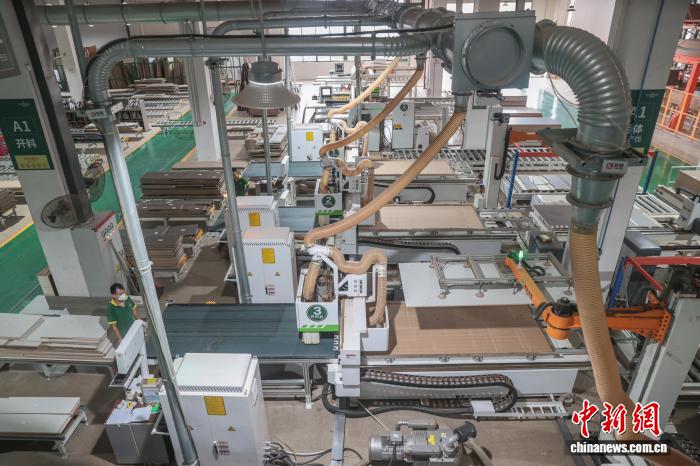
前八月江西经济平稳向好 亿元以上在建项目7828个
Zhong Guo Xin Wen Wang· 2025-09-16 09:17
Economic Overview - Jiangxi Province's fixed asset investment increased by 4.0% year-on-year in the first eight months, with 7,828 ongoing projects valued at over 100 million yuan [1] - The industrial production in Jiangxi saw an 8.0% year-on-year growth in the same period, with 241 out of 453 monitored industrial products experiencing production increases, resulting in a growth rate of 53.2% [1] Industrial Performance - Key industrial products such as new energy vehicles, flat-panel computers, service robots, and optoelectronic devices reported significant production growth rates of 87.1%, 57.4%, 34.6%, and 33.2% respectively [1] - The value added in equipment manufacturing and high-tech manufacturing increased by 12.1% and 11.8% respectively [1] Investment Breakdown - Infrastructure investment rose by 12.8%, while manufacturing investment grew by 9.3%. However, real estate development investment declined by 10.4% [1] - The completed investment from projects valued at over 100 million yuan grew by 7.1%, accounting for 71.9% of total investment and contributing 5.0 percentage points to overall investment growth [1] Real Estate Market - The sales area of new commercial housing reached 17.948 million square meters, marking a 1.6% year-on-year increase, while residential sales area decreased by 1.3% [3] - The sales revenue from new commercial housing was 119.64 billion yuan, down 5.5% year-on-year, with residential sales revenue declining by 6.6% to 102.18 billion yuan [3] Trade Performance - The total value of goods trade in Jiangxi reached 307.32 billion yuan, reflecting a 1.8% year-on-year increase, with a notable acceleration of 1.1 percentage points compared to the previous month [3] - Exports of electromechanical products amounted to 123.04 billion yuan, up 2.4% year-on-year, constituting 62.2% of the province's total exports [3] - Significant growth in exports was observed in integrated circuits, lithium batteries, and automotive parts, with increases of 126.5%, 109.6%, and 74.6% respectively [3]

2025年8月经济数据点评:固定投资继续降速
CMS· 2025-09-16 06:32
Industrial Production - In August, the industrial added value for large-scale industries grew by 5.2% year-on-year, slightly down from 5.7% in July, but still above 5%[4] - Manufacturing value added increased by 5.7%, outpacing overall industrial growth by 0.5 percentage points, reinforcing its core support role[4] - High-tech manufacturing saw a significant expansion with a year-on-year growth of 9.3%, indicating strong momentum in emerging industries[4] Fixed Asset Investment - From January to August, national fixed asset investment grew by 0.5% year-on-year, a notable decline from 1.6% in the first seven months, with a month-on-month decrease of 0.20% in August[4] - Excluding real estate development investment, the cumulative growth rate reached 4.2%, highlighting real estate as a major drag on overall investment[4] - Private fixed asset investment fell by 2.3%, worsening from a 1.5% decline in the previous period, indicating weak vitality in private investment[4] Real Estate Sector - Real estate development investment dropped by 12.9% year-on-year from January to August, with the decline accelerating from 12.0% in the first seven months[4] - In August alone, real estate investment fell by 19.5%, marking the largest monthly decline of the year[4] - New housing starts decreased by 19.5% year-on-year, reflecting developers' cautious long-term outlook despite a slight narrowing of the decline compared to mid-year[4] Consumer Spending - In August, retail sales of consumer goods increased by 3.4% year-on-year, a 0.3 percentage point decrease from the previous month[5] - The "trade-in" policy positively impacted sales, with retail sales of home appliances and audio-visual equipment rising by 14.3% and furniture by 18.6%[5] - Service retail sales grew by 5.1% year-on-year from January to August, continuing to outpace goods retail sales, driven by strong demand in tourism and cultural entertainment[5] Economic Outlook - The economy is expected to maintain recovery momentum, with GDP growth projected to reach around 5% for the year, despite anticipated slower growth in the third quarter compared to the second[5] - Risks include the potential slower-than-expected recovery of domestic demand, which could impact overall economic performance[5]
生产需求基本平稳 就业物价总体稳定 新动能培育壮大 8月份国民经济总体平稳稳中有进
Xin Hua She· 2025-09-16 01:11
Economic Overview - The national economy is maintaining a stable and progressive development trend, with steady production demand and overall stability in employment and prices [1] - New growth drivers are being cultivated and strengthened [1] Industrial and Service Sector Performance - In August, the industrial added value of large-scale enterprises increased by 5.2% year-on-year and 0.37% month-on-month [1] - The service production index grew by 5.6% year-on-year [1] Market Sales and Investment - Social retail sales totaled 39,668 billion yuan in August, reflecting a year-on-year increase of 3.4% and a month-on-month increase of 0.17% [1] - Fixed asset investment continues to grow, and total goods import and export reached 38,744 billion yuan, up 3.5% year-on-year [1] - Exports amounted to 23,035 billion yuan, growing by 4.8%, while imports were 15,709 billion yuan, increasing by 1.7% [1] Employment and Price Stability - The average urban survey unemployment rate from January to August was 5.2%, with August's rate at 5.3%, an increase of 0.1 percentage points from the previous month [1] - The Consumer Price Index (CPI) decreased by 0.4% year-on-year in August, remaining flat month-on-month; however, the core CPI, excluding food and energy prices, rose by 0.9% year-on-year, with an increase of 0.1 percentage points from the previous month [1]
中国宏观周报(2025年9月第2周)-20250915
Ping An Securities· 2025-09-15 07:33
Industrial Production - China's industrial production shows marginal stabilization with daily average pig iron output and cement clinker capacity utilization rates increasing[2] - The operating rates for asphalt and most chemical products have rebounded, while only steel and construction materials show slight adjustments in output and apparent demand[2] - The textile and polyester operating rates have seasonally increased, along with the operating rates for both radial and bias tires[2] Real Estate - New home sales in 30 major cities increased by 7.2% year-on-year as of September 12, with a 5.7 percentage point increase from the previous week[2] - The new home sales area in these cities has shown a 9.8% year-on-year growth since September, reversing from negative growth last month[2] - The listing price index for second-hand homes decreased by 0.59% month-on-month as of September 1[2] Domestic Demand - Movie box office revenue continues to outperform last year's figures, with a 41.0% year-on-year increase in daily average revenue of 51.14 million yuan as of September 12[2] - Domestic flight operations increased by 3.9% year-on-year, with a 4.5 percentage point increase from the previous week[2] - The volume of postal express deliveries grew by 11.0% year-on-year, although this was a slight decline of 1.1 percentage points from the previous week[2] External Demand - Port cargo throughput increased by 5.8% year-on-year, while container throughput rose by 10.5% year-on-year as of September 7[2] - The export container freight rate index decreased by 2.1% week-on-week, with Shanghai and Ningbo's export container rates also declining[2] - South Korea's export value increased by 3.8% year-on-year in the first ten days of September, a 2.5 percentage point increase from August[2] Price Trends - The Nanhua Industrial Index fell by 0.5%, while the Nanhua Black Materials Index and Nanhua Nonferrous Metals Index rose by 0.3% and 0.4%, respectively[2] - Rebar futures closed down by 0.5%, with spot prices also decreasing by 0.4%[2] - Coking coal futures dropped by 1.2%, and Shanxi coking coal spot prices fell by 1.4%[2]
国家统计局: 工业生产较快增长,装备制造业和高技术制造业增势较好
Xin Lang Cai Jing· 2025-09-15 02:04
Group 1 - In August, the national industrial added value above designated size increased by 5.2% year-on-year and 0.37% month-on-month [1] - By sector, the mining industry added value grew by 5.1%, manufacturing by 5.7%, and the production and supply of electricity, heat, gas, and water by 2.4% [1] - The equipment manufacturing industry saw an 8.1% year-on-year increase, while high-tech manufacturing grew by 9.3%, outperforming the overall industrial added value by 2.9 and 4.1 percentage points respectively [1] Group 2 - By economic type, state-controlled enterprises' added value increased by 4.7%, joint-stock enterprises by 6.0%, foreign and Hong Kong, Macao, and Taiwan-invested enterprises by 2.3%, and private enterprises by 4.6% [1] - In terms of products, the output of 3D printing equipment, new energy vehicles, and industrial robots increased by 40.4%, 22.7%, and 14.4% year-on-year respectively [1] Group 3 - From January to August, the national industrial added value above designated size increased by 6.2% year-on-year [1] - In August, the manufacturing purchasing managers' index was 49.4%, up 0.1 percentage points from the previous month, while the business activity expectation index rose to 53.7%, an increase of 1.1 percentage points [1] - From January to July, the total profit of national industrial enterprises amounted to 40,204 billion yuan, a year-on-year decrease of 1.7% [1]
中信证券:8月外贸出口仍有较强韧性 有望支撑工业生产景气边际回升
Zheng Quan Shi Bao Wang· 2025-09-02 00:56
Group 1 - The core viewpoint of the article indicates that China's foreign trade exports showed strong resilience in August, which is expected to support a marginal recovery in industrial production [1] - The report highlights a potential increase in the divergence between domestic and external demand, suggesting that retail sales and fixed asset investment growth may continue to decline [1] - On the production side, the industrial sentiment level in August has generally improved, possibly related to the reduction of extreme weather conditions [1] Group 2 - High-frequency data indicates that the export chain's sentiment remains supported, with an expected export growth rate of approximately 6.5% for August [1]

1-7月东莞经济整体稳中向好,外贸总额同比增长15.6%
Nan Fang Du Shi Bao· 2025-08-27 05:57
Economic Overview - Dongguan's economy showed overall stability in the first seven months of 2025, adhering to the provincial "1310" deployment and focusing on high-quality development [2] Industrial Production - The industrial added value of large-scale enterprises increased by 4.9% year-on-year. Key industries such as electronic information manufacturing, electrical machinery and equipment manufacturing, and chemical manufacturing saw increases of 9.1%, 8.7%, and 12.0% respectively [3] - New momentum industries experienced rapid growth, with advanced manufacturing and high-tech manufacturing added value rising by 7.8% and 9.1% respectively [3] - High-tech product output showed significant growth, with servers, integrated circuits, sensors, and smartwatches increasing by 257.2%, 87.1%, 46.8%, and 45.4% respectively [3] Foreign Trade - The total foreign trade import and export volume reached 888.6 billion yuan, a year-on-year increase of 15.6%. Imports were 346.24 billion yuan (up 26.1%), and exports were 542.36 billion yuan (up 9.8%) [4] - In July, the total foreign trade volume grew by 11.4% year-on-year, with imports increasing by 21.6% and exports by 5.9% [4] Consumer Market - The total retail sales of consumer goods amounted to 250.851 billion yuan, reflecting a year-on-year growth of 3.0%. Dining revenue grew by 2.5%, while goods retail increased by 3.1% [5] - The "old for new" consumption policy showed positive effects, with significant increases in retail sales of furniture (78.9%), communication equipment (77.7%), and building materials (37.5%) [5] - Online consumption demand remained strong, with retail sales through public networks increasing by 27.4% [5] Fixed Asset Investment - Total fixed asset investment decreased by 8.8% year-on-year, but the decline narrowed by 2.1 percentage points compared to the first half of the year. Excluding real estate development, fixed asset investment grew by 10.4% [6] - Investment in new momentum industries grew rapidly, with advanced manufacturing investment increasing by 38.5% and high-tech manufacturing investment by 43.2% [7] - Infrastructure investment rose by 6.3%, while real estate development investment fell by 48.5% [7] Fiscal and Financial Performance - General public budget revenue reached 50.45 billion yuan, a year-on-year increase of 2.2%, while expenditure was 55.209 billion yuan, up 0.4% [8] - By the end of July, the balance of financial institutions' deposits was 2875.951 billion yuan, growing by 6.1% year-on-year, with household deposits increasing by 10.6% [8] Consumer Price Index - The Consumer Price Index (CPI) decreased by 1.1% year-on-year, with six categories of goods and services showing price declines [9] - Notable declines were observed in transportation and communication (3.1%), clothing (2.8%), and education and culture (1.4%) [9]

前7个月安徽全省经济运行总体平稳
Sou Hu Cai Jing· 2025-08-22 01:12
Economic Overview - The overall economic operation in Anhui Province is stable in the first seven months of the year, with industrial production growing rapidly and a good development trend in equipment manufacturing and high-tech manufacturing [1] - The total retail sales of consumer goods reached 1,393.21 billion yuan, a year-on-year increase of 5.2% [1] Industrial Production - The industrial added value of enterprises above designated size increased by 8.5% year-on-year [1] - The equipment manufacturing industry saw an added value growth of 16.9%, with the computer, communication, and other electronic equipment manufacturing sector growing by 31.1% [1] - High-tech manufacturing increased by 25.3% [1] - Specific product outputs included industrial robots up by 46.4%, notebook computers up by 22.7%, and lithium-ion batteries up by 15.4% [1] Consumer Market - Retail sales in categories such as cultural and office supplies grew by 53.7%, communication equipment by 52.2%, and household appliances and audio-visual equipment by 21.2% [1] - Other categories showed growth as well, including food and oil by 12.0%, daily necessities by 11.3%, and furniture by 10.5% [1] Investment Trends - Fixed asset investment decreased by 3.7% in the first seven months [1] - Infrastructure investment grew by 5.8%, with railway transportation investment up by 14.4% and road transportation investment up by 8.1% [1] - Real estate development investment saw a significant decline of 13.3% [1] Financial Sector - By the end of July, the balance of RMB deposits in financial institutions reached 96,387.9 billion yuan, a year-on-year increase of 10.5% [2] - The balance of RMB loans was 91,648.7 billion yuan, growing by 9.1% [2] Price Trends - The consumer price index rose by 0.3% year-on-year [2] - Price changes included a decrease in food, tobacco, and alcohol prices by 0.7%, while clothing prices increased by 1.5% [2] - Other categories showed varied price changes, with transportation and communication prices down by 2.7% and medical care prices up by 3.0% [2]
今年前7个月甘肃省主要经济指标实现稳步增长
Sou Hu Cai Jing· 2025-08-21 00:20
Economic Growth - The main economic indicators in Gansu Province have shown steady growth in the first seven months of the year, with overall economic operation remaining stable [1][2] - The industrial production has increased significantly, with the added value of industrial enterprises above designated size growing by 9.5% year-on-year [1] Industrial Performance - The mining industry saw a value increase of 4.1%, while the manufacturing sector grew by 12.2%, and the electricity, heat, gas, and water production and supply industry increased by 10.2% [1] - Out of 37 major industry categories, 25 reported growth in production activities [1] Fixed Asset Investment - Fixed asset investment in the province grew by 0.8% year-on-year, with a notable increase of 4.4% when excluding real estate development investments [1] - Infrastructure investment rose by 7.4%, and manufacturing investment increased by 10.0%, while real estate development investment declined by 14.2% [1] Consumer Market - The total retail sales of consumer goods reached 2500.8 billion yuan, marking a year-on-year growth of 3.4% [2] - The "old for new" policy has positively impacted retail sales in categories such as home appliances (54.3% growth), communication equipment (37.0% growth), and furniture (20.8% growth) [2] Foreign Trade - The total import and export value reached 394.6 billion yuan, with a year-on-year increase of 24.4% [2] - Exports grew by 33.2% to 95.5 billion yuan, while imports increased by 21.9% to 299.1 billion yuan [2] - Trade with countries involved in the Belt and Road Initiative accounted for 74.4% of total trade, with a growth of 21.0% [2] Fiscal and Financial Stability - The general public budget revenue was 658.3 billion yuan, reflecting a year-on-year growth of 3.7%, while expenditures increased by 5.3% to 2848.6 billion yuan [2] - By the end of July, the balance of deposits in financial institutions reached 30383.8 billion yuan, growing by 8.1%, and the loan balance was 29981.5 billion yuan, up by 4.3% [2]
宏观经济专题:建筑需求同比下行速度放缓
KAIYUAN SECURITIES· 2025-08-19 01:47
Supply and Demand - Construction starts remain at seasonal low levels, with asphalt plant operating rates at 32.9%, down 12.9% year-on-year, and cement dispatch rates at 40.1%, down 4.4% year-on-year[14] - Industrial production shows a mixed picture, with PX operating rates at 82.4%, down 7.7% year-on-year, while automotive steel tire operating rates have decreased[24] - Some construction demand has turned positive year-on-year, with rebar apparent demand showing a positive change, primarily due to a low base in 2024[29] Prices - International commodity prices are fluctuating, with crude oil prices declining and gold prices showing a slight increase[39] - Domestic industrial prices are generally weak, with the Nanhua Composite Index declining, while coal prices have continued to rise[40] - Agricultural product prices have shown an upward trend, while pork prices have been declining[56] Real Estate - New housing transactions remain at historical lows, with a 18% decrease in average transaction area in 30 major cities compared to the previous two weeks, and a year-on-year decline of 29% compared to 2023[58] - Second-hand housing transactions are also weak, with Beijing, Shanghai, and Shenzhen showing year-on-year changes of -8%, +4%, and +2% respectively[62] Exports - Exports from August 1 to 17 are estimated to have increased by approximately 7% to 9% year-on-year, with models indicating a 7% increase and container ship loading data suggesting a 9% increase[65] Liquidity - Recent weeks have seen fluctuations in funding rates, with the R007 at 1.45% and DR007 at 1.51% as of August 1[71] - The central bank has conducted a net withdrawal of 21,022 billion yuan through reverse repos in recent weeks[72] Risk Warning - There are risks associated with unexpected fluctuations in commodity prices and potential changes in policy strength[76]