
新兴产业

Search documents
海外订单与新兴产业驱动高增长,德州上市公司答卷亮眼
Da Zhong Ri Bao· 2026-02-02 00:44
Core Insights - The overall performance of listed companies in Dezhou is significantly improving, with many companies forecasting a net profit increase of over 50% for the fiscal year 2025, and some even projecting growth as high as 167.98% to 212.03% [1][2] Group 1: Company Performance - Five out of eleven listed companies in Dezhou have released performance forecasts, with notable examples including Suotong Development, which expects a net profit of 730 million to 850 million yuan, representing a year-on-year increase of 167.98% to 212.03% [1][2] - Other companies also show impressive growth, such as Shuangyi Technology with a projected net profit exceeding 150 million yuan, an increase of 80% to 100%, and Tongyu Heavy Industry expecting a net profit of over 62.5 million yuan, up by 51.05% to 75.22% [2] Group 2: Market Dynamics - The aluminum industry, particularly the prebaked anode sector, is experiencing favorable conditions, leading to price increases for Suotong Development's main products [2] - New production capacities from joint ventures with high-quality clients are contributing to significant year-on-year growth in production and sales [2] Group 3: International Expansion - Overseas markets are becoming a crucial growth engine for many listed companies, with Suotong Development seeing a substantial increase in overseas orders and signing a joint venture agreement with Emirates Global Aluminium worth approximately $295 million [3] - Baolong Chuangyuan is experiencing a rapid recovery in international orders, which is driving significant growth in its international business [3] Group 4: Emerging Sectors - New sectors such as new energy vehicles and low-altitude economy are emerging as new growth drivers for companies, with Shuangyi Technology expanding its product offerings to include components for new energy buses and drones [4] Group 5: Regional Economic Resilience - The overall positive performance of listed companies reflects the stability and improvement of the regional economy, with companies across various sectors such as new materials, environmental technology, and heavy machinery showing resilience [5] - Dezhou is actively fostering a supportive environment for listed companies, with initiatives aimed at enhancing the quality and quantity of listings on the North Exchange [6]
支持新兴产业与未来产业发展
Xin Lang Cai Jing· 2026-02-01 19:22
Group 1 - The core viewpoint of the article emphasizes the new guidelines issued by the National Development and Reform Commission and other ministries to strengthen the planning and direction of government investment funds [1] - The guidelines highlight that the focus of government investment funds will be on supporting the development of new productive forces, with key areas including emerging industries such as next-generation information technology, new energy, new materials, high-end equipment, new energy vehicles, green environmental protection, civil aviation, and marine engineering equipment [1] - Future industries identified in the guidelines include cutting-edge fields such as the metaverse, brain-computer interfaces, quantum information, humanoid robots, generative artificial intelligence, biomanufacturing, biological breeding, future displays, future networks, and new energy storage [1] Group 2 - The management measures propose that funds with top evaluation results will receive incentives such as public commendation, demonstration promotion, project recommendations, and resource guarantees [1] - National-level funds are encouraged to increase cooperation with local funds that rank high in evaluation results in terms of capital contribution and project investment [1] - Development and reform departments at all levels will provide lists of key government investment projects and quality private investment projects to funds with top evaluation results, guiding financial institutions to increase matching financing and reduce financing costs [1]
西部证券新兴产业周报-20260201
Western Securities· 2026-02-01 11:26
Investment Rating - The report recommends an "Overweight" rating for solid-state batteries, innovative drugs, and new consumption sectors, while suggesting a "Neutral+" rating for humanoid robots and AI applications [5][10][21]. Core Insights - The report highlights a focus on solid-state batteries, innovative drugs, and new consumption as key investment themes, indicating a positive outlook for these sectors [5][10]. - The report notes that the overall emerging industry is showing a strong fundamental outlook with a neutral technical perspective, suggesting potential for growth despite recent fluctuations [16]. Summary by Relevant Sections Investment Themes - **Solid-State Batteries**: Rated "Overweight" with a strong technical outlook, indicating a recovery from a low position. The industry is moving towards commercialization with significant developments from companies like Geely [5][10]. - **Innovative Drugs**: Also rated "Overweight", with a stable outlook as the National Medical Products Administration has approved multiple innovative drugs, enhancing market confidence [5][10]. - **New Consumption**: Rated "Overweight", with initiatives in Beijing to promote new consumption landmarks, indicating a supportive environment for growth [5][10]. - **Humanoid Robots**: Rated "Neutral+", with a moderate technical outlook. The sector is experiencing a transition from prototypes to mass production, which could enhance market opportunities [5][10]. - **AI Applications**: Rated "Neutral+", with signs of recovery. The commercialization of AI applications is seen as a turning point, with significant investments from major companies [5][10]. Market Trends - The report indicates that the overall emerging industry has returned to below the mean plus two standard deviations, with moderate rotation intensity and average crowding levels, suggesting a potential for rebound in profitability expectations [16][18]. - Recent events, such as the launch of new products and approvals in the innovative drug sector, are expected to drive growth and investor interest [10][11].
中山百货携潮入沪:双城共振,百项签约续写百年商脉
2 1 Shi Ji Jing Ji Bao Dao· 2026-02-01 09:58
中山与上海,商缘绵长,百年交辉。 1917年10月20日,上海南京路浙江路口,由香山(今中山)商人马应彪创立的先施公司隆重开业。"万 国货物云集,笙歌悦耳"的盛况一时轰动沪上,也正式宣告了中国内陆首家环球百货的诞生。其后,同 样由香山商人创办的永安公司、新新公司、大新公司也相继在上海落成开业。四大百货风云沪上、声震 天下,共同开创了中国现代百货业的先河。 如今,中山百货携潮入沪,再度激荡双城百年商脉。 1月31日,由中共广东省委宣传部、广东省工业和信息化厅、上海现代服务业联合会指导,中山市人民 政府主办的"广货行天下·中山百货进上海"启动仪式在上海市浦东新区EKA天物空间创意园铜堡空间举 行,标志着2026年中山市首场"城市形象宣传+特色产品促销"活动拉开序幕。 本次活动紧扣春节前黄金消费期,依托"广货行天下"春季行动,分别于1月31日至2月1日在浦东新区 EKA天物空间创意园、1月31日至2月2日在虹口区瑞虹新天地太阳宫设置线下会场。 活动打造出"第一会场领航+第二会场联动+热闹惠周末"的特色模式,搭建了线下中山优品活动区,围 绕家电、家具、消费电子、服装、日化、食品、文旅等领域,分类打造"魅力中山""智造 ...
东湖高新区举行“世界光谷”全球产业合伙人大会,现场签约项目总投资额突破200亿元
Xin Lang Cai Jing· 2026-02-01 01:00
据长江日报消息,1月31日,东湖高新区举行"世界光谷"全球产业合伙人大会,现场签约项目总投资额 突破200亿元,涵盖光电子信息、生命健康、现代服务业及未来产业等关键领域。签约项目中,投资80 亿元的存算一体产业园一期直指集成电路的核心环节;朗来科技AI创新药科技园等项目,强化了在生 物医药与高端医疗器械领域的创新布局。尤为引人注目的是对未来赛道的押注:盛创机器人全国总部、 览翌航空eVTOL(电动垂直起降飞行器)研发生产基地等项目,卡位人形机器人与低空经济这两个全 球竞逐的未来产业和新兴产业高地。 ...

习言道|推动我国未来产业发展不断取得新突破
Xin Lang Cai Jing· 2026-01-31 15:24
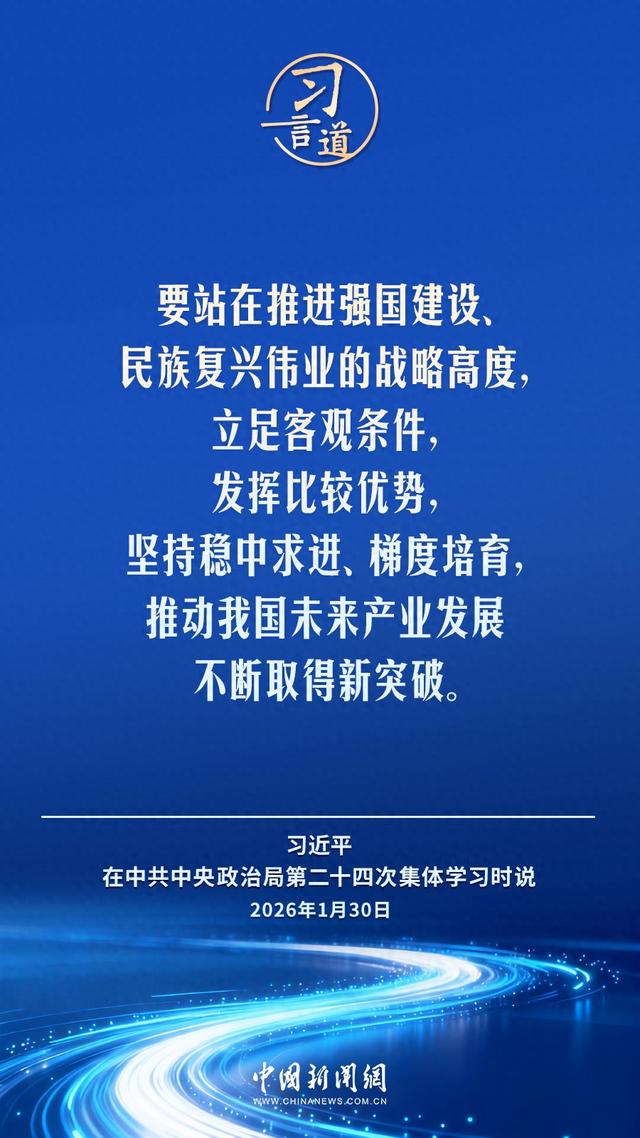
中共中央政治局1月30日就前瞻布局和发展未来产业进行第二十四次集体学习。中共中央总书记习近平 在主持学习时强调—— 在中共中央政治局第二十四次集体学习时说 2026年1月30日 P (图 机图 程 未来产业具有 前瞻性、战略性、颠覆性等特点, 需要科学谋划、全局统筹。 要聚焦"十五五"时期 我国未来产业发展的主攻方向, 科学论证技术路线, 提升前沿技术战略预判能力。 习近平 在中共中央政治局第二十四次集体学习时说 2026年1月30日 P (图) 编图 中国 狗闻 網 要综合考虑 国家战略需求、技术成熟程度、 要素支撑条件等因素, 因地制宜、错位发展。 要强化产业协同, 推动未来产业 同新兴产业、传统产业 相傳益彰。 习近平 要充分发挥新型举国体制优势, 坚持"产业出题、科技答题", 加大重点领域 关键核心技术攻关力度, 加强基础研究 战略性、前瞻性、体系化布局, 加快科技成果转化应用。 习近平 在中共中央政治局第二十四次集体学习时说 2026年1月30日 . 倒 利用 据 很多未来产业的兴起 是靠企业一步步突破带动的。 要发挥企业主体作用, 推动各类创新资源向企业集聚, 大力培育 核心技术领先、创新能力强的 ...

从0到1构建发展新引擎 人才“活水”+资金“活水”推动新兴产业“加速跑”
Yang Shi Wang· 2026-01-31 06:55
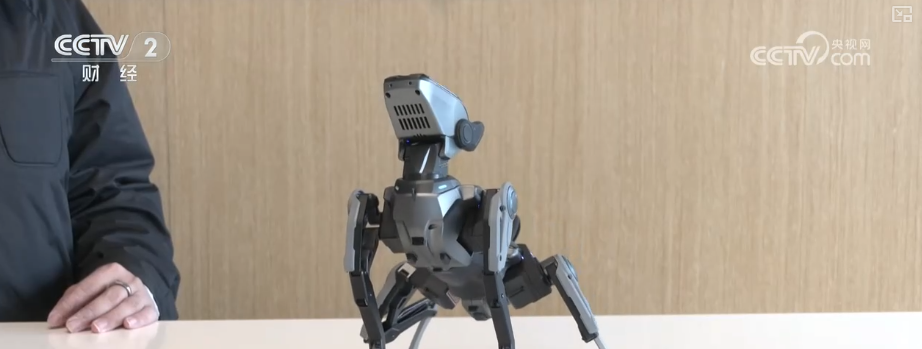
央视网消息:近年来,重庆通过构建产业发展新机制,统筹产业链发展、金融支持与高校人才培养,来推动创新链、产业链的深度融合。 2025年,重庆实现地区生产总值33757.93亿元,同比增长5.3%。其中,新兴产业增长亮眼。 在重庆的明月湖国际智能产业科创基地,康啸虎正在调试公司的主打产品——智能宠物机器狗。他介绍,公司成立之初只有4个"95后",除了 技术和创意,资金、市场等资源都很缺乏。就在大家都感到迷茫时,政府指导科创基地及时施以援手。 企业负责人康啸虎介绍他们最开始的种子资金,包括第一轮的天使轮投资,都是由明月湖基地和(重庆)两江新区这边一起来进行的一个投 资,给他们梳理了一些创业方向。 目前,康啸虎公司的主打产品已经实现了月产1000多台,并在海内外市场有了不错的反响。在基地另一家主打星空摄影硬件的科创企业,负责 人周少阳也有着同样的感受。 企业负责周少阳介绍,启动资金要求非常高,在明月湖基地的对接和推荐下,他们获得了重庆市种子基金的资金投入,让他们走上了研发和生 产的"快车道"。 投年轻人、投硬科技、投新产品,科创基地聚焦创业者早期的困难,提供了从0到1的培育孵化和投资帮助。 明月湖国际智能产业科创基地 ...
(新春走基层)浙江绍兴:台商“三个愿望”话新春
Zhong Guo Xin Wen Wang· 2026-01-31 06:19
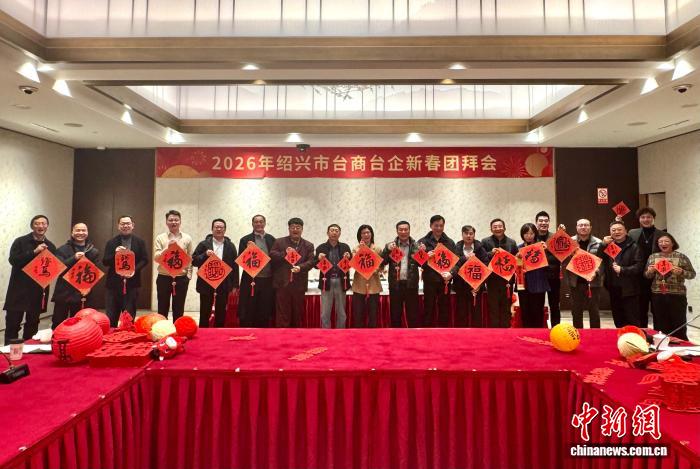
Core Viewpoint - The Taiwanese business community in Shaoxing expresses optimism for the new year, focusing on development aspirations and collaboration opportunities [1] Group 1: Business Development Aspirations - Taiwanese businessman Zhang Jinman emphasizes the importance of "hard work leads to success," highlighting the need for technological innovation to navigate external challenges and industry transformation [2] - In 2025, Shaoxing successfully signed six Taiwanese investment projects in the digital industry cooperation zone, with a total investment of 9.1 billion yuan, bringing the total investment in Taiwanese projects to 63.876 billion yuan [2] - The Taiwanese business community aims to leverage Shaoxing's complete industrial chain and market potential to achieve their goals [2] Group 2: Networking and Collaboration - Businessman Zheng Jianzhih expresses a desire to expand his professional network and engage in more industry exchanges to explore new development paths [3][4] - Newcomer businessman Zeng Zhenrui, focusing on the optoelectronics industry, aims to dedicate more time to industry interactions and integrate into the local community [5] - The growth of emerging industries in Shaoxing has led to an increase in Taiwanese enterprises, with 76 Taiwanese companies in the digital economy sector by the end of 2025, accounting for 30.6% of the total [5] Group 3: Quality of Life Expectations - Taiwanese businessman Li Maorong highlights the importance of understanding local policies that benefit Taiwanese entrepreneurs in areas such as education and healthcare [6] - Businessman Chen Haoxiang values both work and life, using sports to build connections and enrich his social life in Shaoxing [7] - The Shaoxing municipal government expresses commitment to supporting Taiwanese businesses and fostering a conducive environment for their development [7]
越秀资本与广纸集团合作设立创投基金
Zheng Quan Ri Bao Zhi Sheng· 2026-01-30 14:06
(编辑 张昕) 据了解,越秀资本以"金融服务实体经济,推动高质量发展"为导向,深耕粤港澳大湾区,将绿色、普 惠、科技作为发力点,深度融入服务国家战略。投资管理业务坚持"产业联盟+投研驱动"策略,重点布 局符合国家战略发展方向的行业,持续以长期资本、耐心资本助力新质生产力发展。 公告显示,越秀资本此次发起设立的新兴产业创投基金,将立足"项目招引、产业培育兼顾财务回报"原 则,构建新兴产业领域的投资与资源整合平台,精准捕捉行业发展机遇,依托各方资源培育协同发展的 产业生态。 本报讯 (记者丁蓉)1月30日晚间,广州越秀资本控股集团股份有限公司(以下简称"越秀资本")披露 公告,公司控股子公司广州越秀产业投资有限公司、广州越秀产业投资基金管理股份有限公司与关联方 广州造纸集团有限公司(简称"广纸集团")共同发起设立创业投资基金,募集总规模10亿元,聚焦新兴 产业领域开展投资,为广州市加快构建"12218"现代化产业体系贡献力量。 ...

加快完善现代化产业体系
Xin Lang Cai Jing· 2026-01-30 04:13
Core Viewpoint - The construction of a modern industrial system is a crucial support for advancing Chinese-style modernization, with significant progress expected by 2025 in various initiatives such as industrial renewal and "AI+" actions [1] Group 1: Emerging Industries - Emerging industries are accelerating their development, with revenue from central enterprises in these sectors expected to increase by over 10 percentage points compared to 2022 [1] - Five leading enterprises in commercial aerospace and satellite internet have been selected, and over a hundred typical scenarios for future industries are being developed in brain-like computing [1] - World-class industrial clusters are being established in new generation information technology, new energy, new materials, and high-end equipment, with new business models continuously emerging [1] Group 2: Traditional Industries - The transformation of traditional industries is noticeably accelerating, with central enterprises leading large-scale equipment renewal actions [2] - Seventy excellent-level smart factories have been established, including a core component lean manufacturing smart factory for rail transit equipment [2] - Six leading smart factories have been cultivated, and 39 projects have been included in the second batch of national green low-carbon advanced technology demonstration projects [2] Group 3: Supply Chain Resilience - The resilience of industrial and supply chains is continuously strengthening, with central enterprises implementing high-quality development action plans for key manufacturing industry chains [2] - Breakthrough achievements have been made in fields such as integrated circuits, industrial mother machines, and new generation mobile communications [2] - Major projects focusing on food security, energy resources, and high-end equipment are being carried out to maintain the safety of China's industrial and supply chains [2] Group 4: Strategic Directions - The State-owned Assets Supervision and Administration Commission will guide central enterprises to focus on intelligent, green, and integrated directions to enhance their advantages [2] - Key strategic areas include "three concentrations," aiming to adjust existing structures and optimize new investments to enhance the integrity, advancement, and safety of China's industrial system [2] - A number of emerging pillar industries will be developed, with a focus on market-oriented and specialized state capital operation platforms in fields such as new energy, aerospace, and quantum technology [2]