
港股市场

Search documents
沪指涨0.64%再次站上3900点,关注A500ETF易方达(159361)、沪深300ETF易方达(510310)投资价值
Sou Hu Cai Jing· 2025-12-22 05:06
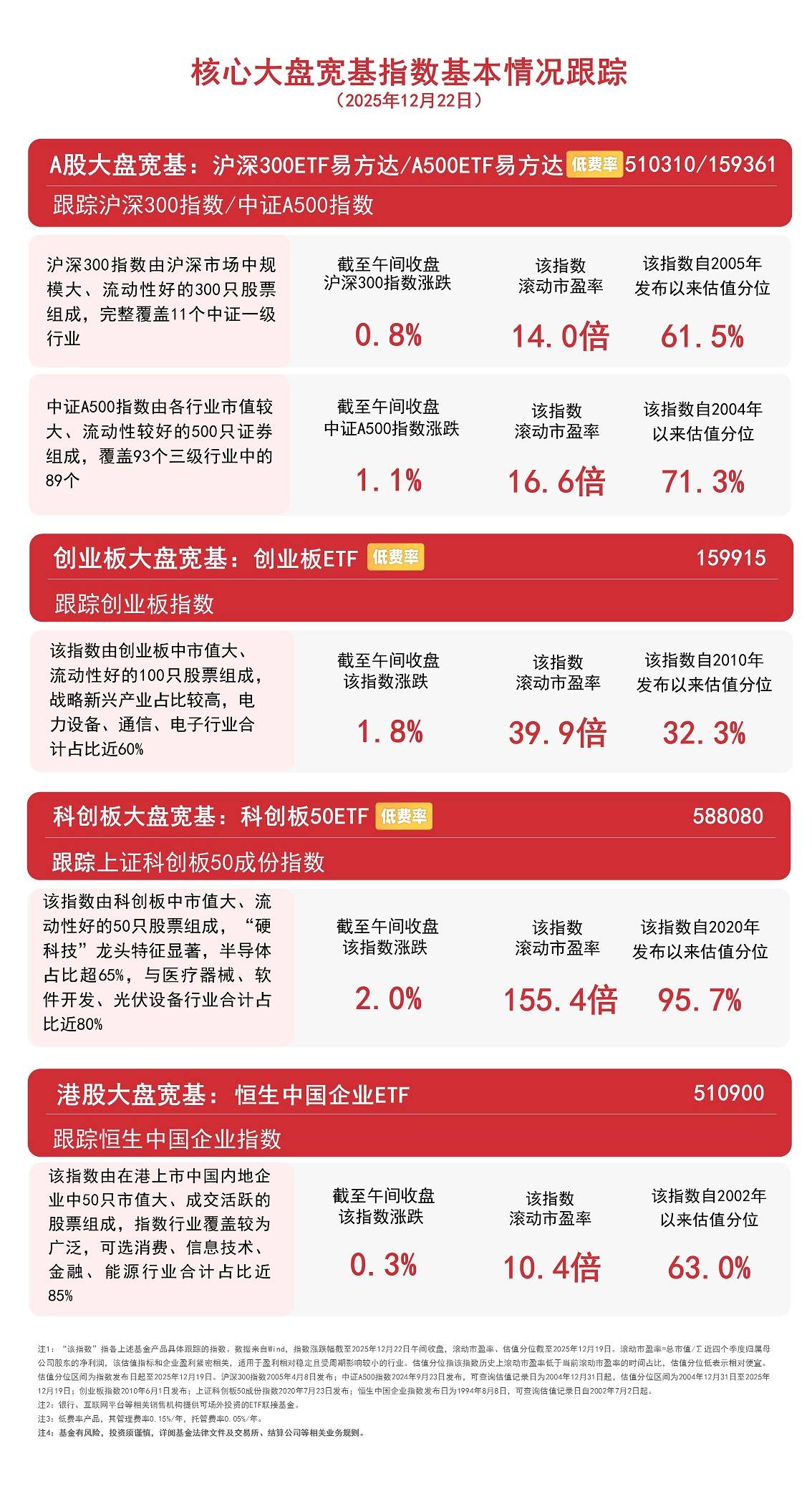
Group 1 - The A-share market showed strong performance with all three major indices rising, with the Shanghai Composite Index increasing by 0.64% to surpass 3900 points, and nearly 3500 stocks in the market gaining [1] - The active sectors included Hainan, storage chips, and precious metals, while the pharmaceutical and film sectors experienced adjustments [1] - The Hong Kong stock market exhibited mixed performance, with semiconductor stocks leading gains, while automotive, robotics, and software sectors also saw significant increases, and the pharmaceutical and high-dividend sectors weakened [1] Group 2 - The CSI A500 index rose by 1.1%, the CSI 300 index increased by 0.8%, the ChiNext index climbed by 1.8%, and the STAR Market 50 index surged by 2.0% by midday [1] - The Hang Seng China Enterprises Index saw a modest increase of 0.3% [1] Group 3 - The STAR Market 50 ETF tracks the STAR Market 50 Index, which consists of 50 stocks with large market capitalization and good liquidity, predominantly in the semiconductor sector, accounting for over 65% [4] - The rolling price-to-earnings ratio of the STAR Market 50 Index is 155.4 times, with a valuation percentile of 95.7% since its inception in 2020 [4] Group 4 - The Hang Seng China Enterprises ETF tracks the Hang Seng China Enterprises Index, which includes 50 large-cap and actively traded stocks listed in Hong Kong, covering a wide range of industries [5] - The index's sector distribution includes consumer discretionary, information technology, finance, and energy, which together account for nearly 85% [5] - The rolling price-to-earnings ratio of the Hang Seng China Enterprises Index is 10.4 times, with a valuation percentile of 63.0% since its inception in 2002 [5]

港股市场速览:科技巨头带动整体市场持续回撤
Guoxin Securities· 2025-12-20 13:45
Investment Rating - The report maintains an "Outperform" rating for the Hong Kong stock market [4] Core Insights - The overall market is experiencing a pullback driven by technology giants, with the Hang Seng Index down by 1.1% and the Hang Seng Composite Index down by 1.2% [1] - Valuation levels for most industries are declining, with the Hang Seng Index's forward P/E ratio decreasing by 1.7% to 11.6x [2] - Earnings expectations have been adjusted upwards overall, with the Hang Seng Index's EPS increasing by 0.3% compared to the previous week [3] Summary by Sections Market Performance - The Hang Seng Index decreased by 1.1%, while the Hang Seng Composite Index fell by 1.2%. Mid-cap stocks outperformed small-cap and large-cap stocks [1] - Among major concept indices, the Hang Seng Consumer Index rose by 0.3%, while the Hang Seng Internet Index dropped by 2.9% [1] Valuation Levels - The valuation of the Hang Seng Index decreased by 1.7% to 11.6x, and the Hang Seng Composite Index's valuation fell by 2.4% to 11.4x [2] - The most significant valuation increase was in the basic chemicals sector (+11.6%), while the real estate sector saw the largest decline (-19.0%) [2] Earnings Expectations - The EPS for the Hang Seng Index increased by 0.3%, and the Hang Seng Composite Index's EPS rose by 1.2% compared to the previous week [3] - The real estate sector saw a substantial EPS upward revision of 20.5%, while the basic chemicals sector experienced a downward revision of 10.2% [3]
港股开盘:恒生指数涨0.53%,恒生科技指数涨0.81%
Jin Rong Jie· 2025-12-19 01:33
Group 1 - The Hong Kong stock market opened with the Hang Seng Index rising by 0.53% [1] - The Hang Seng Tech Index increased by 0.81% [1]
港股收评:恒指涨0.92%、科指涨1.03%,航空股、有色金属及芯片股走高,金融股午后活跃
Jin Rong Jie· 2025-12-17 08:21
Market Performance - The Hong Kong stock market experienced a narrow fluctuation in the morning and a strong rally in the afternoon, with the Hang Seng Index rising by 0.92% to 25,468.78 points, the Hang Seng Tech Index increasing by 1.03% to 5,457.95 points, and the National Enterprises Index up by 0.98% to 8,843.57 points [1] - Major technology stocks mostly rose, with Alibaba up 1.25%, Tencent Holdings up 1.42%, JD Group up 1.26%, and Meituan up 1.81% [1] - The aviation sector showed strong performance, with China Southern Airlines rising over 5%, while financial stocks also saw gains, with China Life Insurance increasing over 4% [1] - The metals sector led the gains, with Tianqi Lithium up nearly 6%, Ganfeng Lithium up over 5%, and Luoyang Molybdenum up over 2% [1] - Semiconductor stocks also rose, with Shanghai Fudan up 4%, Huahong Semiconductor up nearly 3%, and SMIC up over 2% [1] Corporate News - China Energy Construction (03996.HK) announced the official operation of the first phase of the Zhongnengjian Songyuan Hydrogen Energy Industrial Park project [2] - China Pacific Insurance (02601.HK) reported that its cumulative original insurance premium income for the first 11 months reached RMB 250.32 billion, a year-on-year increase of 9.4%, while its property insurance premium income was RMB 187.68 billion, up 0.3% [2] - Hansoh Pharmaceutical (03692.HK) entered into a licensing agreement with Glenmark for Amivantamab, which includes an upfront payment and potential milestone payments exceeding USD 1 billion [2] Financing Activities - Yuexiu Property (00123.HK) secured a term loan financing of HKD 500 million [3] - China Railway Construction (01186.HK) plans to issue company bonds with a total amount not exceeding RMB 4 billion [4] - Genscript Biotech (01672.HK) increased its share buyback fund from a maximum of HKD 300 million to HKD 500 million [5] - Tencent Holdings (00700.HK) repurchased 1.067 million shares for approximately HKD 636 million at prices ranging from HKD 592.5 to HKD 602.5 [6] - Xiaomi Group (01810.HK) repurchased 7.2 million shares for HKD 294 million at prices between HKD 40.36 and HKD 41.00 [7] - Kuaishou Technology (01024.HK) repurchased 1.8231 million shares for HKD 116 million at prices from HKD 63.05 to HKD 64.4 [8] - Geely Automobile (00175.HK) repurchased 299,900 shares for approximately HKD 50.54 million at prices between HKD 16.72 and HKD 17.2 [9] Institutional Insights - According to China Merchants Securities, the recent weakness in the Hong Kong stock market is attributed to southbound capital returning to A-shares due to new public fund benchmark regulations, concerns over IPO financing, and the upcoming peak of stock unlocks [10] - Huatai Securities noted that while the market's downside is manageable, the upside potential has not yet opened up, with market sentiment indicators remaining in a pessimistic range [10] - China Merchants Securities also highlighted that the Hong Kong market has not stabilized after overseas interest rate cuts, primarily due to internal liquidity issues [10]

港股开盘:恒生指数涨0.9%,恒生科技指数涨1.02%
Jin Rong Jie· 2025-12-12 01:31
港股开盘,恒生指数涨0.9%,恒生科技指数涨1.02%。 本文源自:金融界AI电报 ...
港股开盘:恒指微涨、科指跌0.04%,航空及有色金属股走高,内房股活跃
Jin Rong Jie· 2025-12-10 01:30
Market Overview - The Hong Kong stock market showed mixed performance on December 10, with the Hang Seng Index rising by 1.26 points to 25,435.49 points, while the Hang Seng Tech Index fell by 2.33 points, a decrease of 0.04% to 5,552.35 points [1] - The China Enterprises Index increased by 0.46 points, up 0.01% to 8,936.87 points, and the Red Chip Index rose by 14.33 points, up 0.35% to 4,144.82 points [1] - Notable movements included Meituan rising over 1%, NetEase dropping over 1%, and China Silver Group increasing over 7% [1] Company News - Datang New Energy (01798.HK) reported a cumulative power generation of approximately 31.6521 million megawatt-hours in the first 11 months, an increase of 10.58% year-on-year [2] - Jiangshan Holdings (00295.HK) reported a total solar power generation of approximately 279.78 thousand megawatt-hours in the first 11 months, a decrease of 5.61% year-on-year [3] - New City Development (01030.HK) reported a cumulative contract sales amount of approximately 17.917 billion yuan in the first 11 months, a decrease of 51.53% year-on-year [4] - Longfor Group (00960.HK) achieved a total contract sales amount of 59.39 billion yuan in the first 11 months [5] - CIFI Holdings Group (00884.HK) reported a cumulative contract sales amount of approximately 15.1 billion yuan in the first 11 months [6] Insurance Sector - China Life Insurance (02628.HK) announced that by November 30, 2025, the total premium income is expected to exceed 700 billion yuan [7] Media and Entertainment - Lingmeng Film and Television (09857.HK) plans to repurchase shares not exceeding 10% of the issued shares based on the repurchase authorization [8] - Yingxing Holdings (01440.HK) entered into a comprehensive merchandise licensing agreement with Netflix CPX, LLC for the use of "Stranger Things" intellectual property [8] Strategic Partnerships - Guangdong-Hong Kong-Macau Holdings (01396.HK) announced a strategic cooperation agreement between its subsidiary Tiandun Data and Huagong Technology (000988.SZ) to integrate products and services into high-performance, stable, and reliable intelligent computing solutions [8] Clinical Trials - QX030N from Qianxin Biotechnology (02509.HK) received ethical approval for Phase I clinical trials in Australia and received a milestone payment of 5 million USD [9] - Fuhong Hanlin (02696.HK) received approval from the National Medical Products Administration for clinical trial applications for HLX22 and HLX87 for breast cancer treatment [9] Capital Restructuring - China Supply Chain Industry (03708.HK) expressed intentions to acquire shares of Huamao International Barter Exchange and suggested implementing capital restructuring [9][11] Market Analysis - CICC noted that the recent weakness of the Hong Kong stock market compared to other regions can be attributed to several factors, including a continuous decline in southbound capital and concerns over potential interest rate hikes by the central bank [12] - CICC emphasized that the current market conditions are a result of a combination of a declining credit cycle, liquidity pressure, and a mismatch between fundamentals and expectations [12] - CITIC Securities highlighted investment opportunities in the lithium industry, focusing on resource self-sufficiency and companies with significant production growth in the coming years [13]
港股宽基指数延续调整,关注恒生中国企业ETF(510900)等产品投资价值
Sou Hu Cai Jing· 2025-12-09 10:12
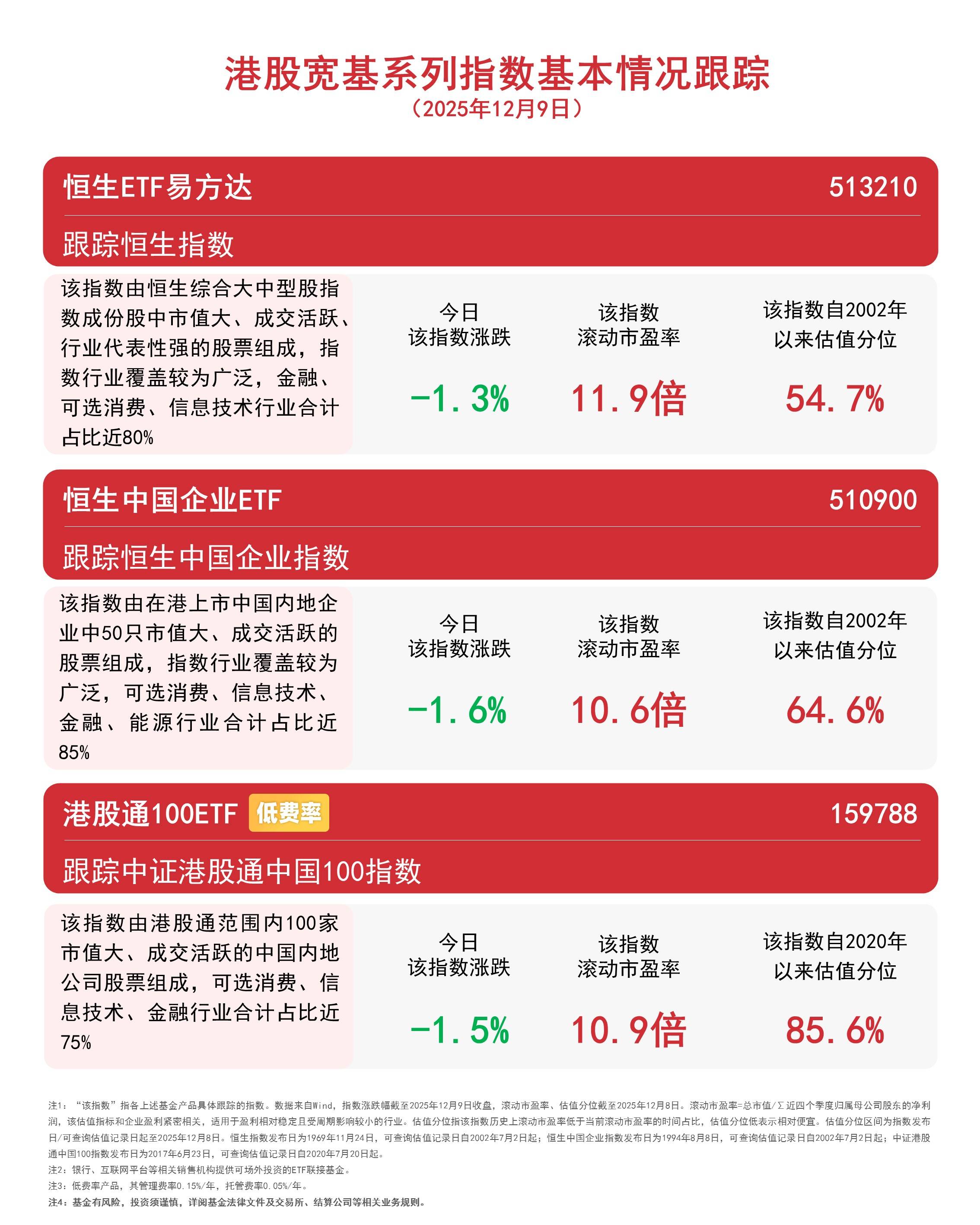
Group 1 - The Hang Seng Index fell by 1.3%, the Hang Seng China Enterprises Index decreased by 1.6%, and the CSI Hong Kong Stock Connect China 100 Index dropped by 1.5% [1] - China Galaxy Securities' report suggests that the upcoming important domestic meetings in December and the Federal Reserve's interest rate meeting are expected to provide medium to long-term policy direction and short-term liquidity signals for the Hong Kong stock market [1] - The report recommends focusing on sectors such as precious metals, domestic consumption, and technology growth for investment opportunities [1]
市场延续调整,关注A500ETF易方达(159361)、沪深300ETF易方达(510310)等产品后续表现
Mei Ri Jing Ji Xin Wen· 2025-12-03 10:03
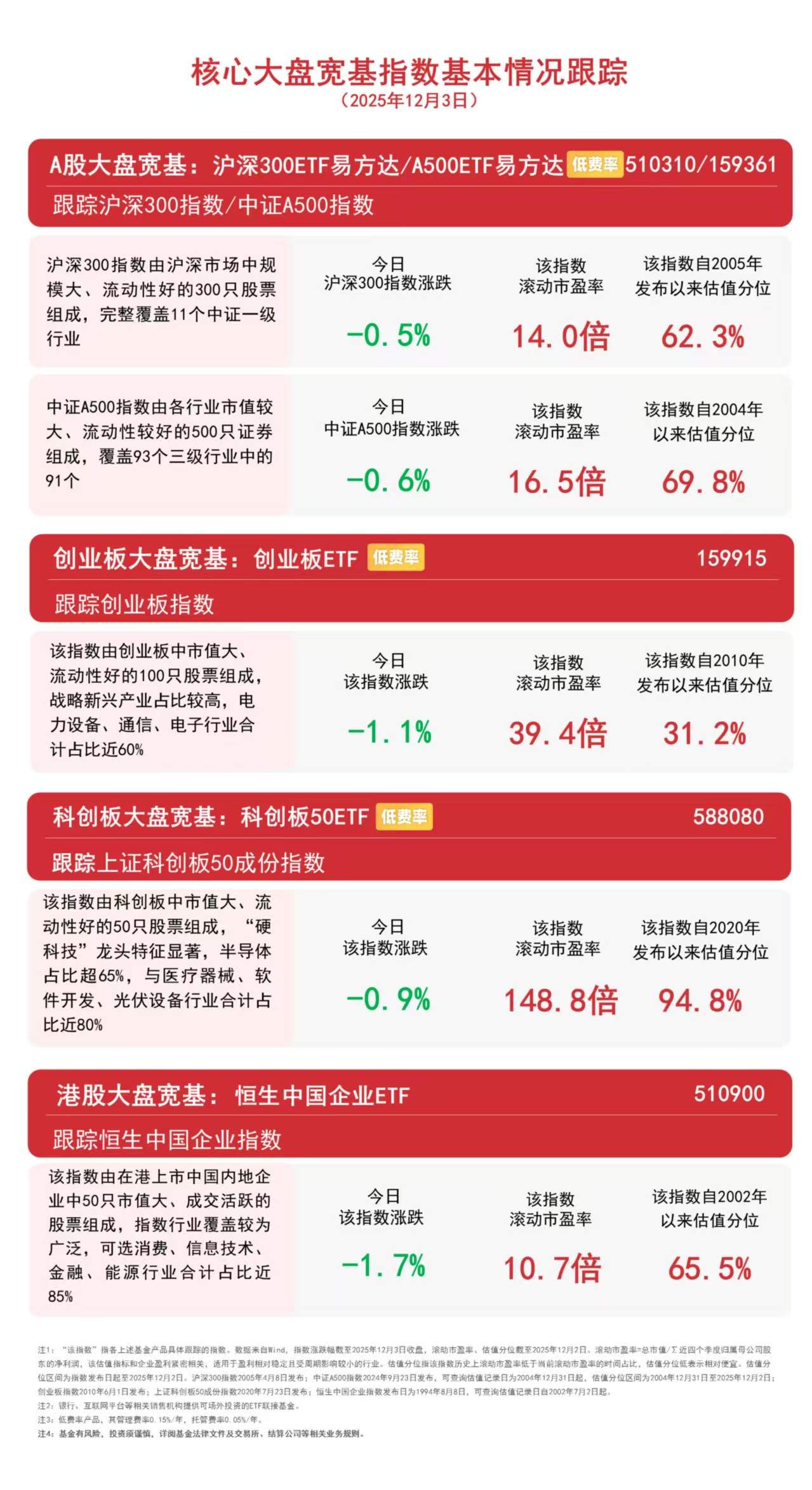
Core Viewpoint - The article provides an overview of the performance and characteristics of major stock indices in the Chinese market, including the CSI 300, CSI A500, ChiNext, and STAR Market indices, highlighting their respective market trends and valuation metrics. Group 1: Index Performance - The CSI 300 Index, composed of 300 stocks from the Shanghai and Shenzhen markets, experienced a decline of 0.5% with a rolling P/E ratio of 14.0 times [2] - The CSI A500 Index, which includes 500 stocks with good liquidity across various industries, saw a decrease of 0.6% and has a rolling P/E ratio of 16.5 times [2] - The ChiNext Index, tracking 100 large-cap stocks in the ChiNext market, reported a drop of 1.1% and has a rolling P/E ratio of 39.4 times [2] Group 2: Sector Composition - The ChiNext Index has a significant representation of strategic emerging industries, with nearly 60% of its composition in the power equipment, communication, and electronics sectors [2] - The STAR Market 50 ETF, which tracks the STAR Market 50 Index, is composed of 50 large-cap stocks with notable liquidity, emphasizing "hard technology" leaders, particularly in the semiconductor sector [2]
市场全天震荡调整,关注A500ETF易方达(159361)、沪深300ETF易方达(510310)等产品投资机会
Sou Hu Cai Jing· 2025-12-02 11:10
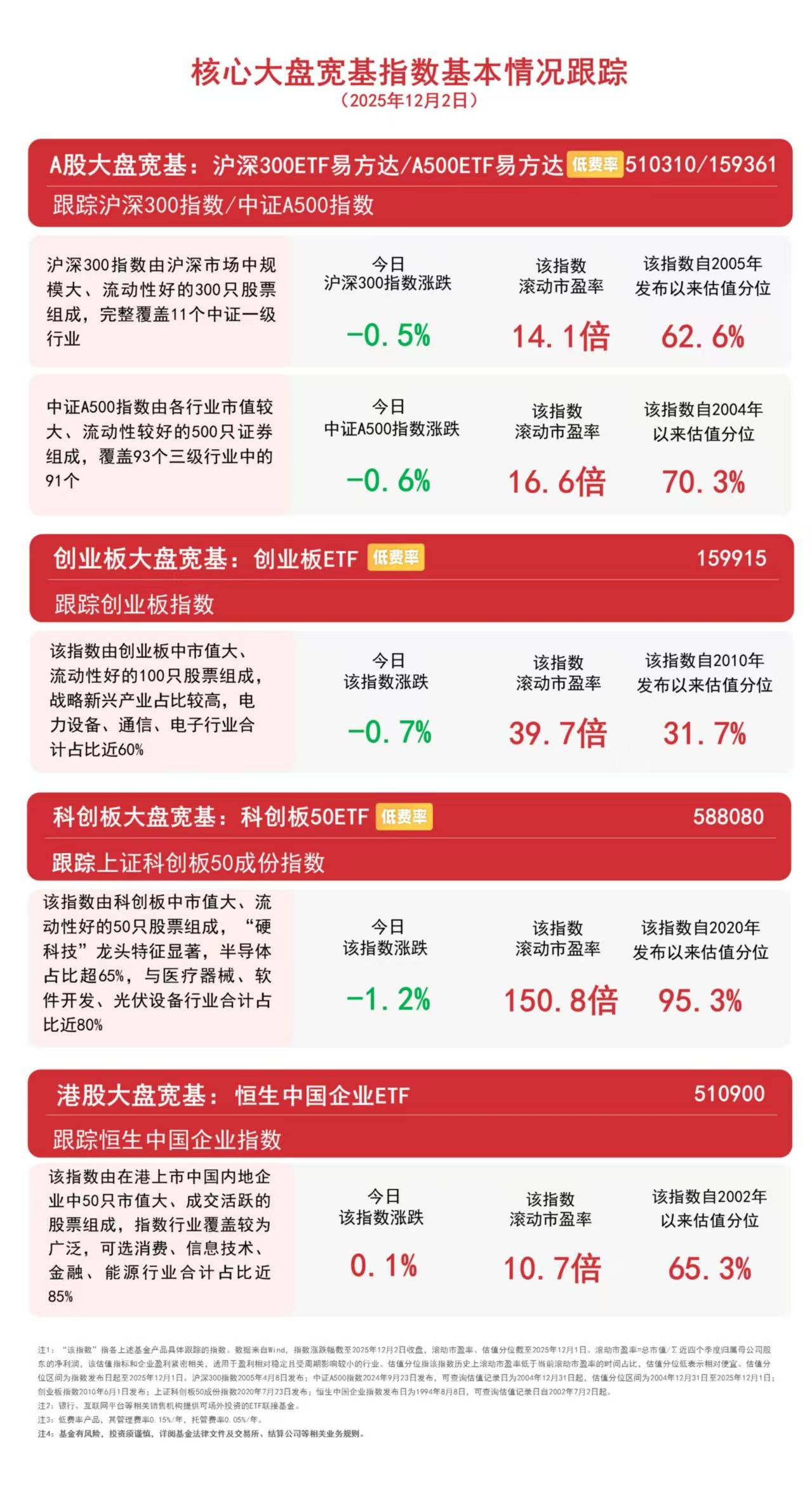
Market Overview - The A-share market experienced a collective pullback today, with the major indices declining: the CSI 4500 index fell by 0.6%, the CSI 300 index decreased by 0.5%, the ChiNext index dropped by 0.7%, and the STAR Market 50 index declined by 1.2% [1] - In contrast, the Hong Kong stock market showed mixed performance, with high dividend and new consumption sectors performing well, while the Hang Seng China Enterprises Index rose by 0.1% [1] Sector Performance - Among the A-share sectors, the top gainers included Fujian, food, and pharmaceutical commercial sectors, while energy metals, non-ferrous metals, and film and television sectors saw the largest declines [1]
股票私募仓位连续两周显著上升 百亿私募仓位已近九成
Shen Zhen Shang Bao· 2025-12-02 00:12
Group 1 - The core viewpoint of the articles indicates a significant increase in stock private equity positions, reflecting sustained optimism in the market, with the stock private equity position index reaching 82.97% as of November 21, marking a 1.84% increase from the previous week and a new high for the year [1] - The index has shown a continuous rise for two weeks, with a growth rate exceeding 1% for both weeks, and has remained above 80% for four consecutive weeks, indicating that recent market adjustments have not caused panic among private equity firms, but rather an opportunity to increase positions [1] - The distribution of positions shows that the proportion of fully invested private equity has risen to 68.99%, while the percentages for medium, low, and empty positions have decreased significantly to 18.56%, 8.56%, and 3.89% respectively, suggesting a growing consensus among private equity firms to increase their investments [1] Group 2 - As of November 21, private equity positions across different scales have all surpassed 80%, with the largest scale (over 100 billion) reaching 89.23%, indicating a particularly optimistic outlook among larger private equity firms [2] - The proportion of fully invested private equity in the 100 billion category has increased to 78.19%, while medium, low, and empty positions have decreased to 16.82%, 4.21%, and 0.78% respectively, highlighting a trend towards full investment among larger firms [2] - The total scale of private equity has surpassed 22 trillion yuan, with private securities funds being the main driver of this growth, as nearly 43 billion yuan was newly registered in October, pushing the scale of private securities funds above 7 trillion yuan for the first time [2] Group 3 - Looking ahead, a well-known private equity firm, Dushuquan, believes that while valuations in A-shares and Hong Kong stocks have rebounded, there is no systemic bubble, and the capital market may face temporary disturbances but is unlikely to cool down systematically [3] - It is anticipated that the effect of sectors may weaken, while the effect of individual stocks is expected to strengthen [3]