美国经济软着陆

Search documents
深夜,银铂飙升!重要数据公布,美国降息有变?美联储,大消息!
Qi Huo Ri Bao· 2025-09-27 00:20
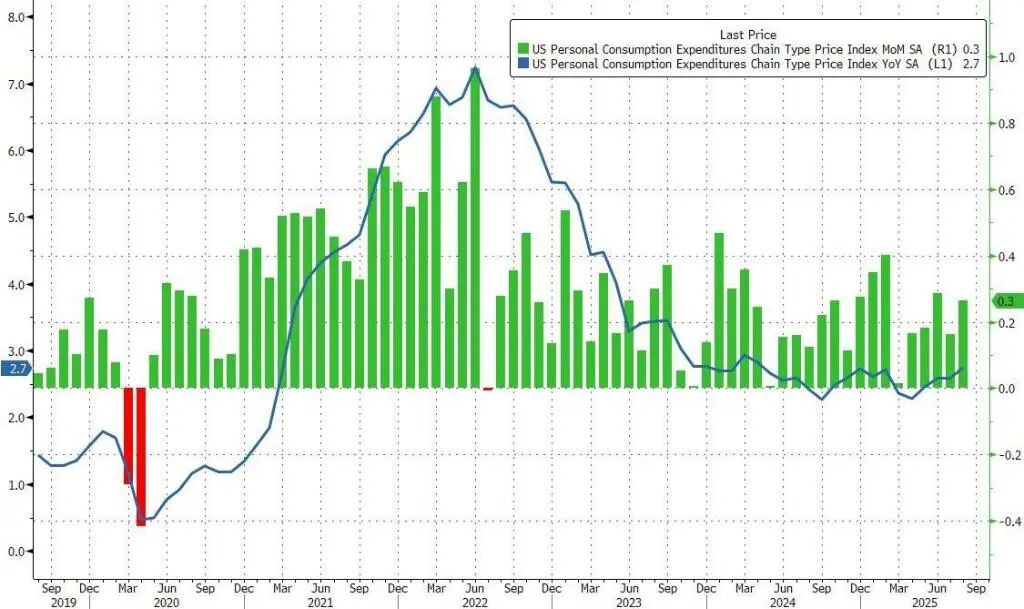
Group 1: Precious Metals Market - International silver prices surged by 2.46% to $45.994 per ounce, marking the highest level since May 2011 [1] - International platinum prices increased by 3.61% to $1611.52 per ounce [1] - Gold prices rose by 0.29% to $3759.895 per ounce, while palladium prices climbed by 1.7% to $1305.3 per ounce [1] Group 2: U.S. Economic Indicators - The U.S. core PCE price index for August showed a year-on-year increase of 2.9%, consistent with previous values, while the overall PCE index rose by 0.3% month-on-month [2][4] - Personal income in August grew by $95.7 billion, a month-on-month increase of 0.4%, and personal consumption expenditures rose by $129.2 billion, a month-on-month increase of 0.6% [4] Group 3: Consumer Confidence - The U.S. consumer confidence index for September fell to 55.1, a decrease of approximately 5% from August [5] - The current economic conditions index dropped from 61.7 in August to 60.4 in September, while the consumer expectations index fell from 55.9 to 51.7 [5] - Nearly 70% of consumers expect inflation to exceed income growth in the next year, and about 65% anticipate an increase in unemployment rates [5][6] Group 4: Federal Reserve Insights - Federal Reserve Vice Chair Michelle Bowman emphasized the need for preemptive interest rate cuts to address worsening labor market conditions [7][8] - Recent data indicates increasing vulnerability in the labor market, prompting calls for immediate action from the Federal Open Market Committee [8] - The uncertainty surrounding potential interest rate cuts has increased due to strong economic data, leading to a more cautious approach from the Federal Reserve [11] Group 5: Gold Price Projections - Multiple institutions have raised their gold price forecasts, with JPMorgan predicting spot gold prices could exceed $4000 per ounce by Q1 2026 [12] - Goldman Sachs maintains a target price of $3700 per ounce for gold by the end of 2025, with potential for prices to rise above $4500 per ounce [13] - The ongoing concerns regarding fiscal stability in developed countries and persistent central bank gold purchases are expected to support gold's long-term investment appeal [13]

帮主郑重:美联储降息信号明确!中长线布局窗口正在打开
Sou Hu Cai Jing· 2025-09-26 16:15
Group 1 - The core inflation indicator, core PCE, remains stable at 2.9% year-on-year, aligning with expectations, indicating a steady economic outlook [1][3] - The report suggests a clearer path towards interest rate cuts, with a 0.2% month-on-month increase in core PCE and no signs of inflation rebound, supporting the notion of a "soft landing" for the U.S. economy [3][4] - Market reactions include a 300-point surge in the Dow Jones and rising gold prices, indicating a potential influx of capital into A-shares, particularly in technology and renewable energy sectors sensitive to interest rates [4][5] Group 2 - Long-term investment focus should be on core assets such as leading internet companies in Hong Kong and consumer blue chips in A-shares, which are most sensitive to global liquidity conditions [5] - Growth sectors like semiconductors and innovative pharmaceuticals, which rely on long-term capital, may benefit from reduced pressure on valuations due to anticipated interest rate cuts [5][6] - The potential risks include the impact of a U.S. government shutdown on key economic data and the delayed effects of tariffs imposed by former President Trump, which have yet to fully materialize [6][7]

美联储“谨慎降”阵营再添一员 巴尔金强调“软着陆”仍在把控之中
智通财经网· 2025-09-26 12:48
Group 1 - The core viewpoint is that despite deviations in unemployment and inflation from the Federal Reserve's targets, the risks of further deterioration are limited, indicating a cautious stance on interest rate cuts rather than aggressive reductions [1][2] - Tom Barkin emphasizes the focus on achieving a "soft landing" for the U.S. economy, balancing inflation and unemployment, and suggests that while both metrics are moving in the wrong direction, the downside risks are minimal [1][2] - The recent Federal Reserve decision to lower the benchmark interest rate by 25 basis points reflects growing concerns about the slowdown in the U.S. labor market, with a long-term view of maintaining rates unchanged to assess the inflation risks from tariff policies [1][2][3] Group 2 - There is a significant internal division among FOMC policymakers regarding the future of interest rates, with some advocating for continued rate cuts to mitigate employment risks, while others express concerns about potential inflation [2] - The FOMC dot plot indicates a median forecast suggesting three rate cuts this year, with a possibility of one more next year, but also highlights a split among officials regarding the timing and necessity of these cuts [3] - Most Federal Reserve officials believe that given the current robust outlook for the U.S. economy, there is no need for substantial further rate cuts next year, despite some officials advocating for more decisive action in response to labor market weaknesses [2][3]
太平洋证券投资策略:长风破浪会有时
Tai Ping Yang Zheng Quan· 2025-09-22 07:41
Group 1 - The report indicates that the A-share market is currently facing short-term fluctuations due to trading structure and risk appetite, but the long-term bull market logic relies on a trend of sustained capital inflow, suggesting that adding positions during pullbacks is a better strategy [1][12] - The A-share market is entering a period of consolidation, with two main factors influencing this judgment: the technology sector, a key driver of the bull market, is experiencing a relatively crowded chip structure, and the marginal weakening of the economic fundamentals makes it difficult for the market style to shift to low-position consumer and cyclical sectors [1][12] Group 2 - The report highlights a decline in market profitability, with the technology sector's chip structure becoming relatively crowded, necessitating a time-for-space approach. Since the market's rise starting June 23, the index has increased by 18.18%, with the TMT sector contributing 42% [2][13] - Current unfavorable factors for the technology sector include: 1) a decrease in market profitability and overall risk appetite, with only 32% of stocks rising this week, marking a low point in this rally; 2) the TMT sector's trading volume has reached 37%, and historically, when this figure exceeds 40%, a pullback typically follows; 3) the ChiNext and STAR 50 indices are showing signs of divergence in volume and price; 4) the "calendar effect" before the National Day indicates a lower probability of index gains, with a 60% chance of decline in the five trading days leading up to the holiday [2][13] Group 3 - Economic data has shown marginal weakening, making it difficult to shift styles to consumer and cyclical sectors. In August, production, investment, consumption, and exports all weakened compared to July. The September LPR remains unchanged, with no intention to cut rates. CPI in August was -0.4% year-on-year, and PPI was -2.9%, indicating a narrowing decline [3][14] - The report suggests that the long-term bull market is not yet over, with indicators such as equity risk premium (ERP), the rate of economic securitization, and the ongoing increase in deposits at non-bank financial institutions indicating significant upside potential for A-shares [3][14] Group 4 - The report anticipates that the narrative of a soft landing and re-inflation in the U.S. economy will return in the fourth quarter. Despite recent trade tensions and disappointing non-farm payroll reports, employment data is expected to be revised upward, and the economy is showing signs of steady growth, with the second quarter GDP growth revised to 3.3% [4][27] - The report notes that core inflation remains sticky, with indicators showing a potential for re-inflation in the fourth quarter. The housing market is expected to contribute to inflationary pressures as mortgage rates decline and loan application activity rises [4][27] Group 5 - Compared to the U.S., the Eurozone faces greater fiscal challenges, which may lead to a rebound in the dollar index and make U.S. stocks the best choice among major asset classes. The Eurozone's economic data has been weaker than that of the U.S., and the euro's significant appreciation has reduced export competitiveness [6][44] - The report indicates that speculative long positions in the euro have reached historically high levels, while short positions remain low, suggesting that there is still considerable room for adjustment in the trading structure [6][44]

大和:若美元弱势持续,将在年底前为A股及港股带来支持
Sou Hu Cai Jing· 2025-09-19 08:58
Core Insights - The report from Daiwa emphasizes that the weakening of the US dollar has a more significant impact on emerging markets, A-shares, and Hong Kong stocks than potential interest rate cuts by the Federal Reserve [1] - A "soft landing" for the US economy would be beneficial for emerging market equities, while weak US economic data could prolong dollar weakness, increasing demand for currency hedging and enhancing liquidity support for emerging markets and the Chinese market by the end of 2025 [1] Market Conditions - The Asian market is currently in a risk-on environment, with the MSCI Asia Pacific (excluding Japan) index rising approximately 10% since July [1] - Key drivers for this market performance include easing geopolitical risks, favorable regional policies, and market expectations regarding the potential resumption of the Federal Reserve's interest rate cut cycle [1]
摩根资管:若资金持续流入港A市场 HIBOR跌幅或较预期更大
Zhi Tong Cai Jing· 2025-09-18 08:06
Group 1 - Morgan Asset Management's Chief Market Strategist for Asia Pacific, Xu Changtai, predicts that with the Federal Reserve entering a rate-cutting cycle and the expectation of a depreciating US dollar, funds may flow into emerging markets, benefiting the Hong Kong A-share market [1] - Xu estimates that the Hong Kong Interbank Offered Rate (HIBOR) will continue to have room for decline, potentially more than expected, which will positively impact the Hong Kong residential property market, with a better environment anticipated in 2026 compared to this year [1] - The Federal Reserve is expected to cut rates by 0.25% in both October and December of this year, with further cuts of 2-3 times in 2026, bringing the long-term federal funds rate down to a neutral level of 3% [1] Group 2 - Historical data suggests that during previous rate-cutting cycles, such as in 2019, US stock performance was strong, leading to a preference for technology-related sectors, while retail and industrial stocks are expected to be more volatile [2] - The US dollar is currently stable, but with the US facing fiscal and trade deficits and entering a rate-cutting cycle, alongside Europe nearing the end of its rate cuts and Japan potentially raising rates, a depreciation of the dollar is anticipated, estimated at 5-7% over the next 12-18 months [2]
研客专栏 | 9月FOMC会议前瞻:如履薄冰
对冲研投· 2025-09-16 12:05
Core Viewpoint - The article discusses the pricing dynamics in the commodity market, driven by domestic supply policies for lithium and silicon, and the anticipated interest rate cuts by the Federal Reserve affecting precious metals and copper [4][5]. Group 1: Interest Rate Cuts - The market is currently pricing in a potential 75 basis points (bp) cut by the Federal Reserve within the year, with expectations for consecutive cuts in the upcoming FOMC meetings [6]. - Factors contributing to the optimistic outlook for rate cuts include a shift in the Federal Reserve's decision-making approach, the weakening U.S. labor market, and political pressures from the Trump administration [7][8]. - The long-term interest rate target may be adjusted downwards, providing more room for monetary policy adjustments, with current expectations for long-term rates around 2.8%-2.9% [8]. Group 2: U.S. Economic Landscape - The article highlights that inflation may ease next year, influenced by the dual mandate of the Federal Reserve and the impact of tariffs on core commodity inflation [11][13]. - The Zillow rent index shows a significant decline, which may indicate a lagging effect on the Consumer Price Index (CPI) and overall inflation trends [11]. - Despite the weakening labor market, there remains confidence in a soft landing for the U.S. economy, with no immediate signs of a severe downturn [15][16]. Group 3: Commodity Market Outlook - Precious metals are expected to have upward elasticity during the rate-cutting cycle, while copper and other base metals may follow suit if the U.S. economy shows signs of improvement [5][16]. - The article suggests that the valuation of commodities will depend on the Federal Reserve's terminal rate outlook and the anticipated adjustments in economic growth rates [16][17]. - There is a notable preference for gold in overseas markets, with domestic silver showing good upward potential, influenced by macroeconomic drivers [17].

过去24小时内,虚拟货币共有超12万人爆仓
Sou Hu Cai Jing· 2025-09-15 06:17
Group 1 - The cryptocurrency market experienced a significant decline, with Dogecoin down 5.24%, Ripple down 3.34%, Ethereum down 1.41%, and Bitcoin down 0.36% as of September 14 [1] - Over the past 24 hours, more than 120,000 traders in the virtual currency market faced liquidation [2] - The Federal Reserve is set to hold a monetary policy meeting from September 16 to 17, with a 92% probability of a 25 basis point rate cut and an 8% probability of a 50 basis point cut [2] Group 2 - Following the release of the Consumer Price Index (CPI) and initial jobless claims data, the 10-year U.S. Treasury yield fell below 4%, the dollar index declined, and U.S. stocks reached new highs [3] - The rise in initial jobless claims to a nearly four-year high has shifted the Federal Reserve's focus towards employment, reinforcing expectations for rate cuts [3] - Despite the consensus on three rate cuts by the end of the year, there are concerns about the potential for an unexpected rebound in inflation due to supply-side factors, which could limit the Fed's ability to ease monetary policy [3][4] Group 3 - The future performance of the U.S. financial markets post-rate cut will largely depend on the economic outlook; a soft landing could support stock market gains, while a rapid deterioration in the economy could lead to significant market adjustments [4]
美联储9月降息已无悬念
2 1 Shi Ji Jing Ji Bao Dao· 2025-09-12 16:18
Group 1 - The Federal Reserve is expected to lower interest rates three times by the end of the year, driven by rising unemployment claims and stable inflation data [2][10][11] - The Consumer Price Index (CPI) for August increased by 0.4% month-on-month, with a year-on-year increase of 2.9%, while core CPI rose by 0.3% month-on-month and 3.1% year-on-year [2][4] - Initial jobless claims rose by 27,000 to 263,000, the highest level since October 2021, indicating a cooling labor market [2][8] Group 2 - Inflation data shows that while overall inflation is stable, certain categories like new and used cars and housing prices exhibit stickiness, suggesting limited room for aggressive rate cuts [4][5] - The market is concerned about the potential for a "stagflation-like" scenario if inflation rises unexpectedly alongside a weakening economy [11][12] - The response in financial markets indicates a strong expectation for rate cuts, with the 10-year Treasury yield dropping below 4% and the dollar index declining [11][12]

美联储9月降息已无悬念
21世纪经济报道· 2025-09-12 16:06
Group 1: Federal Reserve and Interest Rate Expectations - The upcoming Federal Reserve meeting in September is expected to result in interest rate cuts, with the market pricing in three rate cuts by the end of the year [1][9][11] - The recent increase in initial jobless claims to 263,000, the highest since October 2021, has shifted the Fed's focus towards employment, reinforcing the expectation of rate cuts [1][6] - Despite stable inflation data, the Fed's monetary policy is likely to lean towards supporting employment due to the deteriorating job market [10][11] Group 2: Inflation Trends - The August Consumer Price Index (CPI) showed a month-on-month increase of 0.4% and a year-on-year increase of 2.9%, aligning with market expectations [1][3] - Core CPI, excluding volatile food and energy prices, rose 0.3% month-on-month and 3.1% year-on-year, indicating controlled inflation despite some upward pressures from tariffs [3][4] - Certain categories, such as new and used cars and housing, exhibit price stickiness, suggesting that while inflation is manageable, there are still risks of upward pressure in the medium to long term [4][6] Group 3: Employment Market Dynamics - The U.S. job market is showing signs of cooling, with non-farm payrolls increasing by only 22,000 in August and the unemployment rate rising to 4.3%, the highest in nearly four years [7][10] - The combination of rising inflation and a weakening job market could lead to two scenarios: a soft landing with gradual rate cuts or a hard landing resulting in recession [6][7] - The potential for a "stagflation-like" scenario exists if inflation rises unexpectedly while the economy slows, limiting the Fed's policy options [10][11]