
对等关税

Search documents
跪了也没有用,美国反手就是一巴掌,特朗普:对欧盟加征30%关税
Sou Hu Cai Jing· 2025-07-14 12:12
欧盟由27个国家组成,其中包括德国、法国和意大利这三大G7成员国,赋予了其相当强劲的经济实力。理论上说,欧盟有能力与美国展开经济博弈,然而 现阶段的欧盟似乎更多地表现出了一种"顺从"的姿态。即便如此,似乎欧盟的妥协并没有带来预期的好处,反而迎来美国的直接回击。最近,欧盟在数字税 问题上已对美国做出了让步,然而美国对于欧盟并未表现出任何温情,外界了解到日前,特朗普总统通过社交媒体发文,宣布将对欧盟加征高达30%的关 税。这一举动再次展示了美国在国际贸易中的强硬态度,尽管欧盟在某些方面已经让步,但美国看来并没有改变其原有的立场。 欧盟长期以来面对美国采取了一种屈从姿态,结果使美国对其不断施加压力。在美国发起关税战之际,曾多次威胁要对欧盟实施制裁,包括对进口汽车和钢 铁制品加征关税。如今美国再次宣布将加征30%的关税,法国总统马克龙对此表示强烈不满,而欧盟委员会负责人冯德莱恩也明确表态,欧盟保留实施反制 措施的权利。通过欧盟的回应,可以看出他们仍希望通过谈判来解决关税问题。然而从美国与日本的谈判情况来看,美国对于让步并不情愿,即便经历了七 轮谈判,最终也仅给予日本25%的关税待遇。 在现阶段的关税安排中,英国似乎成 ...

出口增速为何再上升?——6月外贸数据解读【陈兴团队•财通宏观】
陈兴宏观研究· 2025-07-14 11:40
Core Viewpoint - The article discusses the postponement of reciprocal tariffs by Trump as a strategic move, highlighting the limited trade agreements with certain economies and the inability to bear the costs of comprehensive tariff increases [1][3]. Tariff Adjustments - The new tariff standards announced by Trump show significant increases for certain countries, with Mexico and Canada facing over 30% increases, Brazil's tariffs rising from 10% to 50%, and the EU's tariffs increasing from 20% to 30% [1][3]. - The average U.S. import tariff has risen by 5.6 percentage points to 28.9% since the initial version in April, with the most significant increases for Brazil, Canada, and Mexico [3][4]. Impact on Exports - The overall increase in U.S. import tariffs may shrink the total import "pie," potentially affecting China's export share, while higher tariffs from other countries could allow China to regain market share [4][10]. - Household appliances, light manufacturing, and electrical equipment are expected to benefit the most from the tariff changes, with a potential final tariff increase of only 10% for China [7][9]. Export Performance - China's export growth rate in June was recorded at 5.8%, a 1 percentage point increase from May, indicating strong export resilience [10][11]. - The increase in exports is attributed to the easing of U.S.-China trade tensions, leading to a significant rebound in exports to the U.S. [10][11]. Trade Surplus - China's trade surplus expanded to $114.77 billion in June, continuing to grow, with future attention on the potential impacts of the second round of reciprocal tariffs [24].

热点洞察:延长关税豁免期后,东盟将会如何应对?
Yin He Zheng Quan· 2025-07-14 11:09
Group 1: Trade Policy and Tariffs - The U.S. extended the tariff exemption period to August 1, 2025, targeting six ASEAN countries with tariffs as high as 40% for Laos and Myanmar, and 36% for Cambodia and Thailand[9][12]. - ASEAN countries exhibited a "rush to export" behavior during the initial 90-day exemption period, with Vietnam leading with a 48.3% year-on-year export growth to the U.S.[27][29]. - The U.S. aims to reduce trade deficits and encourage manufacturing return through tariff negotiations, but the effectiveness of these measures is questioned due to the deep integration of Chinese manufacturing in global supply chains[7][49]. Group 2: Economic Impact and Market Reactions - Despite the announcement of new tariffs, the market reaction was relatively calm, with Asian stock markets generally rising, indicating that investors had anticipated these changes[9][12]. - The long-term outlook suggests that new tariffs will negatively impact regional trade and economic growth, particularly affecting the export and re-export capabilities of ASEAN countries[10][12]. - The trade structure between ASEAN and the U.S. shows a high similarity with that of China, making it difficult for tariffs to fundamentally alter the existing trade dynamics[7][49]. Group 3: Negotiation Strategies and Outcomes - ASEAN countries are accelerating their negotiation efforts with the U.S., with expectations that agreements will be reached before the new tariffs take effect[10][43]. - Vietnam has reportedly reached a preliminary agreement with the U.S. to lower tariffs to 20%, while other countries like Cambodia and Thailand are also expected to finalize agreements soon[10][43]. - The negotiation landscape is complicated by discrepancies in tax rate expectations, as seen in Vietnam's case where the U.S. unilaterally raised the agreed tax rate from 11% to 20%[12][43].
外贸半年报出炉:“对等关税”影响下,二季度为何增长更快?
Xin Jing Bao· 2025-07-14 09:48
Core Insights - China's foreign trade achieved a record high of 21.79 trillion yuan in the first half of the year, marking a year-on-year growth of 2.9% [1] - Exports reached 13 trillion yuan, growing by 7.2%, while imports totaled 8.79 trillion yuan, declining by 2.7% [1][2] Group 1: Trade Performance - The import and export scale stabilized above 20 trillion yuan, with a historical high for the same period [1] - In Q2, the year-on-year growth of imports and exports accelerated to 4.5%, a 3.2 percentage point increase from Q1 [1][5] - All three indicators of trade—total trade, exports, and imports—showed positive growth in June, indicating a more robust trend [1] Group 2: Export Dynamics - Exports surpassed 13 trillion yuan for the first time in history, with significant contributions from private, foreign, and state-owned enterprises [2] - High-tech product exports grew by 9.2%, maintaining a nine-month growth streak, with self-owned brands accounting for 32.4% of exports [2][5] - Emerging markets such as ASEAN, Central Asia, and Africa saw double-digit growth in exports, with specific products like machine tools and agricultural machinery driving this growth [2] Group 3: Import Trends - Imports totaled 8.79 trillion yuan, with a decline attributed to falling international commodity prices, particularly for crude oil, soybeans, and iron ore [3] - Despite the overall decline, Q2 saw a return to positive growth in imports, driven by increased domestic demand and a recovery in manufacturing [3][5] - The manufacturing PMI's recovery contributed to higher imports of high-end machine tools and electronic components [3] Group 4: U.S.-China Trade Relations - Trade with the U.S. decreased by 9.3% to 2.08 trillion yuan, with exports down by 9.9% and imports down by 7.7% due to "reciprocal tariffs" [4] - In June, trade values showed signs of recovery, with a notable increase from May, indicating a narrowing of the year-on-year decline [4] Group 5: Innovation and Market Expansion - China's foreign trade is becoming more diversified, with trade with Belt and Road Initiative countries growing by 4.7% [5] - The share of high-tech products in exports is increasing, reflecting China's role in global green transformation [5] - The export of industrial robots surged by 61.5%, highlighting the innovation in China's robotics industry [5]
印度和金砖“划清界限”,美国也对其让步,不仅降税,还要给特权
Sou Hu Cai Jing· 2025-07-14 08:57
值得一提的是,越南与美国达成的初步协议关税为11%,但最终公布时却提升至20%。而菲律宾由于未与美国展开谈判,面临的关税直接便是20%。因此, 特朗普愿意为印度提供低于20%的关税,显然是一次巨大的妥协。 除此之外,有知情人士透露,此次临时协议中还给予了印度一个独一无二的特权,即在谈判过程中留出充足的时间,无需在8月1日之前完成协议,这使得印 度有更多的时间来解决其他问题,并计划在秋季时达成更为全面的协议。 尽管印度这个国家常常成为其他国家议论的对象,甚至受到一定程度的嘲笑,但不可否认的是,莫迪总理在外交事务上确实展现出了卓越的才能。他通过一 系列"借势击球"和"以退为进"的策略,成功促使美国在关税政策上做出了让步,甚至为印度赢得了一些其他国家无法获得的特权。 最近,金砖国家峰会在巴西如期举行。在这次峰会上,莫迪的立场与过去截然不同,展现出一种全新的外交姿态。曾几何时,印度对金砖集团推动"去美元 化"完全不置可否,而如今却表现出了积极支持的态度。这一转变让人感到惊讶。然而,峰会结束后的第二天,巴西便收到了来自美国的公开信,警告如果 巴西未能在8月1日之前与美国达成协议,将面临高达50%的关税。 在这一事件发生 ...
美国财长本周访问日本,陷入僵局的日美关税谈判能否被激活
Di Yi Cai Jing· 2025-07-14 08:33
Group 1 - The US Treasury Secretary, Becerra, will visit Japan for the first time since taking office, coinciding with the "US National Day" event at the Osaka Expo on July 19 [2] - The US has announced a 25% tariff on all Japanese and South Korean products starting August 1, 2025, which is slightly higher than the previously announced 24% [2][3] - Japan's trade representative, Akizawa, emphasized that the automotive sector is a core issue in negotiations, stating that the 25% tariff on cars and parts has caused significant losses for Japanese companies [3] Group 2 - The Japanese government is unlikely to show signs of compromise before the Senate elections on July 20, which may delay substantial negotiations until after that date [3] - Since July 7, Trump has sent letters to over 20 countries, including Japan and South Korea, announcing the so-called "reciprocal tariffs" [4] - Experts suggest that while there are significant differences in key areas like subsidies and technology transfer, there is an increasing momentum for bilateral and regional negotiations [5]
再折腾也就剩四年,十二年沥血呕心,他甘心美国伟大在别人手里?
Sou Hu Cai Jing· 2025-07-14 08:22
Core Viewpoint - Trump's recent actions have escalated global political tensions, particularly through threats of tariffs to 14 countries, including South Korea and Japan, and extending the deadline for "reciprocal tariffs" to August 1, creating uncertainty in international relations [1][3]. Group 1: Political Maneuvering - Trump's unpredictable approach has become a hallmark of his presidency, characterized by a series of dramatic political moves over nearly a decade [3]. - Upon returning to the White House in January 2025, Trump signed over 40 executive orders aimed at reversing nearly 80 policies from the Biden administration, indicating a strong desire to reshape the political landscape [4]. - The Supreme Court's ruling in June 2025 expanded Trump's executive powers, allowing him to act without federal court restrictions, further solidifying his control [4]. Group 2: Economic Strategy - Trump's economic strategy centers around "reciprocal tariffs," which have generated over $14 billion in tariff revenue for the U.S. by May 2025, enhancing the government's financial leverage [12]. - The tariffs are part of a broader agenda to reclaim American interests and rebuild domestic manufacturing, although they risk harming U.S. interests as well [12]. - The administration's focus on immediate benefits for the current powerful classes, such as tax cuts for the wealthy and support for traditional fossil fuel industries, reflects a prioritization of short-term gains over long-term sustainability [10]. Group 3: International Relations - Trump's tactics involve a cycle of threats, tariffs, and exemptions, compelling global trade partners to respond to U.S. demands, creating a perception of American dominance [12]. - The administration's actions are designed to project an image of a rapidly recovering and powerful America, with the intent of solidifying Trump's legacy before leaving office [20][22]. - The chaotic political environment serves as a backdrop for promoting the narrative of American strength, which is crucial for Trump's self-styled vision of "making America great again" [13][20].
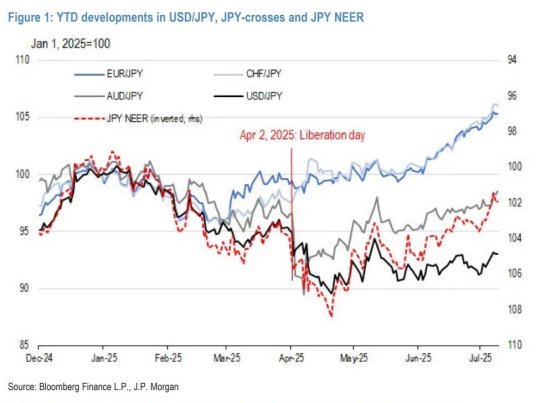
小摩:日元弱势格局料持续 年底美元兑日元目标维持140
智通财经网· 2025-07-14 07:05
Core Viewpoint - Morgan Stanley's report indicates that since the U.S. announced reciprocal tariffs on April 2, the Japanese yen has appreciated slightly against the U.S. dollar but weakened against other G10 currencies, with a declining trend in the nominal effective exchange rate (NEER) [1][3]. Group 1: Factors Influencing Yen Movements - Factors driving the unwinding of long yen positions include improved risk sentiment from rising global stock markets, cooling expectations for Bank of Japan interest rate hikes, domestic political uncertainties in Japan raising fiscal concerns, weakened expectations for U.S.-Japan currency agreements, and stagnation in Japan's "de-dollarization" process [3]. - Following President Trump's statement on April 22 regarding not planning to dismiss Federal Reserve Chairman Powell and softening his stance on China, global stock markets rebounded, with the S&P 500 and TOPIX indices returning to pre-tariff levels. The correlation between stock market rises and yen depreciation was noted from late April to late June [3]. Group 2: Future Outlook and Projections - Morgan Stanley maintains its forecast for USD/JPY at 140 by the end of 2025 and 139 by mid-2026, emphasizing that any rebound in the yen may be more a result of a weakening dollar rather than a strengthening yen [5]. - The direct impact of the 25% reciprocal tariffs on the Japanese economy, central bank monetary policy, and yen exchange rate is considered limited, but there may be indirect effects through stock market volatility. If tariffs lead to a decline in Japanese corporate earnings (with an estimated 9% reduction in earnings per share for the TOPIX index), a stock market downturn could temporarily increase demand for the yen as a safe haven. However, the market generally expects the final tariff rate to be lower than 25%, suggesting a milder actual impact [5].
美威胁对加墨分别征收35%和30%关税,如何影响美墨加产业链?|特朗普关税风云第二季
第一财经· 2025-07-14 06:27
Core Viewpoint - The article discusses the recent tariff increases announced by President Trump on imports from Mexico and Canada, citing drug control issues as the primary reason, while also indicating that the actual impact on trade may be limited due to existing trade agreements [1][6]. Group 1: Tariff Increases - On August 1, a 30% tariff will be imposed on goods imported from Mexico, and a 35% tariff on goods from Canada [1]. - The tariffs are justified by Trump's claims of insufficient action by both countries in controlling drug trafficking, particularly fentanyl [1][6]. - The increase in tariffs is seen as a strategy to pressure Canada and Mexico into further concessions during ongoing trade negotiations [3][12]. Group 2: Trade Relations and Agreements - The USMCA (United States-Mexico-Canada Agreement) provides exemptions for many products, which may limit the actual impact of the new tariffs [4][13]. - Most goods imported from Canada and Mexico currently enjoy low average tariff rates, often below 1% [4]. - The article notes that the trade relationship is heavily interdependent, with Canada and Mexico relying significantly on the US market for exports [12]. Group 3: Economic Implications - If comprehensive tariffs are applied, it could raise US prices by approximately 1.2%, affecting consumer goods and potentially leading to public dissatisfaction [5]. - The tariffs may also influence the automotive industry by increasing local sourcing requirements, although evidence of effective re-industrialization through tariffs is lacking [7]. - The potential for retaliatory tariffs from Canada and Mexico exists, but both countries seem inclined to negotiate rather than escalate tensions [10][12].
海外宏观周报:美国贸易政策风险再升-20250714
Ping An Securities· 2025-07-14 05:41
Group 1: US Trade Policy and Economic Data - Trump announced tariffs ranging from 25% to 50% on imports from 14 countries including Japan and South Korea, with a delay on "reciprocal tariffs" to August 1[1] - Initial jobless claims in the US fell to 227,000, marking the lowest level in two months and a fourth consecutive week of decline[1] - The GDPNow model predicts a 2.6% annualized growth rate for Q2 2025[1] Group 2: Global Market Overview - US stock markets declined, with the S&P 500, Dow Jones, and Nasdaq down 0.3%, 1.0%, and 0.1% respectively, primarily due to rising trade uncertainties[1] - The Euro STOXX 600 index rose by 1.1%, while the Nikkei 225 index fell by 0.6%[1] - The US dollar index increased by 0.91% to 97.87, reflecting heightened inflation risks and cautious rate cut expectations[1] Group 3: Bond and Commodity Markets - The 2-year US Treasury yield rose by 2 basis points to 3.90%, while the 10-year yield increased by 8 basis points to 4.43%[1] - Brent and WTI crude oil prices rose by 3.0% and 2.9% respectively, driven by lower Russian production[1] - Gold prices increased by 0.6%, reflecting a rise in risk aversion among investors[1] Group 4: Economic Risks and Forecasts - Risks include potential overreach of Trump's policies, unexpected levels of stagflation in the US, and volatility in global financial markets[1] - The probability of a 25 basis point rate cut in July increased from 4.7% to 6.7%[1]