
绿色转型

Search documents
我国轻工制造业不断显现内生动力
Xiao Fei Ri Bao Wang· 2026-01-06 00:42
Core Insights - The light industry in China has achieved notable structural adjustments in 2025, with growth driven more by internal upgrades than external stimuli [1] - The overall economic performance of the light industry remains stable, with revenue and profit growth of 1.9% and 1.6% respectively in the first ten months of 2025 [1] - The focus of competition in light industry products is shifting from quantity to consumer experience and value [1] Demand Side Changes - The changes in demand are reflected more in the consumption structure rather than total consumption [1] - Specific sectors such as baked goods, daily chemical products, and home goods have shown more stable performance, indicating a shift towards emotional and daily consumption [1] Export Dynamics - The export growth of light industry products has shown significant differentiation, with traditional markets like Europe and the US slowing down while emerging markets such as ASEAN, the Middle East, and Latin America maintain rapid growth [2] - The reliance on low-price orders is decreasing, with an increase in brand-oriented, customized, and small-batch export models [2] Digital Transformation - The digital transformation of the light manufacturing industry has entered a practical phase, with a focus on specific sectors such as home appliances and furniture [2] - Policies aim for a 75% CNC rate in key processes of major light industry enterprises by 2027 [2] Green Transition - The green transition is becoming a prerequisite rather than an added benefit, with environmental standards increasingly included in procurement and cooperation agreements [3] - Companies are experiencing short-term cost increases but are gaining competitiveness in mid-to-high-end markets [3] Regional Policies - New regional policies and institutional environments are providing support for the light manufacturing industry, with free trade zones and cross-border e-commerce platforms enhancing attractiveness [4] - The light manufacturing industry is focusing on structural optimization rather than high-speed expansion, emphasizing long-term returns and comprehensive capabilities [4] Industry Outlook - The light industry is gradually moving away from the "low added value" label towards a more resilient and sustainable direction [4] - The key takeaway for the light industry in 2025 is that stability, quality, and patience are becoming new industry consensus as speed is no longer the sole objective [4]
赤峰市敖汉旗委书记孙广通:持之以恒防沙治沙筑牢生态安全屏障
Zhong Guo Huan Jing Bao· 2026-01-06 00:31
Core Insights - Aohan Banner has made significant progress in ecological restoration and desertification control, transforming from a severely degraded environment to a model for ecological governance in arid and semi-arid regions [1][2][4] Group 1: Ecological Restoration Efforts - Since the 1970s, Aohan Banner has implemented extensive afforestation and grass planting initiatives, reducing desertified land from 2.59 million acres in 1975 to 1.1062 million acres [1][2] - The area of forest reached 5.02 million acres by 2002, with an average annual increase of 160,000 acres since the launch of the Three-North Shelter Forest Program [2] - The "Ecological Flag" strategy was introduced in the late 1990s, focusing on large-scale coordinated efforts for ecological restoration [2] Group 2: Economic and Social Benefits - The development of economic forests has led to an annual production of 117,000 tons of various forest products, increasing per capita income for farmers and herders by over 1,000 yuan [3] - Aohan Banner has stabilized grain production at over 2 billion jin and livestock numbers at over 3.5 million, creating a positive cycle of agricultural productivity [3] - The region has seen a 57.4% local processing rate for agricultural products, with the establishment of several leading enterprises in the industry [3] Group 3: Environmental Protection Measures - Aohan Banner has implemented strict regulations to protect ecological achievements, including a ban on polluting projects and a focus on sustainable development [4] - The "Forest Chief + Prosecutor" system has been introduced, resulting in 16,000 inspections and the resolution of 676 issues related to resource protection [4] - Significant reductions in emissions have been achieved, including a decrease of 443.7 tons of sulfur dioxide and 34 tons of nitrogen oxides [4]
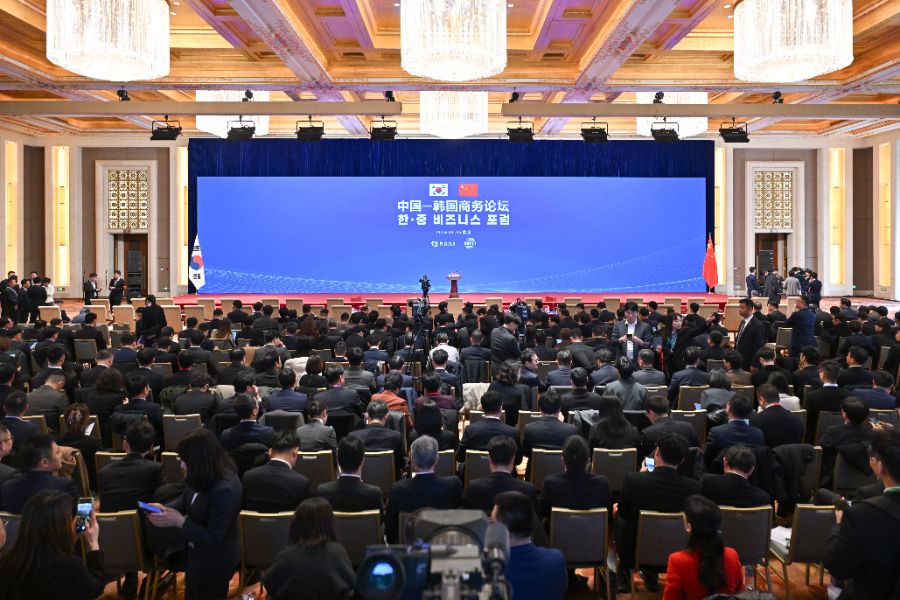
“好邻居金不换!”李在明携韩商业天团访华,呼吁制造业创新合作
2 1 Shi Ji Jing Ji Bao Dao· 2026-01-05 13:48
Group 1: Economic Cooperation - The bilateral trade volume between China and South Korea has increased from $6.5 billion at the time of diplomatic relations in 1992 to $272.9 billion in 2024, with China being South Korea's largest trading partner [2] - The forum highlighted three main topics for discussion: manufacturing innovation, supply chain cooperation, and consumer goods market [3] - The two countries aim to deepen cooperation in emerging fields such as artificial intelligence, biopharmaceuticals, green industries, and the silver economy, as part of the ongoing negotiations for the second phase of the China-South Korea Free Trade Agreement [5] Group 2: Cultural and Service Industry Collaboration - There is a growing interest in cultural exchanges, with popular travel experiences like "Seoul Cultural Tours" and "K-Beauty Experiences" among Chinese youth, and "Shanghai Weekend Trips" favored by South Korean youth [6] - The collaboration in content industries, gaming, performances, and cultural platforms is expected to strengthen ties between manufacturing, consumer investment, and new market exploration [6] - Despite rising competition in certain industries, representatives believe that the strategic and mutual benefits of cooperation between the two countries remain unchanged [6] Group 3: Government Support and Future Outlook - The South Korean government is committed to enhancing cooperation with China to provide a favorable environment for businesses and expand cooperation channels [2][6] - The visit of President Yoon signifies a significant diplomatic achievement, aiming to restore comprehensive relations and plan for the future of bilateral ties over the next 30 years [3][4] - The emphasis on mutual respect and understanding in government communications is seen as crucial for the ongoing development of China-South Korea relations [4][5]

跟着“十五五”规划走,未来公元这样干!
Xin Lang Cai Jing· 2026-01-05 10:45
Core Insights - The article discusses the "15th Five-Year Plan" and its implications for the future development of China's economy, emphasizing the alignment of the company with national policy directions [2][28]. Group 1: Technological Innovation and Infrastructure - The company aims to support the "Two Major" construction projects by providing reliable solutions, leveraging its strong technical foundation [2][30]. - An example of innovation is the customized solution for the Yangtze River Protection Project, which involved creating tailored PE pipes to address installation challenges [4][30]. - Over half of the new patents obtained by the company by 2025 are derived from technological innovations related to "Two Major" projects [4][30]. Group 2: Housing Quality Improvement - The company is committed to enhancing housing quality, aligning with government initiatives to implement a housing quality improvement project and establish a safety management system for the entire lifecycle of buildings [6][32]. - In 2024, the company will launch the "Whole House·Company Home" solution, which promises a lifespan of up to 50 years, ensuring safety throughout the building's lifecycle [6][32]. - The company plans to showcase its new brand IP "Company Good House" at major exhibitions in 2025, translating the concept of quality housing into tangible experiences [8][34]. Group 3: Autonomous Innovation - The company prioritizes autonomous innovation as a key driver for development, establishing a collaborative innovation system through various research and development platforms [9][37]. - It has successfully introduced the largest diameter HDPE solid wall pipe production line in the country, breaking foreign technology monopolies [11][37]. - By the end of 2025, the company aims to have accumulated over 850 national and international patents and participated in the revision of 139 national and international standards [11][37]. Group 4: Green Transformation - The company is actively participating in pollution prevention and environmental protection projects across 75 counties, contributing to national green development goals [12][39]. - It has implemented energy-saving and carbon reduction measures through various systems, earning recognition as a national green factory [12][41]. - The company has developed and implemented 36 national and industry standards for green building materials, achieving 100% coverage of green products in its offerings [12][43]. Group 5: Artificial Intelligence Integration - The company has completed the smart transformation of its factories, applying artificial intelligence and industrial internet technologies to enhance production efficiency [20][45]. - New technologies such as AI defect recognition have been implemented, achieving a defect recognition rate of over 99.5% [22][45]. Group 6: Global Expansion and Cooperation - The company has expanded its international presence, registering its trademark in over 100 countries and establishing its fifth manufacturing base in Vietnam [23][49]. - The overseas market has seen a growth of 17.6% this year, contributing to the high-quality development of the "Belt and Road" initiative [23][49]. - The company aims to continue deepening its focus on "hidden engineering" to support national strategies and meet public needs [25][49].
实施绿色消费推进行动!商务部等9部门联合出台通知
Sou Hu Cai Jing· 2026-01-05 10:41
Core Viewpoint - The Ministry of Commerce and nine other departments have jointly issued a notice to implement green consumption promotion actions, aiming to accelerate the green transformation of consumption patterns and expand green consumption during the 14th Five-Year Plan period [1] Group 1: Specific Measures - The notice outlines 20 specific measures across seven areas, including enriching the supply of green products, enhancing green service consumption, innovating green consumption models, promoting green recycling, optimizing the green consumption environment, solidifying the foundation for green consumption, and increasing policy support [3][4] - It emphasizes the importance of high-quality development by focusing on quality supply in the livelihood sector, promoting green agricultural products, green home appliances, and green automotive consumption [4] Group 2: New Growth Points - The notice encourages the creation of new growth points in green consumption by developing green supply chains, conducting carbon footprint evaluations, and promoting green procurement, products, and packaging [4] - It also suggests the establishment of a universal green consumption points system that can be used both online and offline, along with the promotion of green product certification and standardization of green consumption points collection at retail [4] Group 3: Environmental Optimization - The notice calls for the optimization of the green consumption environment by promoting energy-saving facilities, prioritizing the use of green electricity, and advocating for green travel practices among consumers [5] - It highlights the need for public awareness campaigns to encourage community activities focused on green consumption and low-carbon living [5] Group 4: Policy Support - The Ministry of Commerce plans to work with relevant departments to guide local efforts in promoting green consumption, summarizing successful experiences and practices to further expand green consumption and support comprehensive green transformation in economic and social development [5]
破局铝业“三难”,大宗供应链龙头厦门象屿锻造铝产业链韧性闭环
Sou Hu Wang· 2026-01-05 09:19
Core Insights - Aluminum is a key raw material and strategic resource, with China being the largest producer and consumer globally. The country is expected to maintain its leading position in the production of alumina, electrolytic aluminum, aluminum processing materials, and recycled aluminum by 2024, with respective outputs of approximately 85 million tons, 44 million tons, 49.5 million tons, and 10.5 million tons [1] - The Chinese aluminum industry faces challenges such as high dependence on imported bauxite, insufficient resource supply, high carbon emissions, and reliance on imported high-end products. These issues necessitate a transformation and upgrade of the industry [1] - The Ministry of Industry and Information Technology and ten other departments have released the "Implementation Plan for High-Quality Development of the Aluminum Industry (2025-2027)", which sets quantitative goals for resource security, industrial layout, and technological innovation [1] Resource Security - China's bauxite reserves account for only 3% of global reserves, with a high import dependency of 65%, making resource security a critical issue for the industry [3] - Xiamen Xiangyu is strategically focusing on resource security by penetrating domestic mining areas and investing in overseas bauxite resources, particularly in Indonesia, to secure production capacity and enhance international pricing power [3] Manufacturing Transition - The aluminum processing industry's high-end transformation is a core focus of the "Implementation Plan". Currently, 68% of domestic aluminum capacity is concentrated in low-end sectors, with over 60% of high-performance aluminum alloys for aerospace and electric vehicles being imported [4] - Xiamen Xiangyu's parent company, Xiangyu Group, has invested 3.6 billion yuan in restructuring Zhongwang Group, aiming to upgrade the industry and enhance production capabilities across various segments, including electric aluminum and deep processing [4][5] Supply Chain Integration - Xiamen Xiangyu aims to leverage its supply chain service advantages alongside Zhongwang's manufacturing capabilities, adopting a model that integrates industrial operations with supply chain services to activate existing capacities and penetrate high-end markets [5] - The transition from a traditional supply chain to an integrated manufacturing model allows for rapid construction of vertical integration capabilities, addressing resource anxiety and technological bottlenecks while aligning with national strategies for resource security and low-carbon transformation [6]

国家发改委:长江经济带已成为中国科技资源最富集区域之一
Zhong Guo Xin Wen Wang· 2026-01-05 07:52
Core Insights - The Yangtze River Economic Belt has become one of the most resource-rich and innovative regions in China, driven by significant advancements in technology and industry [1][2] Group 1: Innovation and Technology - The National Development and Reform Commission (NDRC) has established three technology innovation centers and eight national laboratories along the Yangtze River, focusing on key technologies in artificial intelligence, quantum information, integrated circuits, and life sciences [1] - Key innovation hubs such as Hefei Quantum Avenue, Wuhan Optics Valley, and the Chengdu-Chongqing Science City are accelerating development in the tech sector [1] Group 2: Industrial Upgrading - The Yangtze River Economic Belt has cultivated 41 national-level advanced manufacturing clusters and 30 strategic emerging industry clusters, accounting for 51% and 45% of the national totals, respectively [1] - The automotive industry is projected to see significant growth, with electric vehicle production in Shanghai, Jiangsu, Zhejiang, Anhui, and Chongqing expected to exceed one million units each by 2025, forming a comprehensive supply chain across the region [1] Group 3: Green Transformation - The NDRC has initiated 24 national carbon peak pilot cities and parks, along with 14 zero-carbon parks, to promote green transformation in the Yangtze River Economic Belt [2] - The region, which accounts for about one-third of the country's energy consumption and carbon emissions, contributes nearly half of the national GDP, highlighting its role as a leader in ecological priority and green development [2] - Future efforts will focus on accelerating the green transformation of traditional industries and fostering the growth of green low-carbon industries tailored to local conditions [2]
锚定新质生产力 20余省份差异化破局
Bei Jing Shang Bao· 2026-01-05 06:53
Core Viewpoint - The article emphasizes the importance of "new quality productivity" as a driving force for China's economic transformation, focusing on digitalization and green transition in traditional industries, while strategic emerging industries become growth engines for the future [1][5][8]. Group 1: New Quality Productivity - New quality productivity integrates technological innovation, industrial upgrading, and green transformation, serving as a core strategy for regions to break free from traditional paths and create competitive advantages [1][5]. - The "14th Five-Year Plan" and the "15th Five-Year Plan" highlight the need for localities to develop new quality productivity tailored to their unique resources and industrial foundations [1][5]. Group 2: Technological Innovation - Regions recognize the critical role of technological innovation in fostering new quality productivity, with plans to enhance innovation capabilities across various provinces [5][6]. - Beijing aims to strengthen independent innovation capabilities, targeting cutting-edge fields like artificial intelligence and quantum technology, while other provinces focus on specific technological advancements [5][6]. Group 3: Strategic Emerging Industries - The development of strategic emerging industries and future industries is a primary vehicle for building new quality productivity, with a focus on sectors like artificial intelligence, biomedicine, and new energy [6][7]. - Provinces like Guangdong and Anhui are actively creating large-scale industry clusters in these strategic sectors, moving away from a "big and complete" industrial approach to a more competitive and focused strategy [6][7]. Group 4: Traditional Industry Transformation - The transformation of traditional industries through intelligent and digital upgrades is seen as essential for revitalizing existing sectors and enhancing competitiveness [7][10]. - Provinces are implementing initiatives to leverage digital technologies for traditional industries, with a strong emphasis on green and low-carbon development [7][10]. Group 5: Regional Differentiation - The principle of "developing according to local conditions" is crucial for the differentiated development of new quality productivity, avoiding homogenization and encouraging unique regional paths [9][10]. - Eastern coastal provinces focus on high-end manufacturing and innovative industries, while central and western provinces leverage their resource advantages for industrial upgrades [9][10]. Group 6: Innovation Ecosystem - The article discusses the importance of creating a robust innovation ecosystem that connects technology, industry, and finance, with various provinces establishing high-level innovation platforms [14][15]. - Collaborative efforts between enterprises, educational institutions, and research organizations are emphasized to enhance the integration of education, technology, and talent [15][19]. Group 7: Future Industries - There is a strong focus on future industries such as low-altitude economy, quantum technology, and next-generation communication, which are seen as key areas for long-term growth and innovation [16][17]. - These future-oriented initiatives are expected to lay the groundwork for new growth points and ensure sustainable development over the next five years and beyond [16][17].

北京剑指前沿领域!新质生产力成“必答题”,20余省份如何破局?
Bei Jing Shang Bao· 2026-01-05 06:50
Core Viewpoint - The article emphasizes the importance of "new quality productivity" as a core driver for economic transformation and high-quality development in China, underpinned by regional differentiation based on local resources and industrial foundations [1][2]. Group 1: New Quality Productivity - New quality productivity integrates technological innovation, industrial upgrading, and green transformation, becoming a key strategy for regions to break away from traditional growth paths and establish competitive advantages [1][5]. - The "14th Five-Year Plan" and subsequent directives highlight the need for localities to develop new quality productivity tailored to their unique resources and industrial bases, fostering a unified yet differentiated approach across provinces [1][2]. Group 2: Technological Innovation - There is a consensus among provinces on the critical role of technological innovation in cultivating new quality productivity, with many regions prioritizing the enhancement of innovation capabilities [2][5]. - Specific initiatives include Beijing's focus on AI and quantum technology, Shanghai's development of a global innovation hub, and Hubei's commitment to becoming a national technology innovation center [2][3]. Group 3: Strategic Emerging Industries - The article notes a strategic focus on clusters of emerging industries such as AI, biomedicine, integrated circuits, and renewable energy, with provinces like Guangdong aiming to create trillion-yuan industry clusters [3][4]. - Regions are shifting from broad industrial bases to developing competitive advanced manufacturing clusters that leverage local strengths [3][4]. Group 4: Traditional Industry Transformation - The transformation of traditional industries through intelligent and digital upgrades is highlighted as a key measure to stimulate new quality productivity [4][5]. - Provinces like Liaoning and Jilin are implementing initiatives to enhance traditional sectors through digital technologies, aiming to improve core competitiveness [4][5]. Group 5: Regional Differentiation - The principle of "developing according to local conditions" is crucial for fostering differentiated strategies that avoid homogenization and encourage unique development paths [6][9]. - Eastern coastal provinces are focusing on high-end manufacturing, while central and western regions are leveraging their resource advantages to develop specialized industries [6][7][8]. Group 6: Innovation Ecosystem - The article discusses the importance of creating a robust innovation ecosystem that connects technology, industry, and finance, with many provinces establishing high-level innovation platforms [10][11]. - Collaborative efforts between enterprises, universities, and research institutions are emphasized to enhance the integration of education, technology, and talent [11][12]. Group 7: Future Industries - There is significant enthusiasm for laying the groundwork for future industries, with terms like low-altitude economy and quantum technology frequently appearing in regional plans [12][13]. - These initiatives are seen as strategic foresight to ensure sustainable growth and competitiveness in the long term [12][13]. Group 8: Legal and Policy Framework - The article highlights the need for a supportive legal and policy environment to facilitate the transformation of new quality productivity into a core driver of high-quality development [14]. - Recommendations include enhancing legal protections for innovation, improving market mechanisms, and creating a conducive ecosystem for technological advancement [14].
五大关键词看好中国经济新一年
Jin Rong Shi Bao· 2026-01-05 02:33
Core Viewpoint - In 2025, China's economy demonstrated remarkable resilience and vitality, achieving a GDP growth of 5.2% year-on-year in the first three quarters, surpassing initial forecasts by institutions like the IMF and ranking among the top global economies. The year marked a significant "system upgrade" in growth momentum, characterized by accelerated development of new productive forces and a series of targeted macro policies aimed at enhancing future competitiveness and laying the groundwork for the 15th Five-Year Plan [2][4]. Group 1: Economic Growth and Structure - China's GDP growth of 5.2% in 2025's first three quarters reflects strong economic performance, driven by industrial upgrades and the expansion of emerging industries [2]. - The government implemented targeted macro policies focusing on digital economy and AI, supporting urban renewal and enhancing consumption through equipment upgrades and trade-in programs [2]. - The 15th Five-Year Plan emphasizes high-quality development with quantifiable goals such as maintaining economic growth within a reasonable range and improving residents' consumption rates [2]. Group 2: Domestic Demand and Investment - The 2025 Central Economic Work Conference prioritized "domestic demand as the main driver" for economic work in 2026, aiming for qualitative improvements and reasonable growth through multi-dimensional efforts in consumption, investment, and industry [3]. - Investment structure is set to optimize, focusing on new infrastructure, public services, and industrial upgrades, with significant government support in education, healthcare, and technology sectors [5]. Group 3: Innovation and Technology - The emphasis on "innovation-driven" development is crucial for addressing global economic uncertainties, with a systematic enhancement of China's innovation capabilities expected by 2026 [6][7]. - In 2024, R&D expenditure reached 36,326.8 billion yuan, an increase of 8.9% from the previous year, indicating a shift from following to leading in technological innovation [6]. Group 4: Reform and Market Integration - The construction of a unified national market is a key reform focus for 2026, aiming to eliminate market barriers and ensure fair competition through standardized regulations [8][9]. - Data shows that inter-provincial trade sales accounted for 41.1% of national sales revenue from January to November 2025, reflecting deepening trade connections and progress in market integration [8]. Group 5: Institutional Opening and Foreign Investment - The 2025 Central Economic Work Conference called for steady progress in institutional opening, with a focus on expanding service sector access and optimizing free trade zone layouts [11][12]. - From January to October 2025, 53,782 new foreign-invested enterprises were established, a 14.7% increase year-on-year, supported by various measures to attract foreign investment [11]. Group 6: Green Transformation - The commitment to a "dual carbon" strategy aims to drive comprehensive green transformation, with significant investments projected in climate adaptation and zero-carbon industries over the next decade [13][15]. - By August 2025, China's installed capacity for wind and solar power exceeded 1.69 billion kilowatts, tripling since 2020, highlighting the shift towards renewable energy [15][16]. - The establishment of a green financial support system aims to unify standards and enhance funding for green projects, with a notable increase in market confidence reflected in the green industry prosperity index [17].