
AI泡沫

Search documents
致基民的一封信:满4000减200之际,如何熬过市场的考验期
Sou Hu Cai Jing· 2025-11-25 01:09
Group 1 - The current market adjustment is influenced by multiple factors, including concerns over an AI bubble in the US stock market, which has led to a decline in investor sentiment [7][8][11] - The A-share market's internal dynamics, including a shift in risk appetite and a transition towards more stable dividend assets, have contributed to the recent market fluctuations [12][14] - The unexpected downturn in popular sectors, such as lithium and battery industries, has further dampened market sentiment and increased volatility [13][14] Group 2 - The A-share market is not overly reliant on a few tech giants, and its valuation levels are not significantly inflated, suggesting that concerns over the AI bubble may only cause short-term disruptions [16][18] - The core logic supporting the long-term upward trend of the A-share market remains intact, driven by policy support, industrial upgrades, and liquidity easing [19][22] - Historical data indicates that market adjustments are a normal part of the investment cycle, and the current pullback can be seen as a necessary correction within a longer-term upward trend [22][25] Group 3 - Investors are advised to calmly assess their holdings and avoid panic selling during market downturns, focusing instead on the fundamental value of their investments [28] - It is crucial to review asset allocation and ensure a balanced portfolio that includes defensive assets to withstand market volatility [29] - Long-term investors may find opportunities to gradually increase their positions in quality assets once the market stabilizes [30][31]

【芦哲&张佳炜】就业数据的缺席或令美联储降息延后至1月——海外周报20251123
Xin Lang Cai Jing· 2025-11-25 00:25
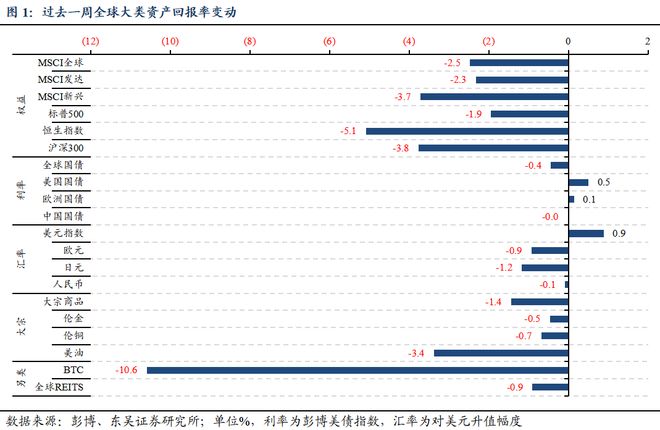
Core Viewpoint - The Federal Reserve's hawkish signals and the delay in the release of November non-farm payroll data have significantly narrowed market expectations for a rate cut in December, leading to a substantial pullback in U.S. stocks. Concerns over the AI bubble and other factors have also contributed to this decline. However, the weak non-farm data from September and the tightening of financial conditions due to the stock market adjustment have rekindled expectations for a rate cut. Looking ahead, in the absence of important data, the company leans towards the Fed pausing rate cuts in December, but this pause is more of a "skip" rather than a cancellation, with a high probability of a rate cut in January next year if the December pause occurs [1]. Major Assets - The combination of the Federal Reserve's hawkish signals, concerns over the AI bubble, and weak year-end buying has led to a significant drop in U.S. stocks, with global markets also retreating. The minutes from the Fed's October meeting indicated caution regarding a December rate cut, and the announcement from the BLS about the delay in the November non-farm data release until December 16 (after the December FOMC meeting) caused market expectations for a rate cut to plummet to as low as 25%. However, the release of better-than-expected September non-farm data later in the week, despite an unexpected rise in the unemployment rate, slightly increased rate cut expectations. Overall, during the week of November 17 to November 21, the S&P 500 and Nasdaq indices fell by 1.9% and 2.7%, respectively, while the MSCI global index dropped by 2.5% [2][3]. Overseas Economy - The September non-farm payroll data exceeded expectations, but the previous value was revised downwards, and the unemployment rate unexpectedly rose, leading to a slight increase in December rate cut expectations. The BLS delayed the release of the September non-farm employment data. In total, the September non-farm payrolls added 119,000 jobs, significantly above the expected 51,000, while the August figure was revised down from 22,000 to -4,000. The unemployment rate rose by 0.1 percentage points to 4.4%. The structural weakness in the non-farm data persists and has worsened, with the majority of new jobs in education and healthcare. Following the data release, the market's interpretation was weak, leading to renewed bets on a soft labor market and Fed rate cuts, with the probability of a December cut rising from a low of 25% to 40% [3][4]. Monetary Policy - The expectations for a December rate cut from the Federal Reserve have fluctuated, with the absence of economic data likely leading to a high probability of a "skip" rather than a cancellation of the rate cut. The combination of hawkish signals from the Fed, the BLS's announcement of delayed data, and the significant drop in the stock market has caused the federal funds futures market to experience volatility in December rate cut expectations, which fell to around 25% mid-week but later rose to 63% [4][5].
中金:AI“泡沫”走到哪一步了?
中金点睛· 2025-11-25 00:06
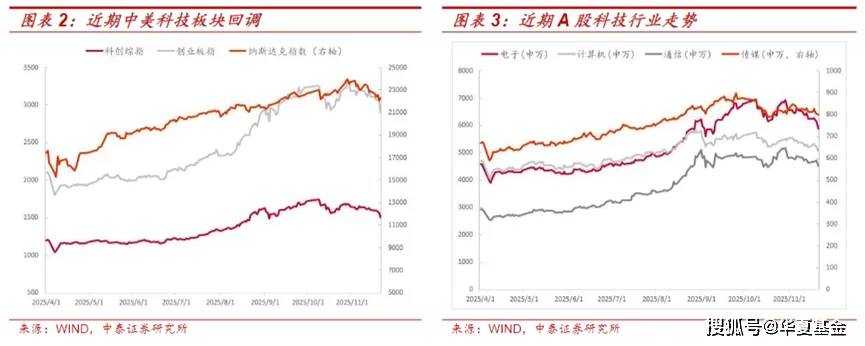
Core Viewpoint - The resurgence of the AI bubble has led to significant declines in global tech stocks, impacting markets in the US, China, and Hong Kong, with notable drops in the Hang Seng Tech Index (-7%), ChiNext (-6%), and the "Magnificent Seven" in the US (-6%) [2][4]. Group 1: AI Bubble Concerns - The primary concern driving market declines is the AI bubble, which has become a key economic indicator in the US and China [4]. - Since the launch of ChatGPT in late 2022, the "Magnificent Seven" stocks in the US have surged by 283%, significantly outperforming the S&P 500, which saw a 69% increase when adjusted for the "M7" [4][6]. - In China, the top ten tech companies have risen by 81% since early 2025, outpacing the Hang Seng Index's 19% increase when adjusted for these companies [6]. Group 2: Understanding the Bubble - The discussion around bubbles should focus on identifying the current stage rather than outright denial of their existence [8]. - Bubbles can drive industry development, and historical examples show that significant gains can occur during bubble phases, as seen in the Nasdaq's 256% rise from 1998 to 2000 despite declining profits [9][11]. - Current market expectations for OpenAI's IPO valuation are around $1 trillion, with a P/S ratio of 50x based on projected revenues of $20 billion, which could drop to 25x if revenues double [12]. Group 3: Investment and Demand Analysis - AI demand is categorized into disruptive external innovations and internal cost-saving efficiencies, with the latter already showing results [16]. - AI applications are projected to reduce costs by 9-11%, potentially saving $300 billion annually across the S&P 500 [19]. - Labor productivity in the non-farm business sector has increased by 5.6% since 2023, outpacing the productivity growth during the internet revolution [21]. Group 4: Investment Intensity and Capacity - Current investment levels in AI are less than half of those during the internet bubble, with technology investment growth expected to rise from 6% in early 2023 to 16% by mid-2025 [39]. - The capital expenditure to sales ratio for the "Magnificent Seven" is projected to rise from 9% in Q4 2023 to 15.9% by Q3 2025, indicating a healthy investment environment [41]. - The reliance on debt financing is lower than during the dot-com bubble, with the current debt-to-equity ratio for major tech firms at approximately 81%, significantly below the 124% average during the peak of the dot-com era [43]. Group 5: Market Valuation and Sentiment - The venture capital market is nearing the levels seen in 1999, with significant increases in funding for AI-related ventures [51]. - The dynamic P/E ratio for the "Magnificent Seven" has reached around 28x, close to the levels seen in late 1998, but still below the extreme valuations of the internet bubble [55]. - Investor sentiment is not as euphoric as during the dot-com bubble, with current net bullish sentiment at -5%, contrasting sharply with the 46% seen in early 2000 [59][61]. Group 6: Future Outlook - The current market environment suggests a potential for volatility due to high valuations, but long-term investment opportunities remain, particularly for companies that can effectively integrate AI into their business models [75]. - The overall economic contribution of AI is expected to be stronger than during the internet bubble, with technology investments contributing significantly to GDP growth [32][36]. - The forecast for the S&P 500 index by the end of 2026 is projected to be between 7600 and 7800, indicating a potential increase of 13-16% [78].

广发策略 | 降息疑云之下,美股如何演绎?——港股&海外周聚焦(11月第4期)
Xin Lang Cai Jing· 2025-11-24 23:26
Group 1 - The core viewpoint is that the US stock market is expected to recover in the short term due to the alleviation of three major negative factors: concerns over the AI bubble, tightening liquidity, and macroeconomic uncertainty [2][3][4] - The US non-farm payrolls for September increased by 119,000, significantly exceeding the expected increase of 52,000, with the unemployment rate rising slightly to 4.4%, the highest level since October 2021 [6][10] - The market interpreted the non-farm report as neutral to weak, with the probability of a 25 basis point rate cut in December rising from 39% to 71% following the report [12][14] Group 2 - The current economic situation in the US is characterized by a "K-shaped" economy and a "Goldilocks" economy, both of which are expected to support strong stock market performance [4][31] - Despite concerns over the AI bubble, the overall health of corporate balance sheets remains acceptable, with only Oracle showing high leverage characteristics [26][34] - The liquidity situation has improved significantly after the government reopened, alleviating previous concerns about dollar liquidity [28][34] Group 3 - The employment market is currently in a delicate balance, with both job growth and layoffs occurring simultaneously, indicating a lower risk of significant downturns in the short term [18][20] - Historical analysis suggests that the Fed may pause rate cuts in the short term, as the current economic indicators do not show signs of a significant recession [22][24] - The potential for sector rotation is highlighted, particularly in the healthcare sector, which has seen recent inflows after underperforming since late 2022 [34]

阿里千问引爆下载热潮 资金涌入AI应用板块
Zhong Guo Zheng Quan Bao· 2025-11-24 21:49
Core Viewpoint - The AI application sector is experiencing significant growth, driven by the surge in downloads of Alibaba's Qianwen app, indicating a positive trend in the commercialization of AI applications and benefiting related industries such as data centers and computing equipment [1][2]. Group 1: Market Performance - The AI application sector saw a collective rise, with several stocks related to Alibaba experiencing notable increases, including BlueFocus (300058) up over 15% and 360 (601360) hitting the daily limit [2]. - Active trading was observed in the AI application sector, with Vision China (000681) achieving a transaction volume of 5.614 billion yuan and a turnover rate of 32.12% [2]. - Major inflows of funds were noted, with iFLYTEK (002230) seeing a net inflow of 372 million yuan, while Inspur Information (000977) and Tianyu Digital Science (002354) had net inflows of 202 million yuan and 238 million yuan, respectively [2]. Group 2: Company Developments - Alibaba announced that its Qianwen app surpassed 10 million downloads within a week of public testing, reflecting strong consumer interest in AI applications [2]. - Ant Group launched a multimodal AI assistant named "Lingguang," which achieved over 1 million downloads within four days, topping the free tools category in the Apple App Store in China [3]. - Tencent's Hunyuan model team released the HunyuanVideo 1.5, a video generation model capable of producing 5-10 second high-definition videos [3]. Group 3: Industry Outlook - Analysts express optimism regarding the commercialization prospects of AI applications, anticipating a significant breakthrough as model capabilities continue to improve [7]. - The upstream AI industry remains robust, with expectations of sustained high growth in computing power and AI chip demand, which will drive the need for storage and data centers [7]. - Alibaba's new AI products and models are expected to create increased demand for AI infrastructure, with a focus on data center operations and related equipment [7]. Group 4: Investment Insights - Concerns about an AI bubble in international markets have led some analysts to suggest that the Chinese market may offer diversification opportunities for investors [5]. - JR Research highlighted that leading Chinese AI companies are narrowing the gap with global leaders without excessive spending on AI infrastructure, making investments in Alibaba potentially advantageous [5]. - Alibaba's strong fundamentals and superior free cash flow margins position it favorably for rational investment, with projected capital expenditures totaling 55.4 billion dollars from fiscal years 2026 to 2028 [5].

阿里千问引爆下载热潮资金涌入AI应用板块
Zhong Guo Zheng Quan Bao· 2025-11-24 20:13
Core Viewpoint - The AI application sector is experiencing significant growth, driven by the rising download numbers of Alibaba's Qianwen app, indicating a strong commercial potential for AI applications and related industries [1][2]. Group 1: AI Application Sector Performance - On November 24, the AI application sector saw a collective rise, with multiple Alibaba-related stocks experiencing notable increases, such as BlueFocus up over 15% and 360 reaching its daily limit [1]. - The trading activity in the AI application sector was robust, with Visual China achieving a transaction volume of 5.614 billion yuan and a turnover rate of 32.12% [1]. - Major inflows of capital were noted, with Keda Xunfei seeing a net inflow of 372 million yuan, while Inspur Information and Tianyu Digital Science had net inflows of 202 million yuan and 238 million yuan, respectively [1]. Group 2: Developments from Major Companies - Ant Group launched its multimodal AI assistant "Lingguang," which reached over 1 million downloads within four days, topping the free tools category in the Apple App Store in China [2]. - Tencent's Hunyuan model team announced the open-source release of HunyuanVideo 1.5, a video generation model capable of producing 5-10 second high-definition videos [2]. Group 3: Market Sentiment and Investment Trends - Discussions around an AI bubble are intensifying, with Google CEO Sundar Pichai acknowledging the presence of both rational and irrational factors in AI investments [2]. - Nvidia's CEO Jensen Huang dismissed concerns about an AI bubble, citing strong revenue expectations that support the legitimacy of AI investments [2]. Group 4: Economic Impact and Investment Opportunities - AI-related capital expenditures have surpassed U.S. consumer spending, becoming a key driver of economic growth, with AI stocks contributing significantly to the S&P 500 index returns [3]. - Major tech companies like Amazon, Google, Meta, and Microsoft are projected to invest approximately $400 billion in AI this year, primarily for data center construction, raising questions about the sustainability of returns [3]. - Research indicates that Chinese AI companies are narrowing the gap with global leaders without excessive spending on AI infrastructure, presenting a potential risk diversification opportunity for investors [3]. - Alibaba's strong fundamentals and superior free cash flow margins position it favorably for rational investment, with projected capital expenditures totaling $55.4 billion from FY2026 to FY2028 [3]. Group 5: Optimism for AI Commercialization - Industry experts are optimistic about the commercialization prospects of AI applications, anticipating a significant acceleration in the formation of an AI industry ecosystem [4]. - The upstream AI industry remains robust, with expectations for high growth in computing power and demand for AI chips, storage, and data centers [4]. - Alibaba's new AI products and models are expected to drive increased demand for AI infrastructure, benefiting its partners in data center operations and related fields [4].
全球股市暴跌,大调整来袭,终点锁定两关键时间
Sou Hu Cai Jing· 2025-11-24 16:32
全球股市崩盘!大调整何时结束这轮调整的终点看两个关键时间点,下面把主要脉络直接说清楚,别拐 弯抹角,让人好奇后面的细节,因为里面有时间点和真相,会牵动你钱包和情绪。 这次突然的大跌,核心原因简单明了,是美联储可能不会在12月降息,这一消息像断了支柱,AI泡沫 赖的两条腿——企业业绩和降息预期——当中一条被拔掉,市场就像没了平衡杆的杂技演员翻了跟头。 近五年来,纳斯达克和美联储利率关系负相关,这次美国9月非农数据在11月20日公布,市场预期新增5 万人,实际却是11.9万人,就业强劲意味着美联储更可能维持利率,市场对降息的幻想被迅速打破。 | Wind热门概念指数 | | | | | | | | --- | --- | --- | --- | --- | --- | --- | | Kimi 小红书 拼多多合短剧游戏 虚拟人 | 水产 FENASS | | | | | 中文语 | | 3.51% 0.65% 0.47% 0.42% 0.22% 0.02% 0.01% -0.33% | | | | | | | | WEB3.0 白色家电 多模态 生物育种央企银行抖音豆包 AIGC 谷子经济 -0.43% -0.5 ...

今夜,暴涨!
中国基金报· 2025-11-24 16:14
Group 1 - The core viewpoint of the article highlights a significant rise in technology stocks, particularly in the U.S. markets, with the Nasdaq index surging nearly 2% [2][3] - Major semiconductor companies like AMD and Micron, along with tech giants such as Tesla and Alphabet, saw substantial stock price increases, contributing to the overall market rally [3] - The market sentiment is largely influenced by rising expectations for a potential interest rate cut by the Federal Reserve, with the probability of a cut next month reaching nearly 80% [4][5] Group 2 - The article notes that the Boston Fed President Susan Collins does not see an urgent need for rate cuts, while New York Fed President John Williams indicated that there may be reasons for a cut in the near term [5] - Analysts express that the current economic data is subject to various interpretations due to delays in official data releases, complicating the economic outlook [7] - Chinese stocks also performed well, with the China concept stock index rising approximately 2.5%, and Xiaomi's ADR increasing over 4% following a significant share buyback by its founder Lei Jun [7][8]






可选消费W47周度趋势解析:AI泡沫论调和12月减息可能性降低影响全球资产表现-20251124
Haitong Securities International· 2025-11-24 14:05
Market Performance - The US hotel sector increased by 2.8%, with Marriott and Hilton rising by 3.8% and 1.83% respectively, demonstrating resilience under pressure[6] - The overseas sportswear sector decreased by 0.2%, with Amer Sports surging by 12.2% due to strong Q3 performance, leading to a revenue increase of 30%[14] - The jewelry sector fell by 2.1%, influenced by AI bubble concerns and reduced expectations for a December rate cut, strengthening the dollar[14] Sector Analysis - The domestic sportswear sector dropped by 2.4%, with major OEMs like Shenzhou International and Crystal International declining by 6.7% and 2.6% respectively due to geopolitical tensions[14] - The retail sector saw a decline of 4.0%, with China Duty Free falling by 10.5% as investors took profits amid uncertain policy outlooks[14] - The pet sector decreased by 5.7%, with concerns over sustainability as sales expenses outpaced revenue growth[14] Valuation Insights - The expected PE for the overseas sportswear sector in 2025 is 29.0x, which is 54% of the past 5-year average[15] - The expected PE for the domestic cosmetics sector is 27.6x, representing 52% of the past 5-year average[15] - Most sectors are valued below their historical 5-year averages, indicating potential investment opportunities[15]
英伟达财报也救不了美股科技股
第一财经· 2025-11-24 13:43
Core Viewpoint - The article discusses the mixed market reactions following Nvidia's earnings report, highlighting ongoing concerns about the sustainability of AI investments and the broader implications for the tech sector [3][4][5]. Group 1: Nvidia's Earnings Report - Nvidia's earnings report showed a significant year-on-year revenue growth of 65%, marking a return to acceleration for the first time in two years, with data center revenue increasing by 66% [4]. - The company's fourth-quarter guidance exceeded market expectations, projecting approximately $65 billion, surpassing the consensus estimate of $62 billion [4]. - Despite the strong earnings, the market remains concerned about the potential for an "AI bubble," leading to a sell-off in tech stocks rather than a rebound [4][5]. Group 2: Market Sentiment and Investment Trends - Institutional investors have been selling off tech stocks, with funds flowing into more defensive sectors, particularly healthcare, indicating a lack of confidence in the tech industry's future [3][4]. - Concerns about the sustainability of cash flows in the face of aggressive capital expenditures by AI giants have emerged, with examples like Oracle and Meta increasing their leverage to maintain investment levels [5][6]. - The market is increasingly wary of the "burn rate" of capital in the tech sector, with significant doubts about whether the current investment strategies can yield sustainable returns [5][6]. Group 3: Macroeconomic Factors - The probability of interest rate cuts by the Federal Reserve has decreased significantly, which poses a threat to growth stocks sensitive to interest rates [9][10]. - Recent employment data showed mixed signals, complicating the Fed's decision-making process regarding interest rates, with a notable increase in job creation but a rise in the unemployment rate to 4.4% [9]. - Concerns about inflation persist, with potential implications for government debt issuance and the overall economic outlook, particularly if AI-driven productivity gains do not materialize as expected [10].
