PPI

Search documents
8月份我国消费市场运行总体平稳 核心CPI继续回升
Yang Shi Wang· 2025-09-10 07:52
Group 1 - The overall consumer market in China remained stable in August, with the Consumer Price Index (CPI) unchanged month-on-month and down 0.4% year-on-year [1] - The Producer Price Index (PPI) was flat month-on-month after a 0.2% decline in the previous month, with a year-on-year decrease of 2.9%, marking a narrowing of the decline compared to the previous month [1] - The year-on-year decline in CPI was primarily due to a high comparison base from the previous year and lower seasonal price increases for food items such as pork, eggs, and fresh fruits [1] Group 2 - Core CPI, excluding food and energy, increased by 0.9% year-on-year, marking the fourth consecutive month of growth and reaching a new high for the year [1] - The decline in PPI year-on-year narrowed by 0.7 percentage points compared to the previous month, the first contraction since March of this year [1] - Key industries such as coal processing, black metal smelting, photovoltaic equipment manufacturing, and new energy vehicle manufacturing saw a reduction in the year-on-year price decline, contributing to the overall narrowing of PPI decline [1]

Fed Will Prop Up Assets Until Next Week: 3-Minute MLIV
Youtube· 2025-09-10 07:28
There is a huge amounts of news flow this morning, Mark, but let's start by looking ahead to one of the big data points of the day. We're going to be looking at inflation in the form of PII. Now, you do think this is a data point that matters.Give us what you're watching for. Yeah. Good morning, Ana.Normally API gets released after CPI and largely gets dismissed. CPI is the more important component. And since P.I. comes after it, it's kind of, well, we've already got the bigger signal. But this is one of th ...
Fed Will Prop Up Assets Until Next Week: 3-Minute MLIV
Bloomberg Television· 2025-09-10 07:28
Inflation & Monetary Policy - The market is anticipating the release of PII data as a potential directional signal for the more significant CPI data, which will influence expectations for the Federal Reserve's upcoming meeting [2][3] - The market believes the Federal Reserve's upcoming meeting will likely be dovish, providing support for both stocks and bonds [5][8] - The market expects any inflation-related news to only cause a short-term shock, with focus quickly returning to the Federal Reserve's dovish stance [5] Geopolitical Risk - The market is currently dismissing news of a Russian drone incursion into Poland, with minimal impact on market sentiment [6][7] - Despite negative geopolitical news from Europe, the overall backdrop remains supportive for stocks due to positive earnings and expectations of a dovish Federal Reserve [8] Stock Market & Administration Influence - The market believes the influence of the US administration on the stock market is less immediate than commonly perceived, requiring a significant drawdown before intervention [10][11]

CPI、PPI点评:反内卷带动煤钢价格环比转正
Huafu Securities· 2025-09-10 07:25
Inflation Trends - August CPI fell significantly by 0.4 percentage points to -0.4%, the lowest in nearly six months, primarily due to low food prices[3] - Core CPI improved slightly by 0.1 percentage points to 0.9%, driven by rising gold prices and stable service consumption[5] Food Prices - August food CPI decreased by 2.7 percentage points to -4.3%, significantly impacting overall CPI[4] - Fresh food supply was ample, with egg prices rising by 1.5% and fresh fruit prices dropping by 2.8% month-on-month[4] Industrial Prices - PPI's year-on-year decline narrowed by 0.7 percentage points to -2.9%, with month-on-month prices stabilizing after eight months of decline[6] - Coal and steel prices rebounded, with coal mining and washing industries increasing by 2.8% and black metal smelting rising by 1.9% month-on-month[6] Economic Outlook - The recovery of core CPI and PPI is expected to be gradual, influenced by fiscal policy and the real estate market's ongoing challenges[6] - Export demand is showing initial signs of cooling, necessitating close monitoring of economic conditions through 2026[6]
重要数据发布!核心CPI持续回升
Sou Hu Cai Jing· 2025-09-10 06:30
Group 1: Consumer Price Index (CPI) Insights - In August, the national Consumer Price Index (CPI) remained flat month-on-month and decreased by 0.4% year-on-year, with the core CPI (excluding food and energy) rising by 0.9%, marking the fourth consecutive month of growth in this metric [1][2] - The year-on-year decline in CPI was attributed to a high comparison base from the previous year and lower-than-seasonal food price increases, with the tail effect from last year's price changes contributing approximately -0.9 percentage points to the CPI [2] - The prices of industrial consumer goods, excluding energy, increased by 1.5% year-on-year, with significant contributions from gold and platinum jewelry prices rising by 36.7% and 29.8%, respectively [2] Group 2: Producer Price Index (PPI) Insights - The Producer Price Index (PPI) decreased by 2.9% year-on-year in August, but the decline was narrower by 0.7 percentage points compared to the previous month, marking the first contraction in the decline since March [4] - The month-on-month PPI change shifted from a decline of 0.2% to flat, influenced by improved supply-demand dynamics in certain energy and raw material sectors, with coal processing prices rising by 9.7% [4] - The narrowing of the PPI decline was also supported by the ongoing optimization of domestic market competition, with significant reductions in price declines for coal processing and black metal smelting industries [5] Group 3: Service Price Trends - Service prices have shown a gradual increase since March, with an August rise of 0.6%, contributing approximately 0.23 percentage points to the CPI, driven by stable price increases in domestic services such as housekeeping and hairdressing [3] - Medical and educational service prices also saw year-on-year increases of 1.6% and 1.2%, respectively, indicating a broader trend of rising service costs [3] Group 4: Emerging Industry Trends - New growth drivers in emerging industries are contributing to price increases in specific sectors, with integrated circuit packaging and testing prices rising by 1.1%, and shipbuilding prices increasing by 0.9% [5][6] - The demand for upgraded consumer goods is also driving price increases in various manufacturing sectors, such as a 13.0% rise in the prices of arts and crafts products [6]
国家统计局:8月CPI、PPI环比持平 核心CPI同比上涨0.9%
Qi Huo Ri Bao Wang· 2025-09-10 05:51
Group 1: Consumer Price Index (CPI) Analysis - In August, the Consumer Price Index (CPI) remained stable month-on-month, with a year-on-year decrease of 0.4%. The core CPI, excluding food and energy, increased by 0.9% year-on-year, marking the fourth consecutive month of growth in this metric [1][2] - The decline in CPI year-on-year was primarily attributed to a high comparison base from the previous year and lower-than-seasonal increases in food prices. The year-on-year impact from previous price changes was approximately -0.9 percentage points [1][2] - Food prices rose by 0.5% month-on-month but decreased by 4.3% year-on-year, with significant declines in pork, eggs, and fresh vegetables, contributing to a greater downward impact on CPI [2] Group 2: Producer Price Index (PPI) Analysis - The Producer Price Index (PPI) showed a month-on-month stabilization after a decline of 0.2% in the previous month, with a year-on-year decrease of 2.9%, which is a narrowing of the decline by 0.7 percentage points compared to the previous month [1][3] - The improvement in supply-demand relationships in certain industries led to price increases in energy and raw materials, with coal processing prices rising by 9.7% month-on-month [3] - The narrowing of the year-on-year decline in PPI is attributed to the implementation of more proactive macroeconomic policies and improvements in market competition [3][4] Group 3: Industry-Specific Price Changes - The ongoing optimization of market competition has led to a reduction in the year-on-year price decline in various industries, supported by the deepening of the national unified market construction [4] - Emerging industries and technological innovations are contributing to price increases in certain sectors, with notable price rises in the manufacturing of arts and crafts, sports equipment, and nutritional foods [4]
外需依然偏强——8月经济数据前瞻
一瑜中的· 2025-09-06 01:33
Core Viewpoint - The economic outlook for August indicates resilience under the easing of external demand pressures and the gradual withdrawal of extraordinary internal policies, with highlights in exports, production, and service consumption, while manufacturing investment, infrastructure investment, and durable goods consumption may continue to weaken due to policy rhythms [2][4]. Exports - It is expected that August dollar-denominated exports will grow by approximately 7% year-on-year, while imports will increase by around 2%. Key observations include a significant year-on-year increase of 9% in port container throughput and a manufacturing PMI average of 50.88% among major economies [4][14][15]. Production - The industrial growth rate for August is projected to be around 6.0%. High-energy-consuming industries are expected to remain stable, with a recovery in crude steel production growth. However, downstream consumption production may be relatively weak, as indicated by a PMI of 49.2% in the consumer goods sector [5][13]. Service Consumption - August is expected to see improved resident travel conditions, with increases in the business activity index and new orders in the railway and aviation sectors, likely boosting dining, accommodation, and entertainment consumption [5][21]. Social Financing and Investment - New social financing in August is anticipated to reach 2.1 trillion, an increase of 780 billion compared to the same period last year. The stock growth rate of social financing is expected to decline to around 8.7% [6][22]. - Fixed asset investment growth is projected to fall to around 1.0%, with manufacturing investment at 5.3% and real estate investment at -12.5% [6][18]. Price Levels - The Consumer Price Index (CPI) is expected to decline to around -0.5% year-on-year, while the Producer Price Index (PPI) is projected to recover from -3.6% to approximately -2.9% year-on-year [7][11][12]. Durable Goods Consumption - The "old-for-new" policy is being reintroduced with refined subsidy arrangements, but durable goods consumption growth may slow. Retail sales growth is expected to be around 3.8%, with automotive sales declining by 3.5% [6][20]. Real Estate Sales - Real estate sales area growth is expected to be around -8.0%, with significant declines in sales figures for major property companies [19]. Financial Sector - The government bond issuance and corporate bond issuance in August are projected to be around 1.2 trillion, with a decrease in net financing for government bonds and corporate bonds compared to the previous year [22][24].

提振PPI应从供需两端发力
Qi Huo Ri Bao· 2025-09-05 22:35
Group 1 - The government is focused on addressing low price levels, with the 2024 government work report emphasizing the need to improve supply-demand relationships to maintain prices within a reasonable range [1] - The Central Economic Committee's recent meeting highlighted the intention to regulate low-price disorderly competition among enterprises, indicating a market expectation for price recovery through "anti-involution" measures [1][2] - The current Producer Price Index (PPI) is experiencing prolonged low levels, primarily due to the drag from the energy, chemical, and real estate sectors, with "anti-involution" efforts having limited impact on PPI recovery [3][4] Group 2 - The low PPI is fundamentally a result of insufficient demand, with some industries experiencing profit declines despite sales growth due to aggressive price competition [4] - To achieve a reasonable recovery in PPI, both supply and demand sides need to work in tandem, with recent policies aimed at phasing out inefficient production capacity while balancing the need for economic growth [5][6] - The effectiveness of consumption-boosting policies is limited by various constraints, including trade friction and the sluggish real estate market, which affects overall investment and demand for industrial products [6][7]
中物联:2025年8月中国大宗商品价格指数(CBPI)为111.7点 环比上涨0.3%
智通财经网· 2025-09-05 10:44
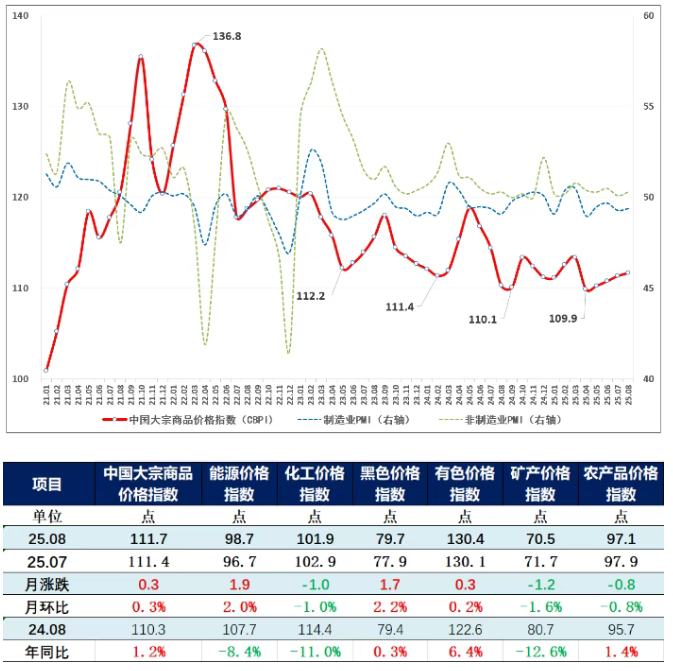
Core Insights - The China Commodity Price Index (CBPI) for August 2025 is reported at 111.7 points, reflecting a month-on-month increase of 0.3% and a year-on-year increase of 1.2% [1][3] - The index has shown a continuous month-on-month recovery for four consecutive months, indicating an expansion in enterprise production and operations due to government policies aimed at boosting domestic demand [1][3] - The upcoming traditional production peak seasons in September and October are expected to sustain the positive development trend in the commodity market, despite ongoing global economic uncertainties [1][3] Price Index Summary - The CBPI for August 2025 is 111.7 points, with a month-on-month increase of 0.3% and a year-on-year increase of 1.2% [3] - The energy price index is at 98.7 points, up 2.0% month-on-month but down 8.4% year-on-year [3] - The black metal price index is at 79.7 points, with a month-on-month increase of 2.2% and a year-on-year increase of 0.3% [3] - The non-ferrous metal price index is at 130.4 points, showing a month-on-month increase of 0.2% and a year-on-year increase of 6.4% [3] - The chemical price index is at 101.9 points, down 1.0% month-on-month and down 11.0% year-on-year [3] - The agricultural product price index is at 97.1 points, down 0.8% month-on-month and up 1.4% year-on-year [3] - The mineral price index is at 70.5 points, down 1.6% month-on-month and down 12.6% year-on-year [3] Commodity Price Movements - Among the 50 monitored commodities, 25 saw price increases while 25 experienced declines [5] - The top three commodities with the highest month-on-month price increases are coking coal (20.1%), neodymium oxide (19.1%), and lithium carbonate (16.6%) [5] - The top three commodities with the largest month-on-month price decreases are apples (-4.6%), methanol (-3.6%), and urea (-2.8%) [5] Market Context - The CBPI shows a divergence from the Producer Price Index (PPI) and aligns with the Consumer Price Index (CPI) trends [4] - The S&P 500 index reached a historical peak of 6508.23 points, supported by expectations of interest rate cuts in the U.S. and a weaker dollar, which bolstered confidence in the commodity market [4]
张瑜:从物价到投资,从供给到需求——供给侧改革全复盘及对当下映射
一瑜中的· 2025-09-05 08:16
Core Viewpoint - The article analyzes the supply-side reform period from 2015 to 2018, highlighting the impact on asset performance and PPI, and contrasts it with the current anti-involution policies, providing insights for future investment opportunities and risks [2]. Group 1: Asset Review During Supply-Side Reform - The introduction of supply-side reform in November 2015 marked a bottoming out of coal and steel prices, leading to a relative outperformance against the market [3]. - In the early stages of the policy (end of 2015 to mid-2016), there was significant volatility in related assets due to the clash between "strong expectations" and "weak realities" [3]. - The trend of rising coal and steel prices began around June 2016, following the breakdown of local capacity reduction targets and improvements in economic fundamentals [3][4]. - The sustainability of the market rally was primarily driven by demand, with profitability in the coal and steel sectors improving due to rising prices, which were largely supported by demand [4][31]. Group 2: PPI Review During Supply-Side Reform - From the introduction of supply-side reform to the PPI turning positive, it took 10 months, with coal, steel, and non-metallic building materials contributing 49% to the PPI recovery [5][53]. - The recovery of PPI was also supported by improvements in the global economy, with oil and non-ferrous metals contributing 36% to the PPI rise during the same period [5][53]. - After PPI turned positive, the breadth of price increases across industries significantly improved, with the proportion of industries experiencing price increases remaining high [5][54]. Group 3: Differences Between Current Anti-Involution and Supply-Side Reform - The macroeconomic context and policy objectives differ significantly between the current anti-involution measures and the supply-side reform, with the latter focusing on reducing ineffective supply and expanding effective supply [7]. - The current anti-involution policies are expected to have a more gradual impact on prices compared to the rapid effects seen during the supply-side reform [7]. - The methods of capacity governance differ, with supply-side reform relying more on administrative measures, while anti-involution emphasizes legal and market-based approaches [7]. Group 4: Future Insights on PPI and Anti-Involution Related Assets - PPI is expected to enter a recovery cycle starting in August, but the timing for it to turn positive may be longer than in 2016, likely extending beyond the first quarter of next year [8]. - The performance of anti-involution related assets will depend on overall macro demand improvement, with key indicators such as manufacturing sector ROE, capacity utilization, and actual inventory growth showing no significant improvement yet [10]. - Active equity funds have a relatively low allocation to key anti-involution sectors, indicating that the momentum from fund reallocation may be weaker than during the supply-side reform period [11].