
全国统一大市场

Search documents
国家统计局公布11月运行数据 中国经济保持稳中有进发展态势
Jing Ji Ri Bao· 2025-12-15 22:56
Core Viewpoint - The latest data from the National Bureau of Statistics indicates that proactive macro policies are yielding results, leading to a stable and progressive development of the national economy [1] Economic Performance - In November, the industrial added value of large-scale enterprises increased by 4.8% year-on-year, maintaining the same growth rate as the previous month [2] - The equipment manufacturing industry, driven by industrial upgrades, saw a significant growth of 7.7%, contributing 59.4% to the overall industrial added value growth [2] - The service production index grew by 4.2% year-on-year, with modern service sectors like information technology and business services showing strong development [2] Market Sales - The total retail sales of consumer goods increased by 1.3% year-on-year in November, with a notable rise in the sales of upgraded consumer goods [2] - From January to November, the retail sales of cultural and recreational services, as well as communication and information services, maintained double-digit growth [2] Foreign Trade - In November, China's total goods import and export value increased by 4.1% year-on-year, with exports growing by 5.7% [3] - The trade with countries involved in the Belt and Road Initiative saw a 6% year-on-year increase from January to November, outpacing overall foreign trade growth [3] Employment and Prices - The urban unemployment rate remained stable at 5.1% in November, while the consumer price index (CPI) rose by 0.7% year-on-year, marking a 0.5 percentage point increase from the previous month [3] - The core CPI, excluding food and energy, increased by 1.2% year-on-year, remaining above 1% for three consecutive months [3] Policy Effectiveness - Various policies aimed at expanding domestic demand and promoting industrial upgrades have played a crucial role in stabilizing the economy [4] - The "old for new" consumption policy has effectively boosted sales in home appliances and communication products, with retail sales in these categories growing by 14.8%, 18.2%, and 20.9% respectively from January to November [4] - Equipment investment increased by 12.2% year-on-year from January to November, contributing 1.8 percentage points to overall investment growth [4] Overall Economic Outlook - Despite challenges, China's economic resilience and strong macro policy support provide favorable conditions to achieve annual targets [6] - The implementation of consumption-boosting actions and the expansion of digital and green trade are expected to further enhance market demand [6] - The recent Central Economic Work Conference has outlined the direction for economic stability and growth, emphasizing the need for proactive macro policies [7]
切实增强从容应对风险挑战的底气
Jing Ji Ri Bao· 2025-12-15 22:49
Core Viewpoint - The construction of a unified national market is essential for building a new development pattern, promoting high-quality development, and gaining an advantage in international competition. It is a strategic arrangement made by the central government to enhance resilience against risks and challenges [1][2]. Group 1: Importance of a Unified National Market - The unified national market is a prerequisite for accelerating the new development pattern and promoting high-quality economic development, serving as a strategic support for China's modernization [2][3]. - The transition from a planned economy to a socialist market economy has led to fragmented and disconnected institutional rules, necessitating the establishment of a unified market to address issues like local protectionism and excessive competition [2][3]. Group 2: Key Requirements for Market Construction - The basic requirements for constructing a unified market include the unification of market foundational systems, infrastructure, government behavior standards, market regulation enforcement, and resource markets, along with the continuous expansion of both domestic and foreign openness [4][5]. - The unification of market foundational systems is crucial for efficient market operation, with recent efforts to reduce restrictive items in market access lists and eliminate local regulations that hinder fair competition [4][5]. Group 3: Challenges and Solutions - Current challenges include low-price disorderly competition, irregularities in government procurement, and local investment attraction issues, which require systematic solutions and regulatory frameworks to ensure fair competition [7][8]. - The establishment of a unified regulatory framework is necessary to maintain market order and reduce transaction costs for businesses operating across regions [6][9]. Group 4: Implementation Strategies - The implementation of the "six focuses" strategy aims to address urgent issues in the market, including enhancing product quality, standardizing government procurement, and promoting integrated development of domestic and foreign trade [7][8]. - Achieving the goals of a unified market requires coordination between central directives and local initiatives, ensuring that local governments contribute positively to the national market while respecting unified standards [10][11].
既要“放得活”又要“管得好”——论贯彻落实中央经济工作会议精神
Jing Ji Ri Bao· 2025-12-15 22:38
Group 1 - The core viewpoint emphasizes the need for a balanced relationship between government intervention ("visible hand") and market forces ("invisible hand") to achieve a well-functioning economy [1] - The recent Central Economic Work Conference highlighted the importance of both "letting go" and "managing well" in economic work, aiming for a dynamic yet orderly economic environment [1][2] - The government and market each have unique strengths that are essential for economic and social development, necessitating a collaborative approach to enhance resource allocation efficiency and market order [1][3] Group 2 - A series of regulatory measures have been introduced this year, including the "Opinions on Strictly Regulating Administrative Inspections Related to Enterprises" and guidelines for building a unified national market, aimed at improving the balance between market freedom and government regulation [2] - The focus on "letting go" involves ensuring that market forces are allowed to operate effectively, with an emphasis on establishing a unified market access system and enhancing property rights protection [2] - The government's role includes effective macroeconomic regulation, market supervision, and public service provision, with a need to respect market dynamics while preparing appropriate regulatory measures [3]
全国发展和改革工作会议部署9项重点工作
Jing Ji Ri Bao· 2025-12-15 22:27
从全国发展和改革工作会议上获悉,今年我国经济顶压前行、向新向优发展,实现质的有效提升和量的 合理增长,年度和"十四五"规划目标任务即将顺利完成。 发展改革系统坚决贯彻落实党中央和国务院决策部署,扎实推动各项工作。一是做好经济分析和政策研 究,加强经济形势研判,强化逆周期调节,推动出台稳就业稳经济政策举措,持续优化宏观政策取向一 致性评估。二是做好中长期规划和年度计划,做好"十五五"规划《纲要》起草,推进重点领域规划编制 实施,加强对地方规划编制的指导,高质量编制实施年度计划。三是做好投资管理和项目建设,统筹用 好中央预算内投资等各方面资金,扎实推进"两重"建设,加力支持"两新"工作,设立投放新型政策性金 融工具,进一步促进民间投资发展。四是做好改革和创新,纵深推进全国统一大市场建设,深入开展市 场准入壁垒清理整治行动和招标投标领域突出问题系统整治,加力化解重点产业结构性矛盾,颁布实施 民营经济促进法,加快推进关键核心技术攻关,深入实施"人工智能+"行动,持续提升利用外资和境外 投资质量,高质量推进共建"一带一路"。五是做好综合统筹和综合平衡,统筹推动区域战略深化实施和 区域联动融合发展,支持经济大省挑大梁,有 ...
建筑材料行业周报:中央经济会议定调积极,继续关注地产链底部反弹机会-20251215
East Money Securities· 2025-12-15 14:10
Investment Rating - The report maintains an "Outperform" rating for the construction materials sector, indicating a positive outlook compared to the broader market [3][54]. Core Insights - The central economic meeting has set a positive tone, emphasizing the need to focus on the real estate chain's bottom rebound opportunities. The macroeconomic stance remains growth-oriented, with policies expected to be flexible and proactive, benefiting real estate and infrastructure demand [20][11]. - The construction materials sector has experienced a decline of 2.01% last week, underperforming the CSI 300 index by 1.9 percentage points. Year-to-date, the sector has risen by 11.5%, lagging behind the CSI 300 index by approximately 5.0 percentage points [11][10]. - Cement prices have shown a month-on-month increase, while the shipment rate has decreased. As of December 12, the national cement shipment rate was 44%, with a price of 360 RMB per ton, reflecting a slight increase [17][24]. - The report highlights three main investment themes: 1. Expanding into emerging industries such as AI and robotics, recommending companies like Zhizhi New Materials and Quartz Shares [20]. 2. Long-term value recovery in consumer building materials, with recommendations for companies like Sankeshu and Dongfang Yuhong [20]. 3. Capitalizing on potential price elasticity due to supply-demand mismatches in bulk building materials, particularly for high-dividend stocks and companies actively expanding overseas, recommending firms like Huaxin Cement and Conch Cement [20]. Summary by Sections Weekly Perspective - The report discusses the positive tone set by the central economic meeting and the focus on real estate chain recovery opportunities [20][11]. - It notes a decline in the construction materials sector's performance relative to the CSI 300 index, with specific declines in sub-sectors such as cement and decoration materials [11][10]. High-Frequency Data - Cement prices have increased month-on-month, while shipment rates have decreased. The average price for cement is reported at 360 RMB per ton, with a shipment rate of 44% [17][24]. - The report indicates that the price of float glass has also risen, with an average price of 1,165 RMB per ton and a decrease in inventory levels [30][31]. - The price of fiberglass remains stable, with the average price for non-alkali fiberglass yarn at 3,475 RMB per ton [34]. Cost Side - The report highlights that most raw material prices are at low levels, which is expected to positively impact corporate profitability. Key raw materials such as coal and soda ash have seen significant price declines [48][50].
克而瑞地产研究:房价环比止跌城市增多 供求结构指标持续优化
智通财经网· 2025-12-15 11:57
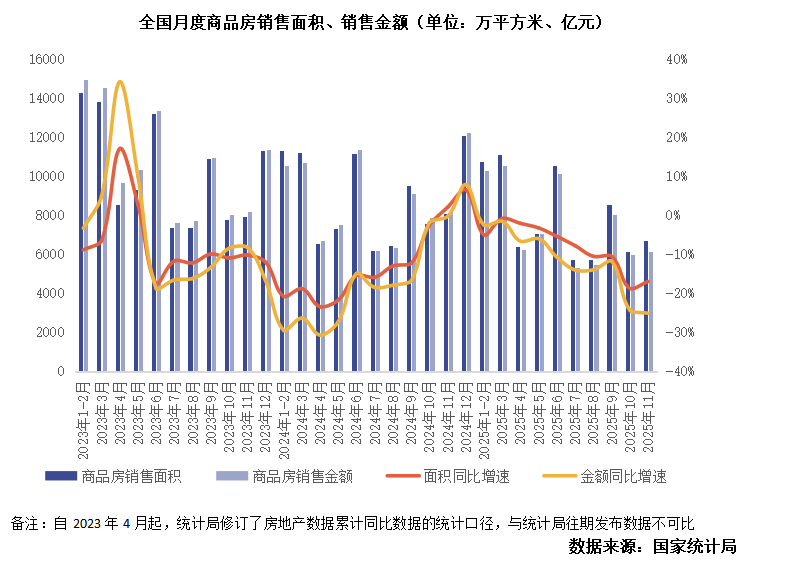
Group 1 - The core viewpoint of the articles indicates that the real estate market is undergoing a critical phase of inventory digestion, price confidence rebuilding, and demand transformation, with a shift from urbanization-driven growth to housing renewal and quality upgrades as the main demand drivers [21][22] - In November, the new housing price index decreased by 2.8% year-on-year, with the decline expanding by 0.2 percentage points compared to the previous month, while the number of cities where prices stabilized increased significantly to 11, up by 5 from the previous month [1][9] - The overall sales area of new homes in the first eleven months fell by 7.8% year-on-year, with the decline in November showing a slight narrowing to 17%, indicating a potential stabilization in the market [5][23] Group 2 - The industrial production showed stable growth, with the added value of the equipment manufacturing and high-tech manufacturing sectors growing by 7.7% and 8.4% year-on-year, respectively, outpacing the overall industrial growth [2] - The total retail sales of consumer goods reached 43.898 billion yuan in November, growing by 1.3% year-on-year, although the growth rate slowed by 1.6 percentage points compared to the previous month [2] - The fixed asset investment in the first eleven months decreased by 15.9% year-on-year, with a notable decline in November, reflecting a trend of aligning investment with sales in the real estate sector [16] Group 3 - The new housing construction area in the first eleven months was 5.3 million square meters, down 20.5% year-on-year, indicating a significant reduction in new projects, which helps alleviate inventory pressure [13] - The completion area of housing reached 3.9 million square meters in the first eleven months, down 18% year-on-year, but showing signs of cyclical recovery in November, reflecting ongoing efforts to ensure housing delivery [15] - The investment-sales gap is narrowing, with real estate development investment in the first eleven months exceeding new housing sales by 4.6%, indicating a shift towards a more rational development model [16][21]

今年前11月广州港外贸吞吐量实现双位数增长
Zhong Guo Xin Wen Wang· 2025-12-15 11:18
Group 1 - The core viewpoint of the articles highlights the significant growth in Guangzhou Port's foreign trade cargo throughput and container throughput, indicating a successful transition towards becoming a dual circulation hub [1][2] - From January to November, Guangzhou Port's foreign trade cargo throughput reached 179 million tons, a year-on-year increase of 10.72%, while foreign trade container throughput was 13.04 million TEUs, up 19.23% [1] - The port is expected to complete an annual cargo throughput of 695 million tons and container throughput of 27.5 million TEUs [1] Group 2 - The foreign trade container throughput has surpassed domestic trade, exceeding 50%, marking a shift from being the largest domestic trade port to a dual circulation hub [1] - Guangzhou Port has established 182 foreign trade shipping routes connecting over 400 global ports, including 152 routes under the Belt and Road Initiative and 98 routes to RCEP countries [1] - The multi-modal transport system supports domestic circulation, with an expected annual sea-rail intermodal volume of over 700,000 TEUs, reflecting a 15.7% year-on-year growth [1] Group 3 - Major projects such as the 200,000-ton channel project and the Nansha Port area developments are progressing ahead of schedule [2] - Future development of Guangzhou Port will focus on six key areas: enhancing hub functions, improving service levels, expanding the port economy, promoting smart transformation, increasing organizational capacity, and deepening open cooperation [2]

【图解】稳中有进!一图速览前11月主要经济指标数据→
Zhong Guo Jing Ji Wang· 2025-12-15 09:50
Economic Overview - The national economy shows a stable and progressive development trend, with macro policies being actively implemented to promote high-quality growth and a unified national market [3][4]. Key Economic Indicators - Grain production reached 14,298 billion jin, an increase of 167.5 billion jin or 1.2% year-on-year, maintaining above 14 trillion jin [4]. - The industrial added value for large-scale industries grew by 6.0% year-on-year from January to November [4]. - The service sector production index increased by 5.6% year-on-year during the same period [4]. Consumer and Investment Trends - The total retail sales of consumer goods amounted to 456,067 billion yuan, reflecting a year-on-year growth of 4.0% [5]. - Fixed asset investment (excluding rural households) totaled 444,035 billion yuan, showing a year-on-year decline of 2.6%. However, excluding real estate development investment, fixed asset investment grew by 0.8% [5]. Trade Performance - The total value of goods import and export reached 412,076 billion yuan, with a year-on-year increase of 3.6%. Exports were 244,579 billion yuan, up by 6.2%, while imports were 167,498 billion yuan, increasing by 0.2% [6]. Employment and Price Stability - The average urban survey unemployment rate was 5.2% from January to November [6].

11月份国民经济保持稳中有进发展态势实现全年预期目标有较好条件
Zhong Yang Ji Wei Guo Jia Jian Wei Wang Zhan· 2025-12-15 09:30
Core Insights - The macroeconomic policies in place are showing positive effects, with a focus on strengthening domestic circulation and expanding the national unified market [1][2] - The national economy is maintaining a steady growth trend, with industrial production and service sectors showing stable growth [1][2] Economic Performance - In November, the industrial added value for large-scale enterprises increased by 4.8% year-on-year and 0.44% month-on-month [1] - The service sector production index grew by 4.2% year-on-year [1] - The total retail sales of consumer goods reached 43,898 billion yuan, reflecting a year-on-year growth of 1.3% [1] - The total goods import and export volume was 38,987 billion yuan, with a year-on-year increase of 4.1% [1] - The urban surveyed unemployment rate remained stable at 5.1% [1] Sectoral Developments - From January to November, the added value of high-tech manufacturing increased by 9.2% year-on-year, while smart consumer equipment manufacturing grew by 7.6% [2] - The added value of digital product manufacturing rose by 9.3%, and the production index for information transmission, software, and IT services increased by 11.3% [2] - Renewable energy sectors, including hydropower, nuclear power, wind, and solar energy, saw an 8.8% year-on-year increase in production [2] - The coal and chemical industries experienced year-on-year growth in added value of 6.3% and 7.8%, respectively, due to upgrades and improvements in production capacity and technology [2] Challenges and Outlook - Despite the steady growth, external environmental changes are intensifying, leading to a mismatch between strong supply and weak demand in some sectors [2] - The economy's resilience, strong foundation, and potential for long-term growth remain intact, supported by innovation and deepening reforms [2] - The macroeconomic policies are expected to provide strong support for achieving annual economic targets despite existing challenges [2]
11月份国民经济运行数据出炉
Chang Jiang Shang Bao· 2025-12-15 09:03
Economic Overview - In November, the national economy continued to operate smoothly, with a focus on high-quality development and stable production supply [1][3] - The total grain output for the year reached 14.298 trillion jin, an increase of 167.5 billion jin or 1.2% year-on-year [1] Industrial Performance - The industrial production showed stable growth, with the industrial added value of large-scale enterprises increasing by 4.8% year-on-year in November and 6.0% from January to November [1] - The profit of large-scale industrial enterprises totaled 59,503 billion yuan from January to October, reflecting a year-on-year increase of 1.9% [1] Service Sector - The service sector maintained steady growth, with the service production index rising by 4.2% year-on-year in November and 5.6% from January to November [1] - The revenue of large-scale service enterprises increased by 7.6% year-on-year from January to October [1] Consumer Market - The total retail sales of consumer goods reached 43,898 billion yuan in November, showing a year-on-year growth of 1.3% [2] - Rural retail sales grew by 2.8%, while urban retail sales increased by 1.0% [2] Investment Trends - Fixed asset investment (excluding rural households) decreased by 2.6% year-on-year from January to November, while manufacturing investment grew by 1.9% [2] - Real estate development investment saw a significant decline of 15.9% [2] Trade Performance - The total import and export value in November was 38,987 billion yuan, with a year-on-year growth of 4.1% [2] - Exports increased by 5.7% to 23,456 billion yuan, while imports rose by 1.7% to 15,531 billion yuan [2] Employment and Prices - The urban survey unemployment rate remained stable at 5.1% in November [3] - The Consumer Price Index (CPI) rose by 0.7% year-on-year, with an increase of 0.5 percentage points compared to the previous month [3]