算力

Search documents
马斯克买了新厂房上GPU,2GW供电规模,“巨硬”更更硬了
Sou Hu Cai Jing· 2025-12-31 07:15
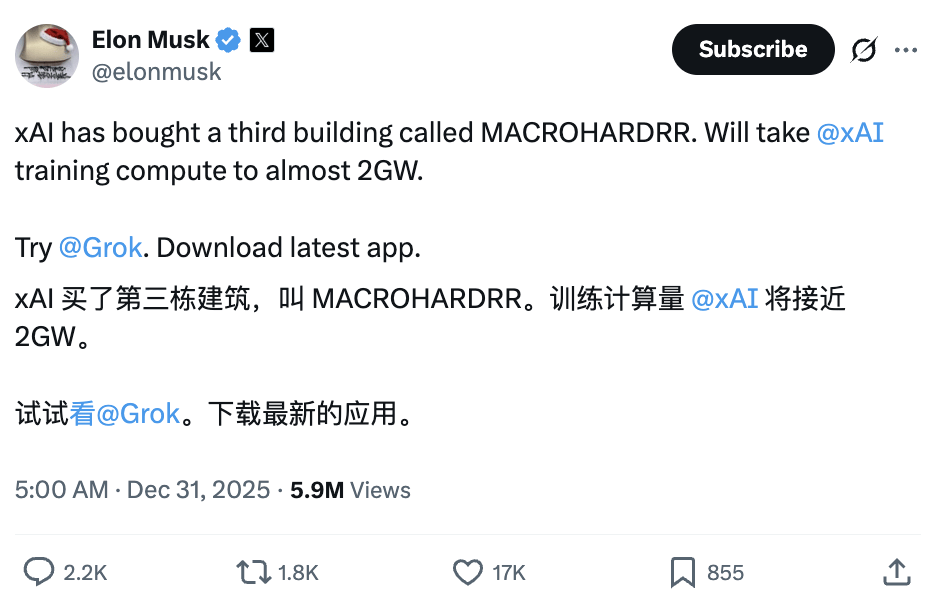
Core Insights - Elon Musk's "Macrohard" project has acquired a third dedicated facility named MACROHARDRR, which will have a power supply capacity of 2GW [1][9] Group 1: Project Overview - The 2GW power capacity is sufficient to meet the electricity needs of approximately 750,000 American households [2] - The facility is expected to support around 1.1 million NVIDIA GB200 NVL72 GPUs based on previous power density and efficiency metrics [2] - The first facility, Colossus I, was built in just 122 days and is currently the largest and most stable single computing cluster globally, equipped with around 200,000 NVIDIA H100/H200 and 30,000 NVIDIA GB200 NVL72 GPUs [2] Group 2: Expansion Plans - Colossus II, the second facility, began construction on March 7, 2025, and has a total area of 1 million square feet, with a cooling capacity of 200MW to support 110,000 GB200 NVL72 GPUs [4][5] - The ultimate goal for Colossus II is to deploy over 550,000 GPUs, with peak power demand expected to exceed 1.1GW [5] Group 3: Infrastructure and Community Impact - The MACROHARDRR facility is located near Colossus II, and construction has included a new road connecting the two sites [9] - The project has faced community complaints regarding air pollution from gas turbines and noise from construction, leading to the installation of a wall to mitigate noise [10] - To avoid impacting the local power grid, 168 Tesla Megapack battery storage systems have been deployed at Colossus II to provide power during peak demand [11] Group 4: Financial Aspects - xAI is reportedly planning to raise $15 billion at a valuation of $230 billion to support the extensive capital requirements for the construction and expansion of these computing facilities [11]

马斯克买了新厂房上GPU,2GW供电规模,“巨硬”更更硬了
量子位· 2025-12-31 05:28
Core Viewpoint - Elon Musk's xAI is expanding its computing power through the "Macrohard" project, with the acquisition of a third facility named MACROHARD RR, which will have a power supply capacity of 2GW [1][2]. Group 1: Facility Expansion - The new facility MACROHARD RR is located near the existing Colossus II site, which is part of the Macrohard project [15][16]. - Colossus I, the first facility, was built in just 122 days and is currently the largest and most stable computing cluster globally, equipped with approximately 200,000 NVIDIA H100/H200 and 30,000 NVIDIA GB200 NVL72 GPUs [6][7]. - Colossus II is set to deploy 110,000 NVIDIA GB200 GPUs in its first phase, with a final goal of over 550,000 GPUs and a peak power demand exceeding 1.1GW [11]. Group 2: Power Supply and Infrastructure - The 2GW power capacity of the new facility can support around 1.1 million NVIDIA GB200 NVL72 GPUs, based on previous power density and efficiency metrics [2][4]. - xAI has partnered with Solaris Energy Infrastructure to build a permanent gas turbine power plant in Mississippi, which is expected to provide over 1GW of power by early 2027 [18][20]. - To mitigate noise complaints from nearby residents, xAI has constructed a wall between the power plant site and residential areas and deployed 168 Tesla Megapack battery storage systems to support local power needs during peak usage [20]. Group 3: Financial Aspects - xAI is reportedly planning to raise $15 billion at a valuation of $230 billion to support its expansion efforts [22]. - Musk has denied reports regarding the fundraising but has not provided further clarification [23].

领益智造(002600):拟收购立敏达,跻身英伟达液冷核心供应商
Shenwan Hongyuan Securities· 2025-12-31 03:45
Investment Rating - The report upgrades the investment rating to "Buy" for the company [6][14]. Core Insights - The company plans to acquire a 35% stake in Limin Da for 875 million yuan, gaining control over 52.78% of the voting rights, which will be consolidated into the company's financial statements [4][6]. - Limin Da specializes in thermal management solutions and has been a key player in the industry for over 30 years, focusing on liquid cooling and air cooling technologies [6][7]. - The financial forecast for the company shows a significant increase in revenue and net profit, with a projected compound annual growth rate (CAGR) of 44% for net profit from 2025 to 2027 [14][15]. Financial Data and Profit Forecast - Total revenue is expected to reach 53,933 million yuan in 2025, with a year-on-year growth rate of 22% [5]. - The net profit for 2025 is projected at 2,453 million yuan, reflecting a 39.9% increase compared to the previous year [5]. - The earnings per share (EPS) is forecasted to be 0.34 yuan in 2025, increasing to 0.70 yuan by 2027 [5][15]. - The company's return on equity (ROE) is expected to rise from 11.2% in 2025 to 16.7% in 2027 [5]. Market Position and Client Base - Limin Da's client base includes major industry players such as NVIDIA, Intel, and Foxconn, positioning the company within the core of the global computing power supply chain [10][14]. - The company is recognized as a supplier for NVIDIA's cooling solutions, enhancing its market credibility and potential for growth [6][9].

债券ETF发行规模暴涨,科创债ETF一年发行超665亿份,机构投资人成购买主力
Hua Xia Shi Bao· 2025-12-31 03:36
Core Insights - The bond market is experiencing a new wave of issuance, with credit bond ETFs seeing significant growth, reaching over 590 billion yuan by December 2025, primarily driven by the contribution of technology innovation bond ETFs [2][3] - The ETF market has seen a record issuance of 351 products in 2025, with a total issuance volume of 2,554.55 million units, surpassing the total issuance of the previous two years [2][3] Group 1: ETF Market Growth - The ETF market is benefiting from policy support, expedited approval processes, and the popularity of index-based investment strategies, leading to a dual increase in issuance scale and product quantity in 2025 [3] - The bond ETF segment has shown remarkable performance, with 32 new bond ETFs launched in 2025, achieving an issuance volume of 914.83 million units, exceeding historical totals [4][5] - The total scale of bond ETFs has grown sevenfold in less than two years, with significant milestones reached throughout 2025, including crossing the 7,000 billion yuan mark by October [5] Group 2: Credit Bond ETFs - The number of credit bond ETFs has expanded from 3 to 35 in 2025, with the scale increasing from approximately 54 billion yuan at the end of the previous year to over 10 times that amount [6] - The recent surge in credit bond ETFs has been marked by a significant inflow of funds, with over 900 billion yuan added in December alone, indicating strong market interest [7] - The trading activity of technology innovation bond ETFs has been particularly high, with average turnover rates exceeding 60% in December [7] Group 3: Investor Demand and Trends - Institutional investors, particularly pension and wealth management institutions, are major buyers of technology innovation bond ETFs, reflecting a strong demand for these products [8] - The issuance of ETFs with "technology" in their names has been notable, with 47 such products launched in 2025, accounting for 13.39% of total issuance [8] - The market is expected to see continued expansion of technology innovation bond ETFs, driven by favorable policies and the growing importance of sectors like AI and semiconductors [8][11]

【国信电子胡剑团队|2026年年度策略】从星星之火到全面燎原的本土硬科技收获之年
剑道电子· 2025-12-31 02:45
Core Viewpoint - The article emphasizes that 2026 is expected to be a year of significant harvest for domestic hard technology in the electronics industry, driven by advancements in AI and a consensus on performance trends within the AI industry chain [3][7]. Group 1: AI Industry Trends - The AI industry is transitioning from divergence to consensus in performance trends, with a notable recovery since the second half of 2023, marked by the return of Huawei's Mate series [3][7]. - The electronics sector has experienced a significant valuation expansion, aided by the rapid growth of passive funds and the resonance of macro policy, inventory cycles, and AI innovation cycles [3][7]. - As of December 16, 2025, the electronics sector has risen by 40.22%, ranking third among all industries [7][16]. Group 2: AI Model Evolution - The evolution of AI models is characterized by innovations in architecture, such as the mixture of experts (MoE) framework, which enhances efficiency by reducing computational load [27]. - The emergence of large models, like OpenAI's GPT-4, showcases the correlation between model size and performance, leading to significant advancements in understanding and reasoning capabilities [27]. - The demand for improved model efficiency has led to innovations in attention mechanisms, which lower computational complexity and memory requirements [27][28]. Group 3: Computing Power and Storage - The domestic chip industry is actively updating and iterating, with companies like Huawei planning to launch new chips in 2026, while the storage sector is expected to face shortages and price increases throughout the year [9]. - The demand for AI-driven storage solutions is projected to increase, with DRAM bit demand expected to rise by 26% year-on-year in 2026, driven by AI applications [9]. Group 4: Power and Connectivity - The optimization of data transfer and communication within servers is becoming a critical breakthrough for enhancing computing power, with the global high-speed interconnect chip market expected to reach $21.2 billion by 2030 [11]. - The increasing power consumption of data center chips necessitates advancements in power supply architectures, with a shift towards high-density power solutions [11]. Group 5: Semiconductor Industry - The semiconductor sector is anticipated to benefit from a recovery in demand, with a focus on domestic manufacturing and the rise of analog chips, which are expected to see increased adoption due to their potential for localization [12]. - The global semiconductor market is projected to achieve double-digit growth for three consecutive years from 2024 to 2026, driven by advancements in AI and domestic chip design [12][14].






为什么是这10个词,定义了2025年AI叙事
Tai Mei Ti A P P· 2025-12-31 00:05
Core Insights - The article highlights the significant evolution of AI in 2025, transitioning from simple chat interfaces to advanced reasoning agents capable of complex tasks, marking a shift towards a competitive landscape focused on computational power and efficiency [2]. Group 1: AI Developments - AI has transformed into agents that drive embodied intelligence across various industries, showcasing enhanced multimodal capabilities and reasoning skills akin to human logic [2]. - The year 2025 saw the emergence of key AI terms that influenced decision-making, with a focus on the competitive landscape of AI infrastructure, particularly centered around GPUs [2]. Group 2: Key AI Terms - **GPU**: In 2025, GPUs became a critical indicator of technological prowess, with NVIDIA's Blackwell architecture GPUs dominating high-end shipments, accounting for over 80% of their output [2]. - **Multimodal**: The release of models like Sora 2.0 and Veo 3 marked the transition of multimodal AI from demo stages to practical applications, enabling high-quality video generation and real-time analysis through AI-integrated devices [4]. - **ChatGPT**: As a leading AI application, ChatGPT maintained its position with over 800 million weekly active users and 20 million paid users, evolving into a comprehensive interactive platform [5]. - **NVIDIA**: NVIDIA solidified its status as a cornerstone of the AI economy, achieving a market valuation exceeding $5 trillion, driven by the successful production of Blackwell architecture chips [6]. - **Reasoning**: The concept of reasoning evolved, with AI models demonstrating advanced capabilities in logical reasoning and self-correction, significantly impacting commercial viability [7]. - **OpenAI**: Despite market challenges, OpenAI continued to lead in technology, achieving a valuation of $500 billion following significant investments [8]. - **DeepSeek**: DeepSeek emerged as a major player, achieving competitive performance with a training cost under $300,000, recognized for its innovative architecture [9]. - **Computational Power**: Computational power became a strategic asset in the AI era, with NVIDIA and AMD enhancing their market positions, while domestic players began commercializing their capabilities [10]. - **Robots**: The rise of embodied intelligence positioned robots at the forefront, with advancements in humanoid robots and autonomous systems gaining public attention [11]. - **Agents**: 2025 was dubbed the "Year of the Agent," with AI systems centered around agents proving to unlock significant productivity potential, as evidenced by the success of startups like Manus [12].

美利信持续发力夯实液冷业务 构筑中长期成长主线
Zheng Quan Ri Bao Wang· 2025-12-30 11:25
Core Viewpoint - The company, Meilixin Technology, has established a joint venture with Taiwan's Juyuan Innovation to enhance its liquid cooling business, while also engaging in discussions with Intel for advanced cooling solutions in high-performance computing [1][2]. Group 1: Liquid Cooling Business Development - Meilixin has formed a joint venture named Xinchang Zhileng (Anhui) Precision Technology Co., Ltd. with Juyuan Innovation, completing the registration on December 29 [1]. - The company has received a sample order for AMD's next-generation high-performance CPU water cooling board and aims for mass production by Q1 2026 [2]. - Intel's delegation visited Meilixin to discuss advanced cooling technologies, with plans to develop solutions for high-power AI servers [2]. Group 2: Market Potential and Strategic Positioning - Meilixin's liquid cooling products are expected to expand from communication base stations to computing and energy storage applications, with a focus on extreme cooling scenarios [3]. - The company is positioned to leverage synergies between its communication and liquid cooling sectors, targeting high-power base station cooling solutions [4]. - The domestic telecom operators are projected to invest nearly 20 billion in 5G-A plans by 2025, providing significant growth opportunities for Meilixin's communication and liquid cooling segments [4]. Group 3: Diverse Business Segments - Meilixin's operations span four main sectors: communication, automotive, semiconductor, and liquid cooling, with a concentrated push expected in 2026 [4]. - In the automotive sector, Meilixin has established a decade-long partnership with Tesla and is also supplying components to other major North American manufacturers [5]. - The semiconductor business has seen Meilixin stabilize its position within the supply chains of leading industry players, enhancing its capabilities from individual components to system-level modules [4].
大利好,02469,直线拉升!“寒王”重回A股第一,国产算力持续高景气
Zheng Quan Shi Bao· 2025-12-30 10:38
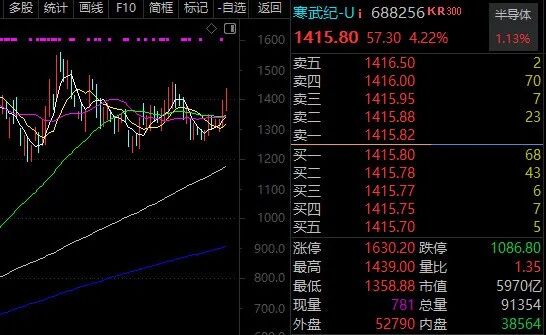
Group 1 - The core viewpoint of the news is the positive impact of government policies on the AI education sector, which has led to stock price increases for related companies like Fenbi (02469.HK) and Dou Shen Education [2][3] - The Ministry of Education plans to further promote AI in education, with policies expected to be released next year, aiming to enhance the educational system and cultivate high-quality talent for the intelligent era [2] - The implementation of the National Education Digital Strategy 2.0 has already shown progress in integrating AI across various educational applications [2] Group 2 - Companies like Century Tianhong are establishing AI+Education as a second growth curve, launching products such as Xiao Hong Assistant and automated grading tools, which have begun commercial trials with positive initial results [3] - The stock market has seen significant movements in the technology sector, particularly in robotics and computing power, with notable gains in companies like Tianming Technology and Hanwang Technology [4] - The stock price of Cambrian (寒武纪-U) has surged over 4%, reaching 1415.8 yuan, reclaiming its position as the top stock in A-shares, driven by strong market sentiment and strategic developments in the semiconductor industry [4][6] Group 3 - The "14th Five-Year Plan" emphasizes support for strategic emerging industries, including quantum technology and AI, which is expected to bolster the computing power sector [6] - Recent disclosures from companies like Chip Origin indicate a significant increase in new orders, with a 129.94% year-over-year growth, highlighting the robust demand in the computing power market [6] - Analysts predict that 23 stocks in the domestic computing power sector will see net profit growth exceeding 20% in 2026 and 2027, with some companies like Cambrian and Chip Origin expected to exceed 30% growth [6][7]

扎克伯格的2025"扫货清单":五笔收购,千亿豪赌AI未来
3 6 Ke· 2025-12-30 10:32
Core Insights - Meta has acquired the AI startup Manus for several billion dollars, marking its fifth AI acquisition of the year and ranking among its top three acquisitions in history [1][6] - The acquisition reflects Meta's commitment to AI as a top strategic priority, with plans to integrate Manus's technology into its platforms [18][19] Company Overview - Manus, founded by Xiao Hong, is not an ordinary AI startup; it has developed productivity tools that have served over 2 million enterprise users [2][4] - The company launched its AI assistant, Monica, which has gained over 10 million users by 2024 [4] Financial Performance - Manus reported an annual revenue of $125 million and has processed 147 trillion tokens since its launch [5] - The company was valued at approximately $500 million after a $75 million funding round led by Benchmark just eight months prior to the acquisition [6] Strategic Significance - Meta plans to continue operating Manus while integrating its technology into Meta AI, potentially reaching billions of users across its platforms [6][19] - The acquisition is part of a broader strategy where Meta has made significant investments in AI, including the purchase of Scale AI for $14 billion and Rivos for enhancing its chip design capabilities [10][11] Industry Context - The AI acquisition trend is not limited to Meta; other tech giants like NVIDIA, OpenAI, Intel, Apple, and Amazon are also aggressively acquiring AI talent and technology [1][20] - The competition for AI talent is intensifying, with companies recognizing that top talent is a critical asset in the AI landscape [24] Future Outlook - Meta's capital expenditure for 2025 is projected to be between $66 billion and $72 billion, with a significant portion allocated to building data centers for AI workloads [19] - The goal is to make Meta AI the most widely used AI assistant by the end of 2025, serving over 1 billion users [19]


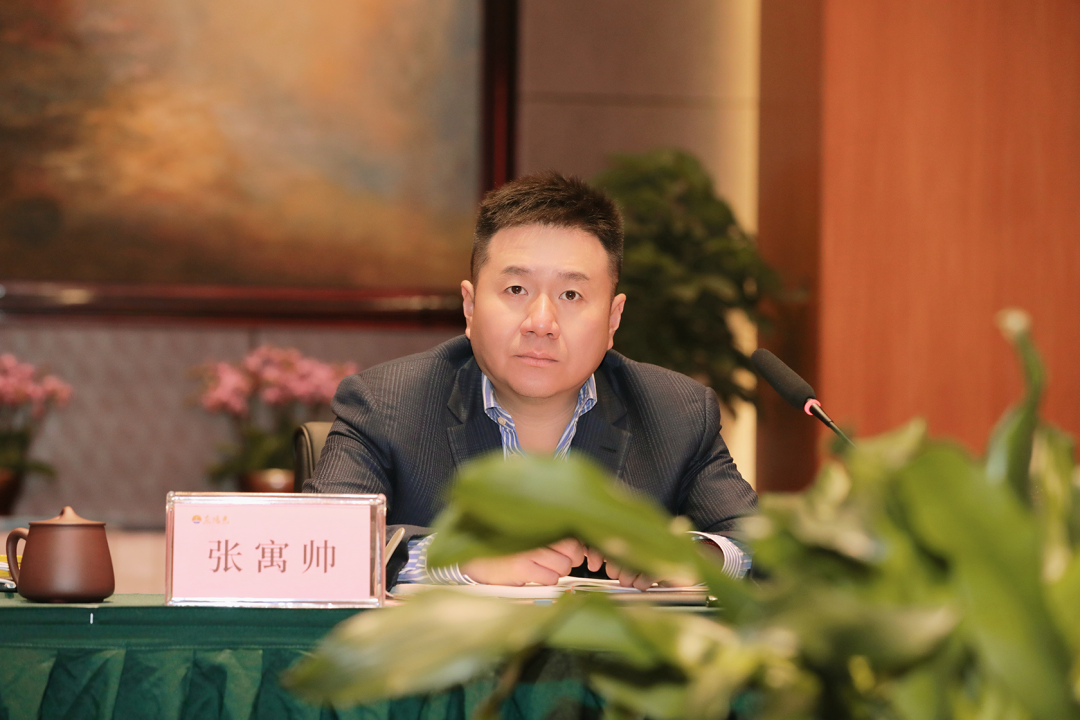
62岁广东富豪转让全部股权,80后儿子接掌双上市公司,集团业务覆盖电子、医疗、算力
Mei Ri Jing Ji Xin Wen· 2025-12-30 08:16
Core Viewpoint - Dongyangguang's actual controller Guo Meilan has transferred her stakes in Luyuan Yunen Electronics (71.75%) and Luyuan Xinjing Technology (74.63%) to Zhang Yushua, enabling him to indirectly hold 100% of Dongyangguang Group and 38.70% of the listed company Dongyangguang [1][4] Group 1: Share Transfer and Ownership Structure - Guo Meilan, aged 62, has transferred her entire stakes in two companies to her son Zhang Yushua, who was born in 1987 [1] - After the transfer, Guo Meilan no longer holds any shares in the two companies and thus does not indirectly hold shares in Dongyangguang [1] - Zhang Yushua now indirectly holds 11.65 billion shares of Dongyangguang, representing 38.70% of the total share capital [1] Group 2: Company Performance and Business Expansion - Dongyangguang Group achieved a record total output of over 51 billion yuan in 2023, with total assets exceeding 80 billion yuan and cumulative taxes paid over 20 billion yuan [4] - The group has expanded its business from electronic materials to biomedicine and health, and is actively acquiring in the computing power sector [4][11] - Dongyangguang's stock market value is approximately 26 billion yuan, with the group directly holding 6.2 billion shares and indirectly holding 5.45 billion shares of the listed company [4] Group 3: Financial Performance - In the first half of the year, Dongyangguang reported a revenue of 1.938 billion yuan, a year-on-year decline of 23.95%, and a net profit of 46.37 million yuan, turning from profit to loss [8] - For the first three quarters, Dongyangguang achieved a revenue of 10.97 billion yuan, with a year-on-year increase of 109.7%, and a net profit of 906 million yuan, up 189.8% [8][10] - The company plans to acquire Qinhuai Data for 28 billion yuan to create a closed-loop business model in the computing power sector [11]