成本控制

Search documents
DorianG (LPG) Q1 Revenue Drops 26%
The Motley Fool· 2025-08-02 01:52
Core Viewpoint - DorianG reported significant underperformance in Q1 FY2026, with adjusted EPS of $0.27, missing the analyst target of $0.74, and GAAP revenue of $84.2 million, down $30.1 million year-over-year, reflecting pressures from lower shipping rates, reduced vessel availability, and increased operating expenses [1][2]. Financial Performance - Adjusted EPS for Q1 FY26 was $0.27, a decline of 78.6% from $1.26 in Q1 FY25 [2] - GAAP revenue was $84.2 million, down 26.4% from the previous year [2] - Adjusted EBITDA decreased by 50.6% to $38.6 million [2] - Time Charter Equivalent (TCE) rate fell to $39,726 per day, down 20.9% from $50,243 in Q1 FY25 [2] - Available vessel days decreased by 7.7%, from 2,260 in Q1 FY25 to 2,086 in Q1 FY26 [5] Operational Challenges - Revenue decline attributed to lower TCE rates and fewer available vessel days due to a heavy drydocking schedule [5] - General and administrative expenses surged by 62.2% year-over-year, primarily due to increased employee bonuses [6] - Vessel operating expenses rose by 7.0% to $21.9 million, driven by costs associated with drydocking and maintenance [6] Market Conditions - The Baltic Exchange LPG Index averaged $63.50 per metric ton in Q1 FY26, down from $72.67 in Q1 FY25, indicating lower freight rates [7] - Freight rate volatility and rerouted LPG trade flows due to U.S.-China tariffs and Middle East conflicts contributed to uncertainty in the market [7] Strategic Focus - DorianG operates a fleet of 26 modern Very Large Gas Carriers, focusing on fleet management, environmental compliance, and strategic partnerships [3] - The company is committed to maintaining a young, fuel-efficient fleet with emission-reducing technology [4] - The Helios Pool partnership represents approximately 97% of DorianG's revenues for FY2025, central to its business model [9] Future Outlook - Management did not provide formal financial guidance for the next quarter or full year but indicated a positive outlook for bookings early in Q2 FY26 [11] - Investors should monitor the company's ability to manage costs and scheduled drydockings, which will impact vessel availability and day rates [12]


Floor & Decor (FND) Q2 EPS Rises 12%
The Motley Fool· 2025-08-01 23:34
Core Insights - Floor & Decor reported better-than-expected GAAP results with diluted earnings per share of $0.58 and revenue of $1.21 billion, surpassing consensus estimates [1][5] - The company achieved its first positive same-store sales growth since late 2022, indicating a potential stabilization in performance [1][6] - Management maintains a cautious outlook for fiscal 2025, anticipating challenges in consumer demand and housing [1][11] Financial Performance - Revenue increased by 7.1% year-over-year to $1,214.2 million, exceeding analyst expectations [2][5] - Diluted EPS rose by 11.5% from the prior period, reflecting improved profitability [2][5] - Comparable store sales growth was recorded at 0.4%, marking a return to positive territory [2][6] - Operating income grew to $81.9 million, a 14.8% increase, while Adjusted EBITDA rose by 9.7% to $150.2 million [2][6] Strategic Focus - The company operates as a specialty retailer of hard surface flooring, targeting both professional installers and homeowners [3] - Key strategic pillars include a direct sourcing model, warehouse-format store growth, and competitive pricing [4] - The company sources from over 240 vendors across 26 countries, reducing reliance on Chinese suppliers [9] Operational Developments - Floor & Decor opened three new warehouse-format stores, bringing the total to 257, with plans to add 20 new stores in FY2025 [8] - Management emphasized disciplined cost control, with operating expenses growing at a slower rate than sales [7] - Digital sales accounted for approximately 18.3% of net sales in Q1 FY2025, supported by product innovation [10] Future Guidance - Management provided guidance for FY2025, projecting net sales of $4.66–4.75 billion and diluted EPS between $1.75 and $2.00 [11] - The guidance reflects ongoing universal tariffs and anticipates potential volatility in consumer demand [11][12] - Investors are advised to monitor the company's navigation of supply-chain dynamics and pricing power as market conditions evolve [12]


道道全:2025年中报显示盈利能力显著提升,现金流状况值得关注
Zheng Quan Zhi Xing· 2025-08-01 22:11
Core Viewpoint - The company has significantly improved its profitability in the first half of 2025, with substantial increases in revenue and net profit compared to the previous year [1] Financial Performance - Total revenue reached 2.792 billion yuan, a year-on-year increase of 1.16% - Net profit attributable to shareholders was 181 million yuan, up 563.15% year-on-year - Non-recurring net profit was 157 million yuan, an increase of 428.51% year-on-year - In Q2, total revenue was 1.306 billion yuan, a 5.15% increase year-on-year - Q2 net profit attributable to shareholders was 78.23 million yuan, up 267.04% year-on-year - Q2 non-recurring net profit was 57.81 million yuan, an increase of 234.08% year-on-year - Gross margin was 11.65%, up 24.85% year-on-year - Net margin was 6.64%, an increase of 612.48% year-on-year [1] Cost Control - Total operating expenses (selling, administrative, and financial expenses) amounted to 109 million yuan, accounting for 3.9% of revenue, a decrease of 43.32% year-on-year - Financial expenses decreased by 98.28%, primarily due to reduced net interest expenses and exchange losses [2] Cash Flow Situation - Operating cash flow per share was 0.94 yuan, a decrease of 76.48% year-on-year - Net cash flow from operating activities decreased by 76.48%, mainly due to increased payment for goods - Monetary funds were 169 million yuan, down 63.83% year-on-year, primarily due to increased raw material procurement [3] Debt Situation - Interest-bearing liabilities were 1.143 billion yuan, a decrease of 39.12% year-on-year - Interest-bearing asset-liability ratio was 25.72%, indicating a relatively high level of debt risk - Accounts payable increased by 77.64%, mainly due to increased raw material payables [4] Main Business Analysis - Revenue from the main business, packaging oil, was 1.751 billion yuan, accounting for 62.71% of total revenue, with a gross margin of 15.67% - Revenue from meal products was 627 million yuan, accounting for 22.45% of total revenue, with a gross margin of 5.40% - Revenue from bulk oil was 382 million yuan, accounting for 13.67% of total revenue, with a gross margin of only 0.19% - Other business revenue was 32.55 million yuan, accounting for 1.17% of total revenue, with a gross margin of 49.84% [5] Regional Distribution - Revenue was primarily concentrated in the Central China region, amounting to 1.284 billion yuan, accounting for 45.99% of total revenue, with a gross margin of 12.20% - Revenue from East China was 769 million yuan, accounting for 27.55% of total revenue, with a gross margin of 10.66% - Revenue from Southwest China was 428 million yuan, accounting for 15.34% of total revenue, with a gross margin of 10.72% - Revenue from other regions was 311 million yuan, accounting for 11.12% of total revenue, with a gross margin of 13.10% [6] Development Prospects - The company is a key national leading enterprise in agricultural industrialization, with a strong market share and brand influence - New products such as high oleic rapeseed oil, tea oil, and various specialty oils have been launched to enhance competitiveness - The company adheres to a brand-oriented operation philosophy and collaborates with quality media for brand promotion - However, cash flow and debt situations need further improvement to ensure long-term stable development [7]

海康威视上半年营收同比增长1.48%,净利润增长11.71%,现金流大幅改善 | 财报见闻
Hua Er Jie Jian Wen· 2025-08-01 12:50
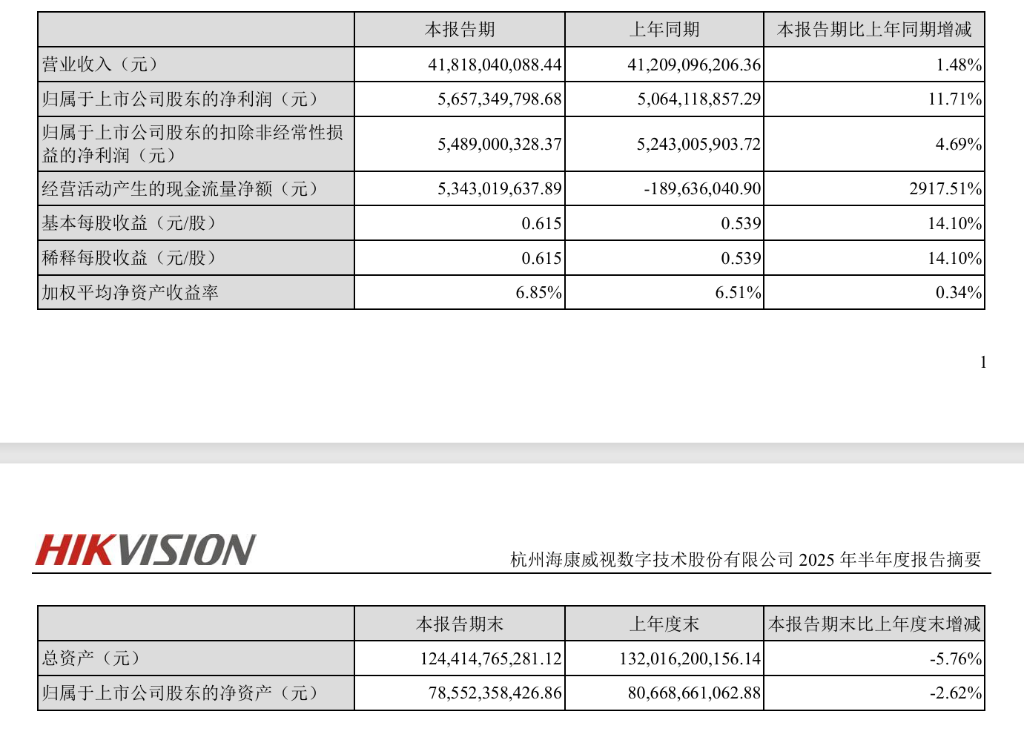
海康威视2025上半年营收增长1.48%,净利润增长11.7%达到56.6亿元,但主要受益于成本控制。经营现金流从去年同期的-1.9亿元大幅改善至53.4 亿元,增长幅度高达2917.5%。 8月1日,海康威视公布2025半年报:2025年上半年营业收入418.18亿元,同比增长1.48%。净利润56.57亿元,同比增长11.71%。经营现金流净额 从去年同期的-1.9亿元大幅改善至53.4亿元,增长2917.5%。每股收益从0.539元提升至0.615元,增长14.1%。净资产收益率从6.51%微升至6.85%, 增幅0.34个百分点。总资产减少5.76%,净资产下降2.62%,反映业务规模调整。 | | 本报告期 | 上年同期 | 本报告期比上年同期增减 | | --- | --- | --- | --- | | 营业收入(元) | 41.818.040.088.44 | 41.209,096,206.36 | 1.48% | | 归属于上市公司股东的净利润(元) | 5,657,349,798.68 | 5,064,118,857.29 | 11.71% | | 归属于上市公司股东的扣除非经常性损 益的 ...

Patrick (PATK) Q2 Revenue Up 3%
The Motley Fool· 2025-08-01 08:55
Core Insights - Patrick Industries reported Q2 2025 GAAP revenue of $1.05 billion, exceeding analyst estimates and reflecting a 3.0% year-over-year increase [1][2] - Adjusted EPS for the quarter was $1.50, surpassing the consensus estimate of $1.40 and slightly up from $1.44 in the previous year [1][2] - Despite revenue and adjusted earnings beats, GAAP net income declined due to a one-time legal settlement, highlighting operational stability amid mixed demand [1][7] Financial Performance - Revenue breakdown: RV segment (46% of total sales) increased 7% to $479 million; marine segment (15% of revenue) fell 1% to $156 million; powersports segment (9% of revenue) dropped 7% to $96 million; housing segment (30% of sales) rose 3% to $315 million [5] - Operating income (GAAP) was $87 million, a 2.7% increase from Q2 2024; adjusted EBITDA rose 3.8% to $135 million with a margin improvement to 12.9% [2][6] - Free cash flow (non-GAAP) for the trailing twelve months declined 24.7% to $262 million, while operating cash flow year-to-date increased to $189 million [10] Business Overview - Patrick Industries manufactures components for RV, marine, powersports, and housing industries, serving OEMs producing motorhomes, boats, and factory-built homes [3] - The company operates 179 manufacturing facilities and 47 distribution centers across North America [3] Strategic Focus - Recent years have seen a focus on strategic acquisitions to expand product lines, particularly in powersports and RV content, while investing in advanced manufacturing and automation [4] - The company is actively investing in its aftermarket e-commerce platform, RecPro, which accounted for about 8% of sales in 2024, with plans to increase its share of total revenue [8][9] Key Developments - A significant one-time legal settlement of $24.4 million pre-tax impacted GAAP net income, which fell 32% year-over-year to $32 million; adjusted net income rose to $51 million [7] - The company repurchased $23 million in stock and paid $13 million in dividends as part of its capital return strategy [10] Outlook - Management did not provide specific revenue or profit targets but indicated expectations for lower wholesale shipments in the second half of 2025 compared to the first half [11] - The company emphasized a focus on cost containment and balance-sheet flexibility, preparing to act quickly if industry conditions improve [11]


PBF Energy (PBF) Q2 Revenue Falls 14%
The Motley Fool· 2025-08-01 01:22
Core Viewpoint - PBF Energy reported a mixed performance in Q2 2025, with non-GAAP earnings per share of $(1.03), surpassing analyst expectations, but both earnings and revenue declined year-over-year, with revenue down 14.4% [1][2] Financial Performance - Non-GAAP EPS was $(1.03), better than the estimate of $(1.26) but a 90.7% decrease from $(0.54) in Q2 2024 [2] - Revenue was $7.48 billion, exceeding estimates by over $500 million, but down from $8.74 billion in Q2 2024 [1][2] - Income from operations was $43 million, a recovery from a loss of $(74.6) million in the previous year [2] - EBITDA decreased by 39.9% year-over-year, reflecting operational challenges [2] - Gross refining margin per barrel was $8.38, a slight increase from $8.12 in Q2 2024 [2] Operational Challenges - The Martinez refinery's partial shutdown significantly impacted production, averaging 845,800 barrels per day, down from 926,700 barrels per day in Q2 2024 [5] - West Coast throughput dropped to 203,500 barrels per day from 296,700 barrels per day year-over-year, with gross margin per barrel turning negative due to outages and compliance costs [5][6] - Operational expenses per barrel increased to $7.96 from $6.94 in Q2 2024, with West Coast expenses particularly high at $15.73 per barrel [6] Market Dynamics - Brent crude oil prices averaged $67.70 per barrel, down from $85.02 in Q2 2024, affecting overall performance [7] - RIN costs rose significantly from $3.38 to $6.14 per barrel-equivalent, inflating compliance costs, especially in California [8] - California is projected to need over 250,000 barrels per day of gasoline imports due to refinery closures, with PBF's refineries expected to be essential suppliers [9] Strategic Initiatives - The company is focusing on operational efficiency, cost containment, and restoring damaged assets, with a target of over $200 million in annualized savings from the RBI initiative [4] - Management expects full operations at the Martinez facility to resume by year-end 2025, contingent on regulatory and supply chain timelines [6][12] Financial Position - Total debt increased to $2.39 billion as of June 30, 2025, from $1.46 billion at the end of 2024, with a total debt to capitalization ratio rising to 31% [11] - The company maintained its quarterly dividend at $0.275 per share despite recent losses [11][14] Future Outlook - For Q3 2025, management forecasts throughput of 865,000–915,000 barrels per day, an increase from Q2 2025 but still below last year's levels [12] - Full-year 2025 capital expenditure guidance remains at $750–775 million, excluding Martinez repairs [12] - Management did not provide formal forward earnings guidance for fiscal 2025, citing ongoing market volatility as a key concern [13]

招金矿业(1818.HK):海域金矿投产有望显著增厚公司业绩
Ge Long Hui· 2025-08-01 00:39
Core Viewpoint - The company is a leading gold ore provider with a comprehensive mining operation, experiencing significant revenue and profit growth due to rising gold prices [1][2] Group 1: Company Overview - The company, established in 1974, is based in Zhaoyuan, Shandong Province, known as "China's Gold Capital" [1] - The main business focus is on gold, with projected revenue of 11.55 billion RMB in 2024, representing a year-on-year increase of 37.1% [1] - The forecasted net profit attributable to shareholders for 2024 is 1.451 billion RMB, showing a substantial growth of 111.3% [1] Group 2: Cost Control and Profitability - The company has demonstrated strong cost control over the years, with gold production costs rising from 135 RMB/g in 2015 to 231 RMB/g in 2024, an annual increase of 5.5% [1] - During the same period, the annualized increase in gold prices exceeded 9%, leading to an improvement in gross profit margin from 44% in 2015 to 59% in 2024 [1] Group 3: Shareholding and Management - Zijin Mining is the second-largest shareholder, having acquired 20% of the company's H-shares for 4.06 billion RMB at the end of 2022 [1] - The management team has been primarily cultivated internally, with the introduction of four Zijin Mining executives to enhance collaborative development [1] Group 4: Future Production and Expansion - The company and Zijin Mining hold 70% and 30% stakes, respectively, in the upcoming Haiyu Gold Mine, expected to produce 15-20 tons of gold annually [2] - The average unit cost of ore processing at the Haiyu Gold Mine is projected to be 340 RMB/ton, with high-grade ore expected to further reduce costs [2] - The company has completed acquisitions of the Abuja Gold Mine and the Komahong Gold Mine, with the Abuja Gold Mine expected to produce over 4 tons of gold annually [2] Group 5: Earnings Forecast - Revenue projections for 2025-2027 are 16.2 billion, 17.7 billion, and 19.4 billion RMB, respectively, with net profits of 3.918 billion, 4.790 billion, and 5.607 billion RMB [2] - The growth rates for net profit are estimated at 170%, 22%, and 17% for the respective years [2] - The company is rated as a "buy" due to the anticipated production and cost advantages from the Haiyu Gold Mine [2]
顺络电子2025年中报:业绩稳健增长,需关注应收账款及债务状况
Zheng Quan Zhi Xing· 2025-07-31 22:13
Overview of Business Performance - The company demonstrated a robust growth trend in the first half of 2025, with total revenue reaching 3.224 billion yuan, a year-on-year increase of 19.8% [1] - The net profit attributable to shareholders was 486 million yuan, up 32.03% year-on-year, while the net profit excluding non-recurring items was 462 million yuan, reflecting a 32.87% increase [1] - In Q2 alone, total revenue was 1.763 billion yuan, representing a 23.12% year-on-year growth, with net profit attributable to shareholders at 253 million yuan, an increase of 27.74% [1] Key Financial Indicators - Gross margin stood at 36.68%, a decrease of 0.76% year-on-year, while net margin increased by 10.98% to 17.34% [4] - Earnings per share rose to 0.62 yuan, a 31.91% increase year-on-year, and net assets per share increased by 4.87% to 7.69 yuan [4] - Operating cash flow per share was 0.99 yuan, up 21.33% year-on-year [4] Cost and Expense Management - The ratio of selling, general, and administrative expenses to revenue was 7.96%, a decrease of 12.86% year-on-year, with total expenses amounting to 257 million yuan [4] - The company maintained good profitability and cost control in the first half of 2025, although accounts receivable and debt levels require further attention [3] Asset and Liability Overview - Cash and cash equivalents amounted to 689 million yuan, a significant increase of 45.86% year-on-year [4] - Accounts receivable reached 2.479 billion yuan, up 16.72% year-on-year, representing 297.94% of the latest annual net profit, indicating a need to monitor collection risks [4] - Interest-bearing debt was 3.86 billion yuan, a 2.41% increase year-on-year, with an interest-bearing asset-liability ratio of 28.9%, necessitating attention to debt repayment capacity [4] Main Business Composition - Revenue from chip electronic components was 3.196 billion yuan, accounting for 99.13% of total revenue, with a gross margin of 36.67% [4] - Domestic sales generated 2.714 billion yuan, representing 84.19% of total revenue, while export sales contributed 510 million yuan, or 15.81%, with a higher gross margin of 40.72% [4]

Ferretti(09638) - 2025 Q2 - Earnings Call Transcript
2025-07-31 13:00
Financial Data and Key Metrics Changes - Revenues increased by 1.5% to €620,000,000 compared to the previous year [5] - Adjusted EBITDA grew by 2.5% to €99,000,000, with an EBITDA margin increase from 15.8% to 16% [5][29] - Net backlog decreased by 3.2% from €786,000,000 to €761,000,000 [5] Business Line Data and Key Metrics Changes - Made to measure segment increased by 8.6%, while superyacht segment grew by 26.5% [28] - Composite yachts above 80 feet accounted for more than half of the orders in Q2 [21] Market Data and Key Metrics Changes - The U.S. market showed a significant increase in negotiations, rising from €270,000,000 to €420,000,000 [34] - The Middle East market is recovering, with negotiations resuming after previous disruptions [68] Company Strategy and Development Direction - The company focuses on high-end markets, specifically above 24 meters, and aims to maintain a strong position despite market pressures [32][33] - A cost containment program has been implemented to enhance competitiveness and support profitability [60][78] Management's Comments on Operating Environment and Future Outlook - The management expressed confidence in achieving the guidance for 2025, despite market uncertainties and pressures from competitors [41] - The upcoming boat shows are expected to provide significant opportunities for sales and brand exposure [6][40] Other Important Information - The company has no debt and maintains over €100,000,000 in cash after paying dividends [42] - The Ravenna Shipyard is expected to be fully operational by October, enhancing production capabilities [40] Q&A Session Summary Question: How do you feel about the news on tariffs in the U.S. market? - Management indicated that tariffs are manageable and do not significantly impact the company, as most products do not have an American flag [47][49] Question: What gives you confidence to reach the 16.5% adjusted EBITDA margin guidance? - Confidence stems from a favorable product mix and a cost containment program that has been implemented [60] Question: Is the increase in order intake driven by a specific region? - The increase is widespread, with notable recovery in the Middle East and the U.S. market returning to normal [68] Question: Can you elaborate on the ongoing cost-cutting initiatives? - The company is reducing fixed costs by adjusting production rates and postponing non-essential expenses, with a goal to cut approximately 5% of fixed costs [78]
华能国际(600011):中期业绩符合预期 Q3旺季延续乐观展望
Xin Lang Cai Jing· 2025-07-31 12:21
Core Viewpoint - The company reported its H1 2025 results, showing a revenue decline but significant profit growth, indicating resilience in profitability despite revenue challenges [1][2]. Revenue Summary - In H1 2025, the company achieved revenue of 1120.32 billion yuan, a year-on-year decrease of 5.70% [1]. - Q2 2025 revenue was 516.97 billion yuan, down 3.26% year-on-year [1]. - The total electricity generated in H1 2025 was 2056.83 billion kWh, a decrease of 2.37% year-on-year, with an average settlement price of 485.27 yuan/MWh, down 2.69% [1]. Profitability Summary - The company reported a net profit attributable to shareholders of 92.62 billion yuan in H1 2025, an increase of 24.26% year-on-year [1]. - Q2 2025 net profit was 42.89 billion yuan, up 50.09% year-on-year [1]. - The adjusted net profit for H1 2025 was 88.06 billion yuan, reflecting a year-on-year increase of 22.64% [1]. Cost Management Summary - H1 2025 operating costs decreased by 10.20% year-on-year, with Q2 costs showing a slight narrowing of the decline [2]. - The company effectively managed coal price fluctuations, optimizing the ratio of long-term contracts to spot market purchases to maintain cost reductions [2]. Segment Performance Summary - In H1 2025, the pre-tax profits for thermal power, wind power, and solar power were 80.66 billion yuan, 39.10 billion yuan, and 18.23 billion yuan, respectively, with thermal power and solar power contributing the most to profit growth [2]. Financial Metrics Summary - Interest expenses decreased year-on-year, contributing to a decline in the financial expense ratio [2]. - The sales, management, R&D, and financial expense ratios for H1 2025 were 0.11%, 2.76%, 0.52%, and 3.02%, respectively, with the financial expense ratio showing a downward trend [2]. Impairment and Minority Interests Summary - The company recognized impairments for certain thermal power units, leading to a significant increase in minority interests, which amounted to 30.45 billion yuan, a year-on-year increase of approximately 1.3 billion yuan [3]. - Excluding minority interests, the net profit for H1 2025 would have reached 123.07 billion yuan, reflecting a year-on-year growth of 34.41% [3]. Profit Forecast and Valuation Summary - The company is projected to achieve net profits of 127 billion yuan, 135 billion yuan, and 140 billion yuan for 2025, 2026, and 2027, respectively, with year-on-year growth rates of 25.78%, 6.05%, and 3.68% [3]. - As of July 30, 2025, the corresponding price-to-earnings ratios are expected to be 9.38, 8.85, and 8.53 times for the respective years [3].