
新消费

Search documents
流入态势强劲 外资对中国市场投资热情持续升温
Sou Hu Cai Jing· 2025-09-13 14:28
Group 1 - Recent foreign capital inflow into the Chinese market has reached its highest monthly net purchase since September 2024, with a significant shift towards onshore markets [1][3] - The increase in foreign investment is attributed to China's leading position in advanced fields such as artificial intelligence and robotics, as well as positive signals from recent economic stabilization policies [1][4] - High-growth technology, high-dividend assets, and high-end manufacturing are the primary sectors attracting foreign investment [1][6] Group 2 - Foreign investors' interest in the Chinese market is on the rise, with over 90% of surveyed U.S. investors indicating plans to increase their exposure, the highest level since early 2021 [4] - The trading activity of foreign capital has significantly increased, with a notable rise in participation through ETFs and programmatic trading rules [4][5] - The structure of foreign investment is shifting from defensive to offensive, with a focus on technology growth and high-end manufacturing, driven by policy and valuation factors [7][8] Group 3 - The average daily trading volume of northbound funds in ETFs reached 3.282 billion yuan in July, indicating a substantial increase in foreign participation [5] - The overall net inflow of overseas funds into the A-share market reached 836 billion yuan by the end of June, with a significant concentration in the information technology and industrial sectors [7] - The recent rise in the A-share market is driven by multiple factors, including policy adjustments, improved liquidity, and enhanced economic fundamentals [8]


千年农耕邂逅新消费 长沙新化青年企业家共话农文旅融合新路径
Sou Hu Cai Jing· 2025-09-13 12:22
Core Insights - The event "Qingju Xinhua · Chuangxiang Future" aimed to bridge traditional agricultural culture with new consumption trends, addressing challenges faced by local agricultural products in gaining market traction [3][6]. Group 1: Event Overview - The event was hosted by the Xinhua County People's Government and aimed to create a resource connection platform for young entrepreneurs [3]. - It focused on dual empowerment between entrepreneurial experiences from Changsha and the development of Xinhua County [3]. Group 2: Key Discussions - Topics included entrepreneurship breakthroughs, new consumption scenarios, and the integration of local products with cultural tourism [3]. - Local representatives discussed the development status and market expansion challenges of geographical indication products like Xinhua Huangjing and purple millet [6]. Group 3: Entrepreneurial Insights - Suggestions for improving talent acquisition included leveraging professional agencies and live-streaming recruitment [5]. - Entrepreneurs shared experiences on brand operation and content marketing, emphasizing the importance of precise positioning and understanding user needs for local products [5]. Group 4: Strategic Collaborations - A signing ceremony concluded the event, establishing strategic agreements between the Changsha Youth Entrepreneurs Association and Xinhua County Business Bureau [6]. - The agreements focused on collaboration for geographical indication products, including supply chain integration and co-branding initiatives [6]. Group 5: Future Opportunities - The Xinhua County Secretary highlighted the potential for innovative culinary experiences by merging traditional flavors with modern consumption trends [7]. - The event showcased the evolving landscape of new consumption in Xinhua, inviting ongoing engagement from consumers [7].

大摩吹响“买中国”号角:外资对中国资产兴趣创2021年新高,资金流入一触即发!
华尔街见闻· 2025-09-13 10:08
Core Viewpoint - American investors' interest in the Chinese stock market has reached its highest level since 2021, with significant capital inflow expected as the reallocation of funds has just begun [1][2]. Group 1: Drivers of Increased Investor Interest - Four key drivers have been identified for the surge in investor interest: technological leadership, improving policy environment, enhanced liquidity conditions, and rising demand for diversification [3]. - Technological leadership: American investors recognize China's global dominance in specific technology sectors such as humanoid robotics and biomedicine, making participation in the Chinese market a necessary choice [3]. - Improving policy environment: Chinese policymakers are taking gradual measures to stabilize the economy and have expressed intentions to support the stock market, boosting investor confidence as the worst period may be over [3][4]. - Enhanced liquidity conditions: The liquidity situation in the Chinese market is significantly improving, which supports a longer-lasting stock market rebound and provides better entry and exit mechanisms for investors [4]. - Rising demand for diversification: American investors' asset allocation is overly concentrated in the U.S. market, leading to an increased demand for diversified investments, presenting new opportunities in the Chinese stock market [5]. Group 2: Investment Scope and Trends - The investment focus is expanding to the A-share market, although the reallocation of funds is still in its early stages [6]. - Historically, American investors primarily focused on ADRs due to trading time and timezone limitations, but this is changing as more themes and sectors gain attention in the Hong Kong and A-share markets, including AI, semiconductors, humanoid robotics, and new consumption [6]. - A recent survey indicates that quantitative and macro funds view trading the Chinese market through A-share ETFs and index futures as a quick and direct way to participate when lacking sufficient time or resources for bottom-up stock selection [6]. - Despite the heightened interest, the reallocation of funds by American investors to China is just beginning, with many needing time to conduct research on specific stocks, particularly in humanoid robotics and new consumption themes [6].


外资看好中国市场,青睐科技板块
Zhong Guo Zheng Quan Bao· 2025-09-13 05:05
Group 1 - Morgan Stanley's recent survey indicates that over 90% of participating investors are willing to increase their exposure to the Chinese market, marking the highest level since early 2021 [1][2] - Foreign capital inflow into Chinese stocks reached the largest monthly net purchase since September 2024, with a 76 basis point increase in total allocation to 6.4% in August, the highest in nearly two years [2] - Korean investors have shown significant interest, with trading volume in Chinese stocks reaching $6.5 billion and total holdings at $3.5 billion, a nearly 50% increase year-on-year [2] Group 2 - International investor interest in China is driven by four main factors: China's leadership in humanoid robots and biomedicine, recent economic stabilization measures, improved market liquidity, and a growing demand for diversification from the US market [2] - UBS analysts suggest that as the Chinese economy gradually recovers, corporate earnings are expected to improve, supported by innovation breakthroughs and a shift in market expectations due to policy changes [3] - The current foreign capital inflow is more direct, with US investors increasingly participating in onshore markets, particularly in sectors like AI, semiconductors, and new consumption [4] Group 3 - The investment logic of foreign capital in China is shifting from defensive to offensive, with a focus on high-growth technology and advanced manufacturing sectors, driven by policy and valuation factors [4] - The recent rise in the A-share market is attributed to multiple factors, including policy adjustments, improved liquidity, and enhanced economic fundamentals [5]
大摩吹响“买中国”号角:外资对中国资产兴趣创2021年新高,资金流入一触即发!
美股IPO· 2025-09-13 00:05
Core Viewpoint - Morgan Stanley indicates that over 90% of investors expressed willingness to increase their investment exposure to the Chinese market during a recent 1.5-week marketing roadshow in the U.S., suggesting a significant influx of capital is anticipated as U.S. investors begin reallocating funds [1][2][6]. Investment Themes - Investors are advised to focus on A-shares, particularly in sectors such as biopharmaceuticals, artificial intelligence/semiconductors, humanoid robotics, and new consumption [1][3]. Drivers of Increased Interest - Four key drivers have been identified for the surge in investor interest: 1. **Technological Leadership**: U.S. investors recognize China's global dominance in humanoid robotics and biopharmaceuticals, making participation in the Chinese market essential [4]. 2. **Improving Policy Environment**: Gradual measures by Chinese policymakers to stabilize the economy and support the stock market have bolstered investor confidence, suggesting that the worst may be over [4]. 3. **Improved Liquidity Conditions**: The liquidity situation in the Chinese market is significantly improving, which supports a longer-lasting stock market rebound and provides better entry and exit mechanisms for investors [7]. 4. **Rising Diversification Needs**: There is an increasing demand among U.S. investors for diversified investments, as their asset allocation has been overly concentrated in the U.S. market, presenting new opportunities in the Chinese stock market [7]. Market Preferences - Historically, U.S. investors primarily focused on ADRs due to time zone limitations, but there is a shift towards greater attention on themes and sectors in the Hong Kong and A-share markets, including biopharmaceuticals, AI/semiconductors, humanoid robotics, and new consumption [8]. - The preferred trading sequence for U.S. investors remains ADRs, followed by Hong Kong stocks and A-shares, indicating a gradual shift in focus [8]. - Despite the heightened interest, the reallocation of funds by U.S. investors to China is still in its early stages, with many needing time to conduct due diligence on individual stocks, especially in humanoid robotics/automation and new consumption themes [8].

新消费之日本经验篇(一):日本消费时代启示录:四阶段演进中的需求变迁
Changjiang Securities· 2025-09-12 02:42
Group 1 - The report outlines four consumption eras in Japan, highlighting the evolution from state-level private ownership to a focus on sharing and altruism in the fourth consumption era [4][7][19] - The transition from the second to the third consumption society marked a shift from family-based consumption to individual consumption, emphasizing personal preferences and quality over quantity [8][30][40] - The report emphasizes that the current fourth consumption society retains characteristics from the previous three eras, indicating a complex interplay of consumption patterns [10][32][36] Group 2 - The third consumption society is characterized by a significant decline in GDP growth rates, with an average of 4.05% from 1974 to 1990 and only 0.95% from 1991 to 2010, reflecting economic stagnation [30][35] - The report identifies five key features of the transition from the third to the fourth consumption society, including a shift from individualism to social consciousness and from private ownership to sharing [9][57] - The rise of non-profit organizations and shared living arrangements in the fourth consumption society reflects a growing interest in altruism and community engagement among the Japanese population [62][65]
A股放量上攻 科技主线领跑
Guang Zhou Ri Bao· 2025-09-12 02:19
Market Performance - A-shares experienced a significant increase with all three major indices rising, particularly the ChiNext Index which surged over 5% and surpassed the 3000-point mark, reaching a new annual high [1] - The total trading volume expanded to over 2.4 trillion yuan, indicating a notable recovery in market sentiment, with more than 4100 stocks rising [1] Semiconductor and AI Sector - The semiconductor sector is witnessing an upward demand cycle, driven by AI as a core growth engine, with A-shares in the AI computing industry chain performing strongly [2] - Oracle's agreement to purchase $300 billion worth of computing power from OpenAI over five years led to a 36% surge in Oracle's stock, increasing its market value by approximately $250 billion in one day [2] - Semiconductor stocks such as Haiguang Information and Zhaoyi Innovation saw significant gains, reflecting the robust performance of the technology sector [2] Pharmaceutical Sector - Despite the overall positive market performance, the innovative drug sector faced pressure, particularly in CRO and weight-loss drug segments, which showed notable adjustments [3] - Several institutions view the recent declines as a buying opportunity, suggesting that the upward trend in A-shares and Hong Kong's pharmaceutical sector is far from over [3] Future Market Outlook - The market may face consolidation after rapid gains, with increased sector rotation testing investors' ability to manage their strategies [4] - Current industry rotation intensity has dropped to a new low for the year, indicating extreme market differentiation, but there are signs of potential structural expansion in the future [4] - Emphasis on growth and cyclical stocks is recommended, particularly in sectors such as internet, innovative drugs, new energy, new consumption, and cyclical industries like non-ferrous metals and chemicals [4]
财报季观察|消费“分野”,燕之屋(1497.HK)们向上生长
Ge Long Hui· 2025-09-12 01:06
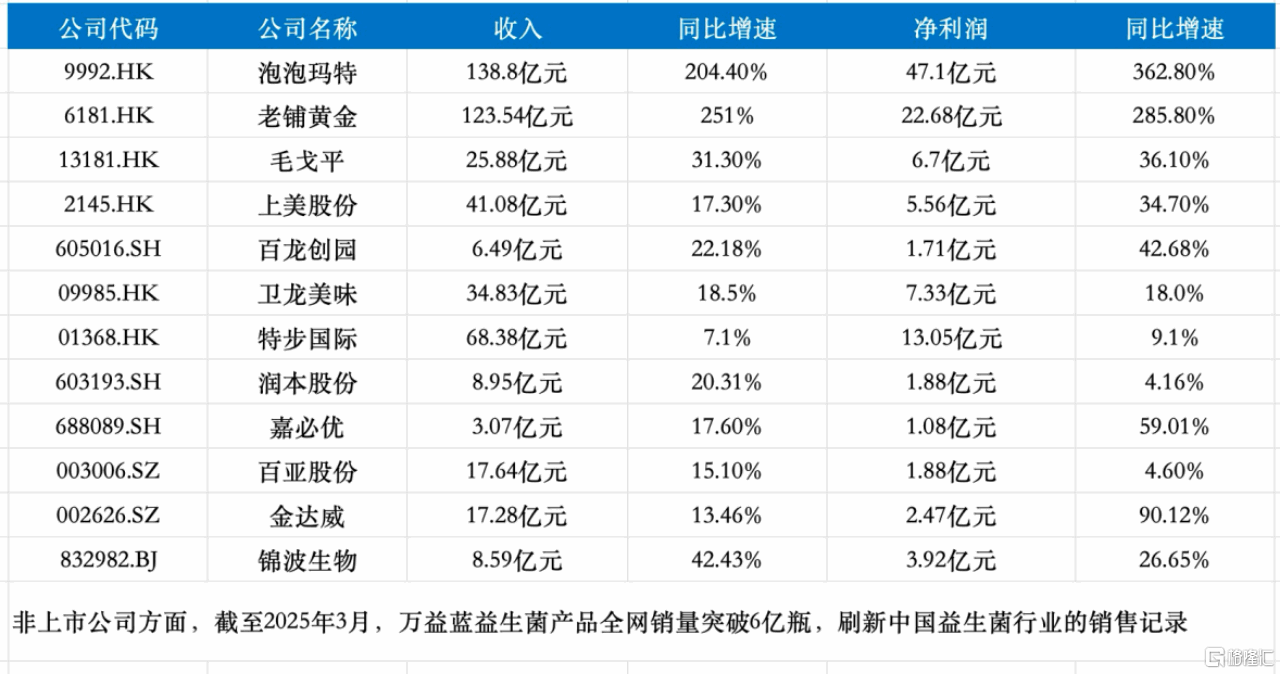
Core Viewpoint - The financial performance of traditional consumer leaders is under pressure, while new consumption forces centered around "self-care" are emerging, indicating a profound transformation in the consumer market [1] Industry Overview - The dietary supplement industry is showing strong growth potential, becoming a "value mine" with significant room for development [4][6] - The global market for dietary supplements is steadily growing, with emerging markets like China having substantial potential for improvement [6] Company Performance - Notable companies in the dietary supplement sector include: - Baolong Chuangyuan: Revenue of 649 million, YoY growth of 22.18%, net profit of 171 million [5] - Jiabiyou: Revenue of 307 million, YoY growth of 17.60%, net profit of 108 million [5] - Jindawei: Revenue of 1.728 billion, YoY growth of 13.46%, net profit of 247 million [5] - Companies like Dong'e Ejiao and Tongrentang are also making significant strides in the market [8][9] Market Trends - The probiotic market is gaining traction, with a high repurchase rate of 80% within six months, indicating a shift towards long-term health management [7] - The menopausal market in China has a large potential user base, with over 210 million women experiencing related discomforts, leading to increased demand for dietary supplements [7] Competitive Landscape - Companies that can position themselves in key segments and diversify their offerings are likely to thrive, such as Dong'e Ejiao and Yanzhiwu [8] - Yanzhiwu has established a strong market position through extensive R&D and product innovation, including the launch of new products like Yanzhiwu peptide [12][14] Consumer Behavior - Consumers are becoming more rational and value-driven, focusing on product efficacy and quality, which is reshaping the dietary supplement market [10][11] - The introduction of new formats like gummies and beverages is gaining acceptance among consumers [10] Future Outlook - The dietary supplement industry is expected to continue its growth trajectory, driven by evolving consumer needs and preferences [7][16] - Companies like Yanzhiwu are well-positioned to capitalize on these trends, supported by strong brand recognition and innovative product offerings [14][16]
公募秋季策略会密集召开 看好权益资产投资机会
Sou Hu Cai Jing· 2025-09-12 00:17
Core Viewpoint - The current market is experiencing an upward resonance of industrial trends, with structural opportunities expected to continue emerging, highlighting the investment value in equity markets [1] Group 1: Market Insights - Multiple public fund companies in Shanghai held autumn strategy meetings, indicating a consensus on the positive outlook for the equity market [1] - The current yield on Chinese government bonds remains at historically low levels, providing support for equity assets [1] - The risk premium is at the historical 56th percentile, suggesting that equity assets still offer a reasonable cost-performance ratio [1] Group 2: Investment Focus Areas - Investment opportunities are recommended in sectors aligned with industrial trends, such as AI and edge computing, robotics, innovative pharmaceuticals, new consumption, and non-ferrous metals [1] - There are clear signals of policy shifts and stabilization in corporate performance within the A-share market, with demand stabilizing in both the real estate and stock markets [1] - The supply side is addressing "involution" competition, while the industrial sector is seeing AI lead a new innovation cycle and "new consumption" becoming a new vehicle for domestic circulation [1] Group 3: AI Investment Perspective - The penetration of AI in daily work and life is continuously increasing, with the upper limit of model capabilities still improving [1] - AI investment should be viewed from an industrial perspective, considering both overseas computing power supply chains and domestic computing capabilities [1] - Key areas of focus include not only optical modules, PCBs (printed circuit boards), and servers but also AI applications [1]
多家公募举行秋季策略会 看好权益资产投资机会
Shang Hai Zheng Quan Bao· 2025-09-11 19:02
Core Viewpoint - Public funds remain optimistic about the equity market's allocation value, anticipating a structural opportunity to emerge as various industries trend upwards [1][2] Group 1: Investment Opportunities - The current low level of government bond yields and a risk premium at the historical 56th percentile support the value of equity assets [1] - Key investment areas include AI, robotics, innovative pharmaceuticals, new consumption, and non-ferrous metals [1] - The "anti-involution" policy and expected recovery in PPI are likely to improve the supply-demand dynamics in certain industries [2] Group 2: Structural Opportunities - There are numerous structural opportunities to explore, focusing on industries with growth potential [3] - The core of the current market rally is driven by confidence and risk appetite recovery underpinned by industrial dynamics [3] - Investment strategies should balance growth and dividend yield, with a focus on sectors driven by new demand and interest rate declines [3] Group 3: Sector-Specific Insights - The pharmaceutical sector has shown strong performance, with innovative drug companies entering a phase of explosive profitability [4] - AI in healthcare is highlighted as a cost-effective investment direction, alongside leading companies in non-innovative drug sectors that remain undervalued [4] - In the renewable energy sector, opportunities in energy storage, wind power, and photovoltaics are significant due to low penetration rates and stabilizing prices [4]