产业高质量发展

Search documents
抵制虚标!温岭水泵产业带联手京东工业“立新规”
Guan Cha Zhe Wang· 2025-09-24 15:33
Core Insights - The establishment of the JD Industrial-Wenling Pump Quality Co-Creation Alliance aims to enhance the quality development of the Wenling pump industry, focusing on resisting false labeling and promoting high-quality standards [1][2] Industry Overview - Taizhou, Zhejiang is a significant hub for China's private economy, with the Wenling pump industry cluster housing over 2,700 related enterprises and notable listed companies such as Lio, New World, and Dongyin [3] - In 2024, 411 large-scale enterprises in Wenling achieved an annual output value of nearly 38.95 billion, with the entire industry scale exceeding 70 billion; small pumps hold over 70% of the domestic market share and over 20% of the international market share [3] Quality Improvement Initiatives - The quality co-creation initiative will leverage digital technology, strict entry and qualification reviews, transparent user feedback mechanisms, and education for honest merchants and consumers to combat false labeling and internal competition [2][3] Collaboration with JD Industrial - New World Pump, a leading enterprise in the Wenling pump cluster, highlights that traditional challenges in the industry include high professional requirements for installation, which often leads to perceived quality issues [4] - The partnership with JD Industrial introduces a certified third-party installation service platform, enhancing consumer experience by providing professional and transparent installation services [4] Logistics and Market Expansion - The collaboration with JD Industrial allows New World Pump to utilize JD's intelligent supply chain and efficient logistics network, achieving next-day delivery for industrial products in key cities, improving customer satisfaction [5] - This partnership also lowers the digitalization barriers for traditional enterprises and facilitates market entry into lower-tier markets, enhancing product accessibility and service reliability [5]



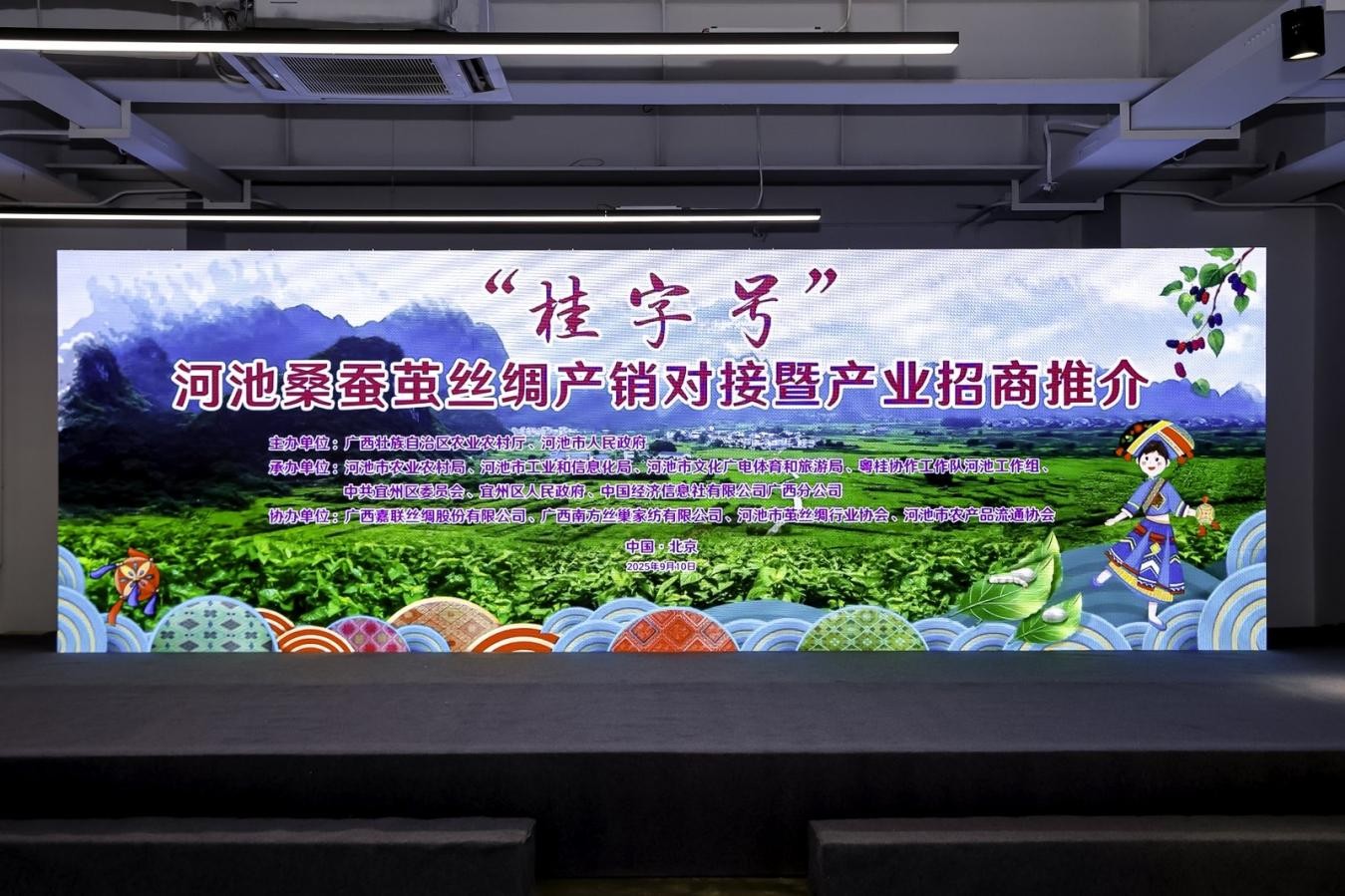
加强品牌建设 “桂字号”河池桑蚕茧丝绸产销对接暨产业招商推介活动在京举行
Ren Min Wang· 2025-09-19 03:02
Core Viewpoint - The event in Beijing focused on promoting the high-quality development of the Hechi silk industry, emphasizing the integration of traditional culture and modern industry practices [1][4]. Industry Development - Hechi is recognized as the "New Silk Capital of China," with a development pattern highlighting its significance in the global silk industry [4]. - The local government is committed to building a comprehensive data space for the silk industry, enhancing the entire supply chain from mulberry cultivation to silk trade [4]. - The silk industry in Hechi aims to achieve a trillion-yuan industrial cluster, enhancing brand recognition and market connections [7]. Production and Quality - In 2024, Hechi is projected to have a mulberry plantation area of 963,200 acres and a silkworm cocoon output of 218,500 tons, accounting for 45% of Guangxi's production, 28% of China's, and 25% globally [7]. - The quality control of silkworm cocoons has been emphasized, with a stable quality rate of over 90% [4]. Cultural Integration - The event showcased the integration of non-material cultural heritage, such as Zhuang brocade and Nandan Yao silk, into the silk industry, promoting innovation and cultural exchange [4][8]. - The collaboration between traditional crafts like Zhuang brocade and modern design is encouraged to attract younger audiences [8]. Support and Collaboration - The event was organized by various governmental bodies and industry associations, indicating strong institutional support for the silk industry [9]. - The China Silk Association aims to facilitate cooperation between Hechi silk enterprises and other silk businesses across the country [7].
农林牧渔行业周报:生猪行业反内卷持续,建议关注成本优秀龙头-20250915
Hua Yuan Zheng Quan· 2025-09-15 09:02
Investment Rating - The industry investment rating is "Positive" (maintained) [1] Core Viewpoints - The swine industry is undergoing significant policy transformation, focusing on capacity regulation and protecting farmers' rights while promoting innovation [5][6] - The latest pig price is 13.52 CNY/kg, with a slight decrease of 0.35 CNY/kg from the previous period, indicating potential short-term price declines due to policy-driven weight reductions [5][15] - The report suggests that if pig prices continue to fall, further market support and capacity control measures may be implemented [5][15] - The overall profitability of listed pig companies has shown significant growth, and with the expected recovery in pig prices and declining costs, profitability is anticipated to remain strong [6][15] Summary by Sections 1. Swine Industry - The latest pig price is 13.52 CNY/kg, with an average weight of 128.32 kg and a 15 kg piglet price of 394 CNY/head [5][15] - The Ministry of Agriculture will hold a meeting with 25 major pig companies to discuss capacity regulation measures [6][15] - Future growth stocks will focus on technological innovation and farmer interests, with companies like DeKang Agriculture and leading pig farming companies such as Muyuan and Wens recommended for investment [6][15] 2. Poultry Industry - The chicken industry faces a "high capacity, weak consumption" contradiction, with the latest chick price at 3.15 CNY/bird and broiler price at 3.43 CNY/kg [7][16] - The report highlights the importance of integrated enterprises and contract farming to increase market share [7][16] - Key investment targets include high-quality imported breeding stock leaders and full-chain leaders like Yisheng and Shengnong Development [7][16] 3. Feed Industry - The report recommends Haida Group due to improved management and increased capacity utilization, expecting significant growth [8][17] - The prices of various fish species have shown mixed trends, with some experiencing declines [8][17] 4. Pet Industry - The pet industry shows a significant increase in sales growth compared to July, with leading brands maintaining strong positions [9][20] - The competitive landscape is characterized by four leading brands, with potential risks for those unable to keep pace with growth [10][22] - The report emphasizes the importance of domestic brands like Guibao and Zhongchong, which are expected to perform well in the future [10][22] 5. Agricultural Products - The USDA's September report is bearish, with an increase in soybean planting area and a decrease in yield expectations [11][23] - The report highlights the importance of monitoring US-China trade negotiations and their impact on agricultural prices [11][23] - The agricultural sector is viewed as undervalued, with potential for significant returns as the industry transitions through various stages of recovery [11][23] 6. Market and Price Situation - The agricultural index increased by 4.81% over the past week, with the livestock sector performing particularly well [24][29] - The report notes that the CPI has been affected by food prices, which have seen a significant decline [50]


商务部印发推广自贸试验区第六批“最佳实践案例”
Shang Wu Bu Wang Zhan· 2025-09-15 06:28
Group 1 - The article discusses the implementation of the sixth batch of "best practice cases" for free trade pilot zones, aimed at enhancing their demonstration and driving effects [1] - A total of 29 cases are promoted, focusing on five main areas: trade facilitation, government function transformation, free flow of factors, open channel construction, and high-quality industrial development [1] - The trade facilitation area includes innovations such as a new model for auxiliary inspection of import and export machinery and electronic products, and a cross-border e-commerce model for tax-free retail imports [1] Group 2 - In the government function transformation area, cases include a new model for issuing multiple professional certificates through a single examination and a new method for handling real estate transfers [1] - The free flow of factors includes the establishment of a secure and convenient cross-border data flow system and new mechanisms for the transformation of university scientific and technological achievements [1] - The open channel construction area features new mechanisms for international intermodal transport along the Asia-Europe route and collaborative development models for logistics along the Yangtze River Economic Belt [1] Group 3 - The high-quality industrial development area includes mechanisms for the sustainable development of leisure fisheries and new models for the gradient transfer of industries [1] - To date, a total of 485 institutional innovation achievements from free trade pilot zones have been promoted at the national level [1] - The Ministry of Commerce will continue to lead the inter-ministerial joint conference mechanism to summarize and promote institutional innovations from free trade pilot zones, aiming to drive deeper reforms and high-level openings across the country [1]
清风为伴产业兴丨一线走访解难题
Zhong Yang Ji Wei Guo Jia Jian Wei Wang Zhan· 2025-09-14 01:19
Core Viewpoint - The article highlights the efforts of the Fencheng City Discipline Inspection Commission in supervising the development of the peach industry, ensuring the effective implementation of agricultural policies, and addressing issues related to the use of agricultural funds. Group 1: Industry Overview - The peach industry in Fencheng City has a cultivation area exceeding 100,000 acres, with an annual production of over 200,000 tons, showcasing its significance as a local specialty industry [1] - The city has 31,000 peach growers, generating an annual output value of 1 billion yuan, illustrating the economic impact of the peach industry [4] Group 2: Supervision and Policy Implementation - The Fencheng City Discipline Inspection Commission focuses on key areas such as the distribution of agricultural funds, addressing issues like false reporting, misappropriation, and interception of funds, thereby enhancing the supervision network [2] - The commission employs a "room-group-field" supervision approach to identify and address problems in the service of industry development, ensuring accountability among officials [1][2] Group 3: Development Strategies - The city has introduced implementation opinions to accelerate the high-quality development of the peach industry, emphasizing government support, state-owned enterprise involvement, technological advancement, and market-oriented operations [3] - Policies have been established to support financial backing, land security, and technology promotion, providing new momentum for the transformation and upgrading of the peach industry [3]
中华土鸡重塑市场竞争力
Huan Qiu Wang· 2025-09-05 07:38
Core Insights - Guangdong Province is a unique player in China's broiler chicken industry, with per capita poultry consumption at 49.2 pounds, double the national average, reflecting a strong regional preference for chicken meat [1] - The launch of the "Chinese Native Chicken Industry Base" aims to enhance the market for native chicken varieties and promote high-quality industry development through multi-party collaboration [1][2] - The introduction of the "Chinese Native Chicken Culinary Culture Promotion Center" by five leading companies aims to establish standards and marketing strategies to differentiate native chickens from fast-growing white-feathered chickens [2][3] Industry Challenges - The market share of yellow-feathered chickens has dropped from 38% in 2018 to 23% in 2024, with younger consumers showing less loyalty compared to older demographics [3] - The emergence of small white-feathered chickens, which offer a balance between growth speed and meat quality, poses a competitive threat to traditional yellow-feathered chickens [3] - The impact of avian influenza has led to live poultry bans in some areas, complicating the supply chain for yellow-feathered chickens [3] Product Development and Innovation - The native chicken varieties are characterized by slower growth and higher production costs, but they offer superior flavor and quality, which are increasingly sought after by consumers [2][4] - Companies like Wens Foodstuff Group have developed a "company + farmer" model to enhance the scale of yellow-feathered chicken farming and have established breeding companies to lead in the industry [5] - The development of a dynamic preservation system for local chicken breeds aims to integrate flavor genetics into commercial breeding, creating a closed-loop system for preservation, breeding, and promotion [5][6] Market Trends and Consumer Preferences - The demand for high-quality, flavorful chicken is rising, with a growing trend towards pre-prepared chicken dishes that cater to health-conscious consumers [8] - The promotion of native chicken culture through creative marketing strategies, such as fashion shows, aims to engage younger consumers and enhance cultural recognition [7][8] - The market for pre-prepared chicken dishes is projected to reach 485 billion yuan in 2024, with a 33.8% year-on-year growth, indicating strong potential for native chicken products [8] Strategic Initiatives - The establishment of the Chinese Native Chicken Industry Base is intended to support the scale and standardization of the native chicken industry, providing a solid foundation for industry upgrades [6] - The focus on product certification and branding aims to enhance consumer trust and recognition of native chicken products, differentiating them from white-feathered chickens [6][9] - The industry is shifting from basic consumption to a focus on high-quality experiences, with companies aiming to meet the evolving demands of consumers for both flavor and cultural significance [9]
中国两部门:依法治理光伏等产品低价竞争
Zhong Guo Xin Wen Wang· 2025-09-04 15:41
Core Insights - The document released by China's Ministry of Industry and Information Technology and the State Administration for Market Regulation emphasizes the need to eliminate "involution" competition in the photovoltaic sector and promote high-quality development [1][2] - The "Action Plan for Stable Growth of the Electronic Information Manufacturing Industry 2025-2026" sets a target for the average growth rate of the value-added output of major electronic manufacturing sectors to be around 7% from 2025 to 2026, with an overall revenue growth rate exceeding 5% when including lithium batteries, photovoltaics, and related components [1][2] Group 1 - The plan aims for the electronic information manufacturing industry to maintain the highest revenue scale and export ratio among 41 industrial categories by 2026, with five provinces achieving over 1 trillion yuan in revenue [1] - The server industry is expected to exceed 400 billion yuan in scale, while the domestic market penetration rate for 75-inch and larger color televisions is projected to surpass 40% [1] - The plan also highlights the transition of personal computers and mobile phones towards higher intelligence and premium quality [1] Group 2 - The document outlines strategies to optimize industrial layout and improve industrial structure, including the establishment of internationally leading electronic information industry bases and specialized clusters for small and medium-sized enterprises [1] - It emphasizes the need to legally address low-price competition in the photovoltaic sector and other products [1] - The plan promotes the advancement of high-end electronic equipment and the integration of artificial intelligence into terminal products, encouraging local innovation in AI applications [2]
两部门:依法治理光伏等产品低价竞争 引导地方有序布局光伏、锂电池产业
Zheng Quan Shi Bao Wang· 2025-09-04 06:31
Core Viewpoint - The Ministry of Industry and Information Technology and the State Administration for Market Regulation have issued an action plan for the electronic information manufacturing industry for 2025-2026, focusing on high-quality development in sectors like photovoltaics while addressing low-price competition [1] Group 1: Industry Development - The plan aims to eliminate "involution" competition and promote high-quality growth in the photovoltaic sector [1] - It emphasizes the need for legal governance of low-price competition in photovoltaic products [1] - Local governments are encouraged to orderly layout the photovoltaic and lithium battery industries and assess production capacity [1] Group 2: Quality Management and Standards - Implementation of quality management for photovoltaic modules and lithium battery products is a key focus [1] - The plan includes the development of a safety recommendation directory for energy storage battery products based on mandatory national standards [1] - Strengthening industry self-regulation through associations and chambers of commerce is supported [1] Group 3: Monitoring and Risk Management - The action plan calls for enhanced monitoring, early warning, and risk alert mechanisms in key industries [1] - There is an emphasis on orderly adjustment of industrial scale to mitigate risks [1]
致全体会员及生猪养殖行业同仁的一封信——广东生猪产能调控倡议书
Nan Fang Nong Cun Bao· 2025-09-03 07:34
Core Viewpoint - The Guangdong Provincial Pig Industry Association has issued a letter advocating for proactive capacity reduction in the pig farming industry to address the oversupply pressure and ensure the long-term healthy development of the industry [2][3][4]. Group 1: Current Industry Situation - The pig farming industry is facing new challenges, with capacity regulation becoming urgent. As of the end of June, the national pig inventory was 424 million heads, with breeding sows at 40.43 million heads, which is 103.7% of the normal holding level, nearing the upper limit of the capacity regulation green zone [10][11][12]. Group 2: Industry Meeting and Discussions - On August 28, a meeting was held by the Guangdong Provincial Department of Agriculture and Rural Affairs, involving major pig farming enterprises, slaughter enterprises, and experts from research institutions to discuss strengthening capacity regulation and promoting high-quality industry development [13][14][15]. Group 3: Key Proposals from the Association - The association proposed targeted initiatives focusing on five areas: capacity regulation, safety production, cost reduction and efficiency enhancement, green farming, and brand building [17][18]. - The association called for all farming enterprises to actively implement capacity regulation policies, gradually reduce breeding sow inventory, avoid secondary fattening, and rationally control slaughter weight to prevent blind expansion [19][20]. Group 4: Safety and Efficiency Measures - Emphasizing safety production, the association highlighted the importance of maintaining strict management to prevent major diseases like African swine fever, especially during market fluctuations [22][24]. - The association encouraged the adoption of technological innovations and new techniques such as IoT and low-protein diets to lower production costs and enhance efficiency through digital and green transformations [26][27][28]. Group 5: Environmental and Brand Development - The association stressed the need to uphold environmental standards, invest in waste resource utilization facilities, and promote sustainable practices like crop-livestock integration [33][34]. - It called for the industry to focus on quality improvement and participate in brand-building initiatives to enhance product value and strengthen the Guangdong pig industry's reputation [35][36][37]. Group 6: Social Responsibility and Future Outlook - Capacity regulation is not only essential for the industry's healthy development but also a social responsibility that each farming enterprise should undertake. The release of this initiative aims to clarify directions for enterprises and foster a consensus on "high-quality development" [38][39].

农林牧渔行业周报:生猪板块半年报高增,推荐“平台+生态”服务型企业德康农牧-20250902
Hua Yuan Zheng Quan· 2025-09-02 01:06
Investment Rating - The investment rating for the agriculture, forestry, animal husbandry, and fishery industry is "Positive" (maintained) [3] Core Viewpoints - The swine industry is experiencing high-quality development with significant policy transformations aimed at protecting farmers' rights and stimulating enterprise innovation. Future growth stocks will likely focus on technological content and innovative models that balance farmer interests [4][12] - The overall profitability of listed pig companies has significantly increased due to a stable pig price year-on-year and a substantial decrease in costs. Although pig prices may face pressure in the second half of the year, the trend of improving efficiency suggests that profitability will remain strong [4][12] - The poultry sector is facing a persistent contradiction of "high capacity, weak consumption," leading to losses that force breeding farms to reduce capacity. Integrated enterprises and contract farming are expected to gain market share [5][13] - The feed sector is recommended to focus on Hai Da Group, which is expected to see growth due to improved management and increased capacity utilization [6][14] - The pet industry is witnessing a concentration of market share among leading brands, with potential growth opportunities for mid-tier brands. The impact of tariffs on exports is expected to diminish over time [7][16] - The agricultural sector is closely monitoring the effects of US-China trade negotiations, with expectations of tightening soybean supply and potential price increases for soybean meal [8][17] Summary by Sections 1. Swine - Latest pig price is 13.70 CNY/kg (down 0.01 CNY/kg month-on-month), with an average slaughter weight of 127.83 kg (down 0.15 kg month-on-month) and a price of 445 CNY for 15 kg piglets (down 18 CNY month-on-month). Short-term price declines may be due to policy-driven weight reductions [3][12] - The industry is undergoing profound policy transformations, focusing on protecting farmers' rights and stimulating innovation. Companies with cost advantages and strong connections with farmers are expected to enjoy excess profits and valuation premiums [4][12][13] 2. Poultry - As of September 1, the price of chicken seedlings in Yantai is 3.45 CNY/piece (down 5.5% month-on-month) and the price of broiler chickens is 3.55 CNY/kg (down 1.39% month-on-month) [5][13] - The white feather chicken industry is facing ongoing challenges of high capacity and weak consumption, leading to a reduction in breeding capacity among chicken farms [5][13] 3. Feed - The feed sector is recommended to focus on Hai Da Group, which is expected to benefit from industry recovery and improved management effects [6][14] 4. Pets - The pet industry is characterized by a stable four-brand dominance, with increasing concentration expected. The impact of tariffs on exports is anticipated to lessen, and leading companies are expected to maintain high growth rates [7][16] 5. Agricultural Products - The agricultural sector is closely watching the impact of US-China trade negotiations, with expectations of tightening soybean supply and potential price increases for soybean meal [8][17] 6. Market and Price Situation - The Shanghai and Shenzhen 300 Index closed at 4497, up 2.71% from the previous week, while the agriculture, forestry, animal husbandry, and fishery index closed at 3001, up 2.02% [18][21]