全球货币体系重构

Search documents
国际金价突破3720美元,年内暴涨42%!现在上车还来得及吗?
Sou Hu Cai Jing· 2025-09-23 04:23
Core Viewpoint - The article discusses the surge in gold prices, driven by factors such as Federal Reserve interest rate cuts, geopolitical tensions, and central bank gold purchases, while also highlighting potential risks and investment strategies for ordinary investors. Group 1: Price Surge Drivers - Federal Reserve Rate Cuts: The Fed has cut rates by 125 basis points in 2025, leading to a 15% decline in the dollar index to 102.3, significantly reducing the opportunity cost of holding gold [2][3] - Geopolitical Conflicts: Escalating tensions in the Middle East and the ongoing Russia-Ukraine war have increased demand for gold, with over 170 tons net inflow into gold ETFs in a single month [4] - Central Bank Purchases: In Q2 2025, global central banks bought 166 tons of gold, with China increasing its reserves to 74.02 million ounces over ten consecutive months [5][6] Group 2: Future Trends - Bullish Outlook: Technical analysis suggests that gold could reach $4,000, with major institutions like Goldman Sachs and JPMorgan raising their price targets [7] - Risk Awareness: The RSI indicator is at 78, indicating overbought conditions, with potential short-term pullbacks to the $3,600-$3,650 range [8] Group 3: Investment Strategies - Allocation Logic: It is recommended to allocate 5%-15% of investment portfolios to gold as a stabilizer against market volatility [9] - Tool Selection: Conservative investors may prefer physical gold or bank savings gold, while aggressive investors might consider gold ETFs or futures contracts [11][12] - Timing Strategy: Investors should look for buying opportunities around the $3,600 support level and consider event-driven strategies around Federal Reserve meetings and employment data releases [13][14]

恒指高开0.35%,港股通科技ETF基金(159101)近一周净流入3.5亿
Sou Hu Cai Jing· 2025-09-23 02:07
Group 1 - The Hang Seng Index opened up 0.35% and the Hang Seng Tech Index rose by 0.21%, with notable increases in stocks such as SenseTime-W (+1.5%) and BYD Electronics (+1.2%) [1] - The Hong Kong Stock Connect Tech ETF (159101) has seen a net inflow of 350 million yuan over the past week, bringing its total size to over 2 billion yuan [1] - The current global monetary system restructuring, characterized by a depreciating US dollar and a reversal of innovative narratives, is seen as a core driver of market trends, potentially benefiting Chinese assets, particularly under favorable policy responses [1] Group 2 - For ordinary investors, direct individual stock investments are high-risk and have high entry barriers; thus, participating through related ETFs is recommended [2] - The Hong Kong Stock Connect Tech ETF (159101) closely tracks the National Index of Hong Kong Stock Connect Technology, selecting 30 large-cap, high R&D investment tech leaders, with the top ten stocks accounting for 77% of the weight [2] - The ETF covers major players like Tencent and Alibaba, as well as emerging forces such as Li Auto and BeiGene, spanning popular sectors including "software and hardware + new consumption + innovative pharmaceuticals + new energy vehicles" [2]
国泰海通:降息开启定底线 有色商品属性添弹性
智通财经网· 2025-09-21 23:17
Core Viewpoint - The Federal Reserve's recent interest rate cut of 25 basis points (BP) to a range of 4.00%-4.25% aligns with market expectations, indicating potential for two more rate cuts by 2025, which enhances market risk appetite and may lead to short-term pressure on gold prices [1][2][3] Group 1: Economic Outlook - The Federal Reserve's decision to lower interest rates is expected to ease recession fears in the U.S., as recent economic data shows improvement, including better-than-expected retail sales and a decrease in initial jobless claims [2] - The Fed's updated dot plot suggests two additional rate cuts by 2025, totaling approximately 50 BP, which could further influence market dynamics [3] Group 2: Precious Metals - The recent rate cut is likely to result in short-term fluctuations in gold prices, as market participants take profits amid rising risk appetite [2][3] - Despite short-term pressures, long-term prospects for gold remain positive due to ongoing U.S. government debt risks and challenges to the dollar's status, suggesting potential for sustained performance in the gold market [2] Group 3: Industrial Metals - The industrial metals sector is expected to benefit from improved supply-demand dynamics, with rising processing rates for copper and aluminum as the market enters a traditional peak season [3] - Increased domestic policy flexibility and a favorable macroeconomic environment, coupled with supply-side disruptions, are likely to strengthen the industrial metals market, presenting a good opportunity for investment [3]

美联储如期降息,中国资产相对受益,A股早盘收涨
Sou Hu Cai Jing· 2025-09-18 05:06
Group 1 - The Federal Reserve announced a 25 basis point interest rate cut, marking the first rate cut of the year, with expectations for two more cuts in October and December [3][4] - The rate cut is seen as a risk management measure in response to slowing economic growth and inflation falling below 3%, approaching the Fed's long-term target of 2% [3][4] - Following the announcement, U.S. stock indices initially rose but then fell, with the Dow Jones increasing by 0.57% while the Nasdaq and S&P 500 saw slight declines [3] Group 2 - The A-share market experienced fluctuations, closing higher after an initial drop, with the Shanghai Composite Index up by 0.45% [5] - Analysts suggest that the Fed's rate cut may lead to a global easing trend, potentially benefiting Chinese assets, especially in the context of a restructuring global monetary system [6][7] - The A-share market's performance is expected to rely more on domestic economic fundamentals and policy environment rather than external liquidity influences [5][6] Group 3 - Specific sectors that may benefit from the rate cut include those with high foreign investment, companies with significant dollar-denominated debt, and industries with solid long-term growth prospects such as technology and renewable energy [7][8] - The anticipated easing of monetary policy could lead to a shift in capital from savings to equity markets, enhancing investment returns for ordinary investors [6][8] - The overall sentiment in the domestic market is positive, with expectations for improved liquidity and potential policy support following the Fed's actions [6][7]

美联储降息25个基点,阿里巴巴、理想汽车、哔哩哔哩等热门中概股集体走强
Mei Ri Jing Ji Xin Wen· 2025-09-18 01:40
Group 1 - The Federal Reserve announced a reduction in the federal funds rate target range from 4.25%-4.50% to 4.00%-4.25%, marking the first rate cut since 2025 [1] - Following the announcement, U.S. stock markets reacted sharply, with the Dow Jones Industrial Average rising by 0.54%, while the Nasdaq and S&P 500 indices fell by 0.33% and 0.1% respectively [1] - Major U.S. tech stocks experienced declines, with Broadcom dropping nearly 4%, Nvidia over 2%, and Amazon and Oracle each falling more than 1% [1] Group 2 - The rate cut by the Federal Reserve is expected to lead to a global reallocation of funds, potentially benefiting Chinese assets amid a backdrop of global monetary system restructuring [2] - The combination of U.S. dollar depreciation and a reversal of innovative narratives may drive the current market trends, with Chinese assets likely to gain from the dual benefits of accelerated capital repatriation and global fund rebalancing [2] - In the context of anticipated RMB appreciation and reinforced expectations of Fed rate cuts, there is optimism for a "catch-up" rally in Hong Kong stocks, particularly in the tech and internet sectors focusing on AI core assets [2] Group 3 - Relevant ETFs in the Hong Kong stock market include the Hong Kong Stock Connect Technology ETF (159101), which covers the entire technology industry chain, and the Hang Seng Internet ETF (513330), which focuses on leading internet companies [3]

中芯国际、商汤、美团-、阿里半日涨逾5%,港股通科技ETF基金(159101)连续吸金
Mei Ri Jing Ji Xin Wen· 2025-09-17 05:37
Group 1 - The Hang Seng Index rose by 1.41%, with the Hang Seng Tech Index surging by 3.49% and the Hang Seng China Enterprises Index increasing by 1.78% on September 17, with a half-day trading volume of HKD 192.36 billion [1] - The Hong Kong Stock Connect Tech ETF (159101) gained 2.71%, with notable increases in component stocks such as SMIC (+5.70%), SenseTime-W (+5.26%), Meituan-W (+5.18%), Alibaba-W (+5.02%), and Tencent Holdings (+2.09%) [1] - The market anticipates a greater than 90% probability of the Federal Reserve restarting interest rate cuts in September, with probabilities exceeding 70% for cuts in October and December [1] Group 2 - The Federal Reserve's interest rate cuts are expected to facilitate global capital reallocation, potentially benefiting Chinese assets amid a backdrop of global monetary system restructuring, with a combination of US dollar depreciation and a reversal of innovative narratives [2] - If policies are effectively managed, Chinese assets may benefit from the dual dividends of accelerated capital repatriation and global capital rebalancing, with some funds possibly flowing into the Chinese capital market [2] - In the context of renminbi appreciation and strengthened expectations for Fed rate cuts, there is optimism for a "catch-up" rally in Hong Kong stocks, shifting focus from "takeout narratives" to "AI narratives," particularly in the tech and internet sectors [2] Group 3 - Relevant ETFs include the Hong Kong Stock Connect Tech ETF (159101) for the tech sector and the Hang Seng Internet ETF (513330) for internet leaders [3]

美降息如何影响中国资产?
Mei Ri Jing Ji Xin Wen· 2025-09-17 03:12
Group 1 - The external constraints are weakening, allowing for a more accommodative monetary policy in China, with two interest rate cuts since the beginning of the current easing cycle [1] - The depreciation of the US dollar has led to differentiated exchange rate gains and losses, with the USD/CNY rate declining from 7.3 to around 7.1 since 2025, easing the debt repayment pressure for companies holding USD loans [1] - The easing of monetary policy is expected to enhance the attractiveness of Chinese assets, benefiting from global liquidity influx and a restructuring of the global monetary system, with a potential return of foreign capital to the Chinese market [1] Group 2 - Foreign capital allocation is focusing on core assets characterized by distinct trends, with significant increases in the software and services, and technology hardware sectors in Hong Kong stocks, driven by advancements in AI technologies [1] - The Hong Kong Stock Connect and QDII funds are highlighted as investment vehicles for technology-related ETFs, such as the Hong Kong Stock Connect Technology ETF (159101) and the Hang Seng Technology Index ETF (513180) [1]
美联储9月重启降息概率较高,关注港股科技
Sou Hu Cai Jing· 2025-09-16 01:40
Group 1 - The Federal Reserve began its current rate-cutting cycle in September 2024, with three rate cuts planned for that year, but no cuts have occurred since 2025 due to various uncertainties [1] - Recent U.S. inflation pressures are low, and employment is weakening, leading to dovish signals from Fed Chair Powell at the Jackson Hole meeting, which has increased market expectations for rate cuts [1] - As of September 13, market expectations for a rate cut in September exceeded 90%, with probabilities for cuts in October and December also above 70% [1] Group 2 - Rate cuts by the Federal Reserve typically lead to a global reallocation of funds, potentially benefiting Chinese assets, especially in the context of a restructuring global monetary system [2] - The combination of U.S. dollar depreciation and a reversal of innovative narratives may drive the current market trends, with a new monetary order favoring RMB assets [2] - In the context of RMB appreciation and strengthened expectations for Fed rate cuts, there is optimism for a "catch-up" rally in Hong Kong stocks, particularly in the technology and internet sectors that focus on AI core assets [2] Group 3 - Relevant Hong Kong stock technology ETFs include the Hong Kong Stock Connect Technology ETF (159101), the Hang Seng Technology Index ETF (513180), and the Hang Seng Internet ETF (513330) [3]
中金公司:美联储重启降息概率较高 人民币资产有望相对受益
Sou Hu Cai Jing· 2025-09-15 03:28
Group 1 - Market expectations for the Federal Reserve to restart interest rate cuts have increased significantly, with probabilities exceeding 90% for September and over 70% for October and December [1] - The Federal Reserve began its rate cut cycle in September 2024, with three cuts planned for that year, but has not cut rates since 2025 due to various uncertainties [1] Group 2 - The impact of the Federal Reserve's rate cuts on Chinese assets can be analyzed through three main aspects: easing external constraints on China's monetary policy, potential depreciation of the dollar leading to a stronger yuan, and global capital reallocation [2] - A weaker dollar may affect export-oriented companies and those with dollar-denominated debts, but it could also reduce repayment pressures for companies with dollar loans [2] - The combination of dollar depreciation and a shift in global monetary order may drive a bullish trend in Chinese equity markets, benefiting from the fragmentation and diversification of the global monetary system [2]

中金:美降息如何影响中国资产?
智通财经网· 2025-09-15 00:06
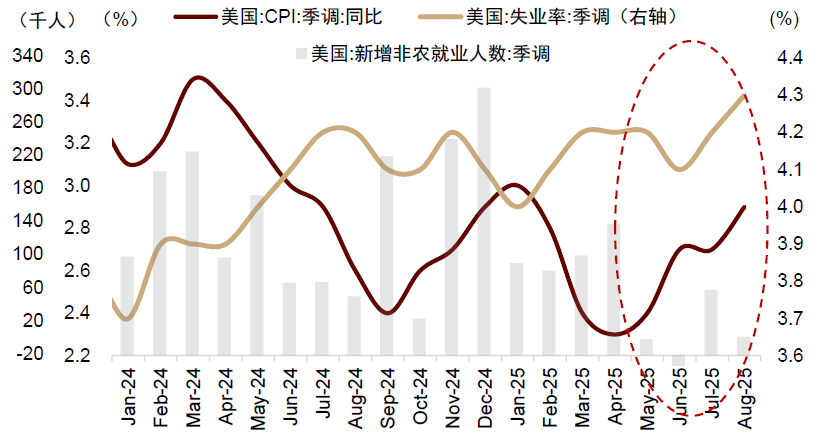
Group 1 - The Federal Reserve is expected to restart interest rate cuts in September 2024, with three cuts anticipated in 2024, but no cuts since then due to various uncertainties [1] - Recent U.S. inflation data shows a slight increase, with the August CPI rising 2.9% year-on-year and core CPI at 3.1%, compared to 2.7% and 3.0% respectively in the previous month [1] - Non-farm employment data for August indicates an increase of 22,000 jobs, which is below market expectations, and a significant downward revision of 911,000 jobs for the period from April 2024 to March 2025 [1] Group 2 - The market probability for the Federal Reserve to cut rates in September exceeds 90%, with probabilities for cuts in October and December also above 70% [1][3] - Historical analysis shows that during previous Fed rate cut cycles, sectors such as non-bank financials and growth stocks in A-shares and Hong Kong stocks tend to perform well [6][7] - In the short term (around 11 weeks), sectors benefiting from market activity, such as non-bank financials, have shown strong performance, while in the medium term (around 20 weeks), sectors like computers, electronics, and communications in A-shares have led in gains [6][7]