全面牛市

Search documents
盘前必读丨全力巩固市场回稳向好态势,证监会召开重要会议;新央企雅江集团领导班子亮相
Di Yi Cai Jing· 2025-07-27 23:29
Market Trends - The market has recently exhibited typical "water buffalo" characteristics, and whether this current trend can evolve into a longer-lasting bull market will depend on future fundamental developments [1][20]. Economic Indicators - The Dow Jones Industrial Average rose by 0.47%, the Nasdaq increased by 0.24%, and the S&P 500 gained 0.40%, with both the S&P 500 and Nasdaq reaching record closing highs [3]. - The Nasdaq China Golden Dragon Index fell by 0.89%, with most popular Chinese concept stocks declining [4]. Government Policies - The State Council approved measures for gradually implementing free preschool education, emphasizing the importance of this initiative for long-term development and its impact on families [5]. - The China Securities Regulatory Commission (CSRC) highlighted the need for a stable capital market amidst complex internal and external environments, focusing on market stability, strict regulation, and enhancing market functions [6]. Corporate Developments - China National Duty-Free Corporation reported a net profit of 2.6 billion yuan for the first half of 2025, a decrease of 20.81% year-on-year, with total operating revenue of 28.15 billion yuan, down 9.96% [16]. - The company *ST Suwu is under investigation for suspected information disclosure violations, which may lead to a forced delisting due to significant legal issues [19]. Investment Opportunities - The upcoming World Artificial Intelligence Conference is expected to catalyze multiple sub-sectors, while the continued implementation of policies supporting the Sci-Tech Innovation Board may lead to a rebound in previously stagnant stocks [20]. - Recommendations include focusing on sectors such as non-ferrous metals, communications, innovative pharmaceuticals, military industry, and gaming as the market approaches the mid-reporting season [20].








机构论后市丨科创板有望迎来补涨行情;“反内卷”下周期行情可能持续
Di Yi Cai Jing· 2025-07-27 10:37
Core Viewpoint - The market is expected to experience a volatile upward trend, with a focus on three main lines of investment, particularly in the technology sector and the potential for a rebound in the STAR Market [1][3]. Group 1: Market Performance - The Shanghai Composite Index rose by 1.67% this week, the Shenzhen Component Index increased by 2.33%, and the ChiNext Index gained 2.76% [1]. - The current market has shown characteristics typical of a "water buffalo" trend, indicating a potential for further upward movement [1]. Group 2: Investment Strategies - Citic Securities suggests that the STAR Market may see a rebound due to the accumulation of retail investor inflows and the strengthening narrative of "anti-involution" [1]. - The recommendation includes focusing on sectors such as non-ferrous metals, telecommunications, innovative pharmaceuticals, military industry, and gaming during the upcoming reporting season [2]. Group 3: Sector Focus - Everbright Securities highlights three main lines for medium to long-term investment: domestic consumption, technological self-reliance, and dividend stocks [3]. - Xiangcai Securities emphasizes the importance of defensive dividend stocks, particularly in banking and insurance, as well as consumer-related sectors like education and passenger vehicles [4]. Group 4: Policy Impact - Huajin Securities notes that the current cycle of rising sectors is driven by policy improvements in fundamental expectations and low valuations in certain industries [5]. - Suggested industries benefiting from the "anti-involution" policy include automotive, new energy, chemicals, construction, and coal [5].
3500点之上破净股仍超300只,全面牛市难现,A股散户如何破局?
Mei Ri Jing Ji Xin Wen· 2025-07-18 08:21
Core Viewpoint - The article discusses the historical context of the A-share market, highlighting that every time the index breaks through the 3500-3600 point range, it is often followed by a strong bull market. The current situation suggests a potential new bull market, but the presence of over 300 stocks trading below their book value indicates challenges ahead for a comprehensive bull market [1][2]. Group 1: Historical Bull Markets - In 2007 and 2015, the A-share market experienced comprehensive bull markets, characterized by a significant reduction in the number of stocks trading below their book value, known as "破净股" [1]. - The ultimate goal of a comprehensive bull market is to eliminate these "破净股," which serve as an important reference indicator for market health [1]. - During the 2007 bull market, the number of "破净股" dropped significantly, with reports indicating that by March 2007, there were virtually no such stocks left in the market [1]. Group 2: Current Market Conditions - As of now, despite the Shanghai Composite Index surpassing 3500 points, there are still over 300 stocks with a price-to-book ratio below 1, indicating a lack of upward momentum for these stocks [2]. - The sectors most affected by "破净股" include real estate, steel, and construction, with banks also showing significant numbers of such stocks, including Minsheng Bank and Huaxia Bank, which have price-to-book ratios below 0.5 [2]. Group 3: Market Dynamics and Challenges - The difficulty of making profits in the current market environment is increasing, with over 1400 stocks in decline despite a median increase of approximately 11.6% among A-shares this year [3]. - The market ecosystem has changed significantly compared to over a decade ago, with the introduction of the registration system and a substantial increase in the number of listed companies, now exceeding 5400 [3]. - The rise of quantitative trading, high-frequency trading, and algorithmic trading has created challenges for retail investors, who are at a disadvantage in terms of information and speed [3]. Group 4: Investment Strategies - In this context, ETFs have emerged as a viable option for retail investors, with total ETF assets reaching 4.3 trillion yuan, and individual investors increasingly participating in ETF trading [4]. - ETFs offer the advantage of diversifying individual stock risks and avoiding the pitfalls of high-frequency trading, thereby enhancing the probability of successful investments through passive and low-frequency strategies [4].
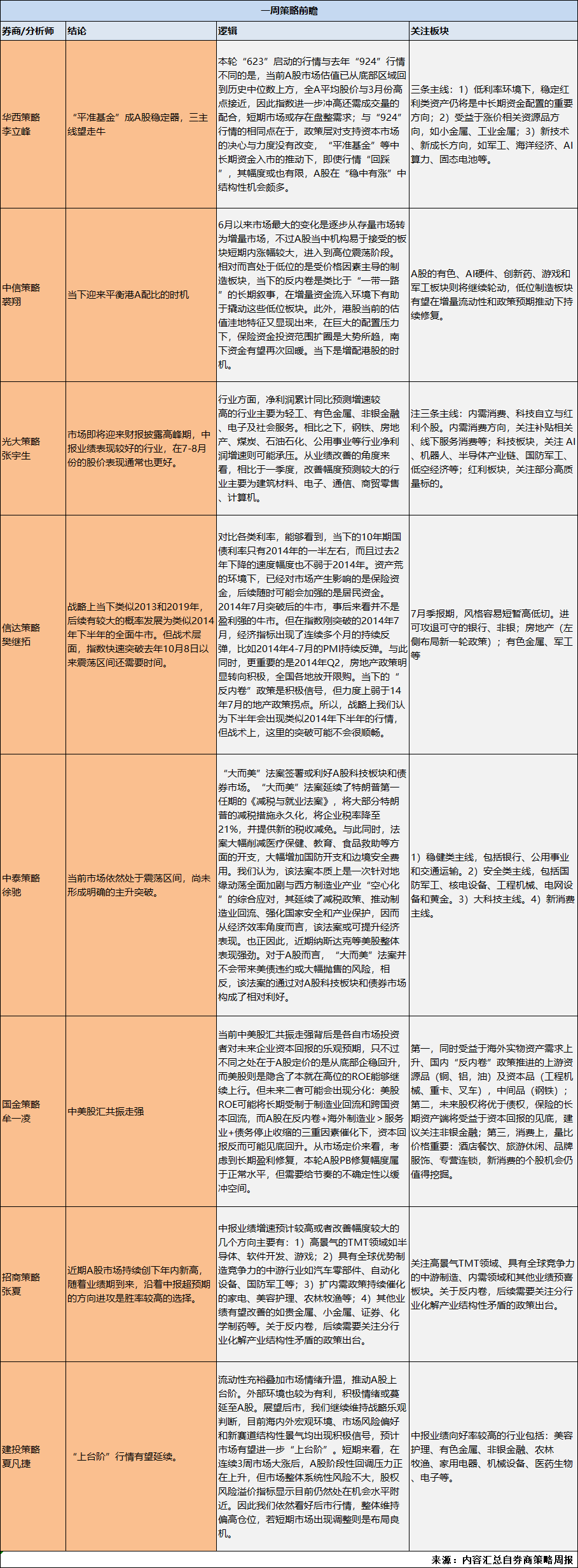
A股分析师前瞻:指数行情的持续性与中报预增方向
Xuan Gu Bao· 2025-07-13 13:28
Core Viewpoint - The current A-share market is experiencing a shift from a stock market dominated by existing shares to one driven by new capital inflows, with a potential for structural opportunities despite short-term consolidation needs [1][3]. Group 1: Market Trends and Strategies - The "623" market rally is distinct from last year's "924" rally, as the A-share market valuation has risen from the bottom to above the historical median, indicating that further index gains require volume support [1][3]. - The strategy outlook suggests a high probability of a market trend similar to the comprehensive bull market of the second half of 2014, driven by low interest rates and potential increases in resident capital inflows [2][4]. - The current 10-year government bond yield is approximately half of what it was in 2014, with a significant decline over the past two years, indicating a favorable environment for market growth [4]. Group 2: Sector Performance and Opportunities - Sectors expected to perform well in the upcoming earnings season include high-growth TMT areas such as semiconductors, software development, and gaming, as well as midstream industries with global competitive advantages like automotive parts and defense [2][3]. - The ongoing domestic demand expansion policies are likely to benefit sectors such as home appliances, beauty care, and agriculture, while other sectors like precious metals and pharmaceuticals are also anticipated to show performance improvements [2][3]. - The market is expected to see better stock performance in July and August for industries with strong mid-year earnings reports, particularly in consumer sectors and technology [3][5].
策略周报:可能重演14年下半年-20250713
Xinda Securities· 2025-07-13 10:45
Core Insights - The report suggests that the market performance has decoupled from earnings since September last year, resembling the period from 2013 to 2015. In the early stages of PPI decline, negative impacts on earnings dominated, but as PPI remained negative for a sufficient duration, policy and liquidity factors improved, leading to a decoupling of market performance from earnings [2][10][11] - The current macro-level asset shortage may exceed that of 2014. If the bull market is driven by liquidity and policy rather than earnings, the logic of asset scarcity becomes more significant. The current 10-year government bond yield is about half of that in 2014, and the rate of decline over the past two years is comparable to that of 2014 [3][20][22] - Insurance funds have already impacted the market, and there is potential for increased inflow from household funds. Since the pandemic in 2020, household deposits have risen rapidly, but their inflow into the stock market has been limited due to the lack of a stable profit-making effect. With the market transitioning from bearish to bullish since September last year, conditions for accelerated household fund inflow are gradually being met [22][24] Market Changes - The report indicates that the A-share market has seen significant increases in major indices, with the ChiNext 50 rising by 2.65% and the ChiNext Index by 2.36%. In contrast, sectors like coal and banking have experienced declines [38][42] - Global stock markets have shown mixed performance, with indices such as Germany's DAX and France's CAC40 performing well, while indices in Brazil and Mexico have declined [39] - The report notes a net inflow of 241.19 billion yuan from southbound funds (Hong Kong Stock Connect) this week, indicating strong market interest [40][48]
信达证券2025年7月“十大金股”组合
Xinda Securities· 2025-06-30 11:19
Group 1: Overall Market Outlook - The current market situation is similar to 2013 and 2019, with a high probability of evolving into a comprehensive bull market, although tactical breakthroughs may take time [6][12] - The market is characterized by low valuation levels, weak corporate earnings, positive policy tone, and active thematic opportunities, indicating potential for a bull market [12][14] - A possible market pullback in July is expected, but the extent is manageable, with a return to bull market conditions likely in Q3 or Q4 if earnings or policies turn optimistic [12][14] Group 2: Industry Allocation Insights - The report suggests a value-oriented approach in the current quarter, with plans to increase exposure to more elastic sectors in Q3 [12][14] - Key sectors for investment include: - New Consumption: Benefiting from domestic demand stability and potential supportive policies [14] - Media: Attractive valuation with a focus on AI application changes [14] - Military Industry: Likely to see continuous thematic events due to unique demand cycles [14] - Banking and Non-Banking: Low sensitivity to overseas economic fluctuations and high sensitivity to domestic policies [14] - Non-ferrous Metals: Strong capacity structure with resilience to economic fluctuations [14] - Real Estate: Positioned for new policy initiatives with low valuation levels [14] Group 3: Top Stock Picks - The top stock picks for July 2025 include: - 分众传媒 (002027.SZ) in Media and Internet - 顺丰控股 (002352.SZ) in Transportation - 药师帮 (9885.HK) in Pharmaceuticals - 万辰集团 (300972.SZ) in Food and Beverage - 青岛银行 (002948.SZ) in Banking - 新集能源 (601918.SH) in Utilities - 豆神教育 (300010.SZ) in Education - 兖矿能源 (600188.SH) in Energy - 江淮汽车 (600418.SH) in Automotive - 卓易信息 (688258.SH) in Computing [3][15] Group 4: Company-Specific Insights - 分众传媒 (002027.SZ) is focusing on offline advertising with a significant share of daily consumer goods advertisers [16] - 顺丰控股 (002352.SZ) has shown remarkable growth in logistics volume, outperforming industry growth rates, driven by customer penetration and operational optimizations [19][21] - 药师帮 (9885.HK) is expected to achieve a compound annual growth rate of approximately 164% in net profit from 2024 to 2027, benefiting from its deep market penetration and strong cash flow [25][27] - 万辰集团 (300972.SZ) maintains a competitive edge in the snack retail sector, with a focus on operational quality and profitability improvements [28][29] - 青岛银行 (002948.SZ) is expanding its business in a robust economic environment, with significant growth in deposits and loans, supported by a strong financial foundation [31][33]





升级为全面牛市可能的条件
Xinda Securities· 2025-06-29 10:03
Group 1 - The report indicates that the current market conditions since October last year resemble those of 2013 and 2019, suggesting a potential transition to a comprehensive bull market [2][10][30] - The strategic characteristics of the current market include low valuation levels, weak corporate earnings, positive policy tone, and active thematic opportunities, which are similar to the market conditions observed in previous bull markets [9][10][30] - Historical analysis shows that out of several past oscillating markets, there were four bear markets and two bull markets, indicating a mixed outcome for similar conditions [3][10] Group 2 - The report highlights that the transition from a structural bull market to a comprehensive bull market in July 2014 was driven by a brief economic rebound, a shift to positive policies, and inflows of resident funds [16][23] - In July 2020, the transition was characterized by a rapid recovery of the economy post-pandemic, global policy easing, and significant inflows of resident funds, leading to a strong earnings bull market [23][30] - The current assessment suggests that while the strategic outlook is positive, tactical indicators do not yet show clear signs of a breakout, and further oscillation may be needed before a transition occurs [30][37] Group 3 - The report provides a configuration suggestion that emphasizes value-oriented investments in the current quarter, with a potential increase in growth sector allocations later in Q3 [37][39] - Specific industry outlooks include a focus on new consumption, media, military industry, and non-bank financial sectors, with an emphasis on the potential for strong performance in these areas [38][39] - The report notes that the financial sector remains undervalued, with expectations of a gradual recovery in the real estate market, which could positively impact financial institutions [39]

复盘A股历史牛市!猜想:现在会是起点吗?
光大证券研究· 2025-05-19 09:14
Group 1 - The article distinguishes between comprehensive bull markets and structural bull markets in the A-share market, highlighting their different market characteristics [1] - Since 2000, there have been four bull markets in A-shares: comprehensive bull markets from 2005-2007 and 2013-2015, and structural bull markets from 2016-2018 and 2019-2021 [1][3] - Comprehensive bull markets are characterized by higher average daily increases in the Shanghai Composite Index and market turnover rates compared to structural bull markets, with a greater proportion of stocks rising over 100% and equity funds yielding over 100% [1][3] Group 2 - The core driver of bull markets is the recovery of fundamentals, with liquidity easing and industrial trends often creating a resonance effect [3] - Comprehensive bull markets typically arise when fundamentals improve broadly, as seen in the 2005-2007 bull market, while structural bull markets can occur during periods of structural improvement in fundamentals combined with liquidity easing and industrial trends [3][4] - The 2005-2007 bull market saw the Shanghai Composite Index rise by 502%, with nominal GDP maintaining double-digit growth and A-share net profit growth rebounding from -5.8% to 63.5% [4] Group 3 - The 2013-2015 bull market was driven by a combination of monetary easing in China and the U.S., along with the influx of leveraged funds, resulting in a 164% increase in the Shanghai Composite Index [4] - The structural bull markets from 2016-2018 and 2019-2021 were influenced by improvements in fundamentals and inflows of northbound capital, with the latter period seeing a 49% increase in the Shanghai Composite Index [4] - The article suggests that the A-share market may enter a new cycle of structural bull markets driven by the three-dimensional resonance of fundamentals, industry, and capital [4][5] Group 4 - Looking ahead, the recovery of fundamentals is expected to be gradual, with macro and micro liquidity resonating with industrial upgrades to drive market growth [5] - The potential for simultaneous monetary easing in China and the U.S. could lead to a shift of domestic assets towards equity markets, supported by a slowdown in IPOs and restrictions on shareholder reductions [5] - The article posits that while a comprehensive bull market may be unlikely due to the broad scope of the A-share market, new incremental capital could drive a structural bull market, with 2025 being a potential starting point [5]

本轮全面牛市的顶点
集思录· 2025-03-25 14:44
Core Viewpoint - The article discusses the current bull market in A-shares, predicting that it will peak on October 8, 2024, at 3674.40 points, emphasizing that the market is currently overvalued with a market capitalization of 90 trillion yuan at 3000+ points, compared to 30 trillion yuan previously [2][12]. Group 1 - The current bull market is expected to peak at 3674.40 points on October 8, 2024, due to excessive market capitalization [2]. - The market's current valuation is significantly higher than in the past, with a market cap of 90 trillion yuan at 3000+ points compared to 30 trillion yuan previously [2][12]. - The article suggests that while a comprehensive bull market may peak, structural bull markets will continue due to insufficient funds and the tendency to speculate on smaller stocks [2]. Group 2 - The author expresses skepticism about the ability to predict bull or bear markets, suggesting a more flexible approach to investment strategies, such as maintaining a half-position [4]. - The article highlights the importance of market sentiment and the need for investors to adapt their positions based on emotional responses rather than rigid predictions [4][10]. - It is noted that the overall market is cyclical, and while individual stocks may not perform well, the index as a whole can still show upward trends [10][11]. Group 3 - The article references the growth of M2 money supply, which is projected to increase from 280 trillion yuan in 2023 to 320 trillion yuan in 2025, indicating that liquidity in the market is not a concern [8][12]. - Historical data shows that previous bull markets have seen significant increases in trading volumes, suggesting that the current market has the potential for similar growth despite recent trends [13]. - The author argues that the market is not lacking in total funds, and as long as investor confidence remains, high trading volumes can be expected [12][13].