政策不确定性

Search documents
TMGM官网:日元连跌四日 通胀侵蚀薪资削弱货币支撑
Sou Hu Cai Jing· 2026-01-09 06:21
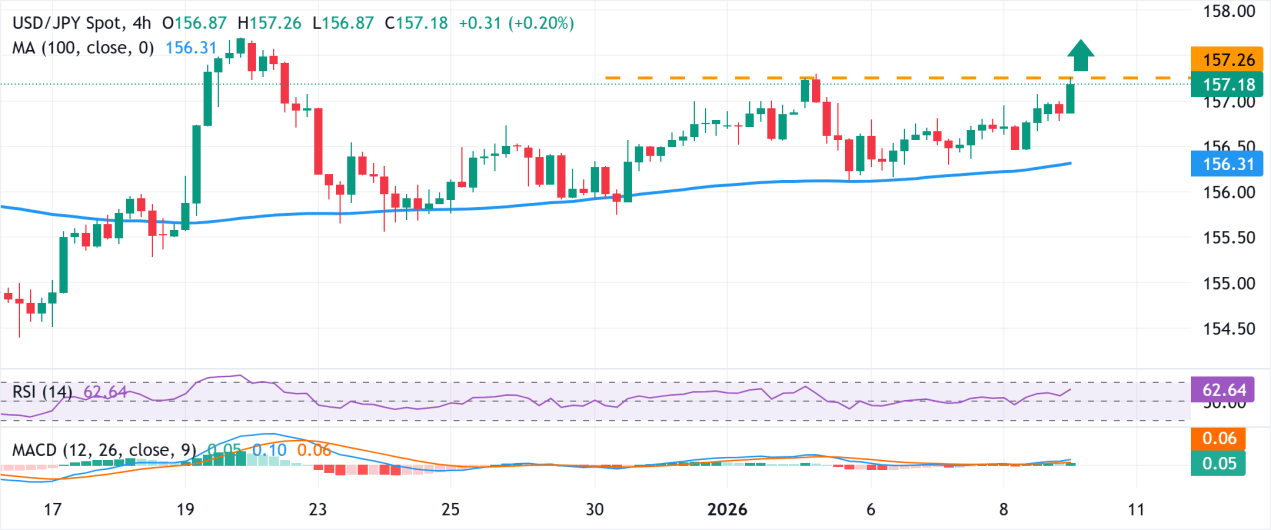
Group 1 - The Japanese yen continues to decline against the US dollar, marking its fourth consecutive day of losses, approaching the lower end of this week's volatility range [1] - Japan's household spending data for November unexpectedly rebounded, showing a year-on-year increase of 2.9%, but this has not reversed the yen's weakness [1] - Real wages in Japan have been declining for 11 consecutive months, with a decrease of 2.8% in November, indicating a persistent imbalance between wages and inflation [1] Group 2 - The weak economic fundamentals are undermining the yen's intrinsic support and pose challenges for the Bank of Japan's policy adjustments [1] - The current Bank of Japan governor retains the potential for further tightening, emphasizing continued rate hikes if economic and price trends align with expectations [1] - Geopolitical tensions, particularly the escalating disputes between China and Japan, have increased supply chain risks for Japanese manufacturers, further pressuring the yen [1] Group 3 - The US dollar has been strengthening over the past two weeks, reaching a one-month high and supporting the dollar-yen exchange rate above the 157.00 mark [2] - Market sentiment and position adjustments ahead of key data releases have contributed to the dollar's strength, although expectations of a potential rate cut by the Federal Reserve in March may limit further gains [3] - Traders are adopting a wait-and-see approach until clearer signals regarding the Federal Reserve's rate cut path emerge, with focus shifting to the upcoming US non-farm payroll report [3] Group 4 - From a technical perspective, the 100-period simple moving average is gently rising to 156.31, providing immediate dynamic support for the current exchange rate [5] - The moving average convergence divergence indicator has returned to positive territory, indicating enhanced bullish momentum, while the relative strength index is at 62, suggesting solid buying pressure [5] - If bullish momentum continues, the exchange rate may rise further, with the 100-period moving average serving as a key support level in case of a pullback [5]

哥伦比亚媒体称高成本与不确定性拖累哥投资
Shang Wu Bu Wang Zhan· 2026-01-08 17:15
Core Viewpoint - Colombia's investment is declining due to high tax burdens, high interest rates, and policy uncertainty, leading to the lowest investment rate in nearly 20 years, projected to drop to 16.1% of GDP by the first half of 2025 [1] Group 1: Investment Trends - The investment rate in Colombia is expected to decrease from 21.9% to 17.6% of GDP between 2020 and 2025, indicating a significant shortfall in capital accumulation [1] - Private consumption is increasingly driving economic growth, rising to 72.6% of GDP during the same period, while investment is lagging [1] Group 2: Government and Public Investment - Public investment's stabilizing effect is diminishing, with government fixed asset investment projected to account for only 2.1% of GDP in the first quarter of 2025 [1] - The construction sector is experiencing a notable decline, particularly in infrastructure and housing investments [1] Group 3: Comparative Analysis - Colombia's investment recovery is significantly lagging behind that of other countries such as Mexico and Chile, suggesting a need for reduced investment costs and stabilized policy expectations to enhance economic growth momentum [1]
“一条推文就能改变外交政策,谁敢去委内瑞拉投资?”美国油企:没担保,不投资
Hua Er Jie Jian Wen· 2026-01-08 14:19
Core Viewpoint - U.S. oil giants are extremely cautious about re-entering the Venezuelan market despite President Trump's pressure for investment, with industry leaders demanding clear legal and financial guarantees from Washington [1][2]. Group 1: Investment Climate - The geopolitical shifts have severely impacted investor confidence, with widespread concerns about political, legal risks, and the low oil price environment hindering substantial investments [2]. - U.S. energy companies believe that without formal government backing, large-scale projects in Venezuela are unlikely to proceed [3]. - A senior executive from a major U.S. energy company emphasized the need for "serious guarantees" from the government before committing to investments in Venezuela [3]. Group 2: Policy Uncertainty - Investors are worried about the continuity of policies beyond the current presidential term, raising concerns about legal, financial, and political risks associated with investing in Venezuela [4]. - Questions about the legitimacy of the Venezuelan government and the legal framework for contracts further exacerbate capital's risk-averse sentiment [4]. - Energy Secretary Chris Wright acknowledged that U.S. oil giants are unlikely to invest billions in new infrastructure in Venezuela in the near term [4]. Group 3: Global Energy Strategy - The Trump administration's takeover of Venezuela's oil sector is viewed as part of a broader agenda to reshape global energy trade according to U.S. terms [5]. - Despite signals from the U.S. government allowing oilfield service companies to operate in Venezuela, industry executives believe that administrative orders and political pressure are insufficient to mitigate actual business risks [5]. - The current environment in Venezuela is still regarded as a "high-risk area" for energy giants accustomed to long-term planning and stable returns [5].


汇丰:预计现货黄金2026年上半年将触及每盎司5000美元
Xin Lang Cai Jing· 2026-01-08 12:22
Core Viewpoint - HSBC's chief precious metals analyst, James Steel, forecasts that gold prices may reach $5,000 per ounce in the first half of this year due to geopolitical risks and rising fiscal debt [1][3]. Group 1: Price Predictions - Short-term gold prices are expected to rise significantly, but the increase will moderate as the year progresses [1][3]. - HSBC anticipates that gold prices will fluctuate between $5,050 and $3,950 per ounce in 2026, with an estimated year-end price of $4,450 [4]. Group 2: Market Drivers - The current price surge is driven by safe-haven buying and risk aversion, partly due to a weak dollar and policy uncertainty [1][3]. - Fiscal concerns and a weakening dollar are expected to support gold prices and limit the extent of any potential pullback [4]. Group 3: Adjustments in Forecast - The average price forecast for 2026 has been revised down from $4,600 to $4,587 [2][5].
禁止机构“买房”、限制军工“分红”,特朗普帖子搅动美股
Hua Er Jie Jian Wen· 2026-01-08 00:33
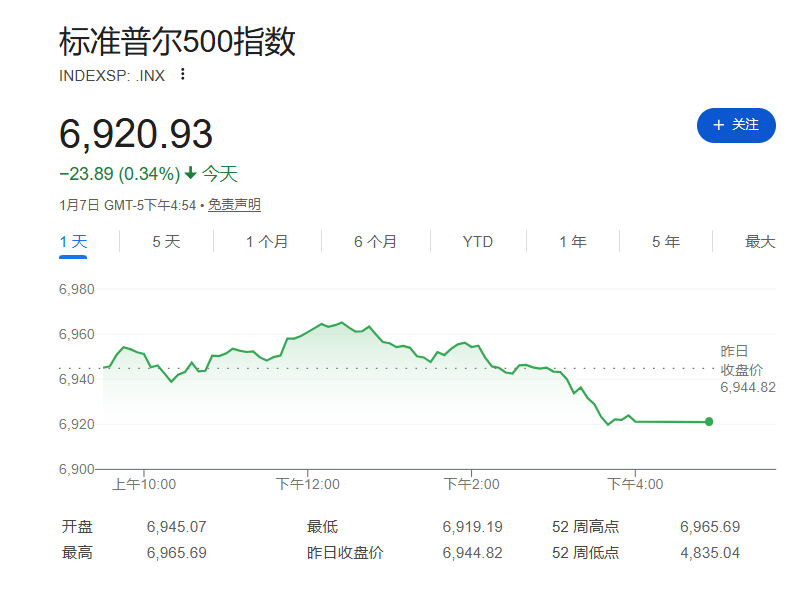
Core Viewpoint - The recent social media posts by President Trump have caused significant volatility in the U.S. stock market, particularly affecting the housing and defense sectors due to policy uncertainty [2][4]. Housing Sector - Trump announced plans to "immediately" prohibit large institutional investors from purchasing single-family homes, aiming to address housing affordability issues. This announcement led to panic selling in related stocks, including major private equity firms and large rental companies [2][4]. - The stock prices of major residential real estate investors like Blackstone and Invitation Homes saw significant declines, with Blackstone dropping as much as 9.3% during trading [6]. - Analysts express skepticism regarding the actual impact of institutional investors on housing affordability, noting that the largest 24 single-family rental owners only account for about 3.5% of the total rental market [10]. Defense Sector - Following the housing announcement, Trump targeted defense contractors, warning them against paying dividends or repurchasing stocks unless they accelerate production and maintenance of military equipment. This led to a decline in defense stocks, including RTX Corp. [8]. - However, after announcing a proposed military budget of $1.5 trillion for 2027, defense stocks rebounded in after-hours trading, indicating a mixed market reaction to Trump's statements [8][10]. Market Reaction - The S&P 500 index experienced a decline of 0.3% after initially approaching the 7000-point mark, reflecting the market's struggle to interpret the implications of Trump's rapid-fire social media communications [2][10]. - Market analysts highlighted the challenges of digesting information released directly via social media without any buffering, suggesting that this could lead to dangerous market adjustments [10].
高盛2026投资展望:十大主题揭秘,中国崛起与AI转型引领增长
Sou Hu Cai Jing· 2026-01-04 08:29
Core Insights - Goldman Sachs has released its annual investment outlook for 2026, highlighting ten key themes to watch in the coming year, with a focus on China's unexpected growth driven by technological advancements and sustained export advantages [1][3] Group 1: Key Investment Themes - The core investment themes for 2026 include technological innovation, breakthroughs in pharmaceuticals, reshaping of trade patterns, and adjustments in energy structures [3] - "The Rise of China" is one of the ten themes, emphasizing the impact of China's economic recovery on global trade and technology [3] - Other notable themes include the deepening of AI infrastructure, shifts in pharmaceutical research focus, blurring lines between physical and online commerce, productivity-driven profit growth, the rise of alternative investments, militarization trends, humanoid robots and autonomous vehicles, nuclear energy revival, and the emergence of rare earth elements [3][4] Group 2: Specific Sector Insights - In the AI sector, there is a significant transformation in investment focus towards data centers, targeting companies that can support global computing power regardless of chip type [3] - In pharmaceuticals, the GLP-1 weight loss drug market is diversifying, with investment attention shifting to new weight loss products expected to gain approval next year, and a transition in biopharmaceutical focus from obesity drugs to a "cardiology revival" [3] - The report highlights advancements in manufacturing capabilities for hardware that can simulate daily activities, assessing the potential profit growth for leading industrial tech companies like Tesla due to humanoid robot development [4] - China is noted to be leading in the autonomous vehicle sector, with projections indicating that the market for self-driving taxis in China could reach $47 billion by 2035 [4] Group 3: Policy and Market Sentiment - The report emphasizes that policy direction will be a significant market theme as 2026 approaches, with potential impacts from Federal Reserve policies and Supreme Court rulings on tariffs shaping market sentiment [4]

帮主郑重年度预判:2026,十字路口的抉择与布局
Sou Hu Cai Jing· 2026-01-04 08:20
Group 1 - The core prediction regarding "AI bubble" highlights a divide between warnings of potential overvaluation due to high interest rates and the assertion that AI investments have driven all GDP growth in the U.S., indicating a significant transformation in productivity and sales [3][4] - The predictions about the "Federal Reserve dilemma" and "U.S. stock market direction" reveal dramatic tensions, with forecasts ranging from a 14% increase to a 20% potential decline, reflecting the uncertainty between policy and corporate earnings resilience [3][4] - Predictions about "quantum computing disrupting cryptocurrencies" and "brain-computer interfaces coming to the forefront" suggest a nearing technological singularity that could revolutionize existing business models and highlight vulnerabilities in current technologies [4][5] Group 2 - The forecast for gold prices reaching $10,000 contrasts with warnings of a potential major economic crisis in 2026, illustrating a dual narrative of distrust in fiat currency and concerns over geopolitical conflicts driving demand for precious metals [4][5] - The overall sentiment indicates that 2026 will be a year of complex variables and significant turning points, requiring investors to navigate a landscape of uncertainty rather than binary choices [5][6] - The recommended investment strategy emphasizes "balanced allocation" between technology and physical assets, focusing on "realization capability" of companies, and maintaining "strategic patience" in a volatile market environment [6]

民调:美国人对自身财务状况更趋悲观
Xin Hua She· 2025-12-30 11:59
Group 1 - The core viewpoint of the article highlights that nearly half of the surveyed Americans believe their financial security is deteriorating due to high inflation and policy uncertainty [1] - A growing number of respondents attribute their financial challenges to the policies of the U.S. government [1]
今日期货市场重要快讯汇总|2025年12月30日
Xin Lang Cai Jing· 2025-12-30 00:25
Group 1: Precious Metals Futures - New York gold prices experienced significant volatility, dropping below $4420 per ounce on December 29, with a daily decline of 2.92%, and further falling to $4330 per ounce, expanding the daily loss to 4.93% [1][6] - On December 30, New York gold initially broke above $4360 per ounce, with a daily increase of 0.38%, but later fell below $4340 per ounce, resulting in a daily decline of 0.09% [1][6] - Spot gold also showed large fluctuations, falling below $4310 per ounce on December 29, with a daily drop of 5.03%, and then rising above $4340 per ounce on December 30, with a daily increase of 0.21% [1][6] - New York silver similarly experienced a volatile market, dropping below $71 per ounce on December 29, with a daily decline of 8.25%, and rebounding above $72 per ounce on December 30, with a daily increase of 2.20% [1][7] - Spot silver fell below $71 per ounce on December 29, with a daily drop of 10.31% [1][7] - Palladium futures fell below $1700 per ounce on December 29, with a significant drop of 15.98% [2][7] Group 2: Base Metals Futures - Base metals futures faced widespread pressure, with copper futures dropping 4% on December 29, now priced at 96420.00 yuan [3][8] - Tin futures showed extreme volatility, initially dropping 5% (to 325220.00 yuan), then 6% (to 321750.00 yuan), and ultimately closing down 7% at 318370.00 yuan [3][8] Group 3: Energy and Shipping Futures - U.S. crude oil futures closed at $58.08 per barrel on December 29, an increase of $1.34, or 2.36% [4][9] - The U.S. Energy Information Administration (EIA) announced a delay in the release of the weekly oil status report, with notifications to be provided at least one hour in advance [4][9] - For the week ending December 19, EIA reported a decrease in natural gas inventories by 1660 billion cubic feet, slightly above the expected decrease of 1680 billion cubic feet [4][9] Group 4: Macro and Market Impact - The volatility in precious metals and metal futures may be linked to geopolitical factors and market sentiment [5][10] - U.S. Congressman Green criticized both parties for their roles in the growth of national debt and the depreciation of the dollar, while Trump mentioned considering legal action against Federal Reserve Chairman Powell, increasing policy uncertainty and market volatility [5][10] - In the U.S. stock market, the Dow opened down 0.2% on December 29, with the S&P 500 down 0.5% and the Nasdaq down 0.8%, while silver mining stocks generally declined, with the Invesco Silver Trust down 7.3% [5][10] - On December 30, all three major U.S. stock indices closed lower, with the Dow down 0.51%, Nasdaq down 0.5%, and S&P down 0.35% [5][10]
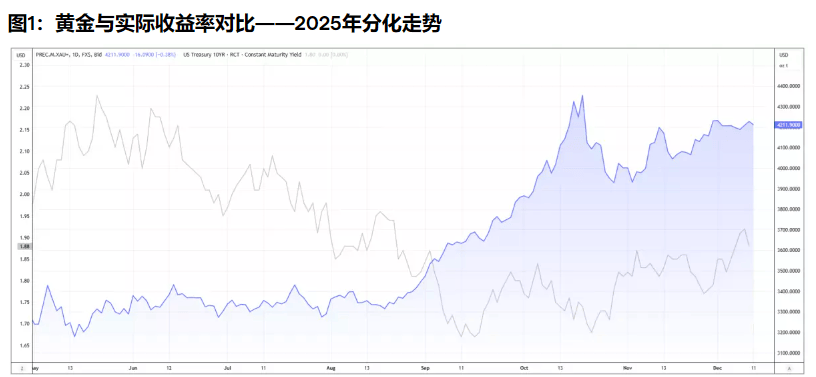
智昇研究:金价在2025年创纪录上涨后,涨势能否持续?
Sou Hu Cai Jing· 2025-12-25 12:25
Core Insights - The gold market is entering 2026 with strong momentum driven by structural demand rather than speculative trading, despite a thin market participation [1][4] - The primary drivers for gold price increases in 2024-2025 are policy uncertainties, high government spending, persistent inflation pressures, and declining real yields [1][9] - Central banks remain a significant structural support for gold, with many maintaining over 50% of their reserves in gold, indicating substantial reallocation potential [4][6] Demand Dynamics - Central banks are increasingly viewing gold as a long-term diversification asset rather than a short-term hedge, with countries like Turkey, Russia, and India actively accumulating gold [6] - The demand from central banks is characterized as structural rather than cyclical, with consistent purchasing even during price increases [6] Price Projections - Major banks project gold prices to range between $4,500 and $4,700 per ounce for 2026, with potential to reach $5,000 if macroeconomic conditions remain loose [9] - The outlook for gold prices is not contingent on crises but rather on maintaining the current state of high debt, policy uncertainty, and a weakening dollar [9]