
有色金属

Search documents
最新调仓路径显现基金经理关注确定性与安全边际
Zhong Guo Zheng Quan Bao· 2026-01-21 21:08
Group 1 - The core viewpoint of the article highlights significant portfolio adjustments by well-known fund managers in anticipation of growth in sectors such as AI, non-ferrous metals, and lithium battery materials for 2026 [1][2][4] - Fund manager Fu Pengbo indicates that high-growth sectors like AI and non-ferrous metals are expected to perform well, while also noting the importance of reducing investment uncertainties in the upcoming quarter [2][4] - Fund manager Li Xiaoxing emphasizes that AI remains a key driver of global technological innovation, with expectations for stable growth in the performance of major domestic internet companies [4][5] Group 2 - The report details that Fu Pengbo and Zhu Lin's fund made minor changes in their top ten holdings, replacing China Mobile with Maiwei Co., and increasing positions in Han's Robotics while reducing stakes in several major companies [1][2] - Fund manager Li Xiaoxing's Silver华心怡 fund saw significant adjustments, with new entries including Tencent, Alibaba, and Meituan, while exiting positions in China Mobile and HSBC [2][3] - Fund manager Gao Nan's Yongying Ruixin fund also made notable changes, adding new stocks such as WISCO and Haier, while increasing holdings in Zhongfu Industrial and reducing stakes in other companies [2][3] Group 3 - Gao Nan focuses on selecting stocks based on growth potential and performance realization, aiming for diversification within the portfolio while capturing growth opportunities [3] - Yang Jinjing adopts a contrarian investment approach, seeking undervalued stocks and avoiding following irrational market trends, focusing on companies at turning points [3] - Yang Jinjing notes a shift in the core contradictions of the domestic equity market, highlighting the disparity between high valuations of growth stocks and the undervaluation of leading blue-chip companies [3] Group 4 - Yang Jinjing anticipates that as PPI data improves, leading companies will leverage competitive advantages to achieve long-term performance turning points, resulting in a "Davis double play" for blue-chip stocks [4] - Li Xiaoxing believes that the overall opportunities in the domestic equity market outweigh risks, with a focus on AI as a central theme for innovation and growth [4][5] - Li Xiaoxing also sees potential in the domestic consumer sector, particularly in high-quality consumer stocks with favorable dividend yields, while maintaining a long-term positive outlook on the domestic innovative pharmaceutical sector [5]
黄金+有色金属+锂电材料,2天2板!2天上涨21.05%!还有机会吗?
Sou Hu Cai Jing· 2026-01-21 10:00
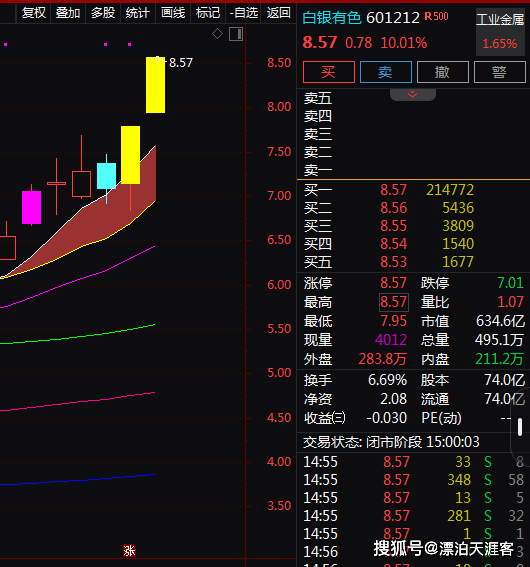
一、热门个股解读——白银有色(601212) | 复权 叠加 | 案后 | 统计 | 画光 | 标记 -自选 返回 | | | 白银有色 601212 R500 | | 工业会屋 | | | --- | --- | --- | --- | --- | --- | --- | --- | --- | --- | --- | | | | | | < | | | 8.57 0.78 10.01% | | 1.65% | | | | | | | | 8.50 | | | | | | | | | | 8.57 | | | 深 | 机 | 撒 | alu | | | | | | | | 8.00 | 交 | | | | | | | | | | | | 卖四 | | | | | | | | | | | | 英三 | | | | | | | | | | | 7.50 | 卖 | | | | | | | | | | | | 英 | | | | | | | | | | | 7.00 | | | | | | | | | | | | | 天天 | 8.57 8.56 | 214772 2436 | | | | | | | | | | ...


英华号周播报|具身智能新风口来了!2026有色金属还值得投吗?
中国基金报· 2026-01-21 09:39
# " 当期热文 NO.1 华夏基金 研究加快培育服务消费新增长点!三分钟看完周末发生了什么 NO.2 鹏扬基金 鹏扬市场观点:央行组合拳稳物价、调结构,降息有空间,基准利率或向隔夜"换锚" NO.3 中信保诚基金 2026,预见|科技篇:竞合突围——算力时代的供应链重构与瓶颈约束 (点击文章标题跳转原文,下同) # " 热转好文 NO.1 景顺 前景有方 | 屏幕背后:驱动娱乐的基础设施 NO.2 富达基金 全球视野|继续看好中国科技股后市表现,AI仍是美国经济扩张主要引擎-1月月度观察 NO.3 天风证券投资者教育基地 ETF课堂 | ETF入门课堂vol.96 中证全指电力公用事业指数有何亮点? # " 趣投教 NO.1: 中国基金报 #湾区创客说 # 机器人装上"指尖大脑",具身智能新风口来了!中国企业领跑触觉革命 NO.2: 中国基金报 #理财师不会告诉你的事# 2026有色金属还值得投吗? 瑞银证券研究部主管 徐宾: 2026年中国企业出海目的地和产品类型越发多元,重点关注汽车、工程 机械及消费品的出海机会 #博时基金# 丙午奋蹄投资路,红启东方十五五——博时基金2026投资策略会 NO.3: 瑞 ...

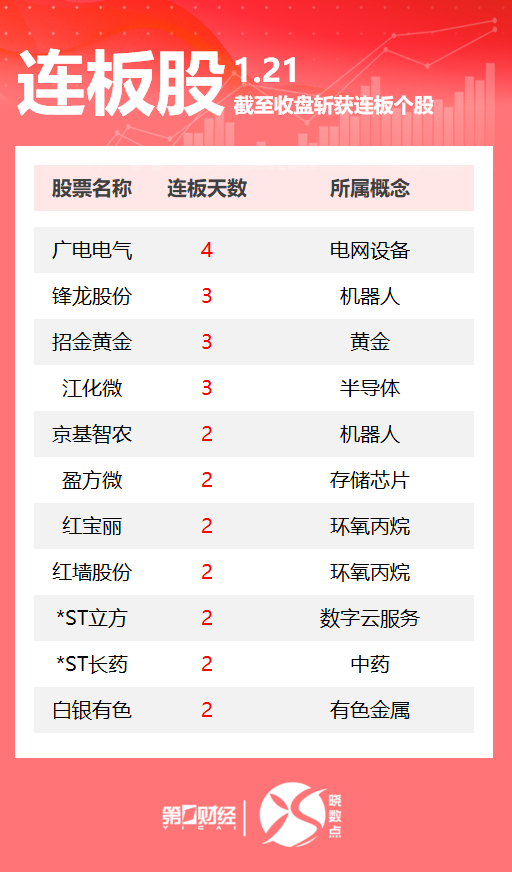
连板股追踪丨A股今日共91只个股涨停 这只黄金股3连板
Di Yi Cai Jing· 2026-01-21 08:24
Group 1 - The core viewpoint of the article highlights the performance of various stocks in the A-share market, with a total of 91 stocks hitting the daily limit up on January 21 [1] - The stock "Guangdian Electric" in the power grid equipment sector achieved a four-day consecutive limit up [1] - "Zhaojin Gold" in the gold sector recorded a three-day consecutive limit up, while "Hongbaoli" and "Hongqiang Co." in the epoxy propylene concept both achieved a two-day consecutive limit up [1] Group 2 - The article provides a detailed list of stocks with consecutive limit ups, including "Fenglong Co." with three days in the robotics sector and "Jianghua Micro" also with three days in the semiconductor sector [1] - Other notable stocks include "Jingji Zhino" and "Yingfang Micro" with two days in the robotics and storage chip sectors respectively, and "ST Cube" and "ST K Medicine" with two days in digital cloud services and traditional Chinese medicine sectors respectively [1] - The article also mentions "Baiyin Youse" in the non-ferrous metals sector achieving two days of consecutive limit up [1]
睿远基金旗下产品最新重仓股曝光:傅鹏博加仓寒武纪,赵枫买回美的
Sou Hu Cai Jing· 2026-01-21 03:57
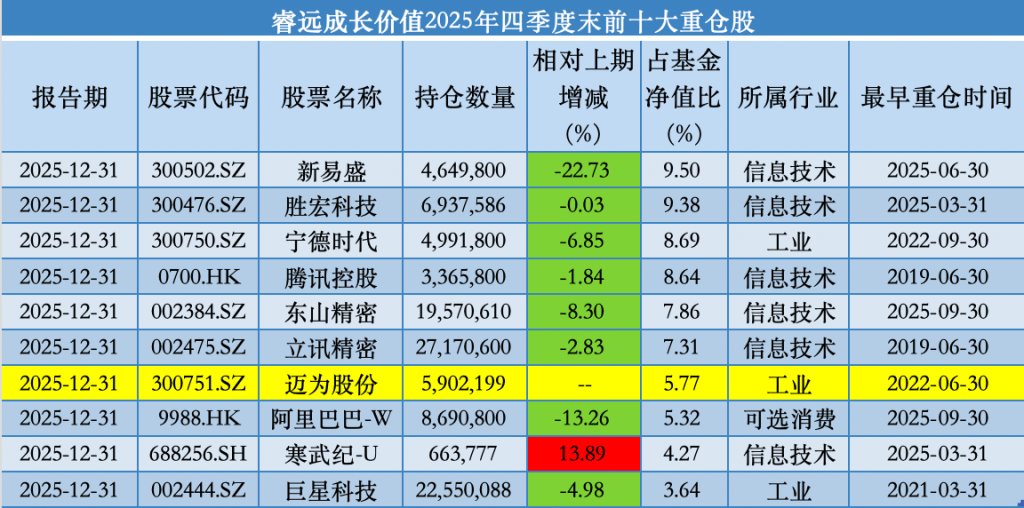
Core Viewpoint - The report highlights significant changes in the investment strategies of Ruiyuan Fund's star fund managers, with notable adjustments in stock holdings and performance metrics for the fourth quarter of 2025. Group 1: Fund Performance and Adjustments - Ruiyuan Growth Value Mixed Fund experienced a net redemption of 136.2 million shares, marking the second-highest redemption in its history, with total net assets decreasing from 23.629 billion yuan to 21.087 billion yuan [3][4] - The fund's stock allocation increased slightly from 89.93% to 90.48%, while the proportion of Hong Kong stocks in the fund's net value decreased from 27.92% to 20.14% [3][4] - Ruiyuan Balanced Value Three-Year Holding Fund's stock allocation reached a three-year high of 90.66%, with a slight increase in the proportion of Hong Kong stocks to 41.99% [10] Group 2: Stock Holdings and Changes - The top ten holdings of Ruiyuan Growth Value Mixed Fund included New Yisheng, Shenghong Technology, and Ningde Times, with New Yisheng seeing a 22.73% reduction in holdings [4][5] - Ruiyuan Balanced Value Three-Year Holding Fund saw significant changes, with the re-entry of Midea Group into the top ten holdings and reductions in holdings of companies like Lixun Precision and China Ping An [10][12] - The fund managers noted a shift in focus towards sectors like photovoltaic and semiconductor high-end equipment manufacturing, while reducing exposure to companies with weak fundamentals [6][10] Group 3: Future Outlook and Strategy - The fund managers expressed optimism about the market, anticipating that the return on equity assets will remain attractive compared to other asset classes, with potential returns exceeding 10% for leading companies [11][13] - They plan to focus on companies with strong fundamentals and competitive advantages, particularly those expanding overseas, as this is expected to drive future growth [13][14] - The report indicates a structural market environment with limited risks of significant downturns, while opportunities for excess returns remain [8][13]






股债震荡“固收+”热度攀升,红利、港股科技成增强主线
Di Yi Cai Jing Zi Xun· 2026-01-20 10:41
Core Insights - The increasing interest in "fixed income +" products reflects investors' desire for stable returns amid a low-interest-rate environment and market volatility [1][3][5] - "Fixed income +" products have seen significant growth, with market size increasing from 1.6 trillion yuan at the end of Q4 2024 to 2.5 trillion yuan by Q3 2025, marking a 52% increase [3][4] Market Trends - The bond market has faced pressure, with the 10-year government bond yield fluctuating above 1.8%, while equity markets have shown active performance, with the Shanghai Composite Index surpassing 4000 and 4100 points [2][6] - The average return for pure bond funds since the beginning of the year is only 0.11%, with some funds experiencing significant losses, indicating a challenging environment for traditional bond investments [2][6] Investor Sentiment - Investors are increasingly cautious yet optimistic, seeking products that balance risk and return, which aligns with the characteristics of "fixed income +" offerings [3][5] - The demand for "fixed income +" products is driven by both institutional and retail investors, highlighting a shift in wealth allocation strategies [4][5] Product Development - The "fixed income +" product matrix is diversifying, with offerings categorized by risk-return profiles and thematic strategies, such as "fixed income + technology" and "fixed income + dividends" [5][6] - Fund managers are focusing on enhancing product features to meet varying investor needs, with a particular emphasis on low to medium volatility strategies [6][7] Future Outlook - The bond market is expected to remain volatile, while the equity market may present structural opportunities, suggesting that "fixed income +" products will continue to attract attention as a new avenue for wealth reallocation [6][7] - The emphasis on strategy differentiation within the industry is likely to become more pronounced, with a focus on maintaining absolute return strategies to build long-term investor trust [7]
大资金减轻“压盘” 高位股打开跌停!A股稳住了?
Mei Ri Jing Ji Xin Wen· 2026-01-19 07:27
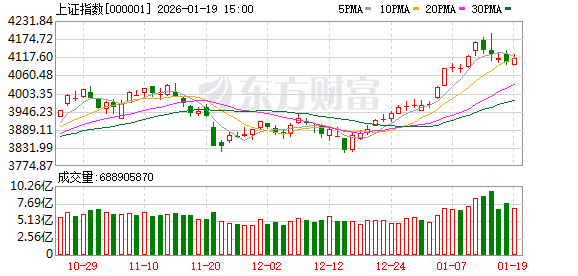
Market Overview - The three major indices showed mixed performance, with the Shanghai Composite Index rising by 0.29% and the ChiNext Index falling by 0.7% [2] - Over 3,500 stocks in the market experienced gains, while the total trading volume in the Shanghai and Shenzhen markets was 2.71 trillion yuan, a decrease of 317.9 billion yuan from the previous trading day [2] Sector Performance - Leading sectors included electric grid equipment, robotics, tourism and hotels, and precious metals, while the CPO concept faced declines [2] - The average stock price of the entire A-share market continued to rise, reaching the high point of the previous week [5] Fund Flow and ETF Activity - There was a notable reduction in heavy selling pressure from large funds in several major ETFs, indicating a potential stabilization in the market [7] - The trading volume of the Huatai-PB CSI 300 ETF was 13.793 billion yuan, showing a significant decrease in selling activity compared to previous days [7] Market Sentiment and Stock Performance - The number of stocks hitting the daily limit down decreased to 30, down from 72 and 61 in the previous two trading days, indicating a potential recovery in market sentiment [15] - Stocks such as Jin Feng Technology and Yan Shan Technology saw significant trading activity, with Jin Feng Technology recovering to a closing gain of 2.44% [13][12] Institutional Insights - Citic Securities noted that the recent market cooling is a strategic move to manage the bull market's pace, suggesting that the overall market sentiment remains positive despite short-term adjustments [17] - Guosheng Securities indicated that the market's short-term adjustment may be nearing completion, with a likelihood of continued upward movement in the near future [18]
中信建投证券:本次主动降温不影响跨年行情的整体格局
Xin Hua Cai Jing· 2026-01-19 05:57
Core Viewpoint - The recent proactive cooling measures in the market aim to mitigate potential short-term severe consequences of an overheated market while maintaining a positive long-term outlook [1] Industry Analysis - The proactive cooling does not affect the overall pattern of the year-end market, but it may alleviate previously overheated conditions, leading to changes in trading directions [1] - Key sectors showing significant growth catalysts include AI computing power, non-ferrous metals, innovative pharmaceuticals, and the automotive industry [1] - Previous market hotspots such as commercial aerospace and AI applications may undergo phase adjustments, prompting attention to other thematic areas like ultra-high voltage, brain-computer interfaces, and controllable nuclear fusion [1]

宏观金融类:文字早评2026/01/19-20260119
Wu Kuang Qi Huo· 2026-01-19 00:58
1. Report Industry Investment Rating No investment rating information is provided in the report. 2. Core Viewpoints of the Report - For the stock index, with the entry of incremental funds at the beginning of the year, the financing scale has risen significantly, and market trading volume has rapidly expanded. In the long - term, policy support for the capital market remains unchanged. In the short - term, attention should be paid to market rhythm, and the strategy should be based on buying on dips [4]. - For treasury bonds, the economic recovery momentum's sustainability needs further observation, and domestic demand still awaits the stabilization of residents' income and policy support. The central bank's attitude towards capital protection remains, and the capital market is expected to be stable. The bond market is expected to continue to fluctuate in the first quarter [7]. - For precious metals, the short - term driving force for gold and silver prices is weakening, but in the medium - term, the Fed's subsequent interest rate cuts and other factors may lead to a significant increase in prices. It is recommended to buy on dips [9]. - For non - ferrous metals, although the market sentiment is cooling, the financial market liquidity in the US is still expected to be loose. The copper market has a tight supply of copper ore but a relative surplus of refined copper, so the price is expected to be volatile. The aluminum market is restricted by the high - level of US aluminum spot premium and low inventory, and the price is expected to be relatively firm. Zinc and lead prices have the potential to catch up, and nickel and tin prices are expected to be volatile. The price of lithium carbonate has large fluctuations, and it is recommended to wait and see or take a light - position approach. The price of alumina is expected to be weak, and it is recommended to wait and see or short on rallies. The stainless steel market is expected to be strong in the short - term, and the price is expected to fluctuate at a high level. The price of cast aluminum alloy is expected to fluctuate and consolidate [12][14][17][19][22][24][26][29][30][33]. - For black building materials, the steel market is in a bottom - oscillating pattern, and attention should be paid to the de - stocking progress of hot - rolled coils and the impact of "dual - carbon" policies. The iron ore price is supported but may oscillate at a high level, and attention should be paid to steel mills' restocking and iron - making production rhythm. The coking coal and coke prices are expected to be oscillating and strong, but attention should be paid to market sentiment fluctuations. The glass market is expected to have a wide - range oscillation, and the soda ash market is expected to be weakly sorted. The manganese - silicon and silicon - iron prices are affected by market sentiment and cost factors, and attention should be paid to relevant policies. The industrial silicon price is expected to be weakly oscillating, and the polysilicon price is expected to fluctuate in the short - term [36][39][43][45][47][50][51][54][56]. - For energy and chemical products, the rubber price is seasonally weak, and a short - selling strategy is recommended if it breaks through a certain level. The oil price is not recommended to be overly short - sold in the short - term, and a range - trading strategy is maintained. The methanol price has limited downward space and is suitable for buying on dips. The urea price is expected to be bearish, and it is recommended to take profits on rallies. For pure benzene and styrene, it is recommended to go long on the non - integrated profit of styrene before the first quarter. The PVC price is fundamentally poor, and a short - selling strategy is recommended in the medium - term. The ethylene glycol price is expected to compress the valuation in the medium - term. The PTA price is expected to accumulate inventory during the Spring Festival, and there are long - term opportunities. The PX price is expected to accumulate inventory before the maintenance season and has long - term opportunities. The polyethylene and polypropylene prices are affected by supply and demand, and relevant trading strategies are recommended [61][63][66][68][70][73][75][77][79][81][84]. - For agricultural products, the short - term price of live pigs may be strong in the near - term, but the medium - term price is under pressure. The egg price is expected to oscillate, with limited upward and downward space. The protein meal price has increased short - term volatility due to multiple negative factors. The short - term outlook for edible oils is weak, but the long - term outlook is optimistic. The sugar price may rebound after the northern hemisphere's harvest, and it is recommended to wait and see. The cotton price is affected by domestic factors, and it is recommended to wait for a callback to go long [87][89][92][95][98][101]. 3. Summary by Relevant Catalogs 3.1 Stock Index - **Market Information**: The A - share market should aim for a long - term bull market rather than a "crazy bull market." The commercial aerospace sector has new developments, and the Spring Festival Gala has completed its first rehearsal. The State Council has studied consumption - promotion measures [2]. - **Basis - Point Ratio of Stock Index Futures**: The basis - point ratios of IF, IC, IM, and IH for different contract periods are provided [3]. - **Strategy Viewpoint**: With the entry of incremental funds at the beginning of the year, the financing scale has increased significantly, and market trading volume has rapidly expanded. The policy support for the capital market remains unchanged in the long - term. In the short - term, attention should be paid to market rhythm, and the strategy should be based on buying on dips [4]. 3.2 Treasury Bonds - **Market Information**: The prices of TL, T, TF, and TS main contracts have changed. The China Securities Regulatory Commission has emphasized market stability, and there are speculations about the next Fed Chairman [5]. - **Liquidity**: The central bank has conducted 867 billion yuan of 7 - day reverse repurchase operations, resulting in a net injection of 527 billion yuan [6]. - **Strategy Viewpoint**: The economic recovery momentum's sustainability needs further observation, and domestic demand still awaits the stabilization of residents' income and policy support. The central bank's attitude towards capital protection remains, and the capital market is expected to be stable. The bond market is expected to continue to fluctuate in the first quarter [7]. 3.3 Precious Metals - **Market Information**: The prices of Shanghai gold and silver have declined, and the prices of COMEX gold and silver have also changed. The expected candidate for the new Fed Chairman has changed, weakening the expectation of significant interest rate cuts by the Fed this year, leading to a short - term correction in gold and silver prices [8]. - **Strategy Viewpoint**: The short - term driving force for gold and silver prices is weakening, but in the medium - term, the Fed's subsequent interest rate cuts and other factors may lead to a significant increase in prices. It is recommended to buy on dips, with the reference operating range of 985 - 1100 yuan/gram for Shanghai gold and 19050 - 23688 yuan/kilogram for Shanghai silver [9]. 3.4 Non - Ferrous Metals Copper - **Market Information**: The copper price has fallen, LME copper inventory has increased, and domestic inventory has also changed. The spot discount of copper has returned, and the import loss has narrowed [11]. - **Strategy Viewpoint**: The expectation of Trump imposing tariffs on key minerals has weakened, and the plan to impose tariffs on 8 European countries has cooled market sentiment, but the expectation of loose liquidity in the US financial market remains. The supply of copper ore is tight, but the supply of refined copper is relatively surplus. The copper price is expected to be in a volatile state, with the reference range of 98000 - 102000 yuan/ton for Shanghai copper and 12500 - 13000 US dollars/ton for LME copper [12]. Aluminum - **Market Information**: The aluminum price has continued to fall, the trading volume has decreased, and the inventory has changed. The spot discount of electrolytic aluminum has expanded, and the LME aluminum inventory has decreased [13]. - **Strategy Viewpoint**: The continuous accumulation of domestic aluminum ingot inventory and the cooling of the precious metals and copper markets have caused the aluminum price to fall back. However, the high premium of US aluminum spot and the low LME global aluminum inventory limit the downward space of the aluminum price. As the price corrects, the downstream inventory is expected to increase, and the aluminum price may be relatively firm in the short - term, with the reference range of 23800 - 24200 yuan/ton for Shanghai aluminum and 3090 - 3160 US dollars/ton for LME aluminum [14]. Zinc - **Market Information**: The zinc price has fallen, and relevant information on inventory, basis, and other aspects is provided [15][16]. - **Strategy Viewpoint**: The port inventory of zinc ore has slightly decreased, and the import TC of zinc concentrate has also slightly decreased. The zinc price has a certain potential to catch up compared with copper and aluminum. The zinc price is currently in the process of following the sector to catch up on the macro - attribute, and it is necessary to observe the trend of leading varieties in the sector and the situation of the Shanghai - London ratio [17]. Lead - **Market Information**: The lead price has fallen, and relevant information on inventory, basis, and other aspects is provided [18]. - **Strategy Viewpoint**: The apparent inventory of lead concentrate has decreased, and the operating rates of primary and recycled lead have increased. The lead supply has increased marginally, and the inventory has accumulated. The lead price is approaching the upper limit of the long - term oscillation range, and the contradiction between long and short positions of macro - funds and industrial - seat funds has increased. It is necessary to observe the trend of leading varieties in the sector and the situation of the Shanghai - London ratio [19]. Nickel - **Market Information**: The nickel price has significantly corrected, and the spot premium and cost have changed [20][21]. - **Strategy Viewpoint**: The oversupply pressure of nickel remains high, but macro - level factors such as loose domestic liquidity and the Indonesian government's plan to reduce RKAB quotas support the price. The Shanghai nickel price is expected to oscillate widely in the short - term, and it is recommended to wait and see. The reference operating range is 130,000 - 160,000 yuan/ton for Shanghai nickel and 16,000 - 19,000 US dollars/ton for LME nickel [22]. Tin - **Market Information**: The tin price has significantly corrected, the supply situation has changed, and the inventory has increased [23]. - **Strategy Viewpoint**: The tin market has weak demand, but the downstream inventory is at a low level. The price is expected to fluctuate with market sentiment. It is recommended to wait and see, with the reference operating range of 360,000 - 430,000 yuan/ton for the domestic main contract and 45,000 - 53,000 US dollars/ton for overseas LME tin [24]. Lithium Carbonate - **Market Information**: The price of lithium carbonate has fluctuated greatly, and relevant price and inventory information is provided [25]. - **Strategy Viewpoint**: The market sentiment of lithium carbonate has fluctuated significantly, and the price has risen and then fallen. The fundamental improvement expectation has been fully traded, and there is still a certain emotional premium. The price has large fluctuations, and it is recommended to wait and see or take a light - position approach. The reference operating range of the main contract of Guangzhou Futures Exchange is 139,500 - 149,000 yuan/ton [26]. Alumina - **Market Information**: The alumina price has fallen, the trading volume has decreased, and relevant information on basis, inventory, and ore price is provided [28]. - **Strategy Viewpoint**: After the rainy season, the shipment from Guinea has gradually recovered, and the AXIS mine has resumed production, so the ore price is expected to oscillate downward. The alumina smelting capacity is in an over - supply situation, and the inventory accumulation trend continues. It is recommended to wait and see, and it is not cost - effective to go long. It is advisable to wait for an opportunity to short the near - term contract on rallies. The reference operating range of the domestic main contract AO2605 is 2650 - 2800 yuan/ton [29]. Stainless Steel - **Market Information**: The stainless - steel price has fallen, the trading volume has decreased, and relevant information on spot price, raw material price, and inventory is provided [30]. - **Strategy Viewpoint**: The supply of nickel ore is expected to be tight, and the stainless - steel market has shown a situation of increasing volume and price. The supply is restricted by raw materials, and the demand is affected by price. In the short - term, the market is expected to remain strong, and the price is expected to fluctuate at a high level, with the reference range of 13900 - 14650 yuan/ton for the main contract [30]. Cast Aluminum Alloy - **Market Information**: The price of cast aluminum alloy has continued to fall, the trading volume has decreased, and relevant information on inventory and price difference is provided [31][32]. - **Strategy Viewpoint**: The cost of cast aluminum alloy is relatively strong, and the supply is disturbed. The demand is relatively average, so the price is expected to oscillate and consolidate in the short - term [33]. 3.5 Black Building Materials Steel - **Market Information**: The prices of rebar and hot - rolled coil have changed, and relevant information on registered warehouse receipts, trading volume, and spot price is provided [35]. - **Strategy Viewpoint**: The steel market is in a bottom - oscillating pattern. The output of hot - rolled coils has slightly increased, and the apparent demand has improved, but the inventory is still at a high level. The apparent demand of rebar has increased significantly, and the output is at a medium level. Attention should be paid to the de - stocking progress of hot - rolled coils and the impact of "dual - carbon" policies [36]. Iron Ore - **Market Information**: The iron - ore price has decreased slightly, and relevant information on inventory, basis, and trading volume is provided [37]. - **Strategy Viewpoint**: The overseas iron - ore shipment has decreased, the near - end arrival volume has increased, the demand for iron ore has decreased slightly, the port inventory has continued to accumulate, and the steel mills' inventory has increased. The iron - ore price is supported but may oscillate at a high level, and attention should be paid to steel mills' restocking and iron - making production rhythm [39]. Coking Coal and Coke - **Market Information**: The prices of coking coal and coke have fallen, and relevant information on spot price, basis, and technical form is provided [40][41]. - **Strategy Viewpoint**: The prices of coking coal and coke have oscillated and fallen, mainly due to the decline of market sentiment. In the future, the overall market sentiment is expected to be bullish, but there may be short - term fluctuations. The supply and demand of coking coal and coke are relatively balanced, but the steel mills' restocking willingness is not strong. The prices are expected to be oscillating and strong, but attention should be paid to market sentiment fluctuations [42][43]. Glass and Soda Ash - **Market Information**: The glass price has increased, the inventory has decreased, and the trading volume has changed. The soda - ash price has decreased slightly, the inventory has slightly increased, and the trading volume has changed [44][46]. - **Strategy Viewpoint**: The glass market has a loose supply - demand balance, and the price is expected to oscillate widely, with the reference range of 1015 - 1200 yuan/ton for the main contract. The soda - ash market has a weak supply - demand pattern, and the price is expected to be weakly sorted, with the reference price range of 1123 - 1310 yuan/ton for the main contract [45][47]. Manganese - Silicon and Silicon - Iron - **Market Information**: The prices of manganese - silicon and silicon - iron have fallen, and relevant information on spot price, basis, and technical form is provided [49]. - **Strategy Viewpoint**: The prices of manganese - silicon and silicon - iron have fallen due to the decline of market sentiment. The supply and demand of manganese - silicon are not ideal, and the supply and demand of silicon - iron are relatively balanced. The future market is affected by market sentiment and cost factors, and attention should be paid to relevant policies [50][51]. Industrial Silicon and Polysilicon - **Market Information**: The industrial - silicon price has fallen, and relevant information on spot price, basis, and trading volume is provided. The polysilicon price has increased, and relevant information on spot price, basis, and trading volume is provided [52][55]. - **Strategy Viewpoint**: The industrial - silicon price is expected to be weakly oscillating due to the decrease in supply and demand. The polysilicon market has a situation of upstream game and downstream policy - driven expectation, and the supply pressure is expected to ease. The price is expected to fluctuate in the short - term, and attention should be paid to spot trading and exchange risk - control measures [54][56]. 3.6 Energy and Chemical Products Rubber - **Market Information**: The rubber price has oscillated and weakened, and there are different views on the rise and fall of the price. The tire factory's operating rate has increased, and the inventory has changed [58][59]. - **Strategy Viewpoint**: The rubber price is seasonally weak. A short - selling strategy is recommended if the RU2605 contract breaks below 16,000. It is recommended to partially build a position in the strategy of buying the NR main contract and short - selling the RU2609 contract
中信建投:本次主动降温不影响跨年行情整体格局
Sou Hu Cai Jing· 2026-01-19 00:40
Core Insights - The report from CITIC Securities analysts indicates that the recent market cooling is a strategic move to mitigate potential short-term consequences of an overheated market, while maintaining a positive long-term outlook [1] - The proactive cooling does not alter the overall trend of the year-end market, but it may alleviate previously overheated conditions and shift the direction of capital trading [1] Industry Analysis - Key sectors showing significant growth potential include AI computing power, non-ferrous metals, innovative pharmaceuticals, and automotive industries, while previous hot sectors like commercial aerospace and AI applications may undergo a phase of adjustment [1] - The ultra-high voltage sector is expected to benefit from clear policy incentives, with total investment during the 14th Five-Year Plan projected to reach 500 to 600 billion yuan, a 40% increase from the previous plan [1] - Breakthroughs in cutting-edge fields such as controllable nuclear fusion technology and accelerated clinical applications of brain-computer interfaces are highlighted, with both sectors having substantial growth potential supported by policy focus [1]