
消费者信心指数

Search documents
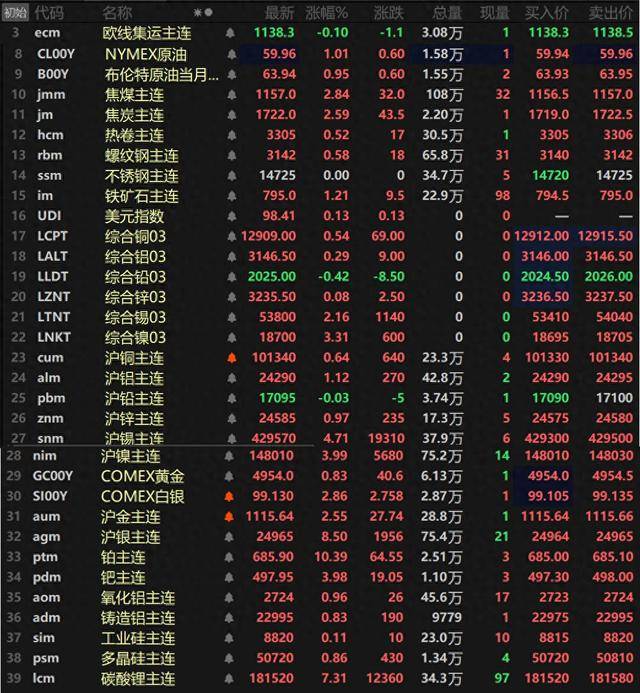
金属近全线上涨 碳酸锂涨超7% 铂主连涨逾10% 贵金属再创新高!
Sou Hu Cai Jing· 2026-01-23 08:23
Metal Market - Domestic base metals experienced a general increase, with only lead showing a slight decline of 0.03%. Tin led the gains with a rise of 4.71%, followed by nickel at 3.99% and aluminum at 1.12%. Other metals had increases of less than 1% [1] - Lithium carbonate surged by 7.31%, reaching a peak of 182,000 yuan/ton, marking a new high since September 2023. Additionally, alumina and casting aluminum rose by 0.96% and 0.83%, respectively [1] - In the black metal sector, iron ore increased by 1.21%, while coking coal and coke rose by 2.84% and 2.59%, respectively [1] - In the external market, most base metals saw increases, except for lead, which fell by 0.42%. Tin and nickel rose by 2.16% and 3.31%, respectively [1][2] - Precious metals also saw significant gains, with COMEX gold rising by 0.83% to a peak of 4,970 USD/oz, and COMEX silver increasing by 2.86% to a peak of 99.395 USD/oz, both hitting historical highs. Domestic gold and silver prices also reached new highs [1][2] Macro Environment - The People's Bank of China conducted a net injection of 38.3 billion yuan through a 1,250 billion yuan reverse repurchase operation, maintaining the interest rate at 1.40% [4] - The US dollar index rose by 0.13% to 98.41, with the US GDP for Q3 growing at an annualized rate of 4.4%, surpassing the previous estimate of 4.3%. Initial jobless claims were reported at 200,000, lower than market expectations [5] - Market expectations for the Federal Reserve's interest rate decisions indicate a 5% probability of a 25 basis point cut in January, with a 95% probability of maintaining the current rate [5]

英国消费者人气改善 但经济阴云未散
Xin Lang Cai Jing· 2026-01-23 00:20
格隆汇1月23日|英国消费者人气在1月份小幅上升,不过对经济前景的信心依然低迷。根据研究机构 GfK与纽伦堡市场决策研究所(Nuremberg Institute for Market Decisions)周五联合发布的指数,1月份消费 者信心指数上升一点,至负16。这项对约2,000名消费者进行的调查结果略好于经济学家的平均预期, 后者此前预计该指数将小幅回升至负16.5。这一上升标志着自2024年8月以来的最高读数。不过,1月份 也标志着该指数已10年未录得正值。GfK的消费者洞察总监尼尔·贝拉米(Neil Bellamy)说:"对个人财务 状况的看法有所改善,但这被对经济日益增长的担忧所抵消。" ...
英国1月Gfk消费者信心指数为-16,预期-16,前值-17
Mei Ri Jing Ji Xin Wen· 2026-01-23 00:08
每经AI快讯,1月23日,英国1月Gfk消费者信心指数为-16,预期-16,前值-17。 ...
本周热点前瞻20260119
Qi Huo Ri Bao Wang· 2026-01-19 01:08
Group 1 - The monthly report on residential sales prices in 70 large and medium-sized cities in China will be released on January 19, 2025, at 9:30 AM, by the National Bureau of Statistics, which is expected to impact related commodity futures prices [1] - A press conference on the national economic operation for 2025 will be held on January 19, 2025, at 10:00 AM, where the National Bureau of Statistics will present the economic data, including a projected GDP growth of 4.5% for Q4 2025, down from 4.8% [2] - The expected GDP growth for the entire year of 2025 is 5.1%, with a forecasted retail sales growth of 1.2% in December 2025, slightly down from 1.3% [2] Group 2 - The People's Bank of China will announce the Loan Prime Rate (LPR) on January 20, 2025, with expectations of the 1-year LPR remaining at 3.00% and the 5-year LPR at 3.50%, indicating a neutral impact on commodity futures and stock index futures if unchanged [3] - The International Energy Agency (IEA) will release its monthly oil market report on January 21, 2025, which is anticipated to influence oil and related commodity futures prices [3] Group 3 - The U.S. Department of Commerce will publish the final GDP for Q3 2025 on January 22, 2025, with an expected annualized quarterly growth rate of 4.3%, consistent with the initial estimate [4] - The U.S. Department of Labor will report the initial jobless claims for the week ending January 12, 2025, with an expectation of 200,000 claims, slightly up from 198,000, which may suppress industrial commodity prices excluding precious metals if the data exceeds expectations [5] Group 4 - The EIA will announce the weekly change in crude oil inventories for the week ending January 16, 2025, on January 23, 2025, with a previous increase of 3.391 million barrels, and further increases may hinder oil and related commodity prices [6] - The Eurozone's consumer confidence index for January is expected to be -12.5, an improvement from -13.1, with the announcement scheduled for January 23, 2025 [7] Group 5 - The U.S. S&P Global Manufacturing PMI for January is expected to be 52.0, slightly up from 51.8, with the announcement on January 23, 2025, which may support industrial commodity prices if the data exceeds expectations [8] - The National Bureau of Statistics of China will release important production material market prices for mid-January on January 24, 2025, covering nine categories and 50 products, which may influence market dynamics [8]
特朗普亮相达沃斯会说些什么?
Di Yi Cai Jing Zi Xun· 2026-01-18 08:31
Market Overview - The U.S. stock market experienced a decline, with the Dow Jones down 0.29%, Nasdaq down 0.66%, and S&P 500 down 0.38% for the week [2] - European indices showed mixed results, with the UK FTSE 100 up 1.09%, Germany's DAX 30 up 0.14%, and France's CAC 40 down 1.23% [2] Economic Indicators - Attention will shift to U.S. GDP data, PCE inflation data, and consumer confidence index, which may provide insights into the Federal Reserve's policy direction [3] - The PCE inflation data for November is set to be released, which is a key indicator for the Federal Reserve [3] - The unemployment rate has unexpectedly decreased, raising the importance of the upcoming inflation data [3] Federal Reserve Predictions - Morgan Stanley has adjusted its forecast for the Federal Reserve's rate cuts to June and September, citing that inflation trends will be crucial for determining interest rate policies [4] - The third-quarter GDP revision data is expected to be closely watched, as the initial growth rate of 4.3% exceeded market expectations [4] Commodity Market - Oil prices have risen for the fourth consecutive week, with WTI crude up 0.54% to $59.44 per barrel and Brent crude up 1.25% to $64.13 per barrel [5] - Geopolitical tensions in Iran continue to influence oil prices, with concerns about potential supply disruptions [5] - Gold and silver prices have increased, with COMEX gold futures up 2.18% to $4588.40 per ounce and silver futures up 11.69% to $88.09 per ounce [6] European Economic Outlook - The Eurogroup finance ministers' meeting is scheduled, with a focus on fiscal stimulus policies, particularly from Germany [7] - The European Central Bank's monetary policy meeting minutes will be released, and there is speculation about future interest rate adjustments [7] UK Economic Data - Upcoming economic reports include the November employment report, consumer price index, and retail sales data [8] - The Bank of England recently lowered the benchmark interest rate to 3.75%, indicating a cautious approach to future rate cuts [8]

2025年12月哥伦比亚消费者信心指数回升
Shang Wu Bu Wang Zhan· 2026-01-15 16:54
Core Insights - The consumer confidence index in Colombia reached 19.9% in December 2025, marking an increase of 2.9 percentage points from November, the highest level in over eight years [1] Economic Conditions - The rise in consumer confidence is primarily attributed to a 5 percentage point increase in the economic conditions index [1] - There was also a 1.5 percentage point improvement in the consumer expectations index [1] Consumer Behavior - In the fourth quarter of 2025, consumers showed a significant improvement in their evaluations of both national and household economic conditions [1] - There was an increased willingness among consumers to purchase durable goods [1]
2025年第四季度上海市消费者信心指数显示:青年群体逆势回升显韧性
Xin Lang Cai Jing· 2026-01-15 11:14
Core Insights - The consumer confidence index in Shanghai shows a comprehensive recovery among the youth demographic aged 20 to 39, indicating positive economic sentiment [1][2] Group 1: Consumer Confidence Index - The overall consumer confidence index for Shanghai is reported at 90.63 points, with the consumer evaluation index at 90.17 points and the consumer expectation index at 91.32 points, all remaining stable compared to the previous quarter [1] - The youth group has a confidence index of 94.0 points, which is significantly higher than the middle-aged group, while the elderly group stands at 95.4 points, showing a minor difference that lacks statistical significance [1] Group 2: Factors Influencing Youth Confidence - The recovery in youth confidence is attributed to the development of emerging industries in Shanghai, such as artificial intelligence, biomedicine, and integrated circuits, which create numerous job opportunities [2] - Government policies, including entrepreneurship subsidies and vocational training support, have alleviated employment pressures for the youth, enhancing income expectations and boosting consumer confidence [2] Group 3: Employment and Income Dynamics - Youth income evaluation and expectation indices have increased significantly by 7.3 points and 8.2 points, respectively, while employment evaluation and expectation indices have risen by 8.7 points and 4.4 points, indicating a positive trend [2] - The favorable employment situation for youth is a result of Shanghai's efforts to stabilize and promote employment through an optimized business environment and the rapid development of sectors like internet and technology services [2] Group 4: Future Implications - The rise in consumer confidence among the youth is expected to inject vitality into Shanghai's consumer market, highlighting the significant potential for consumption within this demographic [2] - It is recommended that Shanghai continues to support emerging industries, create more job opportunities tailored for youth, and enhance policies for employment and entrepreneurship to further unlock consumption potential [2]
高物价、收入下滑,美国关税政策不断加剧自身民生压力
Ren Min Ri Bao· 2026-01-15 01:06
Core Insights - The U.S. tariff policy is exacerbating domestic economic pressures, leading to declining consumer confidence and increased inflation [3][4][6] - A recent survey indicates that the consumer confidence index for December 2025 is at 53.3, significantly down from 74 in December 2024, reflecting growing concerns over economic stability [3][4] - The holiday shopping season saw a 26% average price increase for popular gifts compared to the previous year, with specific categories like home goods and electronics experiencing even higher price hikes [3][5] Consumer Impact - Many American families are feeling the financial strain from tariff policies, leading to reduced purchasing power during the holiday season [4][5] - A survey revealed that 87% of respondents believe grocery prices have risen, and about two-thirds reported increased expenses for utilities and holiday gifts [4][6] - Approximately 40% of families have cut back on the number of gifts purchased, and nearly one-third have reduced the number of gift recipients due to rising costs [5][6] Tariff Effects on Pricing - The majority of tariff costs (70.5%) are being passed on to consumers, with retailers absorbing the remaining 29.5% [6] - Retailers are incorporating tariff costs into product pricing, leading to higher expenses for consumers [6][7] - The analysis indicates that from March to September 2025, imported goods prices rose by about 4%, while domestic goods saw a 2% increase due to tariffs [6][7] Broader Economic Implications - The ongoing tariff policy is expected to suppress overall demand in the U.S., with a forecast of continued pressure on trade volumes and slowing household consumption growth [7] - The OECD has reported that the value of imported goods subject to tariffs has significantly decreased compared to non-tariffed imports, indicating a broader economic impact [7]

【环球财经】1月澳大利亚消费者悲观情绪加剧
Xin Hua Cai Jing· 2026-01-13 02:45
Core Viewpoint - The Westpac Bank and Melbourne Institute report indicates a decline in consumer confidence in Australia, with the consumer sentiment index dropping 1.7% to 92.9 points in January 2026, reflecting a pessimistic outlook among consumers [1]. Group 1: Consumer Confidence Index - The consumer sentiment index for January 2026 has decreased by 1.7% to 92.9 points, indicating ongoing pessimism [1]. - The decline in consumer confidence is primarily driven by concerns over household financial situations and the overall economic outlook for 2026 [1]. - Nearly two-thirds of respondents expect mortgage rates to rise in the next 12 months, a significant increase from the previous year [1]. Group 2: Economic Indicators - The index measuring expectations for the economy over the next year fell by 6.5% to 88.4 points, while the five-year outlook increased by 0.9% to 96.5 points [1]. - The index for assessing household financial conditions over the next year decreased by 4.5% to 97.8 points, while the index reflecting changes in household finances over the past year rose by 2.3% to 82.7 points [2]. - The index for purchasing major household items increased by 0.2% to 99.1 points [2]. Group 3: Housing and Employment Expectations - The housing market index rose by 4% to 89.6 points, indicating a more favorable view on purchasing homes [2]. - The unemployment expectations index increased by 2.1% to 129.4 points, suggesting growing concerns about job security [2]. - The housing price expectations index decreased by 1.4% to 167.5 points, while the interest rate expectations index rose by 5% to 152.8 points [2]. Group 4: Monetary Policy Outlook - The Reserve Bank of Australia is expected to maintain the benchmark interest rate during its upcoming monetary policy meeting in early February 2026, despite strong inflation data and recovering household spending [2]. - The RBA is sensitive to inflation risks and is prepared to raise rates if necessary, but current economic conditions suggest inflation may return to the target range of 2-3% within 2026 [2]. Group 5: Additional Consumer Confidence Insights - The ANZ-Roy Morgan consumer confidence index rose by 3 points to 84.5 points during the week of January 5-11, although the four-week moving average slightly declined [3]. - The weekly inflation expectations decreased by 0.2 percentage points to 5.4%, indicating a slight easing in inflation expectations [3]. - The rebound in consumer confidence observed in January is noted to be the weakest in the past 15 years [3].
1月澳大利亚消费者悲观情绪加剧
Xin Hua Cai Jing· 2026-01-13 02:37
Core Insights - The Westpac Bank and Melbourne Institute report indicates a decline in the consumer confidence index for January 2026, dropping 1.7% to 92.9 points, reflecting ongoing pessimism among consumers [1] - The report highlights that consumer concerns about household finances and the overall economic situation are increasing, despite confidence levels being higher than during the "cost of living" crisis from 2022 to 2024 [1] - A significant factor contributing to the decline in consumer sentiment is the sharp shift in interest rate expectations, with nearly two-thirds of respondents predicting higher mortgage rates in the next 12 months, more than double the proportion from September 2025 [1] Consumer Confidence Indicators - The consumer confidence index for predicting the economic situation over the next year fell 6.5% to 88.4 points, while the five-year economic outlook index increased 0.9% to 96.5 points [1] - The indicator measuring household financial conditions for the next year decreased 4.5% to 97.8 points, while the indicator reflecting changes in household finances over the past year rose 2.3% to 82.7 points [2] - The index for determining the timing of major household purchases increased 0.2% to 99.1 points [2] Housing and Employment Indicators - The housing market index rose 4% to 89.6 points, while the unemployment expectations index increased 2.1% to 129.4 points [2] - The house price expectations index decreased 1.4% to 167.5 points, and the interest rate expectations index rose 5% to 152.8 points [2] Monetary Policy Outlook - Westpac's macroeconomic forecast suggests that the Reserve Bank of Australia is likely to maintain the cash rate at its next monetary policy meeting on February 2-3, 2026, despite upcoming important data releases [2] - Recent strong inflation data and a rebound in household spending have raised concerns about inflation not being fully contained, although the labor market is showing signs of weakness [2] - Inflation is expected to fall within the target range of 2-3% during 2026, reducing the urgency for the RBA to implement tightening measures [2] Additional Consumer Confidence Insights - The ANZ-Roy Morgan consumer confidence index rose by 3 points to 84.5 points during the week of January 5-11, although the four-week moving average slightly declined to 83.8 points, remaining below long-term averages [3] - Weekly inflation expectations decreased by 0.2 percentage points to 5.4%, indicating a slight easing in inflation expectations [3] - The rebound in consumer confidence observed in early January is noted to be the weakest in the past 15 years [3]