美国例外论

Search documents
新南威尔士州政府将美元敞口从75%猛削至14%! 美元熊市周期正在上演
智通财经网· 2025-09-02 23:35
Group 1 - The core viewpoint is that the New South Wales Treasury Corporation's significant reduction of USD exposure has yielded substantial returns, preparing for a further decline in the USD exchange rate, reinforcing the logic of a long-term USD bear market [1][2] - The Treasury Corporation has reduced its USD weight in its foreign exchange investment portfolio from nearly 75% to approximately 14%, indicating a strategic shift towards defensive currencies like JPY, CHF, and EUR [1] - The Chief Investment Officer, Stuart Brentnall, anticipates a further 10% decline in the USD, highlighting the impact of U.S. policy uncertainty and potential Fed rate cuts on the currency's performance [1][3] Group 2 - The recent strategy shift has resulted in a 2% increase in investment returns over the past year, with unhedged positions outperforming hedged ones by about 7% [2] - Analysts expect the USD to continue its downward trajectory, with an anticipated 8% decline for the remainder of the year, reflecting ongoing economic slowdown and Fed rate cut preparations [3] - Concerns over the independence of the Federal Reserve, exacerbated by political tensions, are eroding the USD's safe-haven status, leading to increased demand for alternative assets like gold and silver [4][5]
中外资机构:中国资本市场迎来“慢牛”行情
天天基金网· 2025-09-01 05:45
Core Viewpoint - The article discusses the long-term investment outlook for A-shares and Hong Kong stocks, highlighting a shift towards a "slow bull" market driven by improved investor sentiment and fundamental economic changes in China [4][5]. Group 1: Market Outlook - A-shares and Hong Kong stocks have emerged from valuation lows, indicating a positive shift in investor expectations for the Chinese capital market [4]. - The current market rebound is not merely speculative but reflects sustainable changes in the Chinese economy, including stabilization and recovery, structural optimization, and improved corporate profitability [4][6]. - The participation in this valuation reassessment is primarily from international and domestic institutions, which are adopting more rational and long-term investment strategies [4]. Group 2: Economic Conditions - China's economy is showing a "steady progress" trend, supported by internal consumption recovery, industrial upgrades, and resilient external trade [8]. - The macroeconomic policy mix is effectively improving both internal and external demand, providing a solid foundation for achieving annual growth targets [8]. Group 3: Policy Expectations - Key areas of focus for future policies include proactive fiscal measures, continued moderate monetary easing, and breaking down barriers to enhance domestic market potential [9]. - The government is expected to prioritize the implementation of the 2025 fiscal budget and may slightly ease monetary policy to achieve around 5% growth [9]. Group 4: U.S. Monetary Policy - The Federal Reserve is likely to lower interest rates by 50 to 75 basis points this year, with a high probability of a 25 basis point cut in September [11]. - Market expectations for future rate cuts may be overly optimistic, as persistent inflation could limit the extent of subsequent reductions [11]. Group 5: Asset Allocation Strategies - There is a consensus on increasing allocations to non-dollar assets, such as gold, silver, real estate, and cryptocurrencies, as the dominance of the dollar is expected to weaken [10][14]. - Investors are advised to diversify their portfolios and adjust positions based on policy and asset valuation fluctuations [12][13].

降息预期升温+“美联储独立性战役”打压信心 美元熊市正在上演
贝塔投资智库· 2025-09-01 04:01
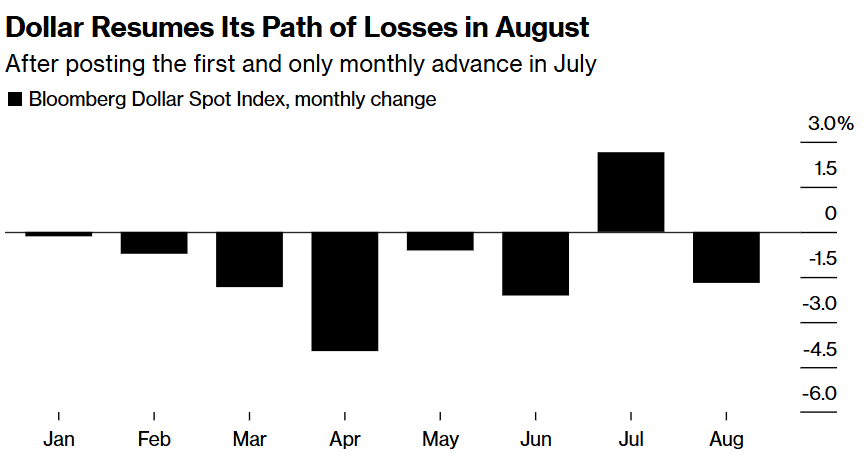
Core Viewpoint - The article discusses the decline of the US dollar and the implications of potential interest rate cuts by the Federal Reserve, driven by economic slowdown and political pressures from the Trump administration [3][5][10]. Group 1: Dollar Performance - The Bloomberg Dollar Spot Index fell by 1.6% in August, reversing the 2.7% increase seen in July, which was the best monthly performance since January 2025 [3][5]. - Analysts expect the dollar to continue its downward trend, potentially declining by 8% for the remainder of the year and into 2026, reflecting a "bear market" trajectory [5][10]. Group 2: Political Influence on Monetary Policy - The Trump administration's threats to the Federal Reserve's independence and the validity of US economic data are undermining the attractiveness of the dollar and US assets [5][8]. - The ongoing legal battle between Trump and Fed Governor Lisa Cook could further destabilize the Fed's independence, leading to a potential shift in monetary policy that favors rate cuts [8][9]. Group 3: Market Reactions and Predictions - Market expectations for a rate cut by the Fed are high, with an 80% probability of a cut in September and a total of 125 basis points of cuts expected by September 2026 [10][11]. - The anticipated decline in US Treasury yields and the dollar index is likely to continue as long as rate cut expectations persist, diminishing the appeal of the dollar [10][11]. Group 4: Investment Strategies - Morgan Stanley suggests that while US assets remain attractive, the uncertainty surrounding policy could lead to increased foreign currency hedging, exerting downward pressure on the dollar [11]. - The potential for a $1 trillion sell-off in dollar assets is predicted if foreign investors adjust their hedging ratios back to normal levels [11][12].
中外资机构:中国资本市场迎来“慢牛”行情
中国基金报· 2025-08-31 12:19
Core Viewpoint - The Chinese capital market is entering a "slow bull" phase, with an increasing consensus on allocating more non-USD assets due to improving long-term investment expectations from both domestic and international investors [12][19]. Group 1: Market Outlook - A-shares and H-shares have emerged from valuation lows, reflecting improved long-term investment expectations in the Chinese capital market [13]. - The current market rebound is not driven by short-term speculation but by sustainable changes in the economy, such as stabilization, structural optimization, and improved corporate profitability [13][15]. - The Hong Kong stock market is expected to attract more overseas investment due to its high dividend yield and growth potential in sectors like artificial intelligence and innovative pharmaceuticals [14]. Group 2: Economic Assessment - The Chinese economy is showing a "steady progress" trend, supported by internal consumption recovery, industrial upgrades, and resilient external trade [17]. - The macroeconomic policy is effectively improving both internal and external demand, providing a solid foundation for achieving annual growth targets [17]. Group 3: Policy Expectations - Key areas of focus for future policies include proactive fiscal measures, continued moderate monetary easing, and breaking down barriers to enhance domestic market potential [18]. - The government is expected to prioritize the implementation of the 2025 fiscal budget and maintain a flexible monetary policy to achieve around 5% growth [18]. Group 4: Asset Allocation Strategy - There is a growing consensus to increase allocations to non-USD assets, such as gold, silver, real estate, and cryptocurrencies, as the dominance of the dollar is expected to weaken [19][23]. - Investors are advised to diversify their portfolios and adjust positions based on policy and asset valuation fluctuations, especially in light of uncertainties surrounding U.S. tariff policies [21][22]. - The rebalancing of global assets is accelerating, with a shift from over-allocated USD assets to local markets in Europe and Asia, which may support local asset valuations [23].

降息预期升温+“美联储独立性战役”打压信心 美元熊市正在上演
智通财经网· 2025-08-29 11:32
Core Viewpoint - The US dollar index has shown a decline in August after a strong performance in July, as investors prepare for a weakening US economy and potential interest rate cuts by the Federal Reserve [1][4]. Group 1: Dollar Performance - The Bloomberg Dollar Spot Index has decreased by 1.6% in August, reversing the 2.7% increase recorded in July, which was the best monthly performance since January 2025 [1]. - Analysts expect the dollar to continue its downward trend for the remainder of the year, potentially declining by 8% overall, reflecting a "bear market-like" trajectory [4]. Group 2: Impact of Government Actions - Recent actions by the US government are expected to have a long-term negative impact on the dollar's status as a safe-haven investment, with risk premiums likely to weigh heavily on it [5]. - The independence of the Federal Reserve's monetary policy is being threatened by the Trump administration, further diminishing the attractiveness of the dollar and US assets [4][5]. Group 3: Federal Reserve and Interest Rate Expectations - There is a high probability (80%) that the Federal Reserve will announce interest rate cuts as early as September 17, with market expectations for a total of 125 basis points of cuts by September 2026 [8]. - The anticipation of stronger rate cuts is contributing to the decline in US Treasury yields and the dollar index, with expectations of continued weakness in the dollar [8]. Group 4: Investor Behavior and Market Sentiment - Market sentiment is shifting towards increased hedging against US assets, with international investors raising their foreign exchange hedge ratios due to rising policy uncertainty [9]. - If the hedge ratios return to normal levels, potential dollar sell-off could amount to approximately $1 trillion, indicating significant pressure on the dollar [9].
美股现在处于泡沫的初期阶段!霍华德・马克斯:现在的投资组合应该更偏向安全,而不是激进
Xin Lang Cai Jing· 2025-08-29 09:35
Group 1 - The core belief emphasized by Howard Marks is that emotional stability, patience, a long-term perspective, and the ability to refrain from impulsive actions typically lead to better investment outcomes [2][54] - Marks suggests that investment is not about precise timing but rather about constructing a resilient portfolio that can withstand various market conditions, akin to a soccer team that plays the entire match with the same lineup [42][45] Group 2 - Marks discusses the current market environment, indicating that the U.S. stock market is in the early stages of a bubble, driven by optimism and a lack of perceived risk [17][26] - He highlights the importance of understanding one's position in the investment cycle and balancing aggressiveness and defensiveness based on individual circumstances [10][12] Group 3 - The traditional economic and market cycles may have been disrupted, particularly due to the pandemic, leading to uncertainty about future economic conditions [18][19] - Marks argues that central banks cannot permanently eliminate market fluctuations; they can only delay them, suggesting that future downturns may be more severe if they are postponed [26][28] Group 4 - In the current environment of narrow credit spreads, Marks emphasizes the need for investors to demand risk premiums when shifting from government bonds to corporate bonds, as optimism can lead to underestimating risks [30][31] - He notes that while the U.S. remains a favored investment destination, non-U.S. markets often present cheaper opportunities, particularly in high-yield bonds [35][37] Group 5 - Marks uses the analogy of American football and Brazilian soccer to illustrate investment strategies, advocating for a consistent approach rather than frequent adjustments based on market conditions [42][45] - He stresses the importance of patience and emotional control in investing, advising against the common tendency to buy high and sell low [51][52]

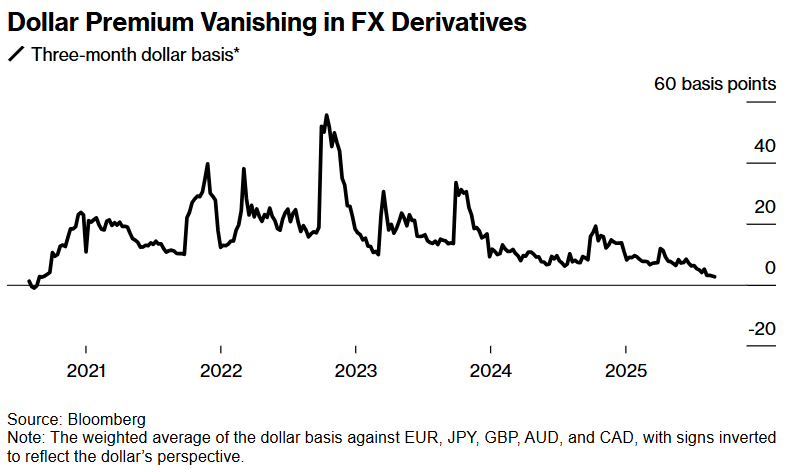
美元基差溢价近乎归零! “大而美法案”与关税重压之下 “抛美债”叙事不断强化
Zhi Tong Cai Jing· 2025-08-25 12:00
Core Viewpoint - The premium of the US dollar in the currency derivatives market is nearly disappearing, indicating a weakening demand for US Treasury bonds among foreign investors, driven by concerns over fiscal policies and tariffs under Trump's administration [1][2][5]. Group 1: Currency Derivatives Market - Recent statistics show that the weighted average basis of the US dollar against five major global currencies has significantly dropped to just below 3 basis points, moving towards a negative value for the first time since August 2020 [2]. - The decline in the dollar premium reflects a shift in investor sentiment, as foreign investors are increasingly seeking higher yields on US long-term Treasury bonds [1][8]. Group 2: Foreign Investment in US Treasuries - The proportion of US Treasuries held by foreign investors has decreased from a peak of 52% in 2012 to 33% currently, indicating a significant reduction in demand [5]. - Concerns over the US government's expanding fiscal policies and Trump's tariff strategies have led to narratives of "selling US assets" and the collapse of the "American exceptionalism" [5][9]. Group 3: Market Reactions and Future Trends - Analysts suggest that the ongoing high "term premium" and the decline of "American exceptionalism" are prompting foreign investors to seek opportunities in emerging markets, particularly in China [9][12]. - The anticipated increase in budget deficits due to Trump's policies may lead to soaring yields on US Treasuries, especially for longer maturities, potentially breaking historical highs [9][10]. - Major investment firms, including Morgan Stanley and JPMorgan, are increasingly optimistic about emerging markets outperforming US equities as the dollar weakens and the Fed enters a rate-cutting cycle [11][12].
研究立身、勇立潮头(申万宏观·赵伟团队)
赵伟宏观探索· 2025-08-21 16:02
Core Viewpoint - The research process is iterative and requires continuous denial and reconstruction to approach the truth, emphasizing the importance of diligent and practical research in the investment banking sector [22]. Group 1 - The year 2025 is marked as a year of comprehensive upgrades for the research team, focusing on restructuring the research framework and systematically displaying research results [22]. - The new development phase of the economy is characterized by a shift in policy focus towards "people-centered" strategies, emphasizing long-term strategies for expanding domestic demand rather than short-term stimuli [25]. - The "new three drivers" of the economy, including service consumption, service industry investment, and service exports, have shown significant acceleration, indicating an approaching transformation opportunity [24]. Group 2 - The "anti-involution" movement is seen as a new phase of supply-side structural reform, with increased government and industry attention, broader coverage, and stronger coordination between policies and market mechanisms [26]. - The global macroeconomic landscape is expected to experience significant changes, particularly with the "American exceptionalism" narrative being challenged, and the need to understand the trends of global capital rebalancing [29]. - Geopolitical risks have become a crucial factor in global macroeconomics and asset pricing since the Russia-Ukraine conflict, with ongoing developments in geopolitical situations influencing market narratives [32].

【环时深度】“审查”博物馆,白宫要争历史叙事控制权
Huan Qiu Shi Bao· 2025-08-19 22:43
Core Viewpoint - The U.S. government plans to review the Smithsonian Institution's museums and exhibitions to align them with President Trump's interpretation of American history, aiming to counter what they term "leftist historical revisionism" [1][2][3] Group 1: Government Actions - The Trump administration has initiated a comprehensive review of the Smithsonian Institution's museums to ensure they celebrate "American exceptionalism" and eliminate "divisive or partisan narratives" [2][3] - An executive order titled "Restoring the Truth and Reason of American History" was signed by Trump, aiming to cut funding for projects that undermine shared American values or promote racial division [3][5] - The administration is also reviewing public monuments to ensure they do not contain inappropriate depictions of Americans, emphasizing the celebration of American achievements [5][6] Group 2: Cultural Impact - The establishment of the "American Heroes National Garden" is a key project for the 250th anniversary of American independence, featuring 250 statues of "American heroes" [6] - The administration's actions are seen as part of a broader cultural war, with critics arguing that it represents an attempt to "whitewash" history [8][10] - The narrative control over American history is viewed as a means to distinguish "true Americans" from those perceived as threats to the American political system [9][10] Group 3: Academic Response - Historians have expressed concerns that the government's actions lack input from qualified historians, with appointments made based on ideological alignment rather than expertise [13][14] - Some historians are actively countering the government's narrative by creating educational content that reflects a more nuanced view of American history [14] - The debate over how history is presented in museums and educational institutions is intensifying, with calls for a more inclusive and truthful representation of America's past [12][14]

花旗银行:超配美股,看跌美元,看涨黄金
21世纪经济报道· 2025-08-17 00:59
Group 1 - The core investment strategy from Citigroup emphasizes an overweight in U.S. stocks, particularly in the technology sector driven by AI, while underweighting UK stocks [3][4] - Capital expenditure in the U.S. has significantly contributed to GDP, surpassing consumer spending, indicating a robust investment environment [4] - Citigroup maintains a neutral stance on government bonds, anticipating a potential interest rate cut by the Federal Reserve, while suggesting a steepening trade strategy for U.S. Treasuries [5] Group 2 - In the credit market, Citigroup is underweighting investment-grade credit in Europe and the U.S. due to narrow credit spreads, which could provide risk protection in case of economic downturns [4][5] - The outlook for emerging market bonds is optimistic, with a preference for markets like Mexico, Brazil, and South Africa, especially when the U.S. dollar weakens [5][6] - The dollar is facing structural and cyclical bearish pressures, with expectations of continued weakness against the euro and high-yield emerging market currencies [6] Group 3 - Citigroup holds a neutral view on commodities but advocates for a "buy on dips" strategy, particularly for gold, which is seen as a valuable asset for diversification away from the dollar [6][7] - Silver is favored in the current market environment due to its historical performance under specific conditions, such as rising U.S. term premiums and a bullish stock market [7] - Overall, Citigroup expresses a positive outlook on global equity markets, especially in the U.S. due to high exposure to AI, while being cautious on U.S. bonds and maintaining a bearish view on the dollar [7]