去美元化

Search documents
杨德龙:近期国际金价大幅波动的原因与启示
Xin Lang Cai Jing· 2026-02-04 01:51
Core Viewpoint - Recent fluctuations in international gold prices have raised concerns among investors, with gold reaching $5600 per ounce before a significant drop, particularly in silver, which saw a 30% decline in a single day [1][2][6] Group 1: Market Dynamics - The recent drop in gold prices is attributed to a hawkish stance from the new Federal Reserve Chairman, leading to fears of tightening liquidity and balance sheet reduction [1][2] - The rapid increase in gold prices, exceeding $1000 in just a couple of weeks, was unsustainable, indicating that such sharp rises often precede significant corrections [1][2][6] - The current rebound in gold prices, now above $4800 per ounce, suggests that many investors are taking advantage of the dip, presenting a re-entry opportunity for those who missed earlier gains [2][7] Group 2: Investment Strategy - Investors are advised to view gold and silver as part of a long-term asset allocation strategy rather than short-term trading opportunities, with a recommendation to allocate about 20% of their portfolio to gold-related assets [2][7] - The volatility in gold and silver prices serves as a reminder that no asset is immune to fluctuations, emphasizing the importance of a rational investment approach [2][7] Group 3: Long-term Outlook - Looking ahead to 2026, gold and silver are expected to remain attractive assets, although the likelihood of a one-sided price surge like in 2025 is low, with increased volatility anticipated [3][8] - Factors such as rising U.S. national debt, which has surpassed $38 trillion, and concerns over fiscal sustainability are likely to support the long-term upward trend in gold prices [3][9] - The ongoing trend of "de-dollarization" is expected to gradually reduce the dollar's dominance in global payments and reserves, enhancing the appeal of gold and other hard currencies [4][9] Group 4: Economic Context - Domestic investors are facing a pivotal moment in asset allocation, with a significant amount of fixed-term deposits maturing and interest rates declining, prompting a search for new investment avenues [10] - The A-share market is showing signs of a slow bull market, with historical patterns suggesting potential for a spring rally, which could lead to increased investment in equities [10][11] - The focus for 2025 will be on technology stocks, while 2026 is expected to highlight innovations in various sectors, indicating a potential shift in capital market dynamics [10][11]
宝城期货贵金属有色早报(2026年2月4日)-20260204
Bao Cheng Qi Huo· 2026-02-04 01:43
宝城期货贵金属有色早报(2026 年 2 月 4 日) ◼ 品种观点参考 时间周期说明:短期为一周以内、中期为两周至一月 | 品种 | | 短期 | 中期 | 日内 | 观点参考 | 核心逻辑概要 | | --- | --- | --- | --- | --- | --- | --- | | 黄金 | 2604 | 震荡 | 震荡 | 震荡 偏强 | 观望 | 短期宏观预期走弱,前期多头资 金了结意愿强 | | 铜 | 2603 | 强势 | 震荡 | 强势 | 长线看强 | 短期宏观预期走弱,前期多头资 金了结意愿强 | 说明: 投资咨询业务资格:证监许可【2011】1778 号 1.有夜盘的品种以夜盘收盘价为起始价格,无夜盘的品种以昨日收盘价为起始价格,当日日盘收盘价为终点价格, 计算涨跌幅度。 2.跌幅大于 1%为弱势,跌幅 0~1%为震荡偏弱,涨幅 0~1%为震荡偏强,涨幅大于 1%为强势。 3.震荡偏强/偏弱只针对日内观点,短期和中期不做区分。 主要品种价格行情驱动逻辑—商品期货 品种:黄金(AU) 日内观点:震荡偏强 中期观点:震荡 参考观点:观望 核心逻辑:继上周五宏观氛围走弱,贵金属有色普跌以 ...
黄金遭受40年以来最大回撤,长期怎么看?
Sou Hu Cai Jing· 2026-02-04 00:54
综合来看,我们认为这是一次在短期快速上涨后事件催化下的交易型调整,并不是叙事逻辑的整体反 转。当然,我们也建议投资者密切关注美元流动性/美元贬值的相关定价逻辑在此后沃什执掌美联储的 时代将如何演进。我们倾向于认为这是对美元贬值压力的边际缓解,但并不改变"去美元化"的整体趋 势。 投资者仍将黄金视作对抗地缘风险的重要避风港,全球央行也将继续作为买方对金价形成支撑。JP Morgan、德意志银行皆预测今年的金价现货有望达到6,000美元/盎司。我们也认为短期回撤不改变长期 定价逻辑,投资者或可考虑在短期风险释放后进行布局。 风险提示: 投资人应当充分了解基金定期定额投资和零存整取等储蓄方式的区别。定期定额投资是引导投资人进行 长期投资、平均投资成本的一种简单易行的投资方式。但是定期定额投资并不能规避基金投资所固有的 风险,不能保证投资人获得收益,也不是替代储蓄的等效理财方式。 黄金遭受40年以来最大回撤,但长期的配置逻辑没有发生重大改变,波动率降低后或有布局机会。投资 者或可关注黄金ETF国泰(518800)等产品。 受到上周五沃什被提名为美联储主席的影响,金银皆录得40年以来最大回撤。沃什主张通过"缩表+降 息 ...
黄金大阳上涨,见底了?结构仍存变化(2026.2.4)
Sou Hu Cai Jing· 2026-02-04 00:47
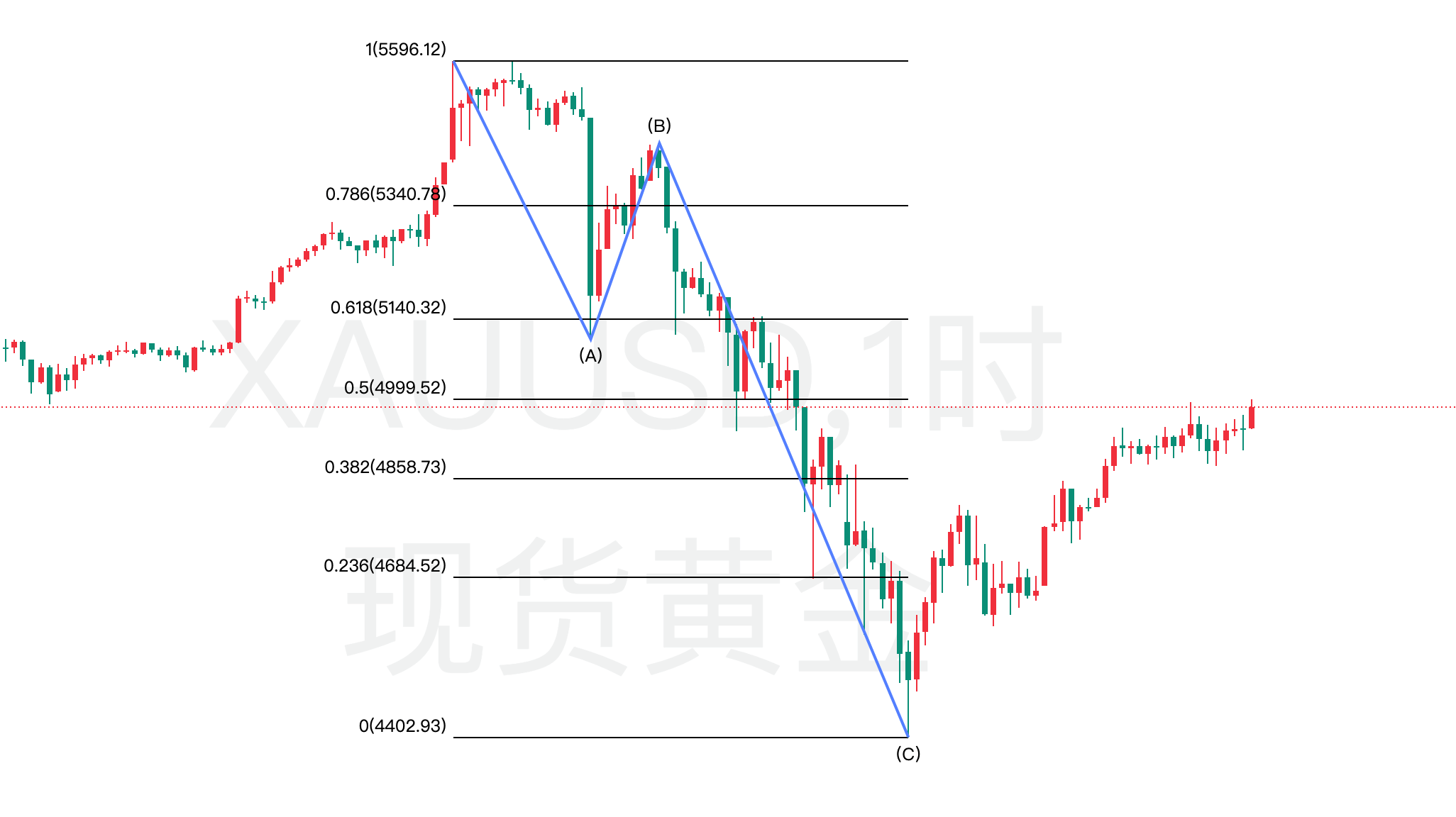
Technical Analysis - Gold prices showed a strong upward trend, recovering over 50% of the previous decline from a high of 5597 to a low of 4403, with an intraday increase exceeding 300 dollars [2][4] - The current upward movement from the low of 4403 may indicate the start of a new bullish wave, but further analysis is needed to confirm if the adjustment phase has officially ended [4][6] - Key support is identified at 4880, with further support levels at 4810-4800, while resistance is focused on the 5000 mark, with potential upward targets of 5100-5140 [6] Fundamental Analysis 1. The market sentiment reversed on February 3, as investors reassessed the impact of the Federal Reserve's personnel changes, leading to a rebound in gold prices after a period of panic selling [8] 2. Economic uncertainty due to delayed employment data from the U.S. government has heightened concerns about future economic trends, reinforcing gold's appeal as a safe-haven asset [9] 3. The weakening credit of the U.S. dollar and ongoing "de-dollarization" efforts by global central banks are expected to drive demand for gold, with projections indicating a net purchase of 863 tons by 2025 [10] 4. Geopolitical risks, particularly the escalation of the Russia-Ukraine conflict, have contributed to increased risk aversion, further supporting gold prices [11] 5. Upcoming economic data releases, including the January ADP employment change and ISM non-manufacturing PMI, will be crucial in shaping market expectations regarding Federal Reserve policies and short-term gold price movements [12]

招商证券:市场在未来一段时间将会以震荡为主 节后指数有望强于节前 风格层面继续推荐成长风格
智通财经网· 2026-02-03 23:53
Core Viewpoint - The market is expected to experience volatility in February, with indices likely to perform better post-holiday compared to pre-holiday levels. The report emphasizes a preference for growth style investments, particularly in small-cap and growth sectors, as the market remains in a spring rally phase [1][2]. Market Style Outlook - Growth style is favored, with a convergence in performance between large-cap and small-cap stocks anticipated. The recommended indices include CSI 1000, ChiNext 50, CSI 300 Quality, and CSI 800 Information [2]. - Historical data from 2016-2025 indicates that small-cap and growth styles have a higher success rate in February. The late timing of the Spring Festival and the upcoming Two Sessions are expected to enhance the performance of small-cap stocks due to increased market risk appetite [2]. Fundamental Analysis - The manufacturing PMI for January recorded at 49.3, indicating a return to contraction territory, with both production and demand showing marginal declines. The ongoing structural issue of insufficient domestic demand remains, with policies aimed at expanding domestic consumption expected to be a primary focus [2]. - On the international front, expectations regarding the Federal Reserve's policies and a weaker dollar may lead to a temporary strengthening of the dollar, which could exert pressure on A-share cyclical styles. However, sectors benefiting from industrial trends, such as technology and AI, are likely to be less affected [2]. Liquidity and Capital Supply-Demand - February is projected to see continued net inflows of incremental capital, with foreign capital expected to continue flowing in before the holiday and financing likely to rebound afterward. The central bank's measures to counteract liquidity tightening from government bond issuances in January are expected to maintain a stable and ample liquidity environment in February [3][4]. - The stock market experienced a net outflow of tracked capital in January, with financing becoming the main source of incremental capital. The demand side shows an increase in net reductions by major shareholders, while IPO and refinancing scales have decreased, keeping overall funding demand stable [4]. Market Sentiment and Capital Preferences - In January, the risk premium for the entire A-share market fluctuated, with major indices experiencing initial gains followed by volatility. The technology sector remained the dominant style, with significant trading activity in small-cap growth and STAR 50 indices, while large-cap growth styles saw lower trading concentration [4].

金价暴跌后反弹,行情逻辑变了吗
Sou Hu Cai Jing· 2026-02-03 23:51
Core Viewpoint - The precious metals market experienced significant volatility in early 2026, with gold prices reaching a historical high of $5,598.75 per ounce and then experiencing a 9% drop, marking the largest single-day decline in nearly 40 years. However, the market has since stabilized, with gold rebounding to around $4,900 per ounce and silver to approximately $87 per ounce, indicating a recovery from extreme panic [1][2]. Group 1: Market Dynamics - The precious metals market saw a remarkable rise in January, with gold prices nearing $5,600 per ounce and silver exceeding $120 per ounce, resulting in cumulative increases of 24% and 62% respectively by January 29 [2]. - The recent sharp declines in gold and silver prices were attributed to three main factors: profit-taking, increased margin requirements by the Chicago Mercantile Exchange (CME), and market sentiment affected by the nomination of a new Federal Reserve chairman [2][3]. - Analysts believe that the recent market fluctuations are more a result of profit-taking after a heated market rather than panic selling, with the long-term price support for precious metals remaining intact until the U.S. dollar's credit issues are resolved [1][4]. Group 2: Valuation and Future Outlook - Current gold prices may have deviated from traditional valuation frameworks, with analysts suggesting that the ongoing market dynamics are fundamentally different from past trends, driven by factors such as global central bank gold purchases and a weakening dollar [5][6]. - The pricing of gold is influenced by three layers: its monetary attribute, financial attribute, and safe-haven attribute, with current prices being significantly above what is considered reasonable based on historical valuations [6]. - Future trends in gold prices will depend on the U.S. addressing issues related to low inflation, low interest rates, and the dollar's dominance, with specific conditions needed to restore investor confidence in U.S. debt [7]. Group 3: Investment Sentiment - Analysts remain optimistic about the future of gold, with expectations that geopolitical tensions and economic data could trigger renewed buying interest in precious metals [8]. - Key support levels for gold are identified around $5,000 per ounce, with predictions for potential price targets ranging from $4,600 to $7,200 per ounce depending on market conditions [8]. - Despite the long-term bullish outlook for gold, short-term investors are advised to be cautious of downward risks, as current prices may have already priced in nearly a decade of potential gains [9].
金价暴跌后反弹 行情逻辑变了吗?
Zhong Guo Zheng Quan Bao· 2026-02-03 23:49
Core Viewpoint - The precious metals market experienced significant volatility, with gold reaching a historical high of $5598.75 per ounce and then experiencing a 9% drop, marking the largest single-day decline in nearly 40 years. However, the market has since stabilized, with gold prices rebounding to around $4900 per ounce and silver prices increasing by approximately 10% [1][2]. Market Volatility - The precious metals market saw a rare fluctuation at the beginning of the year, with gold prices nearing $5600 per ounce and silver prices soaring above $120 per ounce, resulting in cumulative increases of 24% and 62% respectively by January 29. This was followed by a sharp decline, with gold dropping over 9% and silver plummeting more than 26% in just two trading days [2]. - Analysts attribute the recent volatility to three main factors: concentrated profit-taking, increased margin requirements by the Chicago Mercantile Exchange (CME), and market sentiment being affected by the nomination of the Federal Reserve Chairman [2][3]. Underlying Market Drivers - Despite the recent fluctuations, analysts believe that the core logic supporting the long-term price increase of precious metals remains intact, primarily due to the weakening of the US dollar's credibility and ongoing gold purchases by global central banks [4]. - The current gold price is perceived to have deviated from traditional valuation frameworks, with analysts noting that the driving factors for this price increase differ fundamentally from past trends, including structural demand changes due to global central bank purchases and the weakening dollar [5]. Pricing Logic - The pricing of gold can be understood through three layers: 1. Monetary attributes, which determine the long-term valuation center based on fiat currency supply. 2. Financial attributes, which influence short-term price fluctuations, particularly in relation to Federal Reserve policies and US Treasury yields. 3. Safe-haven attributes, which provide a premium during geopolitical tensions and financial crises [6]. - Current gold prices are considered significantly overvalued, with estimates suggesting a reasonable valuation around $2990 per ounce, indicating an 80% premium over current levels. However, this overvaluation may persist due to ongoing geopolitical tensions [6]. Future Outlook - The end of the current gold price uptrend is contingent upon the US addressing issues related to low inflation, low interest rates, and the dominance of the dollar. This requires the US to restore fiscal discipline, rebuild trust in US Treasuries, and achieve robust economic growth [7]. - Analysts remain optimistic about the future of gold, with predictions suggesting potential price targets of $7200 per ounce in bullish scenarios and $4600 per ounce in bearish scenarios. Factors such as escalating geopolitical tensions or weakening economic data could trigger renewed buying in precious metals [8].
[高盛,大摩,瑞银研报]金价还能涨多少?三大投行最新研判来了
Xin Lang Cai Jing· 2026-02-03 23:17
热点栏目 自选股 数据中心 行情中心 资金流向 模拟交易 客户端 来源:GlobalMind财旅 核心观点速览 高盛:金价回调属健康调整,看多逻辑未变 瑞银:短期整固后将继续上涨,但需警惕过度修正风险 摩根大通:年底目标上调至6300美元/盎司,坚定看多 一、上周发生了什么? 上周五(1月31日),金价经历了一次剧烈震荡。周四金价一度冲向5600美元/盎司历史新高,但周五却 暴跌超9%至4900美元附近。这一巨幅波动的导火索是特朗普提名凯文·沃什(Kevin Warsh)出任下届美 联储主席后,美元反弹、贵金属价格回落。 从技术面看,金价在两周内加速上涨约21%,短期动量指标已进入极度超买区域。这次回调幅度达到了 26%,与去年10月金价冲至4300美元后的回调幅度相当。 2027年底:6600美元/盎司 二、三大投行怎么看? 高盛:这是买入良机 核心判断:回调是健康的,中长期看涨逻辑依然成立 关键理由: 1. 需求端异常强劲- 央行和投资者的购金需求远超预期。4季度央行购金757吨,散户投资需求420吨, 双双创下历史高位 2. 结构性支撑持续 - 投资者持金占全球资产比例已升至3.2%,但仍有很大增长空间 ...


金价暴跌后反弹 行情逻辑变了吗
Zhong Guo Zheng Quan Bao· 2026-02-03 20:27
Core Viewpoint - The precious metals market experienced significant volatility, with gold reaching a historical high of $5598.75 per ounce and then experiencing a 9% drop, marking the largest single-day decline in nearly 40 years. However, the market has since stabilized, with gold prices rebounding to around $4900 per ounce and silver prices increasing by approximately 10% [1][2]. Group 1: Market Dynamics - The recent fluctuations in the precious metals market are attributed to a combination of factors, including profit-taking, increased margin requirements by the Chicago Mercantile Exchange, and market sentiment influenced by the nomination of a new Federal Reserve chairman [2][3]. - Analysts believe that the recent market turbulence is more a result of a cooling off after an overheated market rather than panic selling, with the long-term fundamentals supporting price increases remaining intact [1][3]. Group 2: Price Drivers - The core drivers of the recent gold price surge include a weakening dollar, ongoing central bank purchases of gold, and structural shifts in the global monetary system, which have not fundamentally changed [3][5]. - The pricing of gold is influenced by three layers: its monetary attribute, financial attribute, and safe-haven attribute, with current prices being significantly above traditional valuation frameworks [4][5]. Group 3: Future Outlook - Analysts predict that gold and silver prices may recover to previous highs, with key support levels identified at around $5000 per ounce for gold and between $75 to $80 per ounce for silver. The market's future trajectory will depend on reactions to the Federal Reserve's policies and any emerging geopolitical risks [6][5]. - UBS forecasts a bullish outlook for gold, with potential price targets of $7200 per ounce in an optimistic scenario and $4600 per ounce in a pessimistic scenario, while cautioning investors about short-term downward risks [6].
“本想捡柴,结果把家点了”,黄金白银崩盘的众生相跟生存法则
Sou Hu Cai Jing· 2026-02-03 18:13
Core Viewpoint - The recent volatility in gold and silver prices has drawn significant attention, with gold experiencing a nearly 70% increase in 2025 and silver soaring over 140% during the same period, leading to extreme market reactions and investor concerns [3][4]. Price Movements - Gold prices surged from $2,600 per ounce at the beginning of 2025 to nearly $5,500, with rapid increases observed in short time frames [3]. - Silver prices rose from $30 per ounce to a historical high of $117, with significant trading activity in futures markets [3]. Market Reactions - The market witnessed drastic declines following the rapid price increases, with gold dropping over 12% in a single day, marking the largest decline in 40 years, and silver plummeting by 35% [6]. - Various financial products linked to gold and silver also faced severe losses, with some funds experiencing unprecedented drops [6]. Underlying Factors for Price Surge - Three main catalysts for the recent price increases were identified: 1. Heightened risk aversion due to geopolitical tensions and economic uncertainties [10]. 2. European funds reducing exposure to U.S. debt, leading to increased demand for gold as a stable asset [10]. 3. A significant drop in silver inventories, creating a tight supply situation and increasing prices due to high delivery demand [12]. Reasons for Subsequent Price Declines - Several factors contributed to the sharp declines in prices: 1. Profit-taking by investors after rapid price increases [15]. 2. Increased margin requirements for trading, which limited speculative trading [15]. 3. Rebalancing of commodity indices, leading to forced selling by index-tracking funds [15]. 4. Speculation around potential changes in U.S. monetary policy, particularly regarding interest rates and balance sheet management [17]. Long-term Outlook - Despite short-term volatility, the long-term demand for gold remains strong due to central bank purchases and ongoing geopolitical risks [20]. - Silver's industrial demand, particularly in the solar energy sector, is expected to grow significantly, supporting its long-term price potential [22]. - The overall market sentiment suggests a likely rebound after the current adjustments, with continued focus on geopolitical developments and monetary policy changes [20][22].