
存款搬家

Search documents
200万股民入市,A股4600股飘红,大金融爆发
2 1 Shi Ji Jing Ji Bao Dao· 2025-08-15 08:44
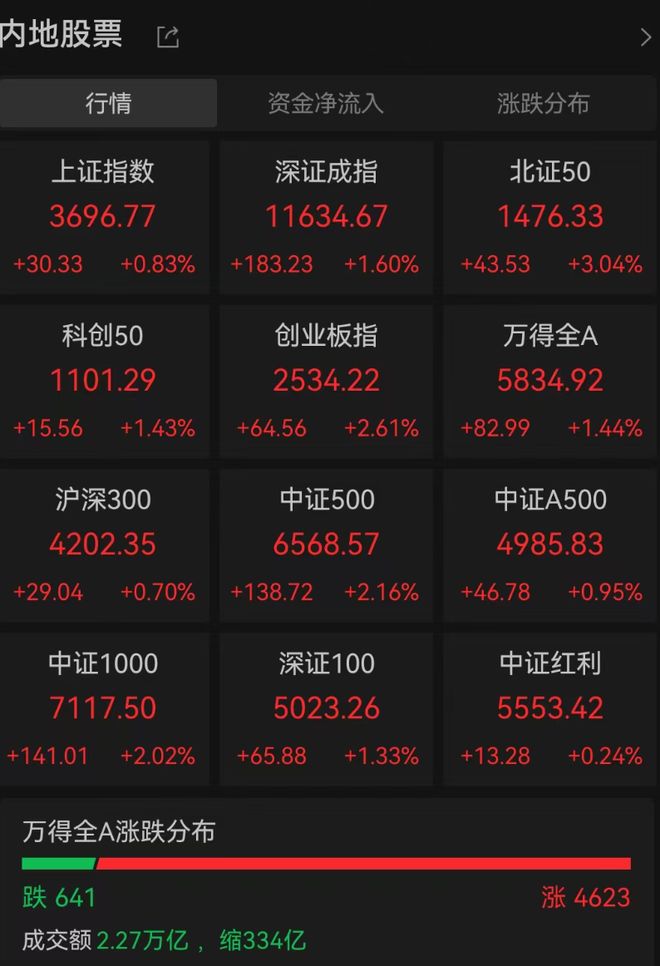
Market Performance - The A-share market showed a strong performance on August 15, with the Shanghai Composite Index rising by 0.83%, the Shenzhen Component Index increasing by 1.6%, and the ChiNext Index gaining 2.61% [1] - The total trading volume exceeded 2 trillion yuan for three consecutive days, indicating heightened market activity [1][14] Weekly Performance - For the week, the Shanghai Composite Index rose by 1.7%, the Shenzhen Component Index increased by 4.55%, and the ChiNext Index surged by 8.58%, marking the largest weekly gain of the year [3] New Account Openings - In July, the number of new A-share accounts reached 1.9636 million, a year-on-year increase of 70.54% and a month-on-month increase of 19.27% [3] - The total number of new accounts opened in 2023 reached 14.5613 million, reflecting a year-on-year growth of 36.88% [3][4] Sector Performance - The financial sector, particularly brokerage and fintech stocks, experienced significant gains, with notable stocks like Zhihui and Tonghuashun reaching historical highs [6] - The brokerage sector saw an overall increase of nearly 4%, with trading volume surpassing 120 billion yuan [8] Investment Trends - There is a notable shift of funds from low-risk deposits to higher-yield investments such as stocks, insurance, and funds, driven by declining deposit rates and increasing attractiveness of equity assets [17] - In July, household deposits decreased by 1.11 trillion yuan, while non-bank deposits increased by 2.14 trillion yuan, indicating a trend of converting fixed deposits into more liquid forms for investment [17] Sector Rotation - The market is no longer dominated by bank stocks, with various sectors such as securities, semiconductors, and insurance showing strong performance and structural opportunities [14] - The recent rally in the A-share market is attributed to multiple factors, including policy improvements, increased risk appetite from retail and institutional investors, and a resilient macroeconomic environment [14]






200万股民入市,A股4600股飘红,大金融爆发
21世纪经济报道· 2025-08-15 08:34
Market Performance - The A-share market has shown significant upward momentum, with the Shanghai Composite Index rising by 0.83%, the Shenzhen Component Index by 1.6%, and the ChiNext Index by 2.61% on August 15, 2023 [1] - For the week, the Shanghai Composite Index increased by 1.7%, the Shenzhen Component Index by 4.55%, and the ChiNext Index by 8.58%, marking the largest weekly gain of the year [2] Market Activity - A notable increase in market activity is observed, with 1.9636 million new accounts opened in July 2023, representing a year-on-year growth of 70.54% and a month-on-month increase of 19.27% [3] - As of July 31, 2023, the total number of new accounts opened this year reached 14.5613 million, a year-on-year increase of 36.88% [3] Sector Performance - The financial sector, particularly brokerage and fintech stocks, has experienced a collective surge, with notable stocks like Zhihui and Tonghuashun reaching historical highs [6] - The brokerage sector saw a strong rally, with an overall increase of nearly 4% and trading volume exceeding 120 billion yuan [7] Individual Stock Highlights - Stocks such as Changcheng Securities, Tianfeng Securities, and Dongfang Caifu have shown significant gains, with Changcheng Securities rising by 10.04% and Tianfeng Securities hitting the daily limit [8][9] - The PEEK materials sector related to robotics has also seen substantial growth, with companies like Huitong and Xinhang New Materials rising over 10% [10] Investment Trends - There is a trend of "deposit migration," where funds are shifting from low-risk deposits to higher-yield investments such as stocks and funds, driven by declining deposit rates and increasing attractiveness of equity assets [16] - In July 2023, household deposits decreased by 1.11 trillion yuan, indicating a shift towards more active investment strategies [15][16] Market Sentiment - The overall sentiment in the equity market has improved, with multiple sectors showing structural opportunities, including securities, semiconductors, and insurance [14] - The market is experiencing a recovery in confidence, with a notable increase in risk appetite among investors [14]

从存款搬家说起
Xin Lang Ji Jin· 2025-08-15 06:16
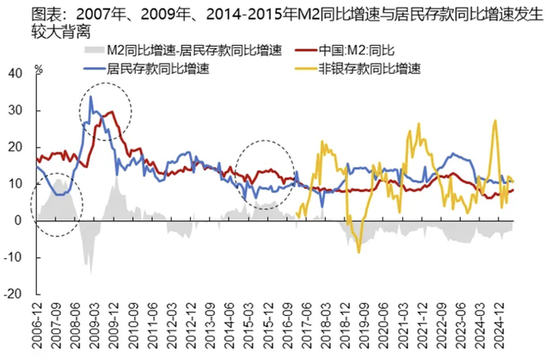
Core Viewpoint - The trend of "deposit migration" in A-shares is driven by declining deposit interest rates and increasing attractiveness of equity assets, leading to a shift of funds from low-risk deposits to higher-yielding investments such as insurance, funds, and stocks [1][6]. Group 1: Deposit Migration Indicators - A key indicator for assessing deposit migration is the divergence between M2 year-on-year growth and resident deposit year-on-year growth. If M2 continues to grow while resident deposits slow down or decline, it indicates funds are flowing out of resident deposit accounts [2][4]. - Recent financial data shows that in July, M2 grew by 8.8%, while resident deposits decreased by 1.11 trillion yuan, indicating a shift towards consumption or investment [4]. Group 2: Historical Context and Fund Flow - Historical instances of significant divergence between M2 and resident deposits occurred in 2007, 2009, and 2014-2015, leading to large-scale deposit migration. The current trend is characterized by a passive outflow due to a scarcity of quality assets rather than an increase in risk appetite [5][6]. - Funds are flowing into various sectors, including stocks, funds, and wealth management products, with real estate expected to attract significantly less interest due to its recent downturn [4][5]. Group 3: Investment Preferences - For conservative investors, bond funds, particularly bond ETFs, are gaining popularity due to their stable historical performance and lower volatility. As of August 13, the scale of bond ETFs reached 536.3 billion yuan, reflecting a 208% increase from the previous year [7][9]. - The emergence of bond ETFs simplifies the investment process for investors, allowing them to rely on indices for selection rather than individual bonds, thus reducing operational complexity [9][12]. Group 4: Ten-Year Government Bond ETF - The ten-year government bond ETF is the only tool in the market tracking ten-year government bond performance, making it a benchmark similar to the CSI 300 index in the stock market [9][10]. - The ten-year government bond ETF offers advantages such as T+0 trading and lower management fees compared to traditional bond funds, enhancing its appeal to both individual and institutional investors [12][13].
中国银河证券:7月社融延续同比多增 非银存款大幅多增
智通财经网· 2025-08-15 02:23
Core Viewpoint - The report from China Galaxy Securities indicates that government bonds continue to support social financing growth, while credit demand remains weak. Opportunities for retail credit growth may arise from the implementation of personal consumption loans and business loan interest subsidies [1]. Group 1: Social Financing and Government Bonds - In July, new social financing amounted to 1.16 trillion yuan, an increase of 386.4 billion yuan year-on-year; as of the end of July, the stock of social financing grew by 9% year-on-year, with a month-on-month increase of approximately 0.1 percentage points [1]. - The issuance of new government bonds reached 1.24 trillion yuan in July, a year-on-year increase of 555.9 billion yuan, supporting the continued rise in social financing growth [2]. - The total issuance of government bonds in July was 2.44 trillion yuan, which is 732.8 billion yuan more than the same period last year [2]. Group 2: Credit Demand and Loan Trends - As of the end of July, the balance of RMB loans from financial institutions grew by 6.9% year-on-year, a decrease of 0.2 percentage points from the previous month; in July alone, RMB loans decreased by 50 billion yuan, a year-on-year decrease of 310 billion yuan [3]. - Resident loans decreased by 489.3 billion yuan in July, with short-term loans down by 382.7 billion yuan and medium to long-term loans down by 110 billion yuan, primarily due to weak real estate sales and early repayments [3]. - Corporate loans increased by 60 billion yuan, but short-term loans decreased by 550 billion yuan, reflecting ongoing challenges in demand and debt management [3]. Group 3: Monetary Supply and Deposits - The growth rates of M1 and M2 in July were 5.6% and 8.8% year-on-year, respectively, with month-on-month increases of 1 percentage point and 0.5 percentage points [4]. - By the end of July, RMB deposits in financial institutions increased by 8.7% year-on-year, with a month-on-month increase of 0.4 percentage points; in July alone, deposits increased by 500 billion yuan, a year-on-year increase of 1.3 trillion yuan [4]. - Non-bank deposits surged by 2.14 trillion yuan year-on-year, reflecting a significant shift in deposits due to active capital markets, with the Shanghai Composite Index rising by 3.74% [4].

105万亿定存到期潮来袭!“存款搬家”入市趋势增强,能否催生慢牛行情?
Sou Hu Cai Jing· 2025-08-15 01:23
Group 1 - The core viewpoint indicates a structural change in the financial landscape, with a significant increase in non-bank deposits and a decrease in household deposits, suggesting a trend of "deposit migration" towards financial products [1][2] - Non-bank deposits surged by 2.14 trillion yuan in July, driven by a recovering capital market and declining bank deposit rates, leading residents to seek higher returns [1][3] - The M2 growth rate rebounded to 8.8% in July, indicating an increase in liquidity and a shift in preference from fixed-term to demand deposits for investment or consumption [1][2] Group 2 - There is a potential for a significant flow of household deposits into capital markets, with approximately 105 trillion yuan of time deposits maturing by 2025, which could provide substantial incremental funds to the capital market [2][3] - Despite the long-term trend of wealth shifting towards financial assets, the current low proportion of equity-based financial products and residents' risk aversion indicate that a stable trend of large-scale "migration" has not yet formed [2][3] - The recent negative growth in credit data highlights weak financing demand in the real economy, contrasting with the recovery in social financing and M1, indicating a lack of internal economic momentum [2][3] Group 3 - The expectation for interest rate cuts has cooled, with recent fiscal subsidy policies reducing the necessity for broad rate cuts, while structural policies aim to support the real economy more precisely [3] - The trend of household deposits moving to non-bank institutions signals an increase in fund activation, providing a positive outlook for the capital market [3] - The large volume of maturing deposits presents a potential foundation for market entry, but the transition from passive to active investment by residents is crucial for supporting healthy capital market development and financing needs of the real economy [3]
一个必须关注的信号 | 谈股论金
水皮More· 2025-08-14 10:09
Core Viewpoint - The A-share market experienced a collective pullback, with the Shanghai Composite Index losing its 3700-point level, indicating a potential correction phase in the market [2][3]. Market Performance - The Shanghai Composite Index fell by 0.46% to close at 3666.44 points, while the Shenzhen Component and ChiNext Index dropped by 0.87% and 1.08%, respectively [2]. - A total of 4396 stocks declined, with only 727 stocks rising, reflecting a broader market downturn despite the seemingly moderate index declines [3]. - The trading volume reached 22.79 billion, marking a significant increase of 1.283 billion from the previous day, indicating a large sell-off [3]. Sector Analysis - Only four sectors saw gains, with the insurance sector leading at a 2.64% increase, driven by China Ping An's acquisition of a stake in China Pacific Insurance [5]. - The insurance sector is expected to benefit from a "Davis Double Play" scenario, where valuation recovery coincides with performance growth [5][6]. - The H-shares of insurance companies have recently outperformed their A-share counterparts, with some nearing a reversal in valuation ratios [5]. Investment Trends - There is a notable trend of "overseas flowers blooming while domestic flowers wither," where foreign investors have a better understanding of the insurance sector compared to domestic investors who have been focusing on speculative stocks [6]. - High dividend yields are highlighted as a focal point for long-term investors, particularly insurance funds, which are expected to be the biggest beneficiaries [6]. Market Sentiment - The current market is characterized by a peak in old themes and a lack of new themes, with performance being heavily scrutinized during the ongoing mid-year report disclosures [8]. - Data shows that 2900 stocks have underperformed the market since August, indicating a structural market where gains and losses are highly differentiated [8]. Monetary Policy - The People's Bank of China announced a 500 billion reverse repurchase operation, indicating ongoing efforts to maintain market liquidity [9]. - The total reverse repurchase operations in August are expected to exceed 1.2 trillion, suggesting a proactive approach to ensure sufficient liquidity in the market [9].



A股突发跳水,背后发生了什么?
Zhong Guo Ji Jin Bao· 2025-08-14 08:37
Market Overview - The Shanghai Composite Index briefly surpassed 3700 points before experiencing a sharp decline, with over 4600 stocks falling [1][2] - As of the market close, the Shanghai Composite Index fell by 0.46%, the Shenzhen Component Index by 0.87%, and the ChiNext Index by 1.08% [1] Stock Performance - A total of 735 stocks rose, with 52 hitting the daily limit up, while 4648 stocks declined [2] - The total trading volume reached 23,062.83 billion, with a total trading quantity of 152,614.8 thousand [3] Sector Highlights - Digital currency concept stocks showed strength, with Hengbao Co., Ltd. hitting the daily limit up [3] - Brain-computer interface concept stocks remained active, with Innovation Medical sealing the board [5] - Robotics concept stocks saw localized activity, with Wolong Electric Drive hitting the daily limit and reaching a historical high [6] - Semiconductor stocks surged, with Cambrian Technology rising over 10% [7] Notable Declines - The aerospace sector experienced adjustments, with Changcheng Military Industry hitting the daily limit down [8] - The stock price of Changcheng Military Industry has increased by 115.1% over the past trading period, leading to concerns about potential suspension for price verification [8] Market Dynamics - The index's breakthrough of the 3700-point mark is seen as facing short-term adjustment pressure, with the need for increased trading volume to sustain the upward movement [9] - Recent data from the central bank indicates a significant increase in non-bank deposits, suggesting a shift of household savings into equity markets [9] - Some banks have issued warnings against the use of credit card funds for stock market investments [9]

突发跳水!背后,发生了什么?
Zhong Guo Ji Jin Bao· 2025-08-14 08:08
Market Overview - The A-share market experienced a significant drop after the Shanghai Composite Index briefly surpassed 3700 points, leading to a decline in over 4600 stocks [2][3] - As of the market close, the Shanghai Composite Index fell by 0.46%, the Shenzhen Component Index by 0.87%, and the ChiNext Index by 1.08% [2] Market Statistics - A total of 735 stocks rose, with 52 hitting the daily limit up, while 4648 stocks declined [3] - The total trading volume reached 23062.83 billion, with a total trading amount of 152614.8 million [4] Sector Performance - Digital currency concept stocks showed strength, with Hengbao Co., Ltd. hitting the daily limit up [4] - Brain-computer interface concept stocks remained active, with Innovation Medical sealing the board [6] - Robotics concept stocks saw localized activity, with Wolong Electric Drive hitting a historical high [7] - Semiconductor stocks surged, with Cambrian rising over 10% [8] Market Dynamics - The index's breakthrough of the 3700-point level is seen as a significant resistance point since 2021, with potential for short-term adjustments due to a lack of strong trading volume [10] - There is a noticeable trend of residents moving deposits into equity markets, with non-bank deposits increasing significantly while resident deposits decreased [10] - Some banks have issued warnings against the use of credit card funds for stock market investments, indicating regulatory scrutiny [10]

“存款搬家”如何影响A股?
2025-08-13 14:52
Summary of Conference Call Records Industry or Company Involved - The discussion primarily revolves around the A-share market in China and the impact of "deposit migration" on it. Core Points and Arguments 1. **Deposit Migration Impact**: The phenomenon of deposit migration is expected to significantly influence the A-share market, with macroeconomic indicators like M1 showing an increase, reflecting enhanced economic vitality and potential recovery in corporate earnings by Q3 2025 [1][4][11]. 2. **Investor Asset Allocation**: The Investor Equity Asset Allocation (AIE) ratio is currently low, indicating a shift in residents' asset preferences, which may help predict future market trends [1][6]. 3. **Excess Deposits**: Despite a decrease in the growth rate of resident deposits from 14% to 10%, there remains approximately 60 trillion yuan in excess deposits, which are gradually moving towards non-bank institutions [1][8]. 4. **Liquidity and New Sectors**: The strong performance of the A-share market is attributed to liquidity support and structural prosperity in new sectors, with M1 and M2 indicators showing significant recovery [3][22]. 5. **Future Market Predictions**: The A-share market is expected to experience a volatile upward trend over the next three years, potentially exceeding 6,600 points, contingent on improved economic conditions and industry logic [2][12]. 6. **Channels for Incremental Funds**: Deposit migration is expected to bring in incremental funds through long-term investments (like insurance funds) and high-risk preference funds, with total long-term funds entering the market potentially exceeding 700 billion yuan [13][14]. 7. **Market Phases**: The current market is in a transitional phase, not yet fully in the second stage of a bull market, but poised for a shift when economic conditions improve [18][22]. 8. **Consumer Behavior**: While consumer willingness to spend remains stable, the desire to purchase homes is low, indicating a cautious approach to spending amid economic uncertainties [9][10]. Other Important but Possibly Overlooked Content 1. **AIE as a Predictive Tool**: The AIE ratio serves as a more effective indicator of asset allocation changes, with its current low level suggesting a potential for higher future market returns [6][7]. 2. **Long-term Trends in Deposits**: The total domestic deposits of residents have reached 160 trillion yuan, significantly above the normal level of around 100 trillion yuan, indicating a substantial amount of excess liquidity in the system [8]. 3. **High-Risk Preference Funds**: High-risk preference funds are expected to enter the market significantly only during bullish phases, which have not yet been realized [15][22]. 4. **Active Equity Funds**: Active equity funds are seen as having unique advantages in the current market, particularly in emerging sectors, which could lead to a positive feedback loop attracting more investments [20][21]. 5. **Market Sentiment and Future Inflows**: The sentiment around the market is expected to improve as deposit migration continues, potentially leading to increased inflows from high-risk preference funds through ETFs and active public funds [22][23].
7月金融数据点评:喜忧参半
CMS· 2025-08-13 14:03
Group 1: Loan Data - In July, new RMB loans decreased by 50 billion, a year-on-year reduction of 310 billion, lower than the Wind average expectation[12] - From January to July, RMB loans decreased by 660 billion year-on-year, with a growth rate decline of 1.6 percentage points compared to last year[12] - The structure of loans deteriorated, with household loans down by 492.7 billion, a year-on-year decrease of 287.1 billion[13] Group 2: Deposit Data - In July, RMB deposits increased by 500 billion, a year-on-year increase of 1.3 trillion[16] - Household deposits decreased by 780 billion year-on-year, while corporate deposits increased by 320.9 billion[16] - From January to July, RMB deposits increased by 7.78 trillion year-on-year, with corporate deposits contributing 45.5%[16] Group 3: Social Financing (社融) - In July, new social financing reached 1.2 trillion, with a growth rate of 9%, up by 0.1 percentage points from the previous month[18] - Government bonds contributed significantly, with net financing of approximately 812.4 billion for local bonds, a year-on-year increase[19] - The overall social financing growth is expected to decline, with government bond growth peaking and then decreasing[18] Group 4: Market Insights - The equity market has exerted emotional pressure on the bond market, leading to a "stock-bond seesaw" effect[3] - The current financial data supports a bullish outlook on the bond market, with a 1.7% yield on ten-year bonds seen as an entry point[5] - The weakening demand for financing in the real economy suggests limited upward pressure on interest rates in the near future[5]