
美元指数

Search documents
非农数据公布后,美元指数DXY短线上涨后大幅下挫,波幅近30点。
Xin Lang Cai Jing· 2025-11-20 13:37
来源:滚动播报 非农数据公布后,美元指数DXY短线上涨后大幅下挫,波幅近30点。 ...
美联储12月降息预期减弱,美元指数再上100点关口
Sou Hu Cai Jing· 2025-11-20 12:01
Group 1 - The likelihood of a Federal Reserve rate cut in December has significantly decreased due to the U.S. government shutdown affecting the release of the October non-farm payroll report [2] - The Federal Reserve's decision-makers are divided on whether to cut rates in December, with more members opposing a cut than supporting it, leading to a rise in the dollar index [2][3] - The updated release schedule for the non-farm payroll report means the Federal Reserve will lack key evidence to support a rate cut, further increasing divisions on inflation outlook among decision-makers [2] Group 2 - The dollar index has seen significant fluctuations this year, dropping from above 109 to around 96, primarily due to changing expectations regarding Federal Reserve rate cuts [3][4] - The recent rise in the dollar index has negatively impacted global risk asset prices, with major stock indices experiencing substantial gains throughout 2025 [4] - The strengthening dollar has led to declines in sensitive assets like Bitcoin and gold, as well as adjustments in high-valuation U.S. tech stocks, indicating a potential end to the current bull market in risk assets [5]


管涛:关税施压,人民币为何逆势走强
3 6 Ke· 2025-11-20 10:43
Core Viewpoint - The Chinese yuan has shown resilience against extreme tariff pressures in 2025, contrary to previous trends, primarily due to a weakening US dollar, a recovering domestic economy, and easing trade conflicts [1][2][3]. Summary by Sections Tariff Pressures and Yuan Performance - The yuan faced significant depreciation from 2018 to 2019 due to escalating US-China trade tensions, with the exchange rate dropping from 6.30 to below 7.30 [2][3]. - In 2025, the US imposed multiple rounds of tariffs on Chinese goods, leading to a peak of 145% tariffs on some products, while China retaliated with 125% tariffs [2][3]. Economic Factors Influencing Yuan Stability - Despite the tariff pressures in early 2025, the yuan remained stable, with slight appreciation observed in the first quarter, and a recovery in April after initial declines [4][5]. - By September 2025, the yuan had appreciated by 1.2% against the US dollar, with the onshore and offshore rates showing similar trends [4]. Internal and External Influences - The yuan's stability is attributed to several factors, including a significant retreat of Trump’s aggressive trade policies, a weakening US dollar, and a positive reassessment of Chinese assets by investors [5][6]. - The Chinese government’s proactive measures in response to tariff threats helped stabilize market expectations and support economic recovery [7]. US-China Trade Relations - Following intense tariff conflicts, the US and China entered a phase of trade negotiations in May 2025, which included agreements to reduce tariffs and establish a consultation mechanism [8][9]. - Subsequent meetings in London and Stockholm further advanced trade discussions, improving market sentiment [8][9]. Currency Valuation and Market Dynamics - The yuan's exchange rate has remained stable despite the weakening of the US dollar and the appreciation of other currencies, indicating a lack of strong upward pressure on the yuan [9][10]. - The International Monetary Fund (IMF) has assessed that the yuan is not significantly undervalued, with the current account surplus relative to GDP remaining within reasonable limits [12][13]. Future Outlook for the Yuan - In 2026, the yuan may benefit from several favorable factors, including potential US interest rate cuts, continued progress in US-China trade negotiations, and a recovering domestic economy [14][15]. - However, uncertainties remain, such as the resilience of the US economy and the potential for renewed tariff pressures, which could affect the yuan's performance [16].
投资者下调美联储降息预期,金价趋于稳定
Sou Hu Cai Jing· 2025-11-20 09:15
来源:环球市场播报 金价在连续两日上涨后趋于稳定,因投资者下调了对美联储下月降息的预期。 此前两个交易日金价累计上涨近 1%,目前现货黄金交投于每盎司 4070 美元附近。美国将不会发布 10 月就业报告,这使得美联储政策制定者在今年最后一次会议召开前,失去了一份关键数据参考。与此同 时,10 月美联储会议纪要显示,多数官员认为,2025 年剩余时间内维持利率稳定可能是适宜的。 黄金这类贵金属通常会从降息中受益,因为它本身不产生利息收益;若美联储维持利率不变,可能会削 弱黄金的吸引力。此外,美元指数周三创下 9 月末以来最大单日涨幅,这也对金价构成压力 —— 美元 走强会使以美元计价的黄金对全球多数买家而言变得更加昂贵。 今年以来金价已大幅上涨,涨幅超 50%,并在 10 月创下历史新高,随后部分回吐涨幅。金价此前的上 涨得益于美联储此前两次降息,同时也受到各国央行增持黄金以及资金流入黄金 ETF(交易所交易基 金)的支撑。 莫迪拉勒・奥斯瓦尔金融服务公司分析师马纳夫・莫迪表示,会议纪要显示美联储内部存在分歧(尽管 部分官员担忧过早降息可能影响通胀治理进展,但美联储上月仍实施了降息),这一消息导致金价回吐 部 ...
ATFX策略师:美国9月大非农来袭,美元指数突破100关口,多头有望延续
Sou Hu Cai Jing· 2025-11-20 08:58
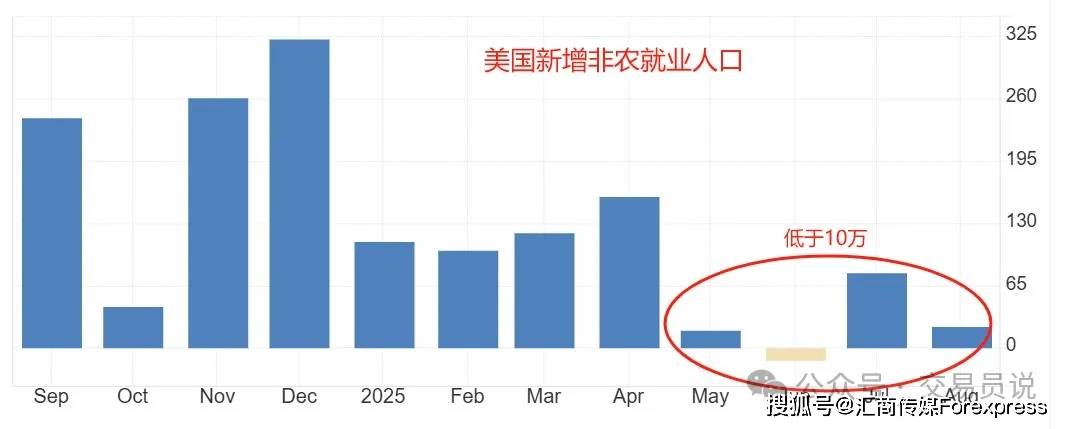
Core Viewpoint - The U.S. Labor Department will release the delayed September non-farm payroll report today at 21:30, which was originally scheduled for October 3 but postponed due to the government shutdown. There is speculation that the October report may never be published due to a lack of data collection [1]. Group 1: Employment Data - The key focus of the September non-farm payroll report is the change in non-farm employment, with a previous value of 22,000 and an expected value of 50,000, indicating a significant anticipated increase, although the absolute figure remains low [3]. - Since May, the U.S. job market has been deteriorating, with non-farm payroll additions falling below 100,000 for four consecutive months, and a negative value recorded in June. This decline is attributed to strict immigration policies and reduced hiring in the AI sector [3]. - The ADP report for September showed a decline of 32,000 jobs, falling short of both the previous value of 54,000 and the expected value of 50,000, suggesting that the non-farm payroll data may also underperform [4]. Group 2: Economic Implications - The poor employment situation has led the Federal Reserve to announce interest rate cuts in September and October, with expectations for further cuts in December if conditions do not improve [3]. - The latest weekly data indicates a loss of 2,500 jobs per week in the U.S. job market, reinforcing the bleak outlook for October and highlighting ongoing recession risks in the macroeconomic environment [4]. Group 3: Market Reactions - The dollar index has seen a significant rise, reaching above the 100 mark, driven by expectations surrounding the non-farm payroll data. If the data aligns with expectations, bullish momentum for the dollar index may continue [6].
美联储降息预期生变,美元兑印度卢比为何应声跳涨?
Sou Hu Cai Jing· 2025-11-20 06:45
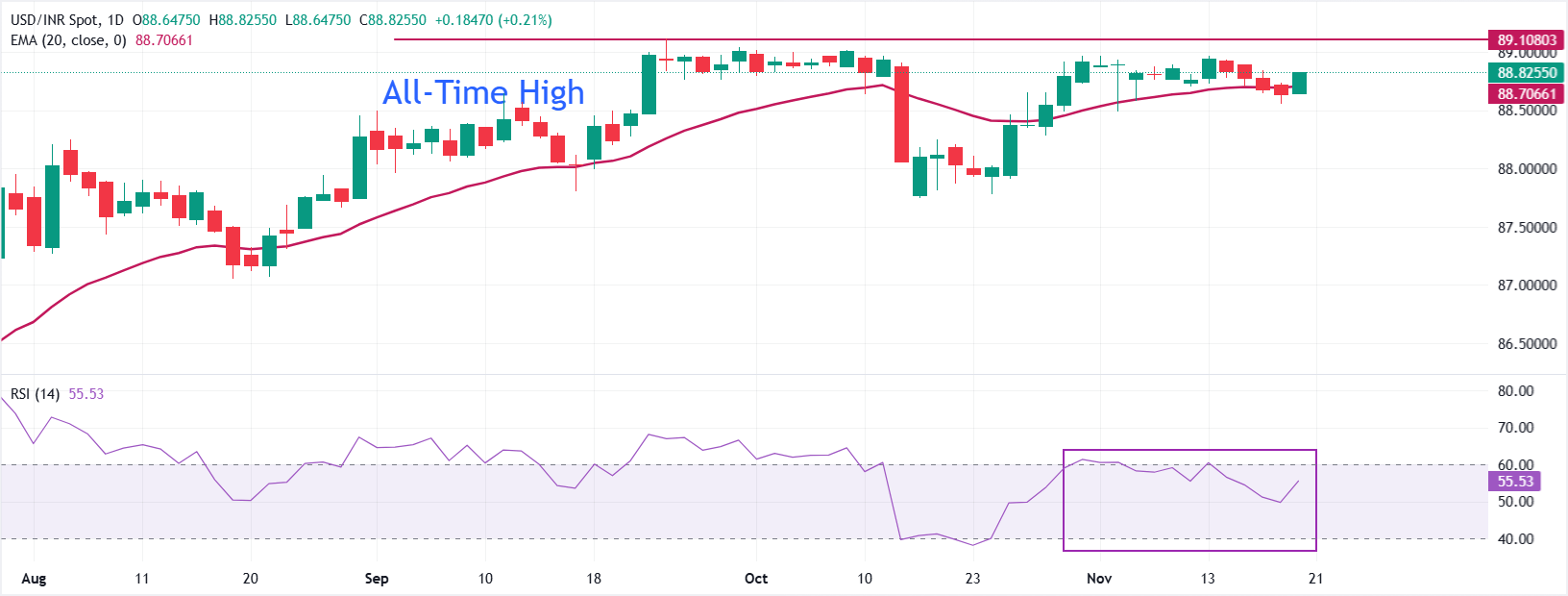
Core Insights - The recent surge in the exchange rate, approaching 88.80, is primarily influenced by the overall strength of the US dollar and market adjustments to Federal Reserve monetary policy expectations [1][2]. Policy Background and Market Expectations - In October, the Federal Reserve lowered interest rates by 25 basis points to a range of 3.75%-4.00%, with most policymakers favoring rate stability to avoid hindering inflation's return to the 2% target [2]. - Disagreements emerged among officials regarding further rate cuts during the December meeting, with some arguing that continued easing could elevate inflation expectations and undermine public confidence in achieving inflation targets [2]. - Market tools indicate that the probability of a 25 basis point cut to 3.50%-3.75% in December dropped from 50.1% to 32.8%, reflecting a significant re-evaluation of monetary policy expectations [2]. Dollar Index and Exchange Rate Dynamics - The dollar index recently reached a five-month high of approximately 100.40, indicating the dollar's strength against a basket of currencies, which has supported the rise of the dollar against the Indian rupee [3]. - The dollar's strength is attributed to market expectations of sustained high interest rates by the Federal Reserve and uncertainties in the global economic environment [3]. Technical Analysis Perspective - Technically, the dollar-rupee exchange rate found support near the 20-day exponential moving average, ending a four-day decline, with the average positioned around 88.70 [5]. - Momentum indicators show the 14-day Relative Strength Index (RSI) has rebounded to around 60.00, suggesting potential bullish momentum if it remains above this level [5]. - Key support is identified at the August 21 low of 87.07, while the historical high of 89.12 is noted as a critical resistance level to watch [5].
冠通期货早盘速递-20251120
Guan Tong Qi Huo· 2025-11-20 06:04
Hot News - The US Bureau of Labor Statistics will not release the October employment report and will incorporate non - farm employment data into the November report. The November report will be released on December 16 [2] - Russian Deputy Prime Minister Novak stated that the latest sanctions from the US and the West have not affected Russia's oil production, and Russia maintains its annual oil production forecast at 510 million tons, adhering to the OPEC+ agreement [2] - As of the week ending November 19, national building material production was 4.4629 million tons, up 100,300 tons from last week; total inventory was 9.0549 million tons, down 490,500 tons; apparent demand was 4.9534 million tons, up 289,100 tons. National hot - rolled coil production was 4.1258 million tons, up 10,900 tons; total inventory was 4.5417 million tons, down 60,600 tons; apparent demand was 4.1864 million tons, up 27,600 tons [2] - According to the UK Telegraph, under a US - proposed conflict - ending plan, Ukraine may be forced to "lease" part of its territory to Russia. The Trump administration's agreement would make Kiev give up control of the eastern Donbass region while retaining legal ownership, and Russia would pay an undisclosed rent for actual control [2] - An East China medium - large recycled lead smelting enterprise's application for renewing the hazardous waste business license was rejected due to incomplete transformation and installation of the MVR facility in its sewage treatment station, not meeting relevant regulations [3] Key Focus - Key commodities to focus on are urea, coking coal, lithium carbonate, industrial silicon, and crude oil [4] Night - session Performance - Non - metallic building materials had a 3.38% increase, precious metals 29.01%, oilseeds and fats 9.93%, non - ferrous metals 23.10%, soft commodities 2.67%, coal - coke - steel - ore 12.74%, energy 2.96%, chemicals 11.02%, grains 1.22%, and agricultural and sideline products 3.97% [4] Position Changes - The document shows the recent five - day position changes of commodity futures sectors, but specific data is not described in text [5] Performance of Major Asset Classes - In the equity market, the Shanghai Composite Index rose 0.18% daily, the SSE 50 rose 0.58%, the CSI 300 rose 0.44%, the CSI 500 fell 0.40%, the S&P 500 rose 0.38%, the Hang Seng Index fell 0.38%, the German DAX rose 0.13%, the Nikkei 225 fell 0.34%, and the UK FTSE 100 fell 0.47% [6] - In the fixed - income market, the 10 - year Treasury bond futures fell 0.06%, the 5 - year fell 0.03%, and the 2 - year fell 0.03% [6] - In the commodity market, the CRB commodity index fell 1.36%, WTI crude oil fell 1.99%, London spot gold rose 0.26%, LME copper rose 0.77%, and the Wind commodity index rose 2.41% [6] - Other assets: the US dollar index rose 0.53%, and the CBOE volatility index remained unchanged [6]
【环球财经】美元指数19日上涨
Xin Hua She· 2025-11-20 05:19
新华财经纽约11月19日电美元指数19日上涨。 衡量美元对六种主要货币的美元指数当天上涨0.68%,在汇市尾市收于100.228。 截至纽约汇市尾市,1欧元兑换1.1521美元,低于前一交易日的1.1585美元;1英镑兑换1.3046美元,低 于前一交易日的1.3155美元。 1美元兑换157.03日元,高于前一交易日的155.53日元;1美元兑换0.8064瑞士法郎,高于前一交易日的 0.7992瑞士法郎;1美元兑换1.4057加元,高于前一交易日的1.3979加元;1美元兑换9.5628瑞典克朗,高 于前一交易日的9.4640瑞典克朗。 (文章来源:新华社) ...
美元指数创9月底来最大单日涨幅
Xin Hua Cai Jing· 2025-11-20 05:15
Group 1 - The US dollar index strengthened for the fourth consecutive trading day, surpassing the 100 mark for the first time since November 6, with a daily increase of 0.5%, marking the largest single-day gain since September 25 [1] - The Federal Reserve's October meeting minutes revealed significant divisions among officials regarding interest rate decisions, with some advocating for maintaining rates through 2025, while others suggested a potential rate cut in December if economic performance aligns with expectations [1] - Concerns about financial stability were raised, particularly regarding the risk of a disorderly decline in the stock market, leading to a consensus among officials to halt the quantitative tightening (QT) actions [1] Group 2 - The delayed September non-farm employment report is set to be released, with economists predicting an addition of 50,000 jobs and an unemployment rate holding steady at 4.3% [2] - The dollar index has been on the rise since June, partly due to a rebound in the US stock market, with the S&P 500 index reaching historical highs before a recent pullback in large tech stocks [2] - Market expectations for a cumulative rate cut of 85 basis points by the end of 2026 indicate a divergence regarding the likelihood of a December rate cut, with some analysts predicting a rebound for the dollar in early 2026 [2]