成本控制

Search documents
“借米下锅”到“自耕良田”,山东能源山东玻纤解锁供应链新密码
Qi Lu Wan Bao Wang· 2025-07-01 11:58
Core Insights - The company is addressing production challenges by enhancing its internal capabilities, particularly in the production of glass bottle tubes, which are critical to its operations [1][2] - Significant cost reductions have been achieved through technological innovations and process optimizations, leading to improved efficiency and reduced reliance on external suppliers [2][3] Group 1: Production Challenges - The company faces a critical supply issue with the glass bottle tubes, requiring nearly one million units annually, which impacts production plans and costs [1] - External supply disruptions have led to production slowdowns, emphasizing the need for self-sufficiency in key components [1] Group 2: Technological Innovations - A new intelligent production unit has been implemented, automating the production of glass bottle tubes and reducing costs by 5 yuan per unit through structural optimization and energy savings [2] - The company has achieved a 99.8% qualification rate for self-produced tubes, significantly reducing waste and further lowering costs [2] Group 3: Cost Control Measures - Various cost-saving measures have been introduced across production processes, including adjustments to drying processes and repurposing idle equipment, leading to substantial monthly savings [3] - The company aims to enhance its competitive edge and risk resilience by focusing on cost control in critical areas such as precious metal processing and chemical agents [3]

聚合顺: 聚合顺新材料股份有限公司相关债券2025年跟踪评级报告(合顺转债)
Zheng Quan Zhi Xing· 2025-06-27 16:32
Core Viewpoint - The credit rating agency maintains a stable outlook for the company, highlighting its competitive position in the nylon 6 chip market and the potential for growth due to significant construction capacity [1][3]. Company Overview - The company, 聚合顺新材料股份有限公司, continues to hold a competitive market position in the nylon 6 chip sector, with a market share that remains among the industry leaders [1][3]. - As of March 2025, the company's total assets are valued at 62.17 billion, with total debt at 36.41 billion and equity at 19.62 billion [1]. Financial Performance - The company expects rapid growth in 2024, with projected revenue of 71.68 billion, up from 60.18 billion in 2023 [1]. - Net profit is anticipated to reach 3.66 billion in 2024, compared to 2.17 billion in 2023 [1]. - The EBITDA interest coverage ratio is expected to remain strong at 18.21 in 2024, indicating solid earnings relative to interest expenses [1]. Capacity and Production - The company has significant construction capacity, with a total of 516,000 tons under construction, which is expected to support future business expansion [1][3]. - The production bases are strategically located, with the Hangzhou base close to downstream industries and the other bases near raw material suppliers, enhancing operational efficiency [1][3]. Market Environment - The nylon chip industry is experiencing steady growth, with a projected apparent consumption of 5.32 million tons in 2024, reflecting a year-on-year increase [6][7]. - The industry is benefiting from increased demand in sectors such as electric vehicles and smart home applications, which are driving sales growth [6][7]. Risks and Challenges - The company faces challenges related to thin product margins, with overall gross margins not exceeding 10%, necessitating precise cost control [1][2]. - Fluctuations in raw material prices, particularly for caprolactam, which constitutes about 90% of production costs, pose a risk to profitability [1][2][15]. - The company may encounter short-term capacity digestion pressures as new capacities come online in 2025-2026 [2][10]. Product Sales and Pricing - The company employs a pricing model based on "cost + processing fee," which allows it to transfer some raw material price volatility risks to downstream customers [15]. - In 2024, the company achieved record sales volumes in fiber-grade and engineering plastic-grade chips, contributing to overall revenue growth [12][14]. Supply Chain and Procurement - The company maintains stable relationships with key suppliers, with the top five suppliers accounting for 65.40% of procurement, indicating a moderate level of supplier concentration [15]. - The average price of caprolactam has been on a downward trend, which may alleviate cost pressures and stimulate demand for nylon 6 chips [15].

Burberry又要靠奥特莱斯清货了
Sou Hu Cai Jing· 2025-06-27 08:40
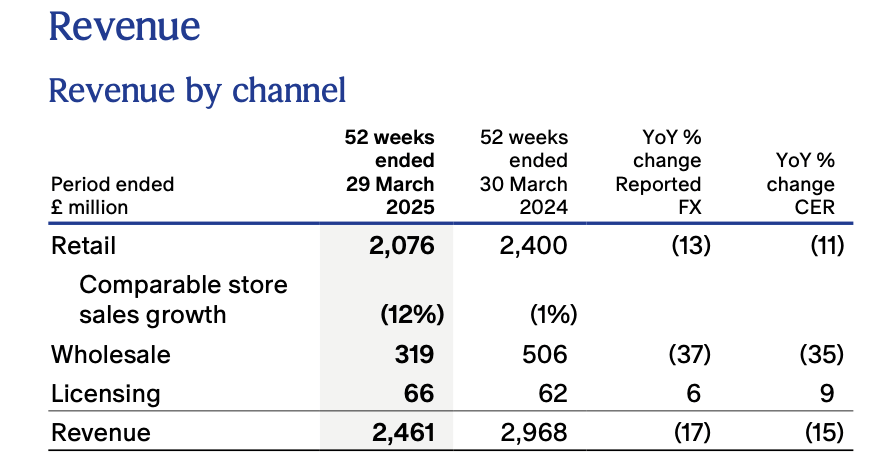
Core Viewpoint - Burberry's proactive price reduction strategy has led to a significant recovery in its stock price, increasing over 70% since mid-April 2023, despite facing severe challenges in the luxury goods sector [2][6]. Financial Performance - For the fiscal year 2025, Burberry reported revenues of £2.461 billion, a 17% decrease year-on-year, with adjusted operating profit down 94% to £26 million [2][5]. - Comparable store sales fell by 12% for the fiscal year, with the Asia-Pacific market experiencing a 16% decline [3][5]. - The fourth quarter showed a narrowing decline in comparable store sales to 6%, better than the market expectation of 7.78% [5]. Strategic Changes - New CEO Joshua Schulman has implemented a strategic shift focusing on classic products and reducing prices, moving away from previous high-end strategies [6][7]. - The company plans to cut approximately 1,700 jobs, which is nearly 20% of its global workforce, aiming to save £60 million by fiscal year 2027 [6][8]. Market Dynamics - Japan was the only market to show growth for Burberry, with a slight increase of 1%, primarily driven by spending from Chinese tourists [4]. - The outlet channel has become increasingly important, with Burberry being referred to as the "Outlet Queen," as it has performed well despite challenges in high-end retail locations [8][10]. Inventory and Pricing Strategy - Burberry has faced significant inventory issues, leading to a 7% decrease in total inventory at constant exchange rates [11]. - The company's gross margin fell to 62.5%, down 470 basis points at constant exchange rates, primarily due to discounting actions to manage excess inventory [11].

Orion(OESX) - 2025 Q4 - Earnings Call Transcript
2025-06-26 15:00
Financial Data and Key Metrics Changes - In Q4 2025, revenue was $20.9 million, up from $19.6 million in Q3 2025 but down from $26.4 million in Q4 2024 [14] - Fiscal 2025 revenues totaled $79.7 million, compared to $90.6 million in fiscal 2024, reflecting a decline [14] - The net loss for Q4 2025 was $2.9 million, or $0.09 per share, compared to a net income of $1.6 million, or $0.05 per share in Q4 2024 [19] - Fiscal 2025 net loss increased slightly to $11.8 million, or $0.36 per share, compared to a net loss of $11.7 million, or $0.36 per share in fiscal 2024 [19] - Cash generated from operations improved to $600,000 in fiscal 2025 from negative $10.1 million in fiscal 2024 [19] Business Line Data and Key Metrics Changes - The EV charging business saw a revenue increase of 1837% in Q4 2025, driven by expanded geographic reach and order backlog execution [14] - LED lighting revenues in Q4 2025 and fiscal 2025 decreased by 3322% year-over-year due to reduced project activity and product demand [15] - Electrical Maintenance Services revenue decreased to $4.1 million in Q4 2025 from $5.2 million a year ago, but gross profit margin improved significantly to 18.2% from 4.4% in fiscal 2024 [16][17] Market Data and Key Metrics Changes - The company expects modest growth in LED lighting and electrical maintenance revenues for fiscal 2026, while anticipating flat to slightly lower EV charging revenues due to uncertainty in project funding [21] - The overall gross profit margin increased by 170 basis points to 27.5% in Q4 2025 compared to 25.8% in fiscal 2024, attributed to improvements in maintenance and a higher margin revenue mix in EV charging [17] Company Strategy and Development Direction - The company has reorganized into two commercial business units: Solutions and Partners, to better leverage capabilities across LED lighting, EV charging, and electrical maintenance [9][10] - The Solutions unit focuses on large projects and cross-selling opportunities, while the Partners unit emphasizes product sales through distribution channels [10] - The company aims to enhance leadership and urgency in executing its growth and profitability goals, with a focus on integrating engineering design and project management capabilities [12] Management's Comments on Operating Environment and Future Outlook - Management acknowledged the need for improved execution on product and service opportunities and emphasized the importance of maintaining customer relationships [6][12] - The company is optimistic about its project pipeline and expects to achieve positive adjusted EBITDA for the full fiscal year 2026 [22] - Management remains cautious about the EV charging segment due to uncertainties in federal funding and project timelines, despite a strong project pipeline [31][38] Other Important Information - The company reduced operating overheads by more than $4 million in fiscal 2025 and plans to implement further reductions in fiscal 2026 [8] - A binding term sheet was executed to address Voltrec earn-out obligations, which includes issuing $1 million in common stock and a cash payment of $875,000 [20] Q&A Session Summary Question: Order trends and expectations for Q2 - Management noted a strong start to the year with orders, particularly in April, and expects this trend to continue [28] Question: Assumptions for EV charging revenue outlook - Management is taking a conservative approach for the EV segment, citing a strong project pipeline but acknowledging potential impacts from federal actions [31][38] Question: Clarification on earn-out obligations - The earn-out opportunity related to the purchase has ended, with remaining obligations tied to stock and cash payments [39] Question: Revenue cadence throughout the quarter - Management expects a more consistent revenue flow throughout the year, with subsequent quarters anticipated to be higher than Q1 [43] Question: Gross margins by business unit - Management expects gross margins to be relatively consistent across business units, with potential for improvement based on cost-saving initiatives [44] Question: Impact of federal government rule changes - Management clarified that while there has been some noise, the company has not been significantly impacted by federal funding issues, particularly in the EV segment [60][61]

新东方-S(09901.HK):教育业务利润率回升 常态化回购或将提振估值
Ge Long Hui· 2025-06-25 18:06
Group 1 - The core viewpoint indicates that New Oriental's revenue for Q4 FY25 is expected to be $1.186 billion, representing a year-on-year growth of 4.4% [1] - The education business, including cultural tourism, is projected to generate $1.034 billion in revenue, with a year-on-year increase of 13.3% [1] - Other businesses, primarily Oriental Selection, are expected to see revenue decline to $152 million, a decrease of 32.1% year-on-year [1] Group 2 - The study anticipates that the overseas examination training and consulting business will generate $298 million in revenue for Q4 FY25, reflecting a year-on-year growth of 5%, but a slowdown compared to previous periods [1] - The company is adjusting its high-end one-on-one training model to a one-to-many format to lower class prices and is expanding its youth overseas examination training services to enhance growth resilience [1] Group 3 - New business revenue, including K9 competency training and learning machine services, is expected to grow by 34% year-on-year to $311 million in Q4 [2] - The number of teaching outlets is projected to increase to 1,251, a year-on-year growth of 22%, indicating sustained expansion [2] - The company is implementing cost control measures and operational efficiency improvements, leading to an expected Non-GAAP operating profit margin expansion to 3% in Q4 [2] Group 4 - The revenue forecast for FY25-FY27 has been slightly adjusted downwards to $4.84 billion, $5.8 billion, and $7.03 billion, respectively, due to slower growth in the overseas study business [3] - Non-GAAP net profit estimates for FY25-FY27 have been revised upwards to $467 million, $575 million, and $710 million, respectively, reflecting improved cost control [3] - The DCF target price has been raised to $76.3, corresponding to a PE ratio of 17.1 for FY25 [3]
维他奶国际发布业绩公告 内地销售额呈增长趋势
Zheng Quan Ri Bao· 2025-06-25 16:13
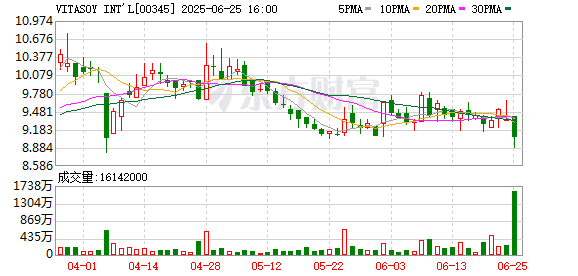
Core Insights - Vitasoy International Group Limited reported a revenue of approximately HKD 6.274 billion for the fiscal year 2024/2025, representing a year-on-year growth of 1% [2] - The company achieved a gross profit of about HKD 3.218 billion, with a year-on-year increase of 3% [2] - The proposed final dividend is HKD 0.102 per share, combined with an interim dividend of HKD 0.04 per share, totaling HKD 0.142 per share for the fiscal year [2] Financial Performance - The net profit attributable to equity holders increased by 102% year-on-year, reaching HKD 235 million [2] - Sales in mainland China showed improvement in the second half of the fiscal year, contributing to a moderate overall sales growth [2] - Operating profit from mainland operations grew by 41% year-on-year, with an operating profit margin of 9% [2] Business Strategy and Market Position - The company aims to expand market share in plant-based milk and ready-to-drink tea products to maintain business scale and profitability amid a slowing beverage market [3] - Vitasoy's Hong Kong operations saw a 24% increase in operating profit, with an operating profit margin of 12%, driven by rising sales and reduced indirect costs [3] - The company has stabilized prices for its lemon tea products in mainland China after a price reduction of 10% to 15% [3] Industry Context - The beverage industry is experiencing overall growth slowdown and intensified competition, which poses challenges for Vitasoy's future growth [4][5] - The company's recent performance relies heavily on cost control and operational efficiency rather than breakthrough innovations or market disruptions [4][5]

新东方-S(09901):教育业务利润率回升,常态化回购或将提振估值
Shenwan Hongyuan Securities· 2025-06-25 07:11
Investment Rating - The report maintains a "Buy" rating for the company [2][8] Core Views - The company's education business is expected to see a recovery in profit margins, and regular share buybacks may enhance its valuation [2][8] - The projected revenue for Q4 FY25 is $1.186 billion, representing a year-on-year growth of 4.4%, with the education segment (including cultural tourism) contributing $1.034 billion, a 13.3% increase [5] - Non-GAAP net profit attributable to the parent company is forecasted to be $51 million, a 39.2% increase year-on-year, with a Non-GAAP net profit margin of 4.3%, expanding by 1.1 percentage points [5][7] Revenue and Profitability - The report anticipates a slowdown in the growth of the study abroad business, projecting a revenue of $298 million for Q4 FY25, a 5% increase, which is a deceleration of 12.5 percentage points compared to the same period last year [6] - New business segments, including K9 competency training and learning machine services, are expected to grow by 34% year-on-year to $311 million in Q4 [6] - The company is expected to improve its Non-GAAP operating profit margin to 3% in Q4, reversing the decline seen in Q3 [7] Financial Projections - Revenue forecasts for FY25 to FY27 have been slightly adjusted to $4.84 billion, $5.8 billion, and $7.03 billion respectively [8] - Non-GAAP net profit estimates for FY25 to FY27 have been raised to $467 million, $575 million, and $710 million respectively [8] - The DCF target price has been increased to $76.3, corresponding to a PE ratio of 17.1 for FY25 [8]
中国旺旺(00151.HK)年度纯利增8.6%至43.36亿元 末期息每股2.04美仙
Ge Long Hui· 2025-06-24 04:31
Summary of Key Points Core Viewpoint - China Wangwang (00151.HK) reported a slight decline in revenue for the fiscal year ending March 31, 2025, but showed growth in gross profit and net profit attributable to equity holders, indicating resilience in its operations despite challenging market conditions [1][2]. Financial Performance - Total revenue for the fiscal year 2024 was RMB 23.511 billion, a decrease of 0.3% year-on-year - Gross profit reached RMB 11.189 billion, an increase of 1.8% year-on-year - Operating profit was RMB 5.837 billion, reflecting a growth of 4.1% year-on-year - Net profit attributable to equity holders was RMB 4.336 billion, up 8.6% year-on-year, with basic earnings per share at RMB 0.3671 [1][2]. Product Performance - Revenue decline was primarily due to adverse weather and market conditions affecting the ice cream and rice snacks categories, which saw low double-digit and high single-digit declines respectively - The company implemented internal organizational changes in the second half of fiscal 2024, leading to a low single-digit revenue recovery compared to the previous year - Dairy and beverage categories achieved mid-single-digit growth, while the ice cream category experienced over 20% recovery growth [1]. Strategic Initiatives - The company is focusing on product innovation and expanding its market presence, with new products launched in the past five years contributing to double-digit revenue proportions in fiscal 2024 - Emerging channels such as OEM and overseas markets showed double-digit growth, continuing to be significant growth drivers for the company [1][2]. Cost Management - The gross margin increased by 1.0 percentage points to 47.6%, aided by a decrease in the unit costs of major raw materials and packaging - Effective control of overall operating expenses and a reduction in financing costs contributed to the profit growth, with the profit margin for equity holders rising by 1.5 percentage points to 18.4% [2].

【私募调研记录】骏胜资产调研大中矿业
Zheng Quan Zhi Xing· 2025-06-20 00:15
机构简介: xa0东莞市骏胜资产管理有限公司成立于2013年10月16日,注册实缴资本1000万元,是一家专注于证券 期货投资、期权投资、资产管理及基金管理的专业化金融公司。公司以"诚信为金、博弈众长、你我共 赢"为经营理念,围绕"打造优秀投资团队,跻身国内知名投行"为经营目标,与广东地区多家券商、期 货公司及银行建立了很好的合作,聚集了从事证券、期权、期货的优秀专业精英团队,对资产有很强的 管理能力和风险控制能力。 以上内容为证券之星据公开信息整理,由AI算法生成(网信算备310104345710301240019号),不构成投资建议。 根据市场公开信息及6月19日披露的机构调研信息,知名私募骏胜资产近期对1家上市公司进行了调研, 相关名单如下: 1)大中矿业 (骏胜资产参与公司现场参观) 调研纪要:大中矿业在碳酸锂价格持续下跌背景下,通过全产业链经营模式、规模化产能布局和成本控 制优势应对价格波动。湖南锂矿项目采用"采、选、冶一体化"经营模式,实现锂原料100%自给自足, 规划年采选生产规模为2000万吨。公司推进硫酸法提锂新工艺中试,实现锂渣减量化、无害化、资源 化,锂收率提高至90%,成本降低。湖南锂 ...
丰山集团: 投资者关系活动记录表
Zheng Quan Zhi Xing· 2025-06-19 09:52
Group 1 - The company has not yet commenced operations at its factories in Ningxia and Inner Mongolia, and raw material prices remain high, keeping product prices stable since Q1 [3] - The company's pesticide segment operates at a high capacity utilization rate, with plans to increase production by approximately 2,000 tons through technological upgrades due to rising market demand for green grass [3] - The company is currently testing the electrolyte for sodium-ion batteries and is selling it primarily to companies like Zhongna [3] Group 2 - The company has not considered new financing plans at this time, but will arrange financing based on investment plans and funding needs, ensuring timely disclosure of any future arrangements [3] - The company is enhancing accounts receivable management and customer credit monitoring, and is using China CITIC Insurance to secure payments for overseas business [3] - The production capacity release for the Yichang project in Hubei is being conducted in phases, with trial production proceeding smoothly and sales meeting expectations, indicating confidence in future performance growth [5]