人工智能(AI)

Search documents
美股:特朗普引发军工巨震,谁是下一只翻倍黑马?
3 6 Ke· 2026-01-09 03:55
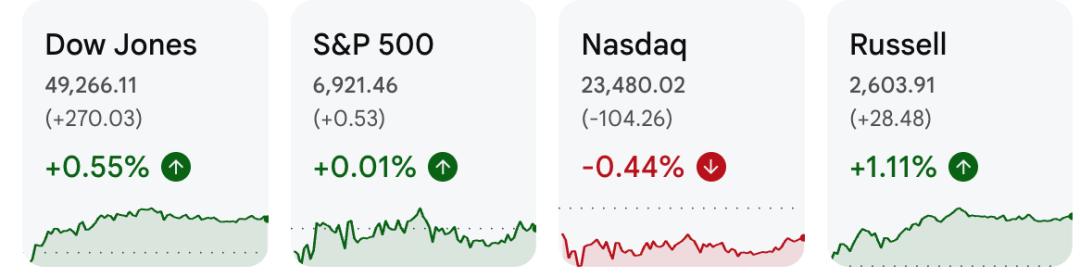
Market Performance - The internal rotation effect in the U.S. stock market was significant, with the Dow Jones increasing by 0.55%, the Nasdaq decreasing by 0.44%, and the S&P 500 rising by 0.01% [1] - The Russell 2000 index, representing small-cap stocks, surged by 1.1%, reaching a historical high and outperforming the Nasdaq 100 by approximately 4 percentage points in the first five trading days of the year, marking the second strongest start to a year in history [1] Sector Performance - Despite mixed performances among the three major indices, the number of stocks that rose significantly outnumbered those that fell, with the energy, consumer discretionary, consumer staples, and real estate sectors overall increasing [3] - In the large-cap tech sector, over half of the stocks experienced a pullback [3] Military Spending and Industry Impact - A major news item was Trump's plan to increase the U.S. military budget by 50% to $1.5 trillion by 2027, with stringent conditions attached [5] - Trump indicated that the military budget shortfall would be covered by tariff revenues, suggesting a potential unprecedented surge in order volume for military contractors [6] - However, Trump imposed three major restrictions on defense companies, including a ban on stock buybacks and dividends until production efficiency is met, a cap on executive salaries at $5 million, and a mandate that profits must prioritize factory expansion and equipment maintenance [6] Legal and Economic Implications - The U.S. Supreme Court is set to release a key opinion that could significantly alter market trends for 2026, particularly regarding the legality of Trump's comprehensive tariff plan [7] - If the court rules against the tariffs, S&P 500 companies could see a 2.4% increase in EBIT for 2026 compared to last year, as tariffs are viewed as a form of corporate tax [8] - Consumer sectors heavily reliant on imports, such as toys, clothing, and home appliances, would benefit from reduced procurement costs if tariffs are lifted, leading to potential valuation recovery [9] - Industries dependent on global supply chains, such as industrials and transportation, would also benefit from lower logistics costs and potential tariff refunds [10] - Conversely, domestic producers previously protected by trade policies may face increased international competition, leading to potential underperformance in stock prices [11] Debt Market Concerns - The bond market is experiencing complex sentiments, with concerns about fiscal sustainability arising from potential tariff revenue losses, which could exacerbate the federal budget deficit [12] - If the court mandates tariff refunds, there may be a surge in bond issuance to raise funds, negatively impacting the bond market [12] Strategic Outlook - Investors have partially priced in the expectation of tariffs being overturned, and initial sell-offs in the bond market may be temporary [13] - The focus for retail investors will not only be on the court's decision but also on the White House's subsequent responses, which could quickly diminish profit expectations in the stock market [13] - If the economic stimulus from tariff removal is too strong, it may cause the Federal Reserve to reconsider its interest rate path for 2026, maintaining high market volatility [14]

入行酒店二十年,他现在要用AI拆掉前台
3 6 Ke· 2026-01-09 01:17
Core Insights - The hotel industry is undergoing a significant transformation with the integration of AI, driven by leaders like Zheng Nanyan, who aims to eliminate traditional front desk operations and enhance customer experience through AI technology [2][3][9] - The success of AI implementation in traditional industries relies heavily on strong leadership commitment and the availability of vast vertical scene data [1][12] Group 1: Company Strategy - Zheng Nanyan has made a bold decision to remove front desks in his hotels, aiming to redefine the business flow with AI as a core feature of the company [3][9] - The company plans to embed AI into both organizational management and consumer-facing services, with a system called "Magic Lamp" expected to be fully deployed by March 2026 [9][10] - The company has a workforce of approximately 300 employees, with 170 dedicated to AI-related tasks, indicating a strong focus on technology integration [9][12] Group 2: Industry Context - Other hotel groups are also exploring AI, with various initiatives such as Huazhu's "Huaxiao AI" and Jinjiang's AI voice systems, but few have successfully integrated AI into their workflows [10][12] - The hotel industry faces challenges in data collection and processing, as the specific terminology used in hotels differs from general language models, complicating AI training [12][13] Group 3: Financial Performance - The company has faced historical challenges, including a significant drop in revenue and profit margins, necessitating a strategic overhaul and brand consolidation [18][19] - The company aims to reduce operational costs by 15% to 25% through AI, which is expected to streamline processes and improve service delivery [12][13] Group 4: Future Outlook - Zheng Nanyan is optimistic about the potential of AI to revolutionize the hotel industry, viewing it as a long-term investment that could take a decade to fully realize [19][20] - The company is also expanding internationally, with investments in Indonesia's hotel management platforms, indicating a dual strategy of AI integration and market expansion [19][20][23]

围观AI对赌直播之后,我见证了一场人类画师对AI的突围。
数字生命卡兹克· 2026-01-09 01:05
Core Viewpoint - The article discusses the emergence of AI in the art community, focusing on the phenomenon of "AI betting" where artists prove their authenticity against accusations of using AI-generated art. It highlights the emotional and creative implications of AI's presence in the art world and the ongoing struggle between traditional artistry and AI capabilities. Group 1: AI Betting Phenomenon - The article introduces a betting scenario where an artist must prove their work is not AI-generated through a live demonstration, with financial stakes involved [10][11] - This betting format has gained popularity on platforms like Xiaohongshu, where artists engage in live sessions to validate their skills against AI accusations [19][39] - The role of a neutral intermediary, referred to as "the middleman," is crucial in these bets to ensure fairness and professionalism [20][61] Group 2: Impact of AI on Artists - The arrival of AI has significantly changed the art landscape, with AI's ability to mimic styles and create detailed works rapidly, posing a threat to traditional artists [31][32] - Artists like "Natural" express concern that AI creates a "slaughter line," where those with average skills are at risk of being overshadowed by AI capabilities [32][36] - The temptation to use AI as a shortcut for creating art has led to increased suspicion and competition among artists, complicating the community dynamics [38][37] Group 3: The Role of the Middleman - The middleman in AI betting has a responsibility to protect artists from unfair treatment and ensure that the betting process is not exploitative [58][60] - The middleman must assess the qualifications of the betting parties to prevent bullying and maintain a supportive environment for artists [61][62] - The article emphasizes the importance of the middleman's role in fostering a fair and respectful atmosphere during live demonstrations [61][64] Group 4: The Future of Art and AI - The article concludes with a reflection on the resilience of human creativity, suggesting that artists who embrace traditional methods can still thrive despite AI advancements [79][80] - It highlights the belief that genuine passion for creation will lead to continuous improvement and innovation, regardless of AI's capabilities [82][84] - The narrative encourages artists to focus on their unique contributions rather than competing directly with AI-generated content [83][86]

CES 2026,中国车来定义“AI+出行”丨品牌新事
吴晓波频道· 2026-01-09 00:30
Core Viewpoint - The article emphasizes that artificial intelligence (AI) is fundamentally reshaping the automotive industry, with Chinese automakers leading this transformation at the 2026 CES [4]. Group 1: AI's Impact on the Automotive Industry - AI is expected to influence the purchasing decisions of 40 to 50 million vehicles globally by 2030, with automakers that successfully implement AI at scale potentially increasing their sales by 20% [4]. - The transition from traditional automotive functions to AI-driven capabilities is likened to the shift from feature phones to smartphones, highlighting the need for vehicles to understand user states rather than just execute commands [9][10]. - Current AI applications in vehicles are often fragmented, lacking integration across systems like driving, cabin, and chassis, which leads to a disjointed user experience [11][12]. Group 2: Challenges in AI Integration - The automotive industry faces significant technical challenges, including the need for a cohesive ecosystem that integrates chips, software, cloud services, and mapping data [15]. - AI's evolution requires vast amounts of driving data and must be built on a foundation of safety [16]. - The gap between experimental AI technologies and their real-world application remains a major hurdle, compounded by the long development cycles of vehicles compared to the rapid pace of AI advancements [17]. Group 3: Geely's AI Strategy - Geely has made significant strides in AI integration, achieving a sales volume of 3.025 million vehicles in 2025, a 39% increase year-on-year, with 1.688 million being new energy vehicles, marking a 90% growth [21]. - The company introduced its "Full-Field AI 2.0" technology at CES 2026, which enhances the integration of AI across various vehicle domains, allowing for continuous evolution and improved decision-making capabilities [22][26]. - Geely's approach combines extensive R&D investment, a comprehensive AI ecosystem, and a large dataset from over 8.5 million assisted driving vehicles, which supports ongoing optimization of its AI systems [31]. Group 4: Competitive Landscape - The article notes that different global automakers are pursuing varied technological paths, with Chinese companies like Geely adopting a systematic approach that leverages a complete supply chain for rapid AI integration [35]. - The unique "Chinese speed" allows for quick iterations of AI algorithms and vehicle products, creating a feedback loop that enhances innovation and market responsiveness [35]. - As competition in the automotive industry shifts from isolated technological advancements to a comprehensive ecosystem approach, the advantages of Chinese automakers become increasingly apparent [36].


伯恩斯坦拉响警报:流动性泛滥催生“全面泡沫“,AI仅是冰山一角
美股IPO· 2026-01-09 00:22
Core Viewpoint - Richard Bernstein Advisors (RBA) warns that excess liquidity is driving asset prices far beyond fundamental support levels, leading to a "broad-based frenzy" in the market, extending beyond artificial intelligence (AI) [1][3] Group 1: Market Conditions - The current market is described as being in a "full-blown bubble," affecting not only AI but also cryptocurrencies, meme stocks, SPACs, investment-grade bonds, and high-yield bonds [3] - The loose monetary and fiscal policies are identified as the primary causes of this disconnection from fundamental valuations [3] Group 2: Concerns in Credit Investments - The AI boom raises particular concerns for credit investors, as they cannot share in the excess returns if AI succeeds, and will bear losses if it fails [4] - Major tech companies are expected to invest approximately $440 billion in AI infrastructure over the next year, with a 34% increase in capital expenditures [4] Group 3: Investment Strategy Adjustments - RBA has completely exited the corporate bond market, having previously been overweight in this area, due to the relative value proposition no longer being valid when spreads fall below 90 basis points [4] - As of now, the U.S. high-grade credit risk premium has risen to 78 basis points, remaining below 90 basis points since May of the previous year [4] Group 4: Future Outlook - There is a warning that if the Federal Reserve's rate cuts do not meet market expectations, credit spreads may widen further this year [5] - RBA is shifting focus towards collateralized loan obligations (CLOs), mortgage-backed securities (MBS), high-grade floating-rate debt, and European equities, which are seen as more attractive due to fiscal stimulus and supportive monetary policy [5]

Aehr Test(AEHR) - 2026 Q2 - Earnings Call Transcript
2026-01-08 23:00
Financial Data and Key Metrics Changes - Revenue for Q2 FY2026 was $9.9 million, down 27% from $13.5 million in the prior year period, primarily due to lower shipments of wafer packs [24] - Non-GAAP gross margin for Q2 was 29.8%, compared to 45.3% a year ago, reflecting lower sales volume and a less favorable product mix [25] - Non-GAAP net loss for the quarter was $1.3 million, or negative $0.04 per diluted share, compared to net income of $0.7 million, or $0.02 per diluted share in Q2 FY2025 [26] - Cash position improved to $31 million at the end of the quarter, up from $24.7 million at the end of Q1 [27] Business Line Data and Key Metrics Changes - Wafer-level burn-in engagements expanded with significant progress in production installations across AI processors, flash memory, and silicon photonics [5][6] - Package-part burn-in systems saw increased demand, with orders totaling more than $5.5 million in the fiscal third quarter to date, exceeding total orders for the entire second quarter [17] - Contact revenues, which include wafer packs and burn-in systems, totaled $3.4 million, representing 35% of total revenue, down from 64% in the same quarter last year [25] Market Data and Key Metrics Changes - The semiconductor test and burn-in market is experiencing growth driven by AI and data center infrastructure, with bookings expected to be between $60 million and $80 million in the second half of FY2026 [5][23] - The company is seeing strong demand for its Sonoma systems, particularly for high-temperature operating life qualifications for AI devices [17][19] - The silicon carbide market is expected to see demand growth, although the company is taking a conservative stance on order expectations [15] Company Strategy and Development Direction - The company is focusing on expanding into key markets such as AI processors, gallium nitride power semiconductors, and silicon photonics, diversifying its customer base and total addressable market [22] - A strategic partnership with ISE Labs was announced to enhance wafer-level test and burn-in services for next-generation high-performance computing and AI applications [8] - The company is reinstating financial guidance for FY2026, expecting revenue between $25 million and $30 million for the second half of the fiscal year [23][28] Management's Comments on Operating Environment and Future Outlook - Management expressed confidence in the outlook due to increased visibility across multiple end markets and the reinstatement of financial guidance [6][22] - The company highlighted the importance of reliability testing in the semiconductor industry, driven by the growing complexity and performance requirements of next-generation devices [21] - Management noted that the demand for AI and data center infrastructure is a significant growth driver for the company [4][20] Other Important Information - The company successfully closed the InCal facility and consolidated operations into its Fremont facility, resulting in cost savings [26] - The company raised $10 million in gross proceeds through an equity offering during the quarter [27] - The company plans to participate in several investor conferences in early 2026 to enhance investor relations [28] Q&A Session Questions and Answers Question: What is the potential booking strength of $60-$80 million in the second half of this fiscal year? - The majority of bookings are expected to come from the AI accelerator processor line, with some contributions from silicon carbide and silicon photonics [30] Question: Can you provide insight into the AI processor market's potential growth? - The company anticipates that the AI business could be measured in hundreds of millions of dollars in a few years, with significant demand for wafer-level burn-in systems [31][32] Question: What is the expected capacity for manufacturing wafer-level systems? - The company discussed the potential to manufacture over 20 systems a month if demand requires it, indicating strong production capabilities [36] Question: Will customers transition from package-part burn-in to wafer-level burn-in? - Customers may initially use package-part burn-in and later transition to wafer-level burn-in as they become more comfortable with the technology [50][51]

美股三大指数涨跌不一,军工股全线走强,中概股多数上涨阿里涨超5%
Feng Huang Wang· 2026-01-08 22:46
Market Overview - The U.S. stock market showed mixed results with the Dow Jones increasing by 270.03 points (0.55%) to close at 49,266.11, while the Nasdaq fell by 104.26 points (0.44%) to 23,480.02, and the S&P 500 rose slightly by 0.52 points (0.01%) to 6,921.45 [1] - Analysts noted a degree of profit-taking after several days of gains, with geopolitical risks remaining high as the market prepares for the upcoming earnings season [1] Economic Data - Initial jobless claims in the U.S. rose slightly, indicating continued weakness in labor demand, corroborating previous ADP employment data and JOLTS job openings data [1] - The market is awaiting the December non-farm payroll report, which is expected to be a significant macroeconomic data point following the end of the longest government shutdown in U.S. history [1] - Fitch Ratings upgraded its U.S. economic growth forecast, predicting a GDP growth of 2.1% in 2025 and 2.0% in 2026, accounting for delayed data due to the government shutdown [1] Sector Performance - Large-cap tech stocks mostly declined, with Nvidia down 2.15%, Microsoft down 1.11%, and Apple down 0.5%, while Tesla rose 1.02% and Amazon increased by 1.96% [2] - The defense sector saw gains, with Northrop Grumman up 2.4%, Lockheed Martin up 4.3%, and General Dynamics up 1.7%, following Trump's proposal to increase military spending to $1.5 trillion for FY2027, a more than 50% increase from the current record budget of $901 billion [2] Company News - Mining giants Glencore and Rio Tinto have restarted merger talks, with discussions focusing on a potential all-stock merger that could involve parts or all of their businesses [5][6] - General Motors announced a $6 billion one-time charge related to scaling back its electric vehicle investments, primarily due to changes in government policy and a cooling demand for electric vehicles [8] - Google is enhancing its Gmail service with new Gemini features, including AI-generated email summaries and real-time proofreading tools, aimed at improving user experience [7]
新贵扩军!A股百元股突破200只 呈现明显“科技味” 电子行业上榜量第一
Shen Zhen Shang Bao· 2026-01-08 18:08
1月8日A股收盘,寒武纪收报1444.00元/股,排名第一;贵州茅台、源杰科技位居二、三名,收盘价分 别为1412.30元/股、715.00元/股。 从市场表现来看,去年1月8日至今年1月8日,A股207只百元股中,仅11只个股逆市下跌;百元股平均 涨幅达182%,远高于全部A股平均涨幅56%。 新年伊始,沪指重回4000点创10年来新高,A股百元股数量大幅扩容。据记者统计,截至1月8日收盘, A股百元股数量达207只,较去年同期增加137只,同比增长196%。 从行业分布来看,A股207只百元股中,以申万一级行业分类,较为集中的行业有电子、计算机、机械 设备、电力设备、汽车、医药生物、食品饮料等,其中,电子行业有76只股票上榜,位居第一名,占比 36.72%;计算机、机械设备行业均有22只股票上榜,并列第二名;电力设备行业有17只股票上榜,位 居第三名。 百元股呈现明显"科技味" 记者统计发现,百元股的分布呈现出明显的"科技味"。科创板、创业板、北交所的百元股数量达165 只,占比近八成,达79.71%。沪市主板、深市主板分别有27只、14只。以科创板为例,在90只科创板 百元股中,寒武纪以1444.00元 ...
1月8日晚间重要公告一览
Xi Niu Cai Jing· 2026-01-08 10:30
Group 1 - Jinli Permanent Magnet expects a net profit of 660 million to 760 million yuan for 2025, representing a year-on-year growth of 127% to 161% [1] - Wens Foodstuffs anticipates a net profit of 5 billion to 5.5 billion yuan for 2025, a decrease of 40.73% to 46.12% compared to the previous year [2] - New Open Source plans to repurchase shares worth 40 million to 50 million yuan, with a maximum repurchase price of 25.77 yuan per share [3] Group 2 - Fosun Pharma's subsidiary has had a drug registration application accepted for a new drug targeting ALK-positive non-small cell lung cancer [4] - Leike Film reported a net profit of -86 million yuan for the first three quarters of 2025, indicating a potential annual loss [5] - Crown Stone Technology's application for a specific issuance of A-shares has been accepted by the Shanghai Stock Exchange [6] Group 3 - Dongxin Technology has completed the business registration change for its subsidiary, Lishuan Technology, and has invested 211 million yuan in it [7] - Tianci Materials has increased its commodity futures hedging business limit from 150 million to 300 million yuan [8] - Gaode Infrared's actual controller has reduced his shareholding by 0.54%, bringing his stake down to 62.95% [9] Group 4 - Tianyong Intelligent expects a net profit of 10 million to 15 million yuan for 2025, marking a turnaround from losses [10][11] - China Merchants Energy anticipates a net profit of 6 billion to 6.6 billion yuan for 2025, an increase of 17% to 29% year-on-year [18] - Guangdong Electric Power A's Huizhou Power Plant's Unit 5 has been put into commercial operation, with an investment of 8.05 billion yuan [19] Group 5 - Jianghuai Automobile reported a 42.24% year-on-year increase in sales volume for December 2025 [25] - China Pharmaceutical's subsidiary has received a drug registration certificate for a new medication [26] - TianNeng Co. plans to use up to 12 billion yuan of its own funds for entrusted wealth management [27] Group 6 - Luoyang Huizhong reported a 10.55% month-on-month decrease in sales revenue from live pigs for December 2025 [28] - Baolidi expects a net profit of 145 million to 152 million yuan for 2025, a year-on-year increase of 27.17% to 33.30% [30] - Changchun High-tech's subsidiary has had a melatonin granule registration application accepted [31] Group 7 - Zhongmin Energy reported a 4.46% year-on-year decrease in cumulative on-grid electricity for 2025 [32] - Huaxin Electronics reported a 7.79% year-on-year decrease in consolidated operating revenue for December 2025 [35] - Xiamen Airport reported a 2.79% year-on-year increase in passenger throughput for December 2025 [36] Group 8 - Baiyun Airport reported a 12.27% year-on-year increase in passenger throughput for December 2025 [37] - Pulaike has received a new veterinary drug registration certificate for a chewable tablet [38] - Yunnan Energy Holdings' subsidiary has reduced its stake to 84% after a capital increase [39] Group 9 - Gansu Energy Chemical's new thermal power project has successfully completed trial operation [41] - Zhenghong Technology reported a significant decrease in sales revenue from live pigs for December 2025 [42] - Huasheng Lithium Battery is planning to issue H-shares for listing on the Hong Kong Stock Exchange [43] Group 10 - Jincheng Mining has signed a mining production contract with an estimated total price of approximately 510 million yuan [44] - Microchip Biotech has received approval for clinical trials of a new drug for pancreatic cancer [45] - Yahon Pharmaceutical has completed the first patient enrollment for a Phase I clinical trial of its drug [46]





2026年宏观经济与资产配置展望
Sou Hu Cai Jing· 2026-01-08 10:17
Group 1 - The core theme for China's economy in 2026 will focus on boosting domestic demand and emphasizing technology development, as external uncertainties persist due to factors like the US-China trade war [2][3][25] - The economic growth target for 2026 is set at approximately 5.0%, which aims to ensure over 10 million new jobs, balancing current needs with long-term goals [6][25] - The potential GDP growth rate is projected to decline to around 4.63% during the 15th Five-Year Plan period (2026-2030), influenced by structural constraints such as an aging population and diminishing capital returns [4][5][6] Group 2 - The government is expected to implement more proactive fiscal and monetary policies, maintaining a fiscal deficit of around 4% and a broad fiscal deficit rate potentially exceeding 10% [7][12] - To address insufficient effective demand, an annual injection of 4 trillion to 5 trillion yuan into the economy is necessary to maintain normal economic circulation [12][25] - The real estate market is anticipated to face significant challenges, with a projected need for approximately 4.58 trillion yuan to normalize unsold housing inventory [9][10] Group 3 - The focus on technology will include significant investments in AI infrastructure, semiconductor manufacturing, and high-end manufacturing sectors, with domestic companies expected to benefit from policy support [21][25] - The consumer market is expected to see a shift towards service consumption, with policies aimed at enhancing consumer environments and increasing household income [19][20] - Structural policies will be necessary to improve income distribution and enhance consumer spending, particularly targeting middle and low-income groups [14][17][25]