
资本市场改革

Search documents
爆了!年中盛典最后入场券
格隆汇APP· 2025-06-27 10:25
Core Insights - The article emphasizes the acceleration of changes and emerging opportunities in the Chinese economy, driven by "new quality productivity" as the engine for transformation in 2025 [1] - It highlights the ongoing release of policy dividends, deepening capital market reforms, and the accelerated return of foreign capital into new economic sectors such as artificial intelligence, high-end manufacturing, and green energy [1] - The article outlines the complex global landscape characterized by geopolitical conflicts, differentiated monetary policies, supply chain pressures, and overlapping political cycles, urging investors to optimize strategies amidst these challenges [1] Event Details - The "2025 Mid-Year Strategy Summit" will take place in Shenzhen on July 4-5, 2025, featuring top thought leaders and practitioners [1] - The summit aims to provide in-depth analysis of core changes in the global and Chinese economies, forward-looking investment trends driven by "new quality productivity," and discussions on risks and opportunities in a complex environment [1] - The event will also cover the benefits of capital market reforms and investment strategies from top-tier institutions managing over 100 billion [1] Participation Information - The global institutional investor forum on July 5 is a paid event, with early bird pricing available for limited seats [2] - The front-row reserved seat is priced at 688 per person (originally 1,088), while general admission is 388 per person (originally 688), with limited availability [2] - Attendees are encouraged to secure their spots promptly to engage in this significant investment dialogue [2]

资本加速向“新”集聚 全面创新的资本市场生态正在形成
Zheng Quan Ri Bao· 2025-06-25 16:43
Group 1: Capital Market Focus on Technology Innovation - The capital market is increasingly focused on supporting technological innovation and the development of new productive forces, with regulatory bodies guiding capital towards cutting-edge technology sectors through institutional innovation [1] - As of June 25, 50 companies have listed on the A-share market this year, a year-on-year increase of 19.05%, raising a total of 37.125 billion yuan, which is a 22.72% increase compared to the previous year [1] - The majority of the newly listed companies are in strategic emerging industries, particularly in new-generation information technology, new materials, new energy vehicles, and high-end equipment manufacturing [1] Group 2: Support for Quality Sci-Tech Enterprises - The China Securities Regulatory Commission (CSRC) has issued implementation opinions to enhance financial services for technology enterprises throughout their lifecycle, including support for quality tech companies to go public [2] - As of June 25, 80 companies' listing applications have been accepted this year, with 53 applications received in June alone [2] - The CSRC is set to deepen reforms with a focus on the Sci-Tech Innovation Board, including the reintroduction of listing standards for unprofitable companies [2][3] Group 3: Mergers and Acquisitions (M&A) Activity - The A-share M&A market has seen increased activity, with 1,833 M&A transactions disclosed this year, including 88 major asset restructurings, a year-on-year increase of 158.82% [5][6] - M&A is viewed as a pathway for companies to quickly acquire scarce technology and market resources, facilitating industry upgrades and valuation reconstruction [6][7] - The CSRC has introduced measures to support M&A, including a simplified review process and encouraging private equity funds to participate [6][7] Group 4: Expansion of Sci-Tech Bonds - The issuance of sci-tech bonds has accelerated, with 792 bonds issued this year, totaling 960.948 billion yuan, and a significant increase of 547.04% since the launch of the "technology board" [8][9] - The introduction of sci-tech bond ETFs is expected to attract various funds to invest in key technology sectors, broadening financing sources for tech companies [8][9] - The regulatory framework is evolving to support asset securitization and REITs in the technology sector, aiming to enhance the financing landscape for innovative enterprises [9]
政策催化,券商板块价值重估?
Xin Lang Ji Jin· 2025-06-25 13:22
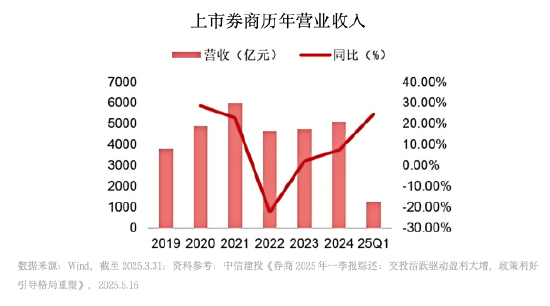
Group 1 - The core viewpoint of the article highlights the recent recovery of the brokerage sector due to favorable policies, particularly the implementation of the "1+6" reform measures in the Sci-Tech Innovation Board, which are expected to benefit the securities industry [1][2] - The "1+6" reform includes the establishment of a growth layer for the Sci-Tech Innovation Board and six innovative measures aimed at enhancing the adaptability of the system to better serve technological innovation and new productive forces [1] - Analysts believe that the relaxation of IPO regulations on the Sci-Tech Innovation Board will positively impact brokerage firms' investment banking and private equity direct investment businesses [1] Group 2 - The brokerage sector is expected to experience strong performance recovery from 2024 to the first quarter of 2025, with 42 listed brokerages projected to achieve a total revenue of 508.847 billion yuan, a year-on-year increase of 7.32%, and a net profit of 147.835 billion yuan, a year-on-year increase of 15.88% [3] - In the first quarter of 2025, listed brokerages are expected to report revenues of 125.930 billion yuan, a year-on-year increase of 24.60%, and a net profit of 52.183 billion yuan, a year-on-year increase of 83.48% [3] - The favorable policies are anticipated to expand the growth space for the securities industry, with increased market stability and improved investment ecology creating a more favorable environment for brokerage firms' proprietary businesses [6] Group 3 - The current valuation of the securities industry is believed to have adjusted to a reasonable level, with the securities II (Shenwan) industry index's price-to-earnings ratio (TTM) and price-to-book ratio (LF) at 19.81 times and 1.31 times, respectively, positioning at the 33rd and 48th percentiles over the past five years [6] - Institutional holdings indicate a significant underweight in the financial sector, with the non-bank sector underweight by 9.48% relative to the CSI 300 index, and the brokerage sector underweight by 6.25%, suggesting potential reallocation opportunities for public funds [6] - Historical experience shows that during an upward cycle in the A-share market, the brokerage sector often becomes a core focus due to increased trading activity, improved brokerage income, and enhanced proprietary business performance [6]
股指期货日报-20250623
Guo Jin Qi Huo· 2025-06-23 11:13
Group 1: Report Industry Investment Rating - No relevant content provided Group 2: Core Viewpoints of the Report - The Fed's June interest rate decision and the geopolitical situation in the Middle East have influenced the market, and the A - share market is in a sideways - oscillating state. Investors should be patient and wait for better trading opportunities [14][15] Group 3: Summary by Directory 1. Market Overview and Market Review 1.1 Overall Market Performance on the Day - On June 19, 2025, the three major A - share indices declined. The Shanghai Composite Index fell 0.79% to 3362.11 points, the Shenzhen Component Index dropped 1.21% to 10051.97 points, and the ChiNext Index decreased 1.36% to 2026.82 points. The trading volume of the Shanghai and Shenzhen stock markets reached 1.2506 trillion yuan, an increase of 59.6 billion yuan from the previous day. The four major stock index futures also adjusted after closing [2] 1.2 Futures Market Data - IF2506 closed at 3840.4 points, down 30.8 points or 0.80%, with a trading volume of 43,781 lots, an open interest of 37,486 lots, a daily decrease of 18,151 lots, and a capital outflow of 5.146 billion yuan. IF2507 closed at 3798.4 points, down 31.4 points or 0.82%, with a trading volume of 28,537 lots, an open interest of 55,095 lots, a daily increase of 1,248 lots, and a capital inflow of 3.315 billion yuan [7] 1.3 Spot Market Data - On June 19, 2025, the overall index price was stable. The CSI 300 Index closed at 3843.09 points, down 31.88 points from the previous trading day [9] 2. Analysis of Influencing Factors 2.1 Comments on Important News and Events on the Day - The Fed announced to keep the current interest rate unchanged in its June interest rate decision, but the number of officials supporting two interest rate cuts this year decreased, showing a marginal hawkish signal. The Fed also lowered the GDP growth forecast to 1.4% and raised the inflation forecast to 3%, indicating increased concerns about the risk of stagflation in the US economy [12][13] - On June 18, the CSRC Chairman Wu Qing proposed three major reform directions at the Lujiazui Forum, including deepening the "1 + 6" reform of the STAR Market, enabling the third set of standards for the ChiNext Board, and implementing new regulations on mergers and acquisitions. These policies are expected to make the A - share market more active in the capital operations of technology - innovation enterprises [12] 2.2 Tracking and Interpretation of Related Data - In the overseas market, the US dollar index rose, the US Treasury bond yield first fell and then rose, the 10 - year US Treasury bond yield slightly declined, the prices of gold and crude oil futures both fell, the three major US stock indices showed a differentiated trend, the Nasdaq Golden Dragon China Index declined, and the offshore RMB exchange rate rose after fluctuations. The market focus remains on the situation in the Middle East [12][13]
资本市场丨科技创新和产业创新深度融合要“畅通循环”
Sou Hu Cai Jing· 2025-06-23 05:17
Core Viewpoint - The integration of technological innovation and industrial innovation is essential for driving economic growth in the context of a restructured global economic landscape. The China Securities Regulatory Commission (CSRC) emphasizes the need to activate the multi-tiered capital market to support this integration effectively [1][11]. Capital Market Development - China's capital market has shown activity in funding sectors like technology, media, communication, and consumption, but remains cautious in hard technology investments. The key to promoting the integration of technological and industrial innovation lies in ensuring efficient capital circulation across different stages and levels [3][4]. - The current capital market faces challenges such as uneven capital distribution, difficulties in early-stage project financing, long investment cycles, and insufficient exit channels [3][4][5]. Exit Channels and Liquidity - The reliance on IPOs as the primary exit strategy for venture capital institutions is problematic, as other exit methods like mergers and acquisitions (M&A) and S-fund transfers are underdeveloped [4][5]. - The development of S-funds is hindered by issues such as valuation difficulties and a lack of professional participants, which prevents the establishment of an efficient market for capital exits [4][5]. Policy Recommendations - To enhance the financing environment for technology enterprises, it is suggested to diversify exit channels beyond IPOs and M&A, and to encourage the development of equity M&A markets [4][9]. - Government initiatives, such as establishing technology guidance funds, can help direct social capital into key areas while reducing financing costs for enterprises [9][10]. - Tax incentives for long-term investments, such as tax breaks for investors holding shares for over five years, could encourage more stable capital allocation [9][10]. Market Structure and Coordination - Strengthening the coordination among various segments of the capital market is crucial. This includes improving the transfer mechanisms between different market segments to ensure that companies can access appropriate financing at various development stages [5][10]. - The capital market should function as a comprehensive, multi-tiered, and efficient "circulation network" to facilitate the flow of capital into and out of technological innovations [5][10]. Investment Trends and Data - As of June 20, 2025, the cumulative financing scale for high-tech enterprises in China's capital market reached 363.87 billion yuan, with 1,772 strategic emerging industry listed companies having a total market value of 20.80 trillion yuan, accounting for 20.47% of the total A-share market value [7]. - In 2024, A-share listed companies' R&D investment reached 1.88 trillion yuan, representing over 50% of the total social R&D investment, with a patent holding rate exceeding one-third of the national total [8].
A股改革来了何时起飞?证监会“高调”划重点:IPO包容度提升,并购重组抓落地,耐心资本持续壮大
Hua Xia Shi Bao· 2025-06-23 00:43
Group 1 - The core message of the news is the announcement by the Chairman of the China Securities Regulatory Commission (CSRC), Wu Qing, regarding the comprehensive deepening of capital market reforms and the integration of technological and industrial innovation [2][3] - Key reforms include the establishment of a "growth layer" in the Sci-Tech Innovation Board (STAR Market) and the introduction of a third set of standards for the ChiNext board to support high-quality, unprofitable innovative companies to go public [4][5] - The CSRC aims to enhance the inclusiveness and adaptability of the system, focusing on multi-dimensional equity financing and creating a more attractive and competitive market ecosystem [3][4] Group 2 - The CSRC plans to strengthen the linkage between equity and debt financing to support technological innovation, including the development of Sci-Tech bonds and related products [4][5] - There is an emphasis on nurturing long-term capital and private equity investments, with initiatives to facilitate the participation of social security funds and insurance capital in private equity investments [5][6] - The introduction of the "merger and acquisition six guidelines" and the management of major asset restructuring is expected to enhance the operational efficiency of listed companies [6][7] Group 3 - The establishment of the growth layer in the STAR Market signifies a new phase in its development, with expectations for more policies to be implemented to facilitate the listing of high-quality, unprofitable tech companies [6] - The reforms are seen as a significant benefit for the A-share market, enhancing its attractiveness to technology companies and potentially encouraging the return of some Chinese concept stocks [8] - The market is currently experiencing fluctuations, influenced by external factors such as geopolitical tensions and monetary policy decisions, but is expected to stabilize and recover in the medium term [10][11]

A股下半年有望震荡抬升 机构建议关注产业趋势支撑下的科创主线
news flash· 2025-06-22 19:55
上周,A股板块密集轮动。除 银行板块持续走强外,其他板块均呈现震荡走势,前期领涨的科技股有所 退潮。在机构看来,短期海外扰动因素明显增加,构成压制A股风险偏好的因素。但展望下半年,随着 一系列资本市场改革措施的逐步推进,2025年整体市场活跃度有望提升。在政策催化下,具备产业趋势 支撑、半年报业绩表现较佳的科技板块值得关注。 (上证报) ...
全球投资者转向海湾地区,阿联酋资本市场有望增长
Shang Wu Bu Wang Zhan· 2025-06-21 02:25
Group 1 - The UAE, particularly Dubai and Abu Dhabi, is becoming a new hub for international capital due to increasing global trade barriers and macroeconomic uncertainties [1] - As of the end of 2024, the total market capitalization of the UAE capital market is projected to reach $1 trillion, with the allocation of UAE assets in global emerging market funds nearly doubling from 35% to 65% since mid-2021 [1] - The CEO of Dubai Financial Market (DFM) indicated that by June 2025, the DFM market capitalization is expected to reach 951 billion dirhams, highlighting the influx of international capital and confidence in Dubai's long-term growth [1] Group 2 - The Abu Dhabi Securities Exchange (ADX) has also shown strong performance, with foreign net inflows reaching 11 billion dirhams in the first five months of 2025, a 78% year-on-year increase, and foreign trading volume growing over 347% in the past five years [1] - Despite a slowdown in global IPO activities, the GCC region's IPO financing increased by 33% year-on-year in Q1 2025, with the UAE and Saudi Arabia leading the contributions through government-led privatization and regulatory reforms [1] - The UAE's bond market and private credit platforms are expanding, providing investors with a wider range of investment tools, supported by strong fiscal buffers and stable credit ratings [2] Group 3 - The Central Bank forecasts a 5.3% growth in the UAE's non-oil GDP by 2025, with sectors such as technology, green energy, infrastructure, and hospitality attracting capital amid a shift towards a knowledge-based economy [2] - HSBC predicts that the UAE's GDP growth will continue to outperform most emerging markets over the next three years, offering a relatively safe investment window in the current unstable global environment [2] - Structural reforms, strategic IPOs, and a diversifying industrial composition are expected to further solidify the UAE's position in global capital markets [2]
经济日报金观平:强化资本市场枢纽功能服务科创
Jing Ji Ri Bao· 2025-06-20 21:56
Core Viewpoint - The Chinese Securities Regulatory Commission emphasizes the need to deepen capital market reforms to better support technological innovation and the integration of industrial innovation, highlighting the capital market's role as a hub for these developments [1]. Group 1: Capital Market and Innovation - The capital market can stimulate entrepreneurial spirit and innovation by facilitating the integration of key production factors such as talent, technology, and data, thereby supporting the upgrading of traditional industries and the growth of emerging industries [2]. - In the previous year, A-share listed companies invested 1.88 trillion yuan in R&D, accounting for over half of the total social R&D expenditure, indicating a significant expansion of the capital market's coverage of technological innovation [2]. Group 2: Capital Ecosystem and Support Mechanisms - There is a need to create a capital ecosystem that aligns with innovation demands, including the establishment of a growth tier on the Sci-Tech Innovation Board to better serve high-quality tech companies with significant breakthroughs and ongoing R&D investments [2]. - The promotion of stock-bond linkage and the development of Sci-Tech bonds are essential for supporting tech companies in utilizing new asset types for financing, thereby revitalizing existing assets in the innovation sector [3]. Group 3: Regulatory and Open Market Enhancements - The regulatory framework for listed companies should be improved to enhance core competitiveness and operational performance, ensuring better returns for investors while strictly regulating illegal activities [3]. - The capital market should deepen its openness and cooperation, integrating domestic markets with global innovation resources, which is crucial for achieving high-quality economic development [3].
武汉市委金融办答21记者问:抢抓资本市场改革“三大机遇”,推动更多科创企业上市
2 1 Shi Ji Jing Ji Bao Dao· 2025-06-20 06:17
Core Viewpoint - Wuhan is accelerating the integration of technology and finance to establish itself as a national technology finance center, with significant progress in the listing of companies in recent years [2][3]. Group 1: Company Listings - Wuhan has seen substantial advancements in company listings, with 8 new domestic and foreign listed companies expected in 2024, including the first stocks in emerging industries such as domestic databases and AI chips [2]. - Notable recent listings include Honghai Technology on the Beijing Stock Exchange and Yuanguang Technology as the first stock for intelligent time-series data services on the Hong Kong Stock Exchange [2]. Group 2: Policy Opportunities - The resumption of the fifth set of standards for unprofitable companies on the Sci-Tech Innovation Board presents a new policy window for quality unprofitable tech companies to go public [3]. - The China Securities Regulatory Commission (CSRC) is promoting the "1+6" policy measures to deepen reforms on the Sci-Tech Innovation Board, which includes the introduction of six reform measures [2][3]. Group 3: Support for Overseas Listings - The CSRC supports qualified companies in going public overseas, with 13 companies from Wuhan, including Dazhong Oral and Wodetong, planning to list abroad [3]. - The city aims to facilitate overseas listings by connecting with regulatory bodies and intermediaries, particularly leveraging the Hong Kong Stock Exchange's "Tech Company Special Line" [3]. Group 4: Capital Market Development - Wuhan is enhancing its capital market fundraising capabilities through online and offline collaborations with major stock exchanges, providing services such as listing guidance and merger restructuring [4]. - The establishment of a "golden seed" and "silver seed" reserve pool of 500 companies, along with a database of 35 companies under review, aims to continuously improve listing services [4].