
产业政策

Search documents
头条话题 | 以竞争政策重塑中国市场经济新优势
Zheng Quan Shi Bao· 2025-09-04 18:53
Group 1 - The core viewpoint emphasizes the need for China's competition policy to evolve from merely existing to being robust and effective, especially in the context of increasing domestic and international competition [1][5] - During the "14th Five-Year Plan" period, significant advancements were made in establishing a legal framework for competition policy, including the first revision of the Anti-Monopoly Law in 2022, which reinforced the foundational role of competition policy [2][6] - The implementation of the Fair Competition Review System has led to the review of nearly 2 million policy measures and the elimination or revision of around 100,000 policies that restricted competition, improving market order and the business environment [2][6] Group 2 - The phenomenon of "involution" in industries such as solar energy and electric vehicles indicates systemic issues, including excessive low-end capacity expansion and a lack of innovation, which could hinder long-term growth [2][3] - The competition policy and industrial policy are misaligned, leading to issues such as model homogeneity and price wars in the AI sector, with local governments competing on subsidy policies that result in resource misallocation [3][4] - International trade rules, such as the EU's Foreign Subsidies Regulation and the US Inflation Reduction Act, pose challenges for Chinese companies, particularly in the electric vehicle sector, highlighting the need for compliance with high-standard international rules [4][8] Group 3 - The "15th Five-Year Plan" aims to strengthen the foundational role of competition policy, ensuring it is integrated into the top-level design of the national economic system, and coordinating with other policies such as industrial, fiscal, and trade policies [6][7] - Establishing a robust legal framework for competition is essential for fostering innovation and ensuring that government interventions do not stifle market dynamics [7][8] - High-level alignment with international trade rules is crucial for transforming China's economic landscape from scale expansion to quality competition, enabling the emergence of world-class enterprises [8]
张维迎们为什么不理解经济学?
Sou Hu Cai Jing· 2025-08-27 05:49
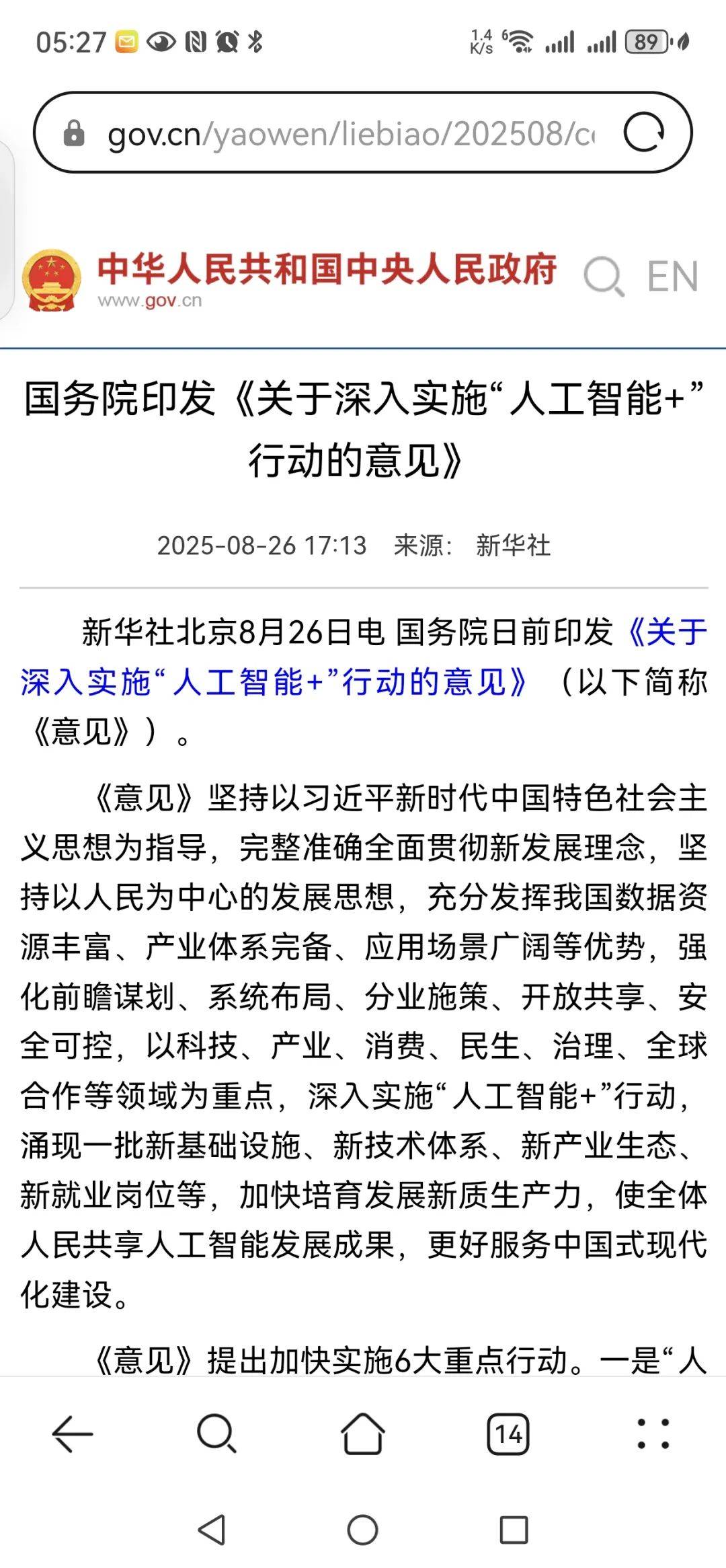
Core Viewpoint - The State Council of China has issued a comprehensive guideline titled "Opinions on Deepening the Implementation of the 'Artificial Intelligence+' Action," which outlines a strategic framework for the future development of artificial intelligence in various sectors [1][7]. Group 1: Key Actions Proposed - The guideline proposes six key actions: 1. "Artificial Intelligence+" in science and technology to accelerate scientific discovery and innovation in research methodologies [1][7]. 2. "Artificial Intelligence+" for industrial development to foster new business models and promote smart transformation in agriculture and services [1][7]. 3. "Artificial Intelligence+" to enhance consumer quality by expanding service consumption scenarios and nurturing new product consumption models [1][7]. 4. "Artificial Intelligence+" for improving public welfare by creating smarter work and learning methods, enhancing quality of life [1][7]. 5. "Artificial Intelligence+" in governance to establish a new paradigm of human-machine coexistence in social governance [1][7]. 6. "Artificial Intelligence+" for global cooperation to promote shared benefits and establish a global governance framework for AI [1][7]. Group 2: Strategic Importance - The guideline emphasizes the importance of leveraging China's rich data resources, complete industrial system, and broad application scenarios to enhance productivity and ensure that all citizens benefit from AI advancements [7][11]. - The document reflects a holistic approach to AI development, aiming to improve efficiency, reduce costs, and boost capabilities across various sectors [11][12]. Group 3: Comparison with Global Standards - The guideline positions China as a leader in AI, with the country accounting for 60% of global AI patents and achieving significant breakthroughs in humanoid robots and intelligent hardware [12]. - The document suggests that China's strategic approach to AI development is more advanced compared to the United States, which lacks a comprehensive industrial policy [3][12].

银河证券:A股市场量能仍在途
Zheng Quan Shi Bao Wang· 2025-08-25 00:26
Core Viewpoint - The A-share market is experiencing an upward trend, driven by a significant recovery in investor risk appetite, which is reflected in the expanding profit-making effect and increased trading volume [1] Market Conditions - The market's funding situation is contributing important incremental support, with the margin trading balance continuing to grow, now exceeding 2.1 trillion yuan [1] - However, the margin trading balance as a percentage of A-share circulating market value and the margin trading volume as a percentage of A-share trading volume remain at historical average levels, significantly lower than the peak values seen in 2015 [1] Investor Behavior - There are signs of a shift in residents' deposits towards equities, influenced by both the asset scarcity and the enhanced profit-making effect in the stock market [1] Policy Outlook - Market expectations regarding policy remain a key variable for mid-term trends, with the Central Political Bureau's July meeting indicating plans for the 14th Five-Year Plan and potential policy adjustments [1] - The ongoing deepening of capital market reforms and sustained industrial policy efforts are expected to further enhance risk appetite and investment confidence [1] Global Influences - At the Jackson Hole global central bank annual meeting, Powell signaled a potential easing, suggesting a possible interest rate cut in September, which could lead to a rebound in equity assets [1] - The long-term weakening of the US dollar index is reshaping global capital flows, providing additional support for the upward movement of the A-share market [1]

重磅!2025年中国及31省市连接器行业政策汇总及解读(全)
Qian Zhan Wang· 2025-08-21 08:19
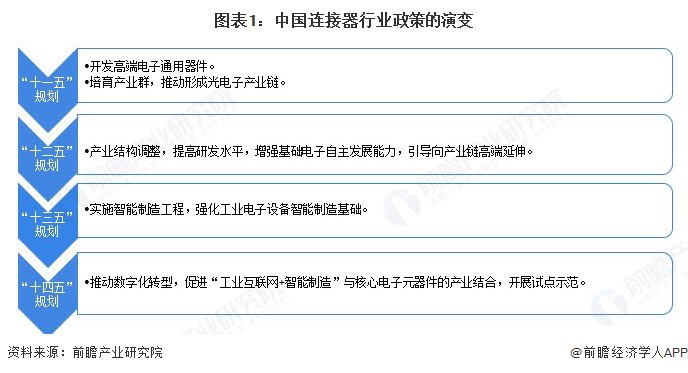
Core Insights - The article discusses the development policies and goals for the connector industry in China, highlighting the government's focus on enhancing technology, innovation, and market competitiveness in this sector [1][3][6]. Policy Overview - The connector industry policies in China have evolved from the "11th Five-Year Plan" to the "14th Five-Year Plan," emphasizing the importance of digital transformation and high-end development in the electronic components sector [1][3]. - Key policies include the "Industrial Technology Innovation Capability Development Plan (2016-2020)" and the "Basic Electronic Components Industry Development Action Plan (2021-2023)," which aim to boost the development of critical electronic components like connectors [3][4]. Development Goals - By 2023, the total sales of electronic components are expected to reach 21,000 million yuan, while the connector industry aims for a sales target of 3,967 billion yuan by 2025, with an average annual growth rate of 6% during the "14th Five-Year Plan" period [7]. - The industry aims to establish a standardized organization and patent alliance led by domestic companies, focusing on high-quality standards and patent layout [7]. Technological Advancements - The "Manufacturing Reliability Improvement Implementation Opinion" emphasizes the need for high reliability and longevity in connectors, pushing for advancements in technology and quality standards [8]. - Policies encourage the development of high-frequency, high-speed, and high-reliability connectors, with a focus on integrating cutting-edge technologies like silicon photonics and optical-electrical hybrid transmission [9]. Market Demand and Applications - The demand for connectors is expected to grow in sectors such as smart connected vehicles, low-altitude economy, and 5G communication, driving the need for high-voltage, high-current connectors [8][9]. - The article highlights the importance of aligning domestic production with international standards to enhance competitiveness in the global market [9]. Provincial Policies - Various provinces, including Henan, Sichuan, and Shaanxi, have outlined specific policies to develop high-speed connectors, indicating a regional commitment to advancing this sector [17]. - Local governments are also focusing on fostering innovation and supporting the growth of specialized enterprises within the connector industry [11][12].



中美就24%关税继续暂停90天等达成共识 未来经贸谈判有这些关键点
Mei Ri Shang Bao· 2025-08-12 22:16
Group 1 - The core point of the news is the announcement of a joint statement from the US and China regarding trade negotiations, which includes a temporary suspension of additional tariffs on each other's goods for 90 days [2][3] - The US will pause the implementation of a 24% tariff on Chinese goods while retaining a 10% tariff, and China will similarly suspend the 24% tariff on US goods while keeping the 10% tariff in place [2][3] - The adjustments to tariffs are part of a broader strategy to stabilize trade relations and may influence future negotiations, particularly regarding market access and technology transfer [7][8] Group 2 - The Chinese government has decided to continue suspending export control measures against 16 US entities for 90 days and will stop executing measures against 12 other entities [5] - The adjustments to the unreliable entity list will also see a 90-day suspension of measures against certain US entities, allowing domestic companies to apply for transactions with them [6] - Future negotiations are expected to focus on key issues such as market access, intellectual property protection, and macroeconomic policies, including currency issues [7][8] Group 3 - China's foreign trade data shows a total import and export value of 25.7 trillion yuan in the first seven months of 2025, with exports growing by 7.3% and imports declining by 1.6% [10] - The new "China-Europe Arctic Express" shipping route will significantly reduce transport time to Europe, enhancing trade efficiency and positioning Ningbo-Zhoushan Port as a key trade hub [11][12]

日本2nm晶圆厂,困难重重
半导体行业观察· 2025-08-12 00:52
Core Viewpoint - Rapidus has successfully formed a 2-nanometer transistor structure at its Chitose factory, marking Japan's first production of advanced semiconductor components since 2009-2010, but faces significant challenges ahead in mass production and customer acquisition [2][3] Group 1: Technological Achievements - Rapidus achieved a significant milestone by forming a 2-nanometer transistor structure, a feat not accomplished by Japanese companies for over a decade [2] - The only companies currently capable of prototype mass production of 2-nanometer semiconductors are TSMC, Samsung, and Intel, with TSMC being the only one expected to achieve scalable profitability [2] Group 2: Financial and Operational Challenges - The estimated funding required for Rapidus to achieve mass production is 5 trillion yen (approximately 34 billion USD), primarily sourced from government funding, potential customer investments, and bank loans [3][4] - There is a concern that Rapidus may fall into a trap of nationalization, as the government is heavily involved in funding and supporting the company [3] Group 3: Strategic Considerations - The Japanese government recognizes the importance of domestic demand for the success of semiconductor factories, indicating that without it, establishing such facilities in Japan may be futile [3] - Rapidus is advised to adopt a more flexible strategy and avoid rigidly pursuing its initial plan, which may not align with the evolving industry landscape [4]

德国化工企业预计2026年行业方见曙光
Zhong Guo Chan Ye Jing Ji Xin Xi Wang· 2025-08-04 23:22
Group 1 - The German chemical industry is projected to see a 2% decline in production by 2025, with recovery expected in 2026 [1] - In the first half of this year, production in the German chemical sector fell approximately 15% compared to the same period in 2018, with a year-on-year decline of 3% and a sales drop of 2% [1] - The average utilization rate of German chemical companies is at 80%, with around 40% of firms facing order shortages [1] Group 2 - The chief economist of Deutsche Bank indicated that U.S. tariff policies will significantly reduce the export volume of the German chemical industry to the U.S. [1] - Major German chemical companies like BASF and Covestro have lowered their profit forecasts for 2025 due to weak demand and uncertainties related to tariff policies [1] - The German Chemical Industry Association highlighted that high operational costs, complicated approval processes, and rising raw material prices are causing many companies to delay investment plans in Germany [1] Group 3 - The association emphasized the need for Germany to enhance energy transition management, balancing supply security, climate protection, and cost affordability [2] - It suggested that industrial policies should support innovation and technological advancement to improve economic and industry resilience [2] - The association proposed establishing a capital market and banking union within the EU framework to consolidate resources and stimulate investment [2]
二季度政治局会议传递积极信号
水皮More· 2025-07-31 10:37
Core Viewpoint - The article emphasizes the continuation of a stable yet progressive macroeconomic policy, focusing on maintaining policy stability while enhancing flexibility and timely adjustments to stimulate economic recovery [1][3]. Fiscal Policy - The fiscal policy aims for detailed implementation, emphasizing structural optimization, with a focus on enhancing social welfare and targeted spending for specific groups [4]. - The government plans to accelerate the issuance of long-term special bonds, with net financing reaching 7.66 trillion yuan in the first half of 2025 [4]. Monetary Policy - A moderately loose monetary policy is anticipated, with potential interest rate cuts to lower overall financing costs for society [5]. - The central bank has already implemented a 10 basis point interest rate cut and a 50 basis point reserve requirement ratio reduction, with further easing expected [5]. Industry Policy - The industry policy focuses on fostering technological innovation and promoting healthy competition, with an emphasis on emerging industries and strategic sectors [6][8]. - Key areas for support include quantum computing, artificial intelligence, and biotechnology, with a push for collaboration between research institutions and enterprises [6]. Real Estate Policy - The real estate policy highlights the importance of high-quality urban renewal and managing local government debt risks, with a focus on stabilizing the housing market [9]. - Recent data shows a decline in property sales, with June's sales area and revenue down by 5.5% and 10.8% year-on-year, respectively [9]. Domestic Demand Expansion - The strategy for expanding domestic demand involves enhancing both consumption scenarios and consumer capacity, with potential policies to optimize social security contributions and tax structures [11][12]. - Recent retail sales data indicates a 4.8% year-on-year growth, but a decline in consumer confidence remains a concern [11]. Employment and Social Welfare - The employment policy prioritizes job creation for key demographics, including recent graduates and migrant workers, while ensuring social safety nets are in place [13]. - The approach combines development with safety nets to stabilize society and rebuild consumer confidence [13]. Capital Market - The capital market is encouraged to enhance its attractiveness and inclusivity, with recent positive performance in A-shares and Hong Kong stocks [14]. - The government has introduced various supportive measures to stabilize and invigorate the capital market, including optimizing monetary policy tools [14]. High-Level Opening Up - The policy aims to maintain a stable foundation for foreign trade and investment, with measures to support foreign trade enterprises and promote integrated development of domestic and foreign trade [15]. - The focus is on enhancing the resilience of enterprises and the support capabilities of open platforms in a complex external environment [15].
7月政治局会议解读:财政“蓄水池”成为下半程的关键
Guoxin Securities· 2025-07-30 13:09
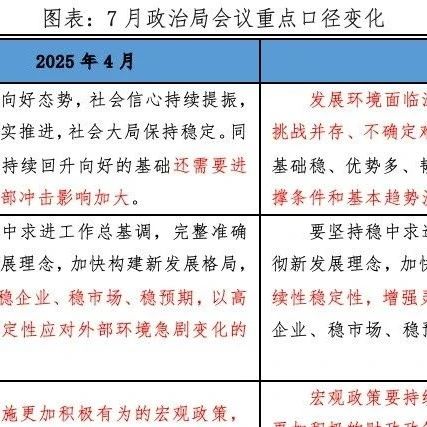
Economic Overview - China's GDP grew by 5.3% year-on-year in the first half of 2025, significantly higher than the previous year's growth and the annual target[4] - The construction sector's GDP growth was only 0.7%, down from 4.8% in the previous year, indicating a shift towards new economic sectors like information technology[4] Policy Direction - The Politburo emphasized the need for continuous and flexible macroeconomic policies to stabilize employment, businesses, and market expectations[4] - A more proactive fiscal policy is required, with an acceleration in government bond issuance to enhance fund utilization efficiency[6] Fiscal Measures - In the first half of 2025, special bonds and long-term bonds totaled 2.43 trillion yuan, with an additional 3.7 trillion yuan in new special bonds issued, leaving approximately 1.3 trillion yuan unutilized[6] - The government plans to issue 3.8 trillion yuan in special bonds in the second half of the year to support fiscal spending[6] Consumption and Demand - The meeting highlighted the importance of boosting domestic consumption, particularly through service consumption, which has a significant multiplier effect on employment[5] - The government aims to implement special actions to stimulate consumption, focusing on both goods and services[5] Risk Management - The meeting called for proactive measures to mitigate local government debt risks and prevent the emergence of new hidden debts[12] - A total of 2.8 trillion yuan in debt for debt resolution has been issued this year, with 776.9 billion yuan in special new bonds issued to address corporate debt issues[13] Monetary Policy - The probability of significant monetary easing in Q3 is low, with a focus on maintaining liquidity and reducing financing costs through structural monetary policy tools[17] - The average interest rate on new corporate loans and personal housing loans decreased by approximately 50 basis points and 60 basis points, respectively, in Q1[22] Trade and Exports - Exports showed resilience with a year-on-year growth of 5.9% in the first half of 2025, despite challenges from external demand[26] - The government plans to stabilize foreign trade and foreign investment, emphasizing support for affected export enterprises[27] Real Estate Policy - The meeting did not mention measures to stabilize the real estate market, indicating a shift towards urban renewal and quality development rather than expansion[33]
学习7月政治局会议精神:增强政策灵活性预见性
Soochow Securities· 2025-07-30 10:26
Economic Overview - The political bureau meeting on July 30, 2025, acknowledged the economic growth of 5.3% in the first half of the year, laying a solid foundation for achieving the annual growth target of around 5%[1] - The meeting highlighted ongoing risks and challenges in the economy, necessitating continued macro policy support and effectiveness[1] Policy Directions - Macro policies are to "continue to exert force and timely increase strength," maintaining the focus on "stabilizing employment, enterprises, markets, and expectations" as key objectives[1] - The meeting emphasized the need for policy continuity and stability while enhancing flexibility and foresight[1] Demand Expansion - Policies to expand domestic demand will focus on two growth points in service consumption: general consumption and elderly/childcare consumption[1] - For general consumption, service consumption subsidies may replace "old-for-new" subsidies, potentially driving an additional 70 billion yuan in consumption annually, accounting for approximately 0.15% of social retail sales[1] Industrial Policy - The meeting stressed the importance of optimizing market competition order and addressing disorderly competition among enterprises[2] - The approach to capacity reduction will be guided rather than enforced, focusing on market-driven methods to minimize economic shocks[2] Monetary Policy - The monetary policy will prioritize structural support rather than broad easing, with a focus on supporting technology innovation, consumption, small and micro enterprises, and stabilizing foreign trade[2] - The potential introduction of policy financial tools is anticipated, with a timeline similar to previous years, aiming to support various sectors including traditional infrastructure and technology[2] Fiscal Policy - Fiscal measures in the first half of the year showed a 3.4% increase in expenditures, indicating a proactive fiscal stance[2] - The actual deficit rate for the first half reached 3.9%, suggesting significant fiscal effort, although further total policy increases may not be necessary unless economic pressures escalate in the latter half[2] Financial Market - The meeting called for enhancing the attractiveness and inclusiveness of the domestic capital market to sustain its recovery momentum[2] - This involves institutional innovation and market opening to better allocate resources and support various enterprises[2] Real Estate Policy - While not a primary focus, the meeting underscored the importance of implementing urban renewal and improving the real estate development model[2] - Future policies may include optimizing existing regulations and promoting urban renewal projects to stimulate housing demand[2] Risk Considerations - Risks include potential downturns in the real estate market, trade tensions, and the effectiveness of consumption stimulus measures[2]