供需失衡

Search documents
铂金接棒金银大涨,铂金价格年内大涨105%
Xin Lang Cai Jing· 2025-12-16 10:03
Core Insights - Platinum has emerged as the new leader in the precious metals market, following strong upward trends in gold and silver prices [1][2] - The price of platinum has increased by 105% year-to-date, significantly outpacing gold's 63% increase during the same period [1] Group 1: Price Movements - On December 16, domestic platinum futures opened with a continued upward trend, following a significant 7% increase on December 15, where it reached a record high since listing [1] - The highest price for platinum futures on the international market (NYMEX) has surpassed $1862 per ounce [1] Group 2: Market Dynamics - The rise in platinum prices is attributed to supply-demand imbalances and expectations of macroeconomic easing, positioning platinum as a new leading asset in the precious metals market [2] - According to the World Platinum Investment Council, platinum and silver, as representatives of "white precious metals," possess safe-haven attributes while being closely tied to industrial demand and global energy transitions, leading to a price logic that partially deviates from traditional precious metal frameworks [2]
过剩局面不改,镍不锈钢弱势震荡
Hua Tai Qi Huo· 2025-12-16 03:27
1. Report's Industry Investment Rating - Not provided in the content 2. Core Viewpoints of the Report - Due to high inventory and oversupply, nickel prices are expected to remain in a low - level oscillation. For stainless steel, with weak demand, high inventory, and a continuous downward shift in cost center, it is also expected to maintain a low - level oscillation [1][3] 3. Summary by Related Categories Nickel Market Analysis - On December 15, 2025, the Shanghai nickel main contract 2601 opened at 115,070 yuan/ton and closed at 114,690 yuan/ton, a change of - 0.88% from the previous trading day's closing price. The trading volume was 129,996 (+29,560) lots, and the open interest was 105,210 (+252) lots. The price trend continued the recent weakness, showing a pattern of "rising and then falling, oscillating downward" under the triple pressure of supply - demand surplus, high inventory, and technical breakdown [1] - The nickel ore market remained calm with stable prices. Philippine mines mainly fulfilled previous orders, maintaining a price - holding attitude. Downstream factories' production plans remained unchanged, and their pressure on nickel ore purchase prices might ease. In Indonesia, the December (second - phase) domestic trade benchmark price was expected to drop by 0.11 - 0.18 US dollars/wet ton, and the current mainstream premium was + 25, with the premium range mostly between + 25 - 26. The overall domestic trade price of nickel ore was expected to decline [1] - Jinchuan Group's sales price in the Shanghai market was 120,200 yuan/ton, a decrease of 800 yuan/ton from the previous trading day. Spot trading was fair, and the spot premiums and discounts of various refined nickel brands were mostly stable. The premium of Jinchuan nickel changed by 100 yuan/ton to 5,300 yuan/ton, the premium of imported nickel changed by 0 yuan/ton to 400 yuan/ton, and the premium of nickel beans was 2,450 yuan/ton. The previous trading day's Shanghai nickel warehouse receipt volume was 37,872 (+2,622) tons, and the LME nickel inventory was 253,392 (+360) tons [2] Strategy - With high inventory and an unchanged oversupply situation, nickel prices are expected to remain in a low - level oscillation. The strategy is mainly range - bound operation for the single - side, and no operations are recommended for inter - period, cross - variety, spot - futures, and options [1][2][3] Stainless Steel Market Analysis - On December 15, 2025, the stainless steel main contract 2602 opened at 12,560 yuan/ton and closed at 12,480 yuan/ton. The trading volume was 177,564 (+56,756) lots, and the open interest was 118,271 (-4,171) lots. The trend continued the recent weakness, showing a pattern of "rising and then falling, oscillating downward" under the pressure of supply - demand imbalance, high inventory, and export policy disturbances. In the short term, there was unlikely to be an obvious rebound, and it was expected to oscillate and consolidate in the range of 12,400 - 12,600 yuan/ton [3] - The futures market weakened, and downstream purchasing enthusiasm was low, with purchases mainly on an as - needed basis. Inventory reduction slowed down. The stainless steel price in the Wuxi market was 12,750 (+0) yuan/ton, and in the Foshan market was 12,750 (+0) yuan/ton. The premium and discount of 304/2B was 265 - 465 yuan/ton. According to SMM data, the ex - factory tax - included average price of high - nickel pig iron changed by - 1.00 yuan/nickel point to 887.5 yuan/nickel point [3] Strategy - Due to weak demand, high inventory, and a continuous downward shift in the cost center, stainless steel is expected to maintain a low - level oscillation. The single - side strategy is neutral, and no operations are recommended for inter - period, cross - variety, spot - futures, and options [3][4]
铂金罕见涨停、钯金大涨,发生了什么?还能持续多久?
Hua Er Jie Jian Wen· 2025-12-15 13:57
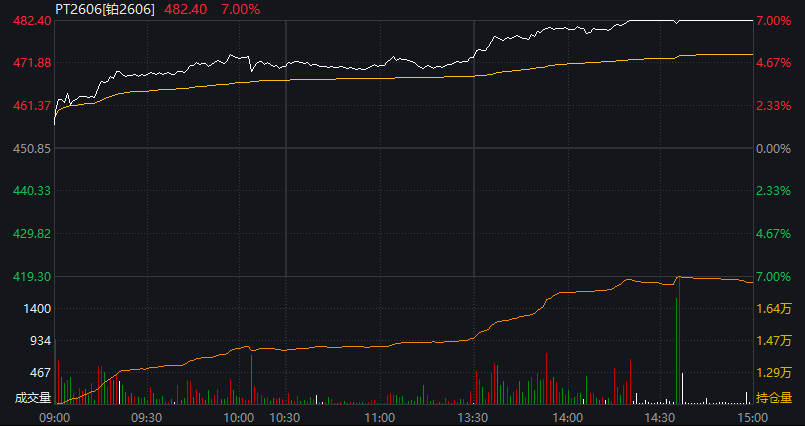
Core Viewpoint - The recent surge in platinum and palladium prices is driven by a combination of macroeconomic liquidity expectations, supply-demand imbalances, and strong market sentiment, marking a significant shift in the precious metals market [1][6][13]. Group 1: Market Performance - On December 15, platinum futures on the Shanghai Futures Exchange hit a 7% limit-up, closing at 482.4 yuan per gram, marking the first limit-up since its listing; palladium futures also rose by 4.73% to 407.6 yuan per gram [1]. - Trading volume for platinum futures surged by 237% to 41,832 contracts, while palladium trading volume skyrocketed by 498% [2]. - Internationally, platinum futures in New York rose over 2% to $1,805 per ounce, and palladium futures increased by 4% to $1,610.50 per ounce [2][3]. Group 2: Supply and Demand Dynamics - Analysts attribute the price surge to macroeconomic easing expectations, tight physical supply, resilient demand, and the overall positive sentiment in the precious metals sector [6][13]. - South Africa, which produces over 70% of the world's platinum, faces structural issues such as power shortages and aging infrastructure, contributing to supply constraints [13]. - The World Platinum Investment Council (WPIC) forecasts a third consecutive year of platinum market shortages, with a potential gap of 30 tons by 2025, indicating a structural supply-demand mismatch [13]. Group 3: Macroeconomic Influences - A weaker US dollar and rising expectations for Federal Reserve rate cuts, particularly with speculation around Kevin Warsh's potential nomination as Fed Chair, have lowered US Treasury yields and the holding costs for precious metals [6][10]. - The market is actively trading on the Fed's policy shift, with expectations of two rate cuts next year, which has further supported precious metals prices [10]. Group 4: Investment Trends - Investment demand remains robust, with China being the largest platinum consumer market; the introduction of platinum and palladium futures options has provided new investment and hedging tools, leading to increased demand [14]. - The rise in ETF holdings indicates a significant recovery in investor sentiment towards precious metals [14]. Group 5: Future Outlook - The sustainability of the current price rally for platinum and palladium will depend on several key variables, including the maintenance of high leasing rates, the macroeconomic environment, and the speed of supply recovery [15]. - Despite the bullish sentiment, concerns remain regarding the potential for high leasing rates to decline, which could lead to market corrections [16].

白银价格刷新历史纪录,飙涨超110%远超黄金,内行人提前预警
Sou Hu Cai Jing· 2025-12-12 17:25
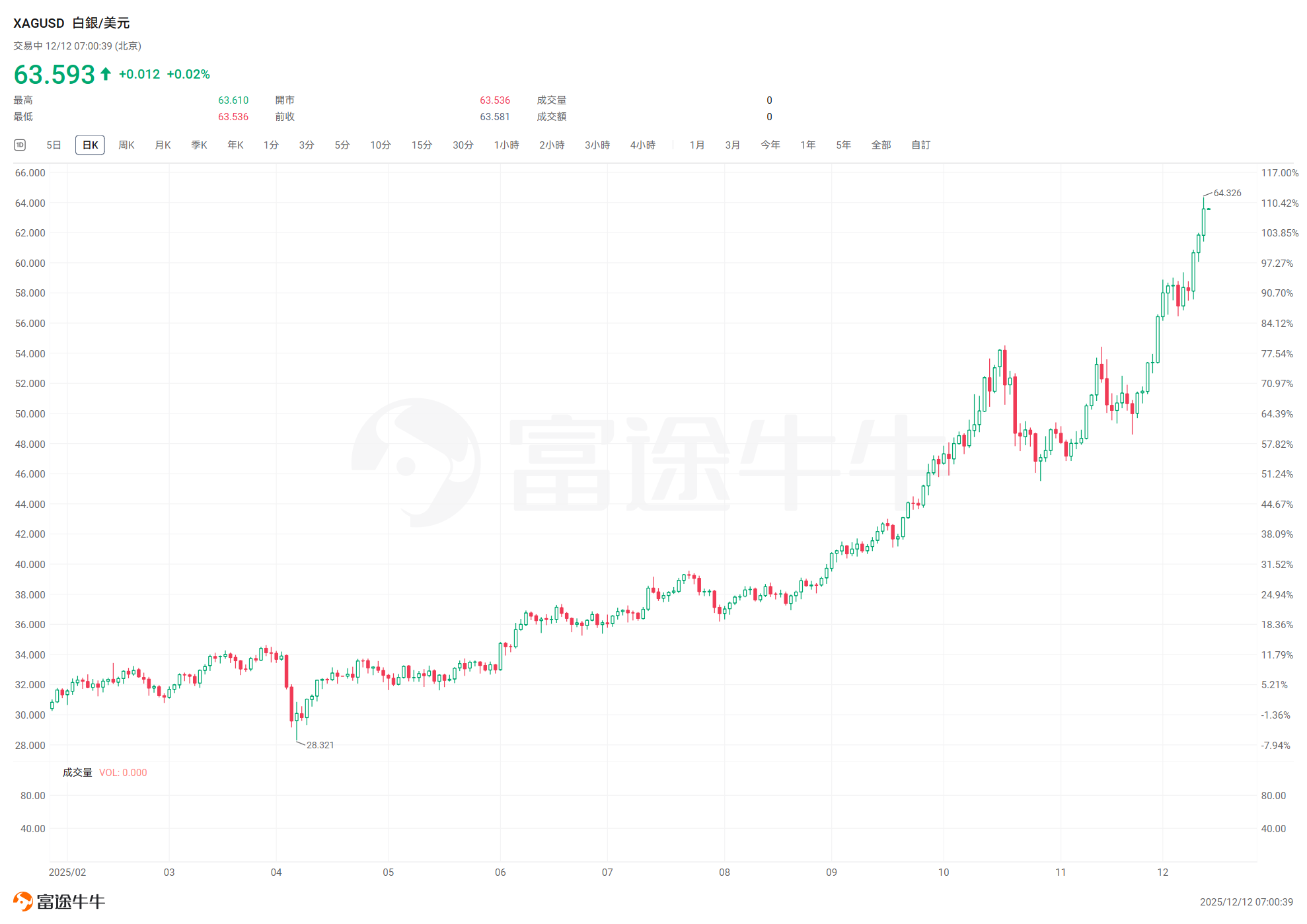
Core Viewpoint - The recent surge in silver prices is driven by a combination of financial and industrial factors, with significant implications for investors and market dynamics [5][12]. Group 1: Price Movements and Market Reactions - A Shanghai investor purchased 20 kilograms of physical silver at approximately 11 yuan per gram, and with current prices exceeding 13 yuan per gram, the investor has realized a paper profit of 60,000 yuan [1]. - Silver prices reached a historic high of 60.83 USD per ounce in early December, with a year-to-date increase of over 110%, while gold's increase was around 60% [3]. - In Shenzhen, the demand for silver bars and silver products has surged, with some merchants selling dozens of kilograms of silver this month [3]. Group 2: Supply and Demand Dynamics - The current surge in silver prices is attributed to both financial attributes, influenced by U.S. Federal Reserve policy expectations, and industrial demand, particularly from the photovoltaic sector [5][11]. - The London Bullion Market Association (LBMA) reported a significant decline in silver inventories, with a drop of 300 tons in October alone, leading to the lowest levels since 2016 [7]. - The World Silver Association anticipates a continued annual deficit in the silver market through 2025 due to constrained supply and rising demand [7]. Group 3: Investment Considerations - Analysts suggest that the current market dynamics create a high volatility environment for silver, with ETF holdings and speculative positions at elevated levels [9][12]. - Investment in silver is seen as a dual-attribute asset, combining financial and industrial characteristics, which has attracted investors seeking alternatives amid limited returns from other investment channels [11][12]. - UBS has raised its silver price target for 2026 to between 58 and 60 USD per ounce, with potential for prices to reach 65 USD per ounce [14].

“双十二”名酒价格再失守,拐点到底何时来?
Nan Fang Du Shi Bao· 2025-12-12 13:49
Group 1 - The core point of the article highlights the significant decline in the prices of famous liquor brands during the "Double Twelve" promotional event, with platforms offering unprecedented subsidies leading to prices dropping below 1499 yuan per bottle for products like Feitian Moutai [2][3] - E-commerce platforms are using aggressive subsidy strategies, typically offering discounts of 20%-30% off the normal market price, to attract customers and increase user engagement, leveraging the high recognition and price transparency of famous liquors [3][5] - The current price fluctuations are primarily driven by supply and demand imbalances, with high inventory levels resulting from previous production expansions and reduced demand due to changing consumption habits and economic factors [8][10] Group 2 - Recent data indicates that the retail prices of major liquor brands such as Feitian Moutai, Wuliangye, and Guojiao 1573 have decreased, with average prices reported at 1925.4 yuan, 863.42 yuan, and 917.83 yuan per bottle respectively, reflecting a downward trend compared to previous periods [5][12] - The high inventory levels and financial pressures on distributors are forcing them to sell at lower prices, with reports of significant price drops, including a 300 yuan decrease for some brands within a month [10] - Industry analysts suggest that the price recovery for famous liquors may not occur until consumer demand improves, inventory levels normalize, and structural adjustments within the industry are completed, with potential stabilization expected around 2026 [10][8]




白银疯涨仍在继续,纽约银日内涨幅一度达6.0%,下一站看多少?
Hua Er Jie Jian Wen· 2025-12-12 00:31
分析师认为供需失衡和宽松利率环境让今年白银涨势超过黄金涨势,周四金银比达67倍、逼近2021年低点。周四现货白银价格触及64.28美元/盎司的历史高 位,纽约期银日内涨幅达6.0%,报64.69美元/盎司。 白银"疯狂"涨势仍在继续。 12月11日,工业金属兼避险资产的白银延续了自年初以来价格翻倍的强劲涨势, $白银/美元 (XAGUSD.FX)$ 价格触及64.32美元/盎司的历史高位,纽约期银 日内涨幅达6.0%,报64.69美元/盎司。 根据白银协会发布的2025年世界白银调查报告,全球白银市场将连续第五年出现供应缺口,2025年预计缺口约为1.17亿盎司(约3660吨),为近年来最大缺口 之一。 矿产供应连年停滞在8.13亿盎司左右,而工业需求却创下历史新高。同时白银在可再生能源、电子产品和绿色技术领域的需求激增,叠加投资者对通胀和货 币波动的担忧,使其成为2025年表现最突出的贵金属之一。 华尔街见闻提及,多位分析师预测白银价格明年有望突破100美元大关,尽管过程中可能出现剧烈波动。Solomon Global的Paul Williams早在10月白银接近50 美元时就预测其将在2026年底前突破1 ...
基本面驱动减弱 工业硅短期走势偏空
Qi Huo Ri Bao· 2025-12-11 23:35
Group 1 - The core viewpoint of the article indicates that the industrial silicon market is experiencing a rebound in spot prices, but futures prices are weakening due to diminishing fundamental drivers and declining costs [1] - As of early December, the spot price for industrial silicon 553 is between 9400-9500 yuan/ton, while 421 is between 9600-9700 yuan/ton [1] - Industrial silicon production capacity is expected to increase to 7.846 million tons in 2025, a year-on-year growth of 8.94%, but production is projected to decline by 13.13% to 4.0893 million tons [1] Group 2 - The supply of industrial silicon remains elastic, with short-term production entering a seasonal low [1] - The average production cost of industrial silicon has remained around 9100 yuan/ton since July, while spot prices have consistently exceeded this average cost [1] - The total number of industrial silicon furnaces is 796, with an operating rate of 29.90% [1] Group 3 - The demand side lacks incremental growth, with polysilicon production expected to be around 1.32 million tons in 2025, a decrease of 26.67% from 1.8 million tons in 2024 [2] - The expected demand for industrial silicon corresponding to polysilicon production is approximately 1.386 million tons, averaging about 115,500 tons per month [2] - The organic silicon industry is projected to reach a production capacity of 3.5 million tons in 2024, nearly doubling from 1.795 million tons in 2020 [3] Group 4 - Industrial silicon exports showed a high-to-low trend throughout the year, with cumulative exports from January to October at 606,700 tons, a year-on-year decrease of 1.22% [3] - As of early December, the social inventory of industrial silicon is 454,300 tons, a year-on-year increase of 30.62% [3] - The overall inventory of industrial silicon has exceeded 600,000 tons, leading to a long destocking cycle estimated at 1.92 months [3] Group 5 - The industrial silicon market is characterized by significant supply elasticity, lack of demand growth, and weakening cost support, which provides space for price declines [4] - Although spot prices are currently stable, the futures market is showing a bearish trend based on these expectations [4] - Short-term industrial silicon prices are expected to maintain a weak operating pattern [4]
累计出栏超1.5亿头!12家上市猪企产能持续释放,已有企业完成全年任务
Xin Lang Cai Jing· 2025-12-11 10:21
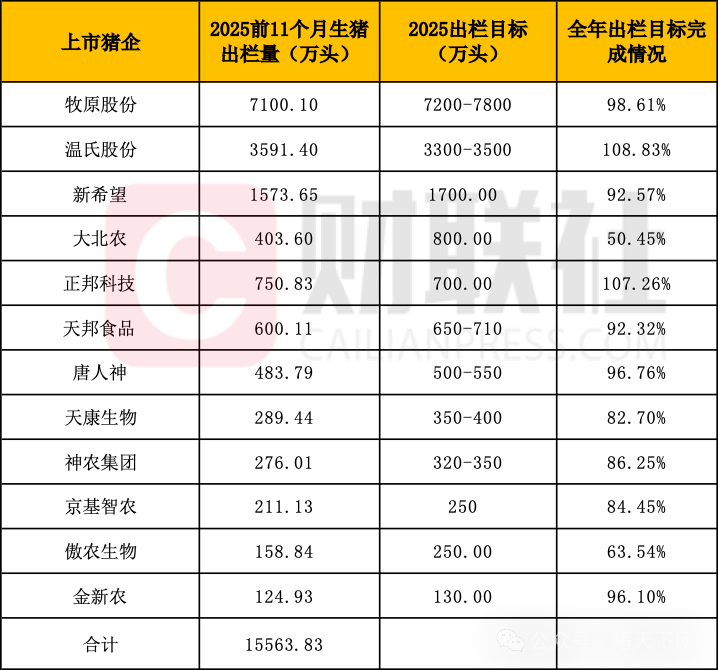
Core Insights - The pig industry is entering its peak season, but the market has not yet emerged from a "cold winter" with significant losses continuing despite increased sales volume [1][4] - Major listed pig companies have reported a general increase in slaughter volume, with some companies achieving their annual targets ahead of schedule, yet the average sales price has dropped nearly 30% year-on-year [1][4] Company Performance - Major listed pig companies have collectively slaughtered over 150 million pigs from January to November 2025, with companies like Wens Foodstuff and Zhengbang Technology completing their annual targets early [1][4] - In November, Muyuan Foods sold 6.602 million pigs, a year-on-year increase of 11.8%, while Wens Foodstuff reached a new high with 4.3535 million pigs sold, marking a 49.71% year-on-year increase [6][3] - Zhengbang Technology and Aonong Biological showed significant growth, with Zhengbang selling 868,300 pigs in November, up 63.04% year-on-year, and Aonong selling 160,000 pigs, up 72.21% year-on-year [3][6] Pricing Trends - Despite increased sales volume, the low pig prices have negatively impacted revenue for listed companies, with Muyuan's average sales price at 11.56 yuan/kg, down 28.73% year-on-year, and Wens' price at 11.71 yuan/kg, down 29.92% [3][6] - The price drop has led to a more significant decline in revenue for companies like Tangrenshen, which saw a 34.16% year-on-year decrease in sales revenue despite a 7.78% drop in sales volume [3][6] Market Dynamics - The long-term low performance of the pig market is attributed to an imbalance in supply and demand, with a high absolute number of breeding sows still present despite adjustments [4][7] - Experts indicate that while the pig market is expected to enter its peak consumption season, the overall price trend is likely to remain weak due to continued supply pressure from a high number of new piglets born earlier in the year [4][7]




白银怎么突然间变得紧缺
Sou Hu Cai Jing· 2025-12-11 08:51
伦敦的白银总库存里,很多都被ETF长期锁住了,真正能流通的白银还不到4000吨,比2024年底少了一 半还多。 期货公司观点 广发期货: 美国经济运行和就业市场持续受到政府"关门"和贸易摩擦的冲击,然而随着美联储内部分歧较大并释放 鹰派信号使短期政策不确定性增加。地缘政治、金融机构"爆雷"等风险事件频发,更多央行增持黄金, 投资者重塑资产定价体系对金融属性强的商品货币的配置比例仍将上升,中长期有望驱动贵金属有望重 现类似 1970 年代的牛市行情。但从前几轮金价上涨经验看,价格在创新高后可能面临2-3 个月的盘整 或要到 12 月酝酿新的上涨动能。由于市场流动性受到美国政府结束"关门"的时点和美联储官员表态扰 动美元偏强加剧价格回调压力但目前看下方买盘力量仍存,短期国际金呈现宽幅波动若跌破3900 美元 (900元)可以择机逢低买入,后期仍以震荡整理走势为主。 国内这边,上海期货交易所的白银库存跌到了近十年的最低点,上海黄金交易所的白银库存更是跌破 3000吨,创下了新低。印度市场更夸张,不少精炼厂的库存都卖光了,商家手里都没货可卖。 所以,今年一整年,白银现货紧缺的问题就一直没平息,供需对不上,进而引发了一 ...
普惠保险 供需失衡待解
Bei Jing Shang Bao· 2025-12-10 12:00
Core Viewpoint - Inclusive insurance is becoming a key pillar in China's financial sector, aiming to provide broad coverage and quality upgrades in response to diverse social needs [1][3]. Group 1: Development and Innovation - Inclusive insurance is evolving from broad coverage to quality enhancement, addressing various demands through policy support and product innovation [1]. - New insurance products are being developed for different demographics, including new urban residents and the elderly, with specific coverage for health risks and accidents [3]. - Companies like Taiping Insurance have introduced high-coverage accident insurance for the elderly, providing over 27 trillion yuan in risk protection for more than 3.1 million elderly individuals by September 2025 [3]. Group 2: Challenges and Gaps - Despite advancements, there are significant challenges in supply-demand mismatches and structural imbalances in inclusive insurance [5]. - Research indicates that 62% of risk protection needs remain unmet, with a lack of long-term insurance products for the elderly and chronic disease patients [5]. - The existing products are primarily short-term, leading to a gap in coverage for specific groups, such as the elderly and those with chronic illnesses [5]. Group 3: Solutions and Recommendations - Addressing the challenges requires collaboration among policy, market, and social sectors, with government support through tax incentives and data sharing to enhance actuarial precision [7]. - Insurance companies should focus on refining risk management, improving operational efficiency, and enhancing consumer awareness to ensure sustainable operations [7]. - A modular and standardized product design approach is recommended to better meet the diverse needs of consumers [7].